

Your new compliance module took eleven weeks to build. It launched in English only, the LMS logged half the completions as “incomplete,” and the warehouse team in Poland never opened it. If any part of that sounds familiar, you’re in the right place. This guide is for L&D managers, HR leaders, and training ops teams who are expected to deliver more courses, to more people, in more countries, with roughly the same headcount.
Below you’ll find the seven problems that cause the most damage in corporate training right now. For each one, we explain what breaks, why it happens, how to fix it, and which in-depth Lara Translate guide covers the tools in detail.
|
TL;DR
|
1. Building course content takes too long
A subject matter expert hands over a 60-slide deck. Three months later, it’s still “in development.” Meanwhile, the process it describes has already changed. Slow production is the most common complaint in L&D, and it compounds: every delayed course pushes the next one back.
Why it happens. Many teams still build courses in tools designed for expert instructional designers, so every edit routes through one or two people. Reviews happen in email threads. Updating a single screen can mean republishing and re-uploading the whole package. The bottleneck is the workflow, not the talent.
How to fix it. Move to an authoring tool that matches who actually creates content in your company. If subject matter experts write most of it, choose a template-driven, browser-based tool with built-in review. If you need complex branching scenarios, keep a desktop tool for your designers and use a rapid tool for everything else. Either way, make sure it exports clean SCORM packages so your LMS can read them without workarounds. Check whether it can export course text for translation, too, because that decision gets expensive later.
We compared the leading options, including pricing, SCORM output, and multi-language support, in our guide to SCORM authoring tools that speed up course creation.

2. There’s no in-house team to build courses
Not every company has instructional designers, video editors, and developers on payroll. Plenty have one L&D generalist and a backlog of requests from every department. That’s a recipe for courses that get built badly, or not at all.
Why it happens. Training budgets often grow in bursts (a new regulation, a merger, a product launch) while headcount stays flat. Hiring a full production team for a peak that lasts six months rarely makes financial sense.
How to fix it. Keep strategy and needs analysis in-house, then outsource production to a custom eLearning partner for large or specialized projects. The right partner depends on what you need most: story-driven creative work, high-volume conversion of legacy content, regulated-industry expertise, or immersive VR. Ask every vendor two questions up front: who owns the source files, and how do they handle translation into other languages? The answers tell you a lot about long-term costs.
For a shortlist with each vendor’s strengths, see our roundup of custom eLearning development companies worth hiring in 2026.
3. Courses break or don’t track across platforms
Here’s what most teams miss until it’s too late. A course plays perfectly in preview, then shows “in progress” forever in the LMS. Quiz scores vanish. Bookmarking fails on mobile. When completion records are wrong, you can’t prove anyone was trained.
Why it happens. SCORM, the standard most courses rely on, was created in 2000 by the Advanced Distributed Learning (ADL) Initiative to solve exactly this interoperability problem. Implementations still vary. An authoring tool might publish SCORM 2004 while your LMS handles SCORM 1.2 more reliably, or the LMS might support the standard in name but not handle edge cases like resume data or multi-SCO packages.
How to fix it. Test before you buy. Upload two or three of your real course packages into a trial of any LMS you’re considering, and check completion, scoring, and resume behavior on desktop and mobile. Agree on one SCORM version across your authoring tool and LMS. If you run training for multiple audiences (employees, partners, customers), check that reporting stays clean across all of them.
Our comparison of the best LMS platforms for SCORM content covers which platforms handle these packages reliably and where each one fits.
Your next course could launch in every language on day one
Upload a course script, a slide deck, or an XLIFF export and get it back translated with the layout intact, in 200+ languages.
4. Learners don’t engage, and adoption stays low
You launched a new platform. Logins spiked in week one, then flatlined. Completion rates sit far below target, and managers have stopped nudging their teams. Low engagement is expensive because you pay for the content and the platform whether anyone uses them or not.
Why it happens. Training usually lives in a separate tool that employees have to remember to open. Courses are long, generic, and disconnected from the work people actually do. Frontline staff often lack a desk, a work email, or a laptop, so a desktop-first platform never reaches them at all.
How to fix it. Bring training to where people already work. That means platforms that integrate with Slack or Microsoft Teams, mobile-first microlearning for frontline teams, and short modules tied to real tasks. Connect learning to performance reviews or career paths so it has visible value. Then measure what matters: did behavior change, not just did people click “complete”?
We reviewed platforms built for exactly this, from SMB-friendly tools to frontline and hospitality specialists, in our guide to employee training software that people actually use.
5. Regulatory pressure keeps growing
Compliance training used to mean an annual harassment module and a fire-safety quiz. In 2026, the list keeps getting longer: data privacy, cybersecurity awareness, anti-bribery, health and safety, and industry-specific rules. Miss a deadline or lose a record, and the problem lands with legal, not L&D.
Why it happens. New rules keep arriving, and many apply across borders. The EU AI Act is a clear example. Article 4 has applied since 2 February 2025, and the AI Omnibus (Regulation (EU) 2026/1744, in force since 27 July 2026) kept it in a softer form: providers and deployers of AI systems must take measures to support the development of a sufficient level of AI literacy among their staff. The wording is lighter, but the expectation of a trained workforce stays. Meanwhile, many teams still track completions in spreadsheets.

How to fix it. Use a platform that automates the boring, high-risk parts: assignment by role and location, recurring certification deadlines, reminders, and audit-ready reports. Pre-built content libraries help with common topics, but check that you can customize them to your own policies. And if your workforce spans several countries, confirm that each employee can take mandatory training in a language they fully understand. A signature on a module someone couldn’t read won’t protect anyone.
Our breakdown of compliance training platforms for regulated teams compares options for healthcare, government, cybersecurity, and general corporate compliance.
6. Your workforce is global, but your training speaks one language
This is the problem that quietly undoes the other five. You can have a fast authoring tool, a perfect LMS, and an engaging platform, and still fail a big share of your people if the course only exists in English. Frontline workers, new hires, and teams in acquired companies are usually the first to be left out.
Why it happens. Translation gets treated as a final step, after the course is “done.” Each update means sending files to a vendor, waiting weeks, and re-translating content that barely changed. Terminology drifts from module to module, so the same safety term appears three different ways. Eventually teams stop updating the translated versions at all, and those learners end up with outdated content.
How to fix it. Make localization part of the build, with three habits. First, keep course text exportable (XLIFF, Word, or PowerPoint) so it can move through translation without rebuilding the course. Second, reuse what’s already been translated, so an update only costs you the sentences that changed. Third, lock key terms in a glossary so every module uses the same wording in every language.
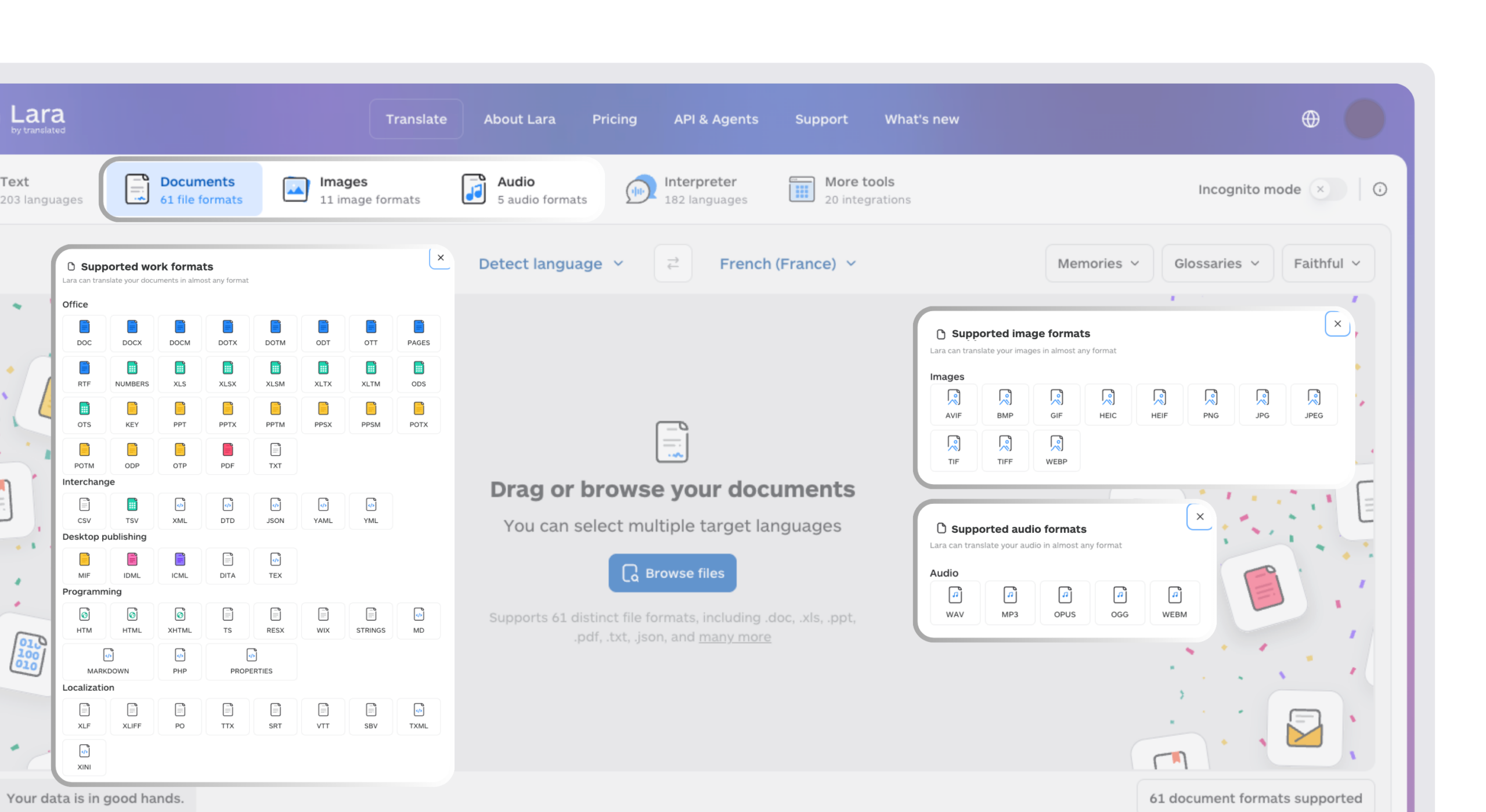
Lara Translate is built for this workflow. It translates documents in 60+ file formats, including DOCX, PPTX, PDF, SRT subtitles, and XLIFF exports from authoring tools, and returns them with the original layout preserved. Translation Memories let Lara Translate reuse your approved translations, so updated modules don’t start from zero. Glossaries enforce your company’s terminology across 200+ languages. For confidential material like internal policies, Incognito mode processes the content without storing it. Courses with voiceover or on-screen text are covered too, through audio and image translation.
We go deeper into workflows, terminology, and multimedia in our guide to localizing training content for a global workforce.
7. Soft-skill gaps don’t close with another module
Ask any manager what their team lacks, and you’ll rarely hear “more product knowledge.” You’ll hear curiosity, problem-solving, patience, communication. These are the hardest skills to teach in a 20-minute course, and the ones that matter most as AI takes over routine tasks.
Why it happens. Soft skills grow through practice, feedback, and time, which is exactly what a checkbox-driven catalog can’t provide. When learning only counts if it happens inside the LMS, companies miss the places where people actually build these abilities.
How to fix it. Widen the definition of learning. Pair formal courses with coaching, peer projects, and stretch assignments. Some companies offer learning stipends that cover language classes, crafts, or other personal pursuits, because the habits those build (observation, patience, research) carry straight into work. It’s cheap to try and easy to measure through simple self-reported goals.
If you need ideas to share with your team, our list of unusual hobbies that build real skills and curiosity is a good place to start.
Corporate training problems and solutions at a glance
| Problem | Solution | Read more |
|---|---|---|
| Course production is slow | Rapid, SCORM-ready authoring tools | Authoring tools compared |
| No in-house production team | Outsource to a custom eLearning partner | eLearning vendors to shortlist |
| Courses don’t track | Standards-tested LMS, one SCORM version | SCORM-friendly LMS options |
| Low engagement | Training inside daily tools, mobile-first | Employee training platforms |
| Regulatory pressure | Automated assignment, deadlines, audit reports | Compliance software reviewed |
| Training in one language only | AI translation with memories and glossaries | Training localization guide |
| Soft-skill gaps | Coaching, projects, and learning beyond the LMS | Skill-building hobby ideas |
Stop re-translating the sentences that didn’t change
Lara Translate reuses your approved translations and enforces your glossary, so course updates reach every language in hours instead of weeks.
The bottom line
You don’t need to fix all seven problems this quarter. Pick the one that’s costing you the most right now: a compliance gap, a stalled course backlog, or a workforce that can’t read the training it’s assigned. Fix that first. The good news is that most of these problems share a root cause, a training stack whose parts don’t talk to each other, so solving one usually makes the next one easier.
Have a valuable tool, resource, or insight that could enhance one of our articles?
Send us an email at press@laratranslate.com
We’ll be happy to review it and consider it for inclusion to enrich our content for our readers! ✍️
FAQ
What are the biggest challenges in corporate training?
The biggest challenges in corporate training are slow course production, limited in-house expertise, courses that don’t track correctly in the LMS, low learner engagement, growing compliance requirements, single-language content for multilingual teams, and soft-skill gaps. Most organizations face several at once, so it pays to start with the one that carries the highest cost or risk.
How can I make employee training more engaging?
Deliver training inside the tools employees already use, such as Slack, Microsoft Teams, or a mobile app, and keep modules short and tied to real tasks. Connecting learning to career paths or performance goals also gives people a reason to finish what they start.
Why is my SCORM course not tracking completion in the LMS?
Most SCORM tracking problems come from a mismatch between the SCORM version your authoring tool publishes and the version your LMS handles best. Publish in one agreed version, test real packages in the LMS before rollout, and check resume and scoring behavior on mobile as well as desktop.
Is the EU AI Act a training requirement?
Partly. Article 4 of the EU AI Act asks providers and deployers of AI systems to take measures to support the development of a sufficient level of AI literacy among their staff. The AI Omnibus, in force since 27 July 2026, softened the original wording, but structured training remains the most practical way to show you’ve taken those measures.
How do you translate eLearning courses without rebuilding them?
Export the course text from your authoring tool (usually as XLIFF or Word), translate it with a tool that preserves the file structure, and import it back. Lara Translate supports this workflow and uses Translation Memories and glossaries so updates only cost you the new or changed sentences.
This article is about
- The seven problems that cause the most damage in corporate training and L&D teams in 2026.
- Why slow production and missing in-house expertise are workflow issues more than talent issues.
- How agreeing on one SCORM version and testing real packages prevents broken completion tracking.
- Where compliance pressure is coming from, including the AI literacy duty in Article 4 of the EU AI Act as amended in 2026.
- How Lara Translate helps L&D teams localize training with layout-preserving translation, Translation Memories, and glossaries.
- Which in-depth Lara Translate guide to read next for each problem.
Sources
- ADL Initiative: SCORM
- EU Artificial Intelligence Act: Article 4, AI literacy
- White & Case: EU AI Omnibus enters into force, amending the AI Act
This article was produced by the Lara Translate content team. Lara Translate is an AI translation platform built by Translated, with more than 25 years of professional translation experience. L&D and HR teams use Lara Translate to localize courses, policies, and onboarding material for global workforces, across 200+ languages and 60+ file formats.