

Run learning for a global company and your catalog has a quiet ceiling. Every course that exists only in English reaches the English-speaking part of your workforce and stops there. The people who often need the training most, frontline and non-headquarters staff, get the least usable version, or none at all. Most learning teams treat that gap as a fixed limit, and quietly accept that part of the workforce learns in a language they only half-follow.
Here is the argument worth making inside any learning team: training content localization decides how much of your workforce your programs actually reach, how well people absorb them, and whether your course library reads as one coherent thing or a patchwork. Treat translation as an afterthought and you cap all three.
|
TL;DR
|
Short answer
Training content localization is the work of adapting courses, assessments, and job aids into the languages your workforce actually uses, so they read as correctly and completely as the original. For a learning team it is about reach and comprehension, not a nice-to-have. English-only content leaves part of your workforce behind, slow localization buries your team in rework, and inconsistent terminology chips away at trust in the program. Fix all three and your training lands in every language your people work in, not just the one your headquarters speaks.
Why it matters: People absorb training best in the language they think in. Language preference is well documented: 76% of people prefer content in their own language and 40% will not engage with another (CSA Research, “Consumers Prefer Their Own Language”). An English-only course quietly excludes the part of the workforce that most needs it, and leaves safety or compliance material least understood where the stakes are highest.
What is training content localization, and why does English-only content limit reach?
Training content localization is the adaptation of learning material into other languages so it stays accurate, on-brand, and ready to use. It limits reach because people only fully absorb training in a language they command, and an English-only course serves the part of your workforce that already speaks English. Language decides who your training actually reaches.

Picture a global compliance program. Your staff in Brazil, Japan, Germany, and Poland all have to complete it and actually understand it. Deliver it only in English and completion slips, comprehension slips further, and the people left guessing are often the ones the training exists to protect.
This is where reach matters as much as quality. Lara Translate covers 200+ languages across 42,230+ language pairs. For a learning team, that is the difference between training the English-speaking part of your workforce and training all of it.
Why does slow localization quietly overload your team?
Slow localization overloads your team because training content is never static, so you keep re-translating the same material. A module gets updated, a regulation changes, a product name shifts, and the whole re-localization cycle starts again against a shrinking deadline. When that work runs on per-word agency queues and manual re-translation, a small learning team spends its time chasing translations instead of building programs.
Two things break the cycle. First, document translation that keeps the original layout intact, so a formatted course module, job aid, or assessment comes back ready to use rather than ready to rebuild. Lara Translate handles 70+ file types, preserves layout, and can translate into several languages at once. Second, reuse. Translation Memories store approved source and target pairs, so the next version of a course reuses what was already translated instead of paying for it again.
For a team updating content constantly, that reuse is where the time comes back. You are not re-translating the same sentence every quarter.
Test Lara Translate on a real course module
See how it handles your terminology, keeps the layout intact, and reuses past translations across a program.
Why is terminology consistency the part learners actually notice?
Consistency is what learners and reviewers notice, because errors are visible in a way that reach and speed are not. Deliver a forty-module program where “incident report” is translated four different ways, or a product name is rendered differently in three places, and people see it immediately. It reads as sloppy. It triggers correction rounds your team has to absorb, and it chips away at trust in the program itself.
For a learning team, the translated version is the course your people in that language actually take, not a copy of the real one. So the terminology has to hold.
Terminology is only the visible half: why glossaries?
Terminology is only the visible half. The other half is instructional meaning. A generic tool can translate every word of an exercise correctly and still break the exercise, because a step, a prompt, or a worked example reads differently once it goes literal. Educational content has to stay pedagogically correct, not just lexically accurate, which is why context instructions matter as much as the glossary. You tell Lara who the learner is and what the module is teaching, and the translation is shaped around that.
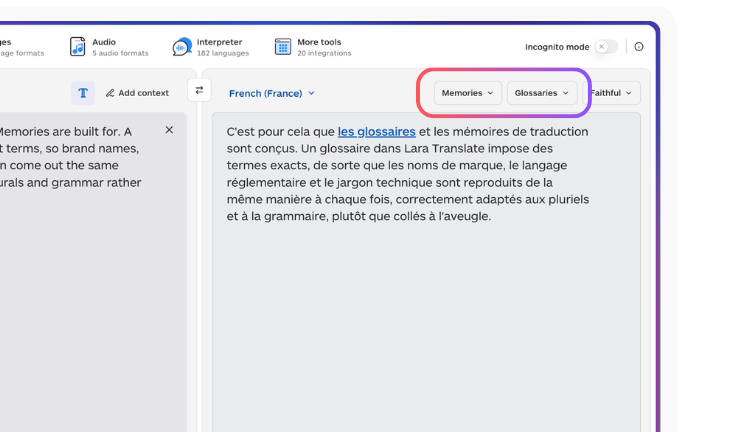
This is what glossaries and Translation Memories are built for. A glossary in Lara Translate enforces exact terms, so brand names, regulatory language, and technical jargon come out the same way every time, adapted correctly for plurals and grammar rather than pasted in blindly. Translation Memories keep phrasing consistent across every module in a program and across every course in your library. Together they turn “we translated it” into “it reads like one coherent program in every language.”
For technical and compliance-heavy material, the Faithful translation style prioritizes literal accuracy and structure, which is what you want when the wording carries legal or safety weight.
What about audio, video, and on-screen text in a course?
A course is rarely just text. It has narration, video voiceover, on-screen graphics, embedded PDFs, and image-based job aids, and each of those usually lives in a different tool. That fragmentation is where multilingual production stalls. Text in one system, documents in another, audio and images handled by hand, with a separate review step bolted onto each.
Lara Translate covers text, documents, images, and audio in one environment, so a learning team can localize a whole course without stitching four workflows together. For a learning team, that means fewer handoffs between exporting, translating, reviewing, and reimporting. That loop is what quietly slows every launch, and collapsing it is where a lot of the time savings actually come from.
How do you make localization a strategic capability, not a chore?
You make it strategic by fixing all three ceilings at once and wiring localization into the workflow your team already runs. English-only content limits reach. Slow localization drains your team. Inconsistent terminology erodes trust. Address them together and localization stops being a chore you squeeze in and becomes the reason your training actually reaches everyone it is meant to.
Lara Translate connects through API and MCP, so this can sit inside your existing authoring or LMS workflow rather than bolting on beside it. Developers can wire it in directly from the Lara developer hub. Built by Translated on 25 million human-translated documents, it is aimed at a professional quality bar rather than a generic one. That is what decides whether your localized catalog reads as polished or machine-made.
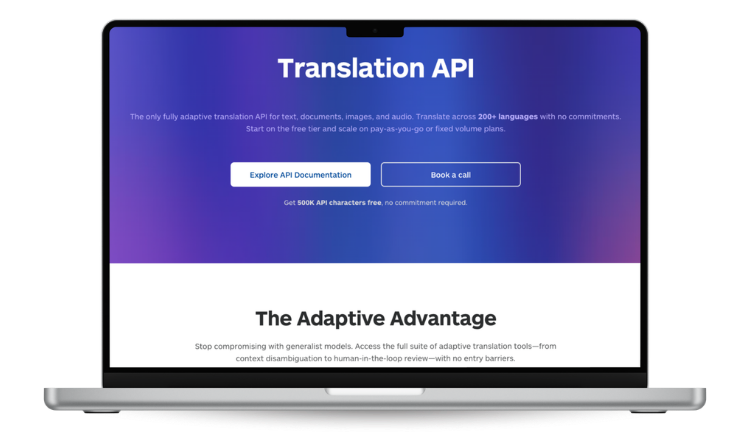
For teams that build in an authoring tool, the fit gets tighter. Lara is natively integrated with Parta.io, so course creators translate content inside the editor without exporting files or managing spreadsheets. Layout and branding stay intact, and glossaries, translation styles, and context instructions control quality in place. It pays off fastest on courses that need many languages quickly, like global onboarding, compliance modules, and partner enablement. Think of it as infrastructure that helps a learning team scale its expertise across languages, not a tool that replaces it.
The learning team that treats localization as a strategic capability is the one whose training reaches everyone it is meant to.
Localize your catalog without rebuilding it
Translate courses into 206 languages, preserve formatting, and lock terminology with glossaries and Translation Memories.
Have a valuable tool, resource, or insight that could enhance one of our articles? Submit your suggestion
We’ll be happy to review it and consider it for inclusion to enrich our content for our readers! ✍️
FAQ
How do you keep terminology consistent across course modules?
Consistency comes from a glossary and a Translation Memory working together. A glossary in Lara Translate enforces exact terms for brand names, regulatory language, and technical jargon, and adapts them correctly for plurals and grammar instead of pasting them in blindly. A Translation Memory stores approved source and target pairs, so recurring phrasing is reused identically across every module and every course. That means “incident report” is rendered the same way in module one and module forty. The result reads as one coherent program in each language, which is the standard your organization and your learners measure it against.
Can you localize training content without rebuilding the layout?
Yes. Lara Translate handles document translation that keeps the original formatting intact, so a course module, assessment, or job aid comes back ready to use rather than ready to rebuild. It supports 70+ file types and can translate into several languages at once. That matters most for training material, where slides, tables, and structured job aids break easily under generic tools. Your team spends its time reviewing content, not reassembling files. It removes the hidden re-layout work that quietly overloads a learning team on every update.
How many languages can a learning team realistically cover?
Lara Translate covers 206 languages across 42,230+ language pairs, enough to serve almost any global workforce. For a learning team, the practical benefit is training your whole organization instead of only the English-speaking part of it. A global compliance program with staff in Brazil, Japan, Germany, and Poland can be delivered as one localized catalog rather than four separate projects. Reach at this level turns training from a headquarters resource into a company-wide one. It changes how much of your workforce a single program can actually serve.
Is AI translation accurate enough for compliance and safety training?
For material where wording carries legal or safety weight, the Faithful translation style prioritizes literal accuracy and structure, which is what compliance content needs. Glossaries lock regulatory terms so they never drift between modules, and Translation Memories keep phrasing stable across a program. Lara is built by Translated on 25 million human-translated documents, aimed at a professional quality bar rather than a generic one. For the highest-stakes content, you can still add a human legal or subject-matter review on top. The point is that the tooling gives a reviewer a correct, consistent starting draft instead of one they have to rewrite.
Can Lara translate course audio and images, not just text?
Yes. Lara Translate works across text, documents, images, and audio in one environment, which matters because a course is rarely just words on a page. Narration, video voiceover, on-screen graphics, and image-based job aids all need to move into the target language too. Handling them in separate tools is what fragments a localization workflow and slows every launch. Keeping text, documents, images, and audio in one place removes the handoffs between exporting, translating, reviewing, and reimporting. For a learning team, that means the whole course ships in a new language, not just the parts that were easy to translate.
Does localization affect whether employees complete and understand training?
Language preference is well documented: 76% of people prefer content in their own language and 40% will not engage with another, according to CSA Research. For training, the stakes are comprehension and completion, not just preference. A learner absorbs safety and compliance material more reliably when it is in the language they think in. For a learning team, that means a localized course is not a courtesy add-on. It is what makes the training effective for the majority of your workforce.
This article covers: why English-only courses reach only part of a global workforce, how slow localization overloads a learning team, why terminology and instructional meaning keep learners’ trust, how to localize text, documents, images, and audio in one place, and how Lara Translate (206 languages, 70+ file types, glossaries, Translation Memories, Faithful style, context instructions, API/MCP, and a native Parta.io integration) fits an existing authoring or LMS workflow.