

Your new hire completed onboarding three weeks ago. Your compliance deadline passed last month. The regional team in São Paulo finished the same employee training course as the team in Chicago, except theirs was still in English. Somewhere between your LMS, your authoring tool, your HR system, and your content library, three problems happened simultaneously, and nobody caught them until they mattered.
This guide compares the best employee training software in 2026 based on criteria that drive outcomes rather than demos, with a decision framework to match the right tool to your situation.
|
TL;DR
|
What makes employee training software worth using in 2026?
- Speed to deployment. A platform that takes six months to implement can’t solve the compliance gap you have today.
- Multilingual learner support. Global teams can’t be trained effectively in one language. Closing that gap means solving two separate problems: the platform needs to deliver training in each learner’s language, and the course content itself needs to exist in that language before it can be delivered. More on this below.
- Frontline and distributed workforce capability. Deskless workers in hospitality, retail, manufacturing, and healthcare need mobile-first access, QR-code login, and microlearning between shifts.
- Performance and HR integration. Training that connects to performance reviews, goal tracking, and HR data yields learning insights that are actionable beyond completion rates.
- Total cost of ownership. Add implementation fees, authoring tool licences, content library subscriptions, and HRIS integration development before comparing any two quotes.
Best employee training software platforms in 2026
| Platform | Best for | Pricing model | Starting price |
|---|---|---|---|
| Learning platforms (LMS and delivery) | |||
| TalentLMS | Fast SMB deployment | Per registered/active user | $119/month (~100 users, annual) |
| 360Learning | Collaborative content teams | Per user/month | ~$8/user/month |
| Rippling | HR-unified training, automated enrolment | Custom (modular) | Contact sales |
| Disprz | AI-powered enterprise learning, skilling, and workforce enablement platform | Custom | Contact sales |
| 5app | Modern LMS | Custom | Free, Contact sales (min ~500 users) |
| Continu | Modern mid-market, Slack-native | Custom | Contact sales (min ~500 users) |
| Moodle Workplace | Open-source, developer teams | Free core LMS; Workplace custom-quoted | Core: free. Workplace: five figures/year |
| LearnUpon | Multi-audience training | Custom | Quote-based, ~$30,000-70,000/year |
| Absorb LMS | Highest peer rating, regulated | Custom | ~$10,000-25,000/year |
| Leapsome | Performance-linked learning, HRIS | Per module/user/month | ~$3-7/user/month per module |
| Course authoring tools | |||
| Easygenerator | Authoring and localizing your own content | Per author/month (tiered) | From €108/month (Pro, ~€1,299/year) |
| Articulate 360 | Advanced interactive course authoring | Per author/year | $1,449/author/year (Personal) |
| iSpring Suite | PowerPoint-based course authoring | Per author/year | $970/author/year (Suite) |
| Trainual | SOP and process documentation | Per seat/month | From $299/month + $1,000 setup fee |
| Frontline and specialist platforms | |||
| Schoox | Frontline and franchise workforces | Custom | Contact sales |
| Opus | Multi-brand franchise hospitality training | Custom | Contact sales |
| Typsy | Hospitality-specific, ready-made video library | Individual, Team, and Enterprise plans | Contact sales |
Learning platforms (LMS and delivery)
1. TalentLMS
Best for: Small to mid-size businesses that need a working training platform fast
TalentLMS holds a 4.6/5 rating on G2 from roughly 800 reviews and is used by more than 70,000 teams across 30+ industries. Most non-technical administrators have active courses running in under an hour. SCORM 1.2, SCORM 2004, xAPI, and cmi5 are all supported. TalentCraft generates courses from prompts and documents, and TalentLibrary provides 1,000+ ready-made courses covering compliance, soft skills, and leadership topics.
- G2 rating: 4.6/5, roughly 800 reviews
- Implementation: Under an hour for basic setup
- Pricing: Free tier (5 users, 10 courses). Core from $119/month, annual billing
Verdict: the fastest and most affordable path to a working training platform. Outgrown when you need advanced analytics or multi-tenant architecture.

2. 360Learning
Best for: L&D teams that want subject matter experts to create and maintain training content
Over 2,500 companies use 360Learning, including Safran, Cognizant, and Duolingo. It holds a 4.6/5 rating on G2 from roughly 580 reviews. The AI course creation feature drafts content from prompts, PDFs, and slides. The collaborative model works best in knowledge-sharing cultures and is less suited to tightly controlled regulatory environments.
- G2 rating: 4.6/5, roughly 580 reviews
- Implementation: 2-4 weeks
- Pricing: Team ~$8/user/month. Business: custom
Verdict: the best platform for knowledge-sharing cultures where subject matter experts are the primary content source.
3. Rippling
Best for: Companies that want training managed inside the same platform as HR, payroll, and IT
Rippling is a unified workforce platform that includes an LMS alongside payroll, benefits, device management, and HR. Its defining advantage is automation: when an employee is hired, promoted, or changes location, Rippling can automatically enrol them in the appropriate training based on their role and attributes, and compliance training can block clock-ins until it’s complete. Through its Go1 partnership, Rippling gives subscribers access to 80,000+ courses from 250+ providers, available in 40+ languages. G2’s Spring 2026 Grid for Corporate Learning Management System named Rippling a Leader, ranking it #1 in both market presence and user satisfaction for that report.
- Certifications: SOC 2, ISO 27001, SOC 1, SOC 3
- Content library: Go1 integration, 80,000+ courses, 40+ languages
- Pricing: Modular, custom-quoted. Contact sales
Verdict: the best choice for organisations that want training embedded inside their HR and payroll system rather than run as a separate platform.
Already shortlisting employee training software? Sort out translation first.
Translate your existing course material (DOCX, PPTX, PDF, XLIFF) into 200+ languages before you rebuild a single module. Same structure, same formatting, ready to re-upload.
4. Disprz
Best for: Mid-to-large organisations building AI-driven, skills-first learning and workforce enablement programs across knowledge and frontline workforces.
Disprz is an AI-powered enterprise learning and skilling platform combining LMS, LXP, skills intelligence, frontline enablement, AI-powered content creation, and sales coaching. Its Turo platform uses agentic AI to create structured learning experiences from existing organisational knowledge and can produce approximately one minute of finished learning content in four minutes, including human review
- Regional strength: India, Southeast Asia, Middle East
- Pricing: Custom. Contact sales
Verdict: A strong choice for mid-to-large organisations, particularly those with distributed or frontline workforces across India, Southeast Asia, and the Middle East.
5. 5app
Best for: Organisations that want a simple, engaging learning platform that brings training, knowledge-sharing and employee communications together
5app is a learning and communications platform designed to make employee training and knowledge-sharing simple, accessible and engaging. Rather than adding another complicated system for employees and administrators to navigate, 5app makes content easy to find and navigate across devices.
The platform supports everything from onboarding and compliance training to skills development and just-in-time learning. Administrators can create and organise content, build targeted learning experiences and track progress, while managers can curate content for their teams and monitor engagement. 5app also offers AI-powered tools, including AI tutor agent VeeCoach, AI authoring tool VeeCreate and AI skills intelligence platform Helix for a full learning ecosystem.
Implementation is quick and straightforward, with 5app handling content migration, technical integrations and custom implementation workshops. The platform can also integrate with existing systems and supports single sign-on.
- G2 rating: 4.8/5
- Implementation: 2-4 weeks, with content migration, technical integrations and implementation workshops supported by 5app
- Pricing: Three simple pricing tiers
Verdict: a strong choice for organisations looking for an intuitive, AI-powered learning platform that combines employee training with knowledge sharing and communications.
6. Continu
Best for: Modern mid-market teams that want training to surface inside Slack and Microsoft Teams
Continu holds a 4.6/5 rating on G2 from roughly 720 reviews as of Spring 2025, when it also won G2’s Highest User Adoption award. A 4.7/5 figure circulating elsewhere traces back to a 2022 recognition and is out of date. Training surfaces inside Slack and MS Teams without requiring a separate login. Notable clients include Slack, Instacart, GoPro, Snapchat, and Upwork, and Continu’s own case study reports that SoFi saved 285 hours of manual reporting using the platform’s AI-powered insights. Continu’s own positioning suggests a practical minimum of roughly 500 users.
- G2 rating: 4.6/5, roughly 720 reviews. G2 Highest User Adoption, Spring 2025
- Integration: Slack, MS Teams, Google Workspace, Salesforce, BambooHR
- Pricing: Custom. Minimum roughly 500 users. Contact sales
Verdict: the best choice for mid-market tech teams where Slack or Teams is the primary communication layer and training adoption is a persistent challenge.
7. Moodle Workplace
Best for: Organisations with development resources that need maximum customisation at minimal licence cost
Moodle’s core LMS is open-source, free to self-host, and supports SCORM, xAPI, and IMS-LTI. Moodle Workplace, the enterprise edition with multi-tenancy, automated reporting, and custom certifications, is licensed separately through certified Moodle Partners at custom-quoted rates that typically run into the tens of thousands of dollars a year for enterprise deployments. The real cost either way is administration: hosting, patching, and maintenance require internal technical staff or a Moodle Partner.
- Implementation: 6-12 months for a full enterprise rollout
- Pricing: Core Moodle LMS: free to self-host. Moodle Workplace: custom-quoted via Moodle Partner, typically five figures annually
Verdict: right for organisations with development resources. Not for teams needing fast deployment.
8. LearnUpon
Best for: Mid-market organisations running training across employees, customers, and partners simultaneously
LearnUpon‘s multi-portal architecture supports separate branded portals for different audiences, each with its own content library and reporting. G2 reviews consistently cite ease of administration and responsive support. LearnUpon doesn’t publish list pricing. Third-party estimates for the multi-portal Premium tier commonly run $30,000-$70,000/year for mid-sized deployments, notably higher than older published estimates. Confirm current pricing directly with LearnUpon before quoting a figure.
- Implementation: 1-3 weeks
- Pricing: Quote-based; confirm current tier pricing with LearnUpon
Verdict: the best choice for organisations training multiple distinct audiences from one platform.
9. Absorb LMS
Best for: Organisations that need a highly peer-rated enterprise training platform
Absorb LMS holds a 4.6/5 rating on G2 from roughly 900 reviews as of mid-2026. Absorb Infuse embeds training inside third-party SaaS products, and Absorb Analyze provides detailed compliance dashboards.
- G2 rating: 4.6/5, approximately 900 reviews, mid-2026
- Pricing: Custom. Mid-market deployments typically run $10,000-25,000/year
Verdict: a strong enterprise choice where peer ratings matter in procurement.
10. Leapsome
Best for: Teams that want learning tied directly to performance reviews, OKRs, and employee development
Leapsome is used by over 1,750 organisations including Bumble, Monday.com, and Sony, and more recent company statements put that figure above 2,000. It holds a 4.8/5 rating on G2 from roughly 2,200 reviews. Its unified data model connects performance review results, goal tracking, and learning paths, letting managers assign development training directly from a performance conversation. Pricing is modular, at roughly $3-7 per employee per month per module, with Leapsome AI included at no extra cost.
- G2 rating: 4.8/5, roughly 2,200 reviews
- Learning features: Learning paths, skill tracking, personalised development plans
- Pricing: ~$3-7/user/month per module. Leapsome AI included
Verdict: the best choice for organisations that want learning directly connected to performance management in one data model.

Course authoring tools
11. Easygenerator
Best for: Teams that need to create and localize their own e-learning content, not just deliver it
Easygenerator is an AI-powered course authoring suite built so subject matter experts, not only instructional designers, can produce training. The company reports 75,000+ authors across 2,000+ companies, including Sodexo, BHP, Electrolux, and GlobeAir, and it holds a 4.7/5 rating on G2 from roughly 175 reviews in the Course Authoring Software category. Its EasyAI assistant drafts course content through conversation, and finished courses export to SCORM and xAPI for use in virtually any LMS. Easygenerator also offers built-in localization, with learner access in 42+ languages and an optional EasyTranslate add-on covering 75 languages, though that translation applies to content authored inside Easygenerator rather than to course files built elsewhere.
- G2 rating: 4.7/5, roughly 175 reviews (Course Authoring Software)
- Export: SCORM and xAPI, works with most LMS platforms
- Pricing: Pro from €108/month (~€1,299/year). Team from €541/month. Enterprise custom
Verdict: the strongest pick for teams that want to build and update their own courses in-house at speed. It authors content and exports it to an LMS rather than replacing one, so it complements the delivery platforms in this list rather than competing with them.
12. Articulate 360
Best for: Teams that need advanced, fully interactive custom course authoring at enterprise scale
Articulate 360 is the most widely used e-learning authoring suite, built around Storyline 360 for custom interactive courses and Rise 360 for fast, responsive authoring, alongside an AI Assistant, a stakeholder review workflow, and a content library of 20 million+ assets. Articulate reports that 125,000 organisations, including every Fortune 100 company, use it to train 133 million learners across 187 countries, and it holds a 4.7/5 rating on G2 from roughly 790 reviews in the Course Authoring Software category. Courses export to SCORM, xAPI, cmi5, AICC, web, PDF, and video. Translating courses into other languages is a separate paid add-on that starts at $5,000/year and covers 80+ languages.
- G2 rating: 4.7/5, roughly 790 reviews (Course Authoring Software)
- Export: SCORM, xAPI, cmi5, AICC, web, PDF, video
- Pricing: Personal $1,449/author/year. Teams $1,749/author/year. Localization add-on from $5,000/year
Verdict: the enterprise standard for sophisticated, highly interactive courses. The most capable authoring suite in this list, and the most expensive once localization is added.
13. iSpring Suite
Best for: Teams that want to build courses quickly from existing PowerPoint slides
iSpring Suite is a PowerPoint-based authoring tool that turns slides into interactive, LMS-ready courses with quizzes, role-play simulations, and video, without design or coding skills. It draws on a content library of 310,000+ training assets, and its AI Assistant generates text, images, and quiz questions, adds text-to-speech voiceovers, and translates courses into 50+ languages. Courses export to SCORM 1.2, SCORM 2004, xAPI, and cmi5. iSpring reports 60,000+ teams using the platform, and it holds a 4.6/5 rating on G2 from roughly 850 reviews, where it is also rated #1 for customer support.
- G2 rating: 4.6/5, roughly 850 reviews. #1 for customer support
- Export: SCORM 1.2, SCORM 2004, xAPI, cmi5
- Pricing: iSpring Suite $970/author/year. Cloud AI from $720/author/year. Suite AI $1,290/author/year
Verdict: the fastest, most affordable route to solid interactive courses for teams that already build in PowerPoint. Less suited to highly custom, branching interactions than Storyline.
14. Trainual
Best for: Small and growing teams that need to document processes and standardise onboarding
Trainual is a training and documentation platform built for SOPs and onboarding standardisation, not a traditional LMS, and it doesn’t include deep SCORM compliance tracking. The entry Small tier (up to 25 employees) is $299/month billed monthly, or roughly $249/month equivalent billed annually, plus a one-time $1,000 implementation fee. Confirm current tiers and fees directly with Trainual before budgeting.
- Implementation: Days, plus a structured 4-5 week onboarding programme included in the setup fee
- Pricing: From $299/month (Small tier, monthly billing), plus a $1,000 one-time implementation fee
Verdict: right for SMBs standardising onboarding and process documentation. Not a replacement for a full LMS.
Frontline and specialist platforms
15. Schoox
Best for: Frontline and franchise workforces in hospitality, retail, manufacturing, and food service
Schoox serves more than 4,300 organisations and 30 million learners, including Subway, Wingstop, Sport Clips, and Sonesta Hotels. It won the 2026 Lighthouse Tech Award for Best Frontline Focused Solution, its third consecutive year receiving that recognition under its current or prior award name. On G2, Schoox holds a 4.7/5 rating from 51 reviews, with category scores of 9.1/10 for ease of use, 9.2/10 for learning paths, and 9.4/10 for quality of support. In its own case studies, Sport Clips reports 63% faster onboarding of new team members, and Biscuitville reports a 57% improvement in onboarding efficiency, cutting new-hire time-to-productivity from seven days to three.
- G2 rating: 4.7/5, 51 reviews
- Target industries: Hospitality, food service, retail, manufacturing, franchise
- Pricing: Custom. Contact sales
Verdict: the strongest LMS for frontline-heavy organisations with distributed locations and high turnover.
16. Opus
Best for: Multi-brand and franchise hospitality operators managing training across dispersed restaurant and retail locations
Opus is a mobile-first microlearning platform for frontline hospitality and restaurant teams, aimed at multi-brand and franchise operators. Its AI tools turn existing documents into microlearning modules, and an override glossary locks brand-protected terms so they stay consistent across languages and locations. It is mobile-native by design rather than SCORM-based.
- Notable clients: Cunningham Restaurant Group
- SCORM support: No (mobile-native content model by design)
- Pricing: Custom. Contact sales
Verdict: the strongest choice for multi-brand franchise hospitality operators who need fast AI content creation and brand-term control. Not for teams that need SCORM portability across delivery platforms.

17. Typsy
Best for: Hotels and restaurants that want a large, ready-made video training library rather than building custom content from scratch
Typsy is the learning and performance intelligence platform built for the hospitality industry. It combines 2,000+ hospitality lessons, recognized credentials, multilingual delivery, custom operational content, and AI-powered performance intelligence. Rather than stopping at course completions, Typsy connects operational signals (such as guest feedback and service gaps) to clear action for the right teams across properties and locations.
- Language support: 40+ subtitle languages, 10+ dubbed languages, and multilingual platform navigation
- Pricing: Individual, Teams, and Enterprise plans
Verdict: Best for hospitality organizations that need to build workforce capability, standardize performance, and connect learning to measurable operational improvement. As a hospitality-specific platform, it is less relevant to organizations seeking a general-purpose, cross-industry LMS.
The employee training gap none of these platforms solve
None of the fifteen platforms above are translation tools, and that’s exactly where global training programmes quietly fail. A regional team that finishes a course still in the wrong language isn’t a rounding error. It’s the same completion dashboard showing 100%, with none of the actual understanding behind it, and it stays invisible until an audit, an incident, or a bad quarter forces the question.
Closing that gap means solving two separate problems. The platform has to deliver training in each learner’s language, which most of the fifteen handle natively. The course content itself has to exist in that language before it can be delivered, and that’s the part an LMS was never built to do.
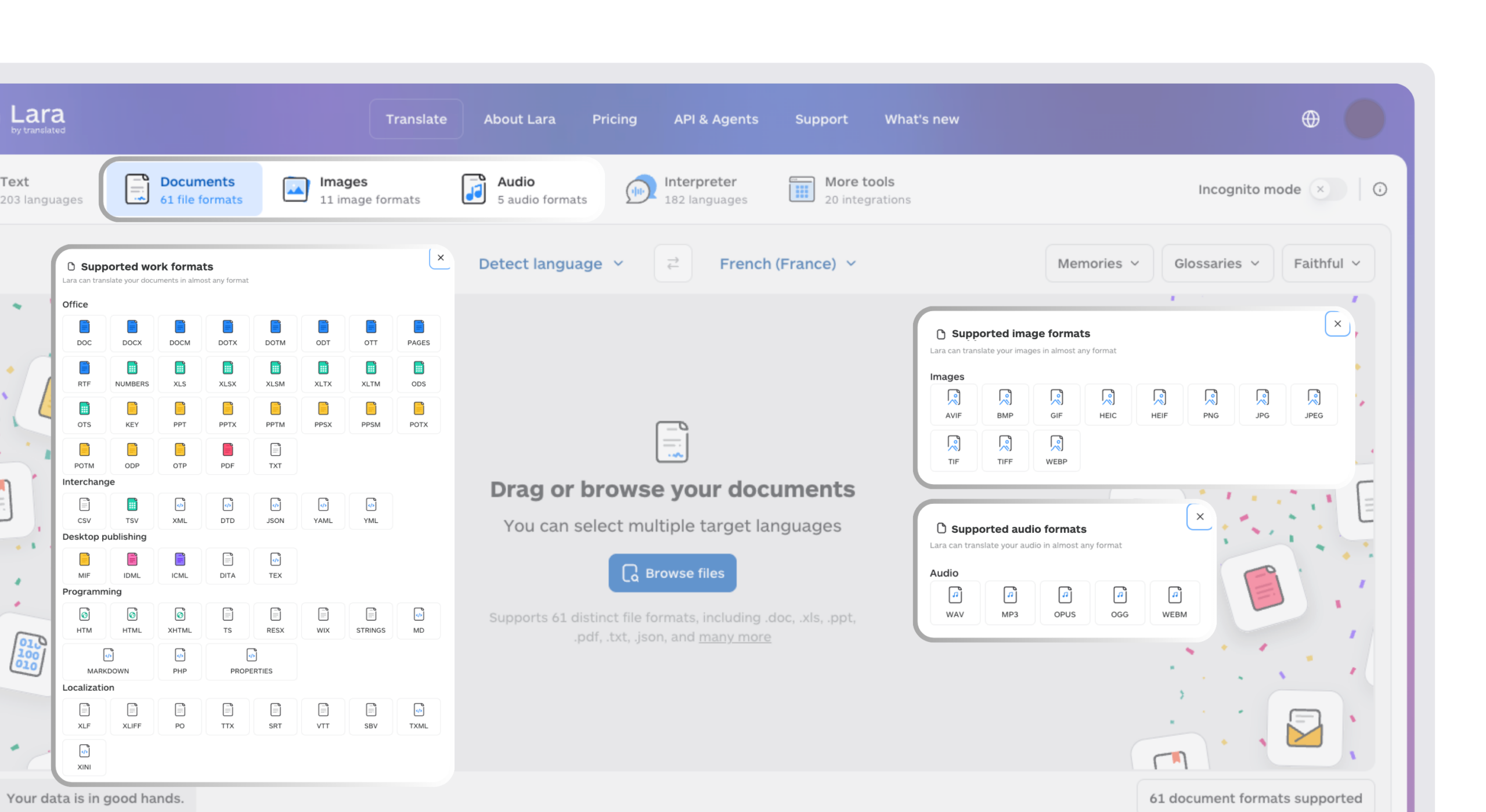
Lara Translate is one option L&D teams use to close that second gap. It’s an AI translation platform built by Translated, a company with more than 25 years of professional translation experience. Lara Translate handles 70+ file formats, including DOCX, PPTX, PDF, and XLIFF, and translates into 200+ languages, so teams can localise existing course materials instead of rebuilding them from scratch.
How to choose the right employee training software
Step 1: define your workforce type first. Desk-based corporate training and frontline deskless training require different platforms. Name your workforce type before evaluating any vendor.
Step 2: decide whether learning should live inside HR or alongside it. Rippling and Leapsome embed training inside HR and performance data. Dedicated LMS platforms sit alongside HR.
Step 3: account for your multilingual workforce. Check two things separately: whether the platform can deliver training in each learner’s language, and whether the course content itself already exists in that language. Most training platforms handle the first problem. Few solve the second one on their own, which is usually where a document translation tool comes in.
Step 4: set your real budget. Add implementation fees, authoring tool licences, content library subscriptions, and HRIS integration development. Model at 250, 500, and 1,000 learners.
Step 5: test before signing. Upload your most complex existing content. Check completion tracking, mobile rendering, and SCORM behaviour.
Got training content that needs to reach five offices in five languages?
Upload the source DOCX, PPTX, or PDF and get it back with the same structure, ready to re-import into your LMS.
The bottom line
No platform wins on every criterion here either. TalentLMS wins on speed and price. 360Learning wins on collaborative content. Rippling wins on HR-native automation. Leapsome wins on performance linkage. Schoox wins on frontline reach. Pick the criterion tied to your actual workforce and budget, filter on it first, and compare the rest only after that.
One line belongs on every shortlist regardless of platform: if your workforce doesn’t all work in one language, get the translation workflow sorted before rollout. A completion dashboard showing 100% means nothing if half the team clicked through a course they didn’t understand.
FAQ
What is the best employee training software in 2026?
It depends on workforce type. TalentLMS for SMBs. 360Learning for collaborative content. Rippling for HR-unified training. Leapsome for performance-linked learning. Continu for Slack-native teams. Schoox for frontline and franchise workforces.
How much does employee training software cost in 2026?
SMBs typically pay $1,500-$15,000/year. Mid-market budgets run $8,000-$30,000/year. Enterprise platforms run $25,000-$100,000+ annually. These bands are general market estimates, not vendor-confirmed figures, so always calculate total year-one cost, including implementation and integration development, and confirm current pricing with each vendor before budgeting.
How do I train employees who speak different languages?
Two separate things have to be true. The platform needs to deliver content in each employee’s language, and the training content itself needs to exist in that language before it can be delivered. Most training platforms solve the first problem natively. The second usually requires a document translation tool that can handle the file formats your course content is already in, such as DOCX, PPTX, PDF, and XLIFF, so you’re not rebuilding courses from scratch for every market.
Have a valuable tool, resource, or insight that could enhance one of our articles?
Send us an email at press@laratranslate.com
We’ll be happy to review it and consider it for inclusion to enrich our content for our readers! ✍️
This article is about
- How 15 employee training platforms compare across deployment speed, multilingual support, HR integration, and frontline capability
- Why TalentLMS, 360Learning, Rippling, Leapsome, and Schoox each lead for a different workforce type and budget
- Why a 100% completion dashboard can hide a team that finished training in a language they don’t understand
- A 5-step framework for choosing employee training software: workforce type, HR integration model, multilingual readiness, real budget, and pre-signing tests
- Why closing the multilingual training gap usually means pairing your LMS with a dedicated translation tool