

A home services company spends heavily on search ads, social campaigns, and local listings. Phones ring all day, but nobody can say which ad drove which call, and the best leads sometimes reach voicemail after hours. Call tracking software helps connect calls and other inquiries to marketing sources, while conversation intelligence turns recordings and transcripts into information teams can use.
This guide compares call tracking and conversation intelligence platforms in 2027 on attribution, AI features, lead handling, and pricing, so marketing and sales teams can build a shortlist.
|
TL;DR
|
What makes call tracking software worth using in 2027?
Attribution comes first. Check how the platform links calls, texts, and forms to campaigns, and when keyword-level reporting is available.
AI should turn conversations into useful data. Test transcription, summaries, and scoring against real recordings to check accuracy and relevance.
Speed to lead matters. Routing, AI agents, and follow-up workflows can help teams respond promptly and reduce missed inquiries.
Integrations prevent blind spots. The tool should send conversions to ad platforms, analytics, and the CRM.
Language matters when callers speak different languages. Scripts, IVR prompts, text messages, and follow-up emails work better in the caller’s language.
Lara Translate helps marketing and contact center teams translate call scripts, SMS templates, and customer communications across 200+ languages and 60+ file formats while keeping formats intact. A native speaker should review key text before it is used with customers.
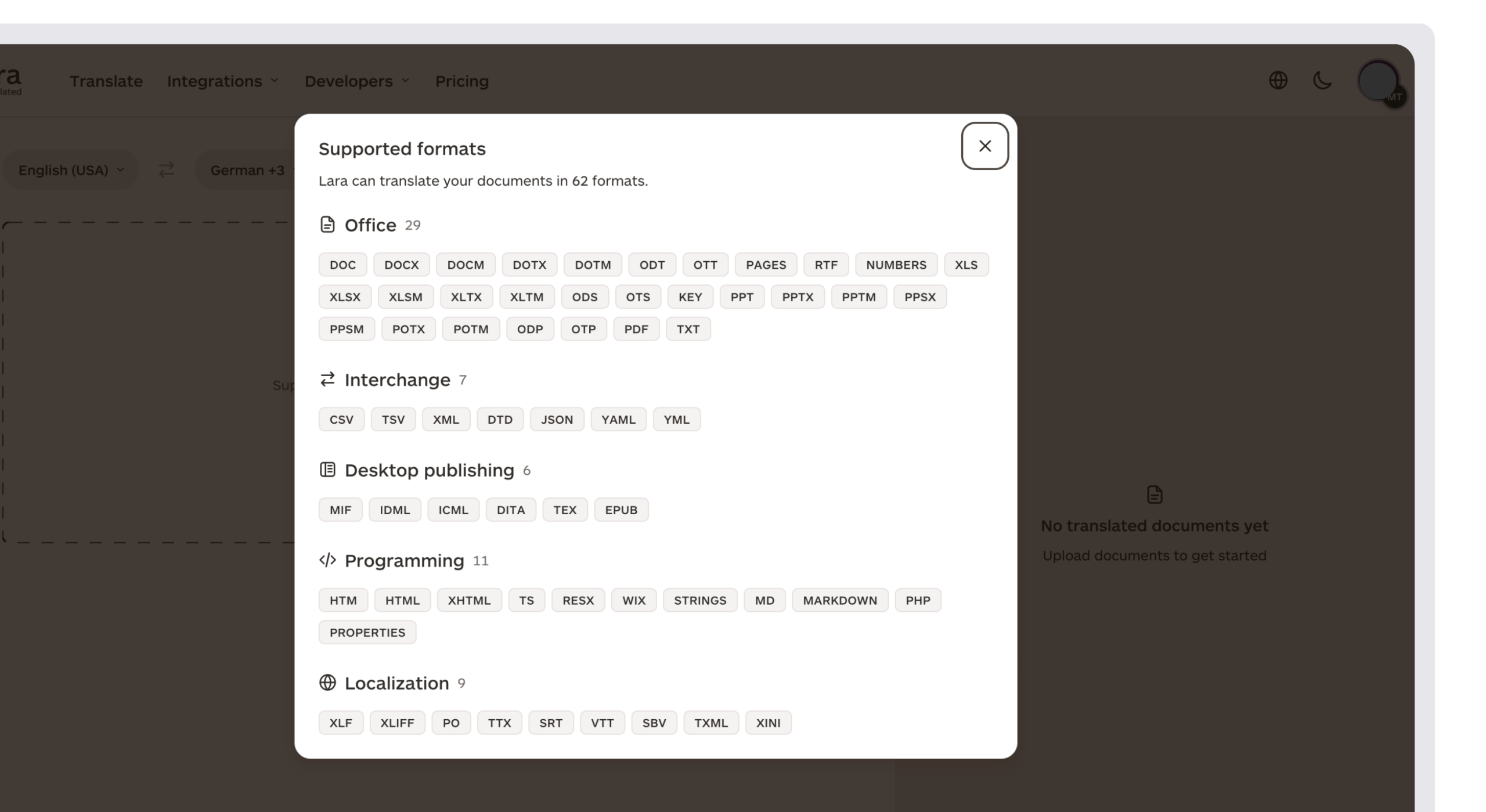
Connect translation to your customer communication workflow by collecting approved scripts, IVR prompts, and message templates in a working document. Translate them with Lara Translate, review the wording, then paste or import the approved text into your call platform. Keep phone numbers, tracking links, customer placeholders, and automation variables unchanged. Test each version before launch; this content workflow does not require a native integration.
Best call tracking and conversation intelligence software in 2027
| Platform | Best for | Model | Pricing |
|---|---|---|---|
| CallRail | Small and mid-size businesses | Lead tracking and conversation intelligence | From $50/month plus usage |
| Invoca | Large B2C brands | Data and AI platform for revenue growth, with AI agents | Quote-based |
| WhatConverts | Agencies and budget-conscious teams | Lead tracking across calls, forms, chats, and transactions | From $30/month; usage credit included |
| CTM (CallTrackingMetrics) | Marketing and sales teams that want tracking and a contact center in one place | Call tracking, conversation intelligence, and contact center platform | From $79/month billed monthly plus usage |
| Marchex | Enterprises and multi-location businesses | AI conversation insights and call tracking | Contact Marchex |
CallRail
Best for: Small and mid-size businesses that want simple, published plans.
CallRail tracks calls and texts back to marketing sources, with call recording, routing, transcription, and automation rules. Higher plans add form tracking and Premium Conversation Intelligence with call summaries, sentiment analysis, and conversation trend reports. Every account starts with a 14-day free trial.
Pricing: Lead Tracking listed at $50 per month plus usage, with Lead Conversion Complete at $195 per month plus usage.
Verdict: Consider CallRail when you want clear pricing and an easy start.

Invoca
Best for: Large B2C brands with busy contact centers.
Invoca offers call tracking, Signal AI for insights from offline conversations, AI Voice Agents that answer and route callers, AI Messaging Agents for SMS and RCS, and PreSense, which uses digital data to route callers and brief agents. It also offers quality management for contact centers.
Pricing: Not published; request a quote.
Verdict: Consider Invoca when you run large paid media programs and enterprise contact centers.
WhatConverts
Best for: Agencies and businesses that want low-cost lead tracking.
WhatConverts tracks phone calls, text messages, forms, chats, and transactions with marketing attribution data. It includes dynamic number insertion, campaign and keyword reporting, and AI call analysis with transcription. Higher plans add call flows, IVR menus, custom reports, and HIPAA compliance.
Pricing: Call Tracking is $30 per month, Plus is $60, and Pro is $100. These single-account plans include a $30 usage credit; model additional usage with the vendor’s calculator. A 14-day free trial is available.
Verdict: Consider WhatConverts when you need affordable tracking across many lead types.
Prepare scripts for every market
Translate approved call scripts, IVR prompts, and message templates, then review them before they reach your customers.
CTM (CallTrackingMetrics)
Best for: Marketing and sales teams that want call tracking, conversation intelligence, and a contact center in one platform.
CTM connects every call, chat, form fill, and text to the ad that drove it, using tracking numbers and dynamic number insertion. AI tools such as AskAI analyze recordings and transcriptions, VoiceAI answers calls around the clock, and ChatAI handles chat inquiries. For sales teams, CTM adds smart routing, a customizable softphone, dynamic call scripts, and live coaching. All plans include unlimited users, and CTM lists phone number availability in more than 80 countries.
- Call tracking with dynamic number insertion
- AskAI call analysis on recordings and transcriptions
- VoiceAI and ChatAI virtual agents
- Smart routing, softphone, and live coaching
- Integrations with Google Ads, GA4, HubSpot, and Salesforce
Pricing: Marketing Lite listed at $79 per month billed monthly, Marketing Pro at $179, Sales Engage at $329, and Enterprise at $1,999, plus usage; lower rates on yearly billing.
Verdict: Consider CTM when you want attribution, AI analysis, and sales tools without switching platforms.

Marchex
Best for: Enterprises and multi-location businesses that want AI insights by industry.
Marchex analyzes customer conversations with Marchex AI, with call tracking and attribution, agent performance analysis, real-time messaging, and the option to bring your own call data. It offers industry-specific insights, for example for automotive dealers.
Pricing: Not published; contact Marchex.
Verdict: Consider Marchex when you need conversation insights across many locations.
How to choose call tracking software
Step 1: Map your lead sources. List the campaigns, channels, and locations you need to track.
Step 2: Define AI needs. Decide whether you need transcription only or full analysis, scoring, and AI agents.
Step 3: Check integrations. Confirm connections with your ad platforms, analytics, and CRM.
Step 4: Estimate usage costs. Model numbers, minutes, and texts on top of the base fee.
Step 5: Run a trial. Test with real campaigns before you commit.
Keep follow-up messages consistent
Bring scripts, SMS templates, and follow-up emails into one translation workflow so your reviewers can check terminology and tone across languages.
Conclusion
The right platform depends on your volume and goals. Shortlist two tools and compare them with your own campaign data.
Have a valuable tool, resource, or insight that could enhance one of our articles?
Send us an email at press@laratranslate.com
We’ll be happy to review it and consider it for inclusion to enrich our content for our readers! ✍️
Frequently asked questions
What is call tracking?
It is software that assigns tracking phone numbers to campaigns so each call can be linked to its marketing source.
What is dynamic number insertion?
Dynamic number insertion replaces the phone number shown on a website according to the visitor’s source or session. This helps connect a subsequent call to a campaign or keyword when the relevant tracking data is available.
What is conversation intelligence?
It uses AI to transcribe, summarize, and score calls and chats so teams can find trends and coach agents.
Do call tracking tools work outside the US?
Some do. Check which countries each vendor supports for phone numbers and pricing.
How can businesses serve callers in several languages?
Prepare scripts, IVR prompts, SMS templates, and follow-up emails in each supported language, then have a qualified reviewer check the wording. Confirm that routing, agent coverage, speech recognition, and transcription support those languages too. Translating a script alone does not add multilingual voice support to a platform.
This article is about
- Call tracking links calls and texts to marketing spend
- Comparing call tracking tools by attribution, conversation analysis, routing, and total cost
- Attribution, AI analysis, and speed to lead matter most
- Trials with real campaigns give the clearest answer
- Multilingual service requires reviewed scripts and suitable language support
Useful links
- Phone Call Translation: Options That Actually Work
- Rolling out AI translation across your company: the problems and the fixes
- Lara Translate: text and document translation
This article was produced by the Lara Translate content team. Lara Translate is an AI translation platform built by Translated, with more than 25 years of professional translation experience. Marketing and customer service teams use Lara Translate to prepare campaigns, scripts, and customer communications for review, across 200+ languages and 60+ file formats.