

Legal won’t let anyone paste contracts into a free translator. Support agents copy tickets into a browser tab and hope for the best. Marketing waits two weeks for an agency to return a campaign that’s already out of date. Every team needs business translation, but most companies still handle it one request at a time. This guide is for operations leads, localization managers, support and marketing heads, and anyone asked to “roll out AI translation” without a clear plan.
Below are seven problems that stall AI translation adoption. For each one, you’ll see what breaks, why it happens, how to fix it, and which in-depth Lara Translate guide to read next. If you want the department-by-department view first, start with our hub on localization problems every department faces.
|
TL;DR
|
1. Free translation tools aren’t good enough for business
The free translator works fine for a menu or a quick email. Then someone uses it for a contract, and a defined term comes out three different ways. That’s usually when the search for an alternative starts.
Why it happens. Consumer tools are built for speed and broad language coverage, not for terminology control, document formatting, or business data terms. They translate sentence by sentence, without your glossary or context.
How to fix it. Compare alternatives on what business use actually needs: document formats, glossary support, translation styles, data retention terms, and integrations. Test each one on your own real content, including a technical document and a marketing page, before you commit.
Our comparison of the best Google Translate alternatives for business covers the main options and when to use each.
2. Security and legal teams block adoption
The rollout stops at the first security review. Where is the text stored? Is it used for training? Who can see it? If nobody can answer, the project goes back in the drawer.
Why it happens. AI translation vendors differ widely on retention, model training, deletion, and access controls. Without clear answers, legal and IT teams have no choice but to say no, and employees keep using unapproved tools anyway.
How to fix it. Ask vendors for written answers on data retention, no-training options, deletion, access controls, and GDPR compliance. Classify content by sensitivity, and require a no-storage mode for confidential material. Involve security early, so the approved tool arrives with their sign-off.
Read our guide to how secure AI translation services protect data for a vendor checklist.
3. Nobody knows which markets and languages come first
Sales wants Spanish, the CEO wants Japanese, and the product team just added German without telling anyone. Budget gets spread across every request, and no market gets done properly.
Why it happens. Language choices often follow the loudest voice instead of data. Without research on demand, competition, and cultural fit, companies translate too much for weak markets and too little for strong ones.
How to fix it. Prioritize markets by revenue potential, competition, regulatory requirements, and cultural fit. Start with a light localization test in the top two or three, measure results, and scale where demand shows up.
Our localization market research guide lays out a four-pillar framework for choosing markets.
4. Support tickets arrive in languages your agents don’t speak
A ticket in Portuguese sits in the queue for a day because nobody wants to guess. When an agent finally replies, the tone is off and the product name is translated wrong.
Why it happens. Most support teams can’t staff every language, so agents paste messages into generic tools. Context, metadata, and conversation history get lost, and there’s no rule for when a person should step in.
How to fix it. Build a support translation workflow: translate inbound messages automatically while preserving ticket history, set confidence thresholds that route sensitive cases to humans, and localize your knowledge base so customers can self-serve. Train agents on when to trust the translation and when to escalate.

Our step-by-step guide on setting up AI translation workflows for customer support covers tickets, chatbots, and help centers.
One translation platform your security team can approve
Lara Translate’s Incognito mode translates without storing your content, and glossaries keep every team on the same terminology.
5. Marketing localization is slow and off-brand
The campaign launches in English on Monday. The French version arrives three weeks later, reads like a manual, and misses the pun that made the headline work.
Why it happens. Marketing content needs more than literal translation. Without a glossary, a style guide, and a clear line between translation and transcreation, every asset becomes a custom project, and brand voice drifts by market.
How to fix it. Build a structured workflow: audit content, maintain a marketing glossary, use AI for the first draft, transcreate headlines and taglines, and review with local marketers before launch. Track performance by market alongside delivery dates.
Our 7-step marketing content translation workflow includes a checklist you can adapt.
6. Translation lives outside your other tools
Export from the CMS. Paste into a translator. Copy the result back. Fix the formatting. Repeat for every language and every update. Here’s the honest truth: copy-paste is where most translation time actually goes.
Why it happens. Translation is often a separate step that nobody has connected to the systems where content is created, stored, or sent. Every handoff adds delay and a chance for errors.
How to fix it. Connect translation directly to your workflows with APIs or automation platforms. Common starting points are translating incoming support tickets, localizing campaign content as it’s published, and translating documents as they arrive in a shared folder.
See how to automate multilingual workflows with Lara Translate and n8n, with three ready-to-use scenarios.
7. Some language pairs are much harder than others
Translations into Spanish look great. Then the first batch of Chinese content comes back, and your Shanghai team says half the technical terms are wrong.
Why it happens. Languages with very different structures, writing systems, or regional variants, such as English to Chinese, are harder for any translation system. Simplified and Traditional Chinese serve different markets, and many technical terms have no direct equivalent.
How to fix it. Decide on the target variant up front, use a context-aware tool, keep a glossary for fixed terms, and add native-speaker review for high-stakes content in hard pairs.
Our comparison of the best English to Chinese translators for professional use shows how the main tools handle these challenges.
Where Lara Translate fits in an AI translation rollout
Most of the problems above come down to the same needs: data you can trust, terminology that stays consistent, and translation that connects to the tools your teams already use. That’s what Lara Translate is built for.
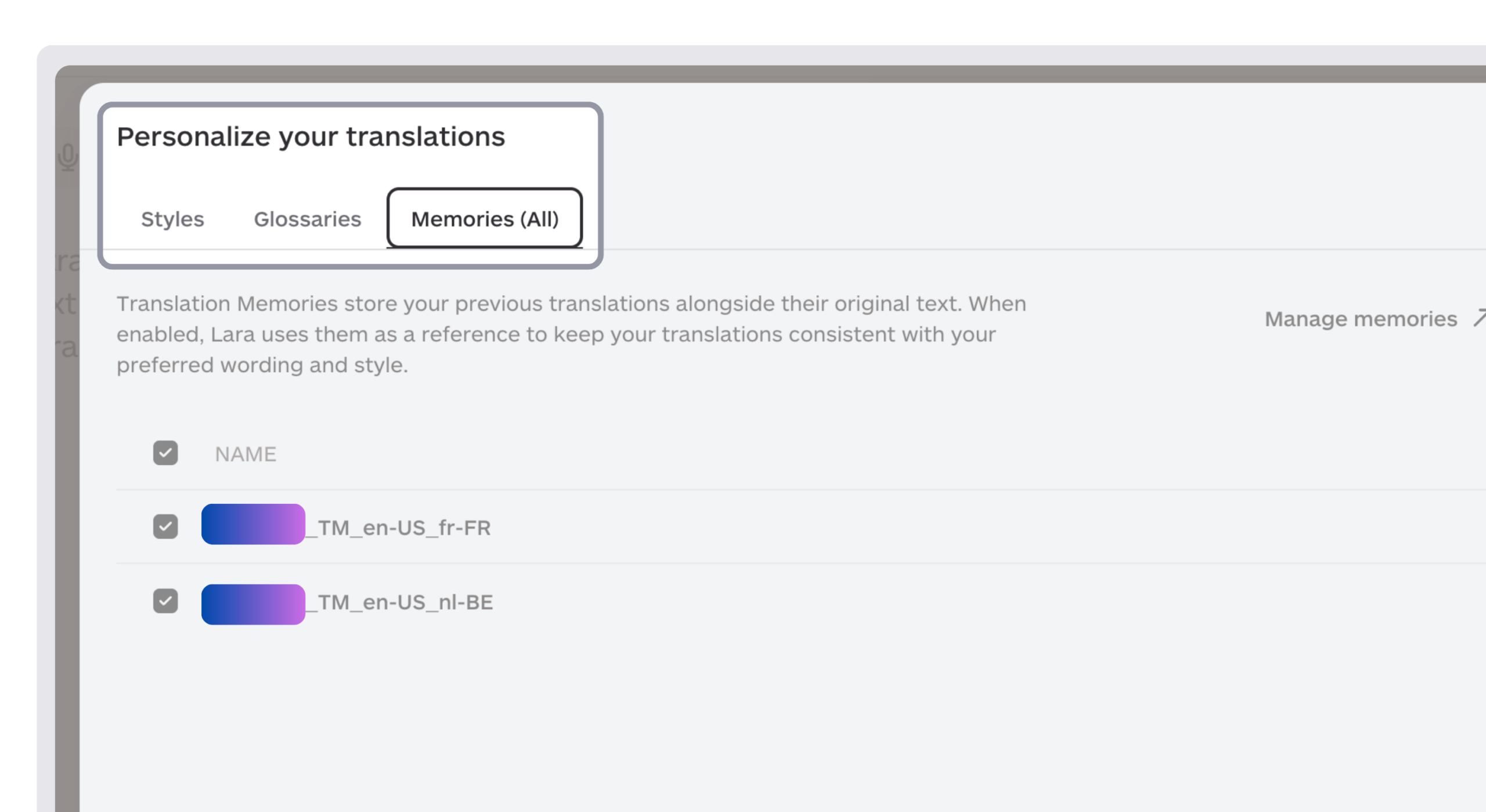
Lara Translate is an AI translation platform built by Translated, with more than 25 years of professional translation experience. Incognito mode translates content without storing it or using it for training, and Translated is a GDPR-compliant Italian company that offers a data processing agreement. Glossaries and Translation Memories keep company terms and approved translations consistent across 200+ languages. Three styles, Faithful, Fluid, and Creative, let each team match the tone it needs, from contracts to campaigns. Documents in 60+ file formats come back with their layout intact. For automation, the API and SDKs, an n8n node, and an MCP server bring translation into support desks, content pipelines, and AI agents. When the stakes are high, you can request a professional human review on top of the AI translation.
AI translation adoption problems and solutions at a glance
| Problem | Solution | Read more |
|---|---|---|
| Free tools fall short | Business-grade alternative, tested on real content | Google Translate alternatives |
| Security blocks rollout | Clear data terms and a no-storage mode | Secure AI translation |
| Unclear market priorities | Research-based market selection | Market research guide |
| Multilingual tickets | Support translation workflow with escalation rules | Support translation workflows |
| Slow, off-brand marketing | Glossary, AI draft, transcreation, local review | Marketing translation workflow |
| Copy-paste between tools | API and automation platforms | n8n workflow guide |
| Hard language pairs | Context-aware tool, glossary, native review | English to Chinese tools |
Stop copy-pasting translations between tools
Connect Lara Translate to your help desk, CMS, or automation platform through the API, and keep terminology consistent everywhere.
The bottom line
Adopting AI translation works best as a company-wide decision. Choose one platform that security can approve, agree on terminology and review rules, and connect translation to the places where work already happens. Start with the team that feels the pain most, often support or marketing, and roll the same setup out from there. Each team you add costs less than the last.
Have a valuable tool, resource, or insight that could enhance one of our articles?
Send us an email at press@laratranslate.com
We’ll be happy to review it and consider it for inclusion to enrich our content for our readers! ✍️
FAQ
Is AI translation good enough for business use?
Yes, for most business content, when you use a business-grade tool with glossaries, context, and clear data terms. Add human review for legal, medical, regulated, or high-visibility content.
How do I roll out AI translation across a company?
Choose one approved platform, get security sign-off, set shared glossaries and review rules, and start with one team that has a clear, repeatable need, such as support or marketing. Then extend the same setup to other teams.
Is it safe to translate confidential documents with AI?
It can be, if the vendor doesn’t store or train on your content and complies with data protection rules like the GDPR. Lara Translate’s Incognito mode translates content without storing it.
What is translation automation?
Translation automation connects a translation engine to the systems where content lives, such as help desks, CMSs, and file storage, so text is translated automatically as part of a workflow instead of being copied by hand.
What’s the best alternative to Google Translate for business?
The best alternative depends on your content, but business teams usually need glossary support, document formatting, translation styles, and clear data terms. Test shortlisted tools on your own documents before choosing.
This article is about
- The seven problems that stall AI business translation adoption in 2026.
- Why free consumer tools fall short for contracts, technical content, and brand copy.
- How to get security and legal sign-off with clear data retention and no-training terms.
- How support and marketing teams can build repeatable AI translation workflows.
- How Lara Translate supports company-wide adoption with Incognito mode, glossaries, styles, and automation through the API, n8n, and MCP.
- Which in-depth Lara Translate guide to read next for each problem.
Sources
- Lara Translate Support: Translation modes, Learning vs. Incognito
- Lara Translate Support: Lara and GDPR compliance
- Lara Translate Support: Request a human review on top of AI translations
This article was produced by the Lara Translate content team. Lara Translate is an AI translation platform built by Translated, with more than 25 years of professional translation experience. Companies use Lara Translate to roll out secure, consistent AI translation across support, marketing, and operations, across 200+ languages and 60+ file formats.