

Marketing launched the German site, but it doesn’t rank. HR rolled out a safety course nobody in the Lisbon warehouse can follow. The product catalog has 4,000 SKUs and three different translations of “waterproof.” Localization problems rarely live in one place. They show up in every team that touches a customer, an employee, or a market. This guide is for founders, marketing and HR leads, ecommerce managers, and anyone who’s been told to “just translate it” with no budget, no process, and a launch date already set.
Below, we go department by department through the seven localization problems that cost companies the most in 2026. For each one, you’ll see what breaks, why it happens, how to fix it, and which in-depth Lara Translate guide to read next.
|
TL;DR
|
1. Founders and product: expanding abroad before you know there’s demand
Here’s the startup catch-22. You need revenue to justify localization, but you need localization to reach the markets that would generate that revenue. Translate everything up front and you can burn runway on a market that never converts.
Why it happens. Many teams treat localization as all or nothing: either the whole product, site, and help center in a new language, or nothing at all. Agency quotes for full localization push the decision later, and competitors get there first.
How to fix it. Validate first, then scale. Translate a landing page and a few key emails, run small campaigns, and measure signups or demo requests per market. Expand to onboarding, docs, and support only where demand shows up. AI translation makes this affordable, as long as you keep a glossary for product terms and add human review where the stakes are high.
We lay out a step-by-step approach in our 5-phase localization validation framework for startups.

2. Marketing: translated pages that don’t rank
The Spanish version of your site went live three months ago. Traffic from Spain is still close to zero. The pages are translated, but nobody in Madrid searches for the words you used.
Why it happens. Direct translation keeps your English keywords, which often aren’t what people search for in other languages. Technical signals get missed too. Without hreflang annotations, Google may not know which language version to show which searcher, and duplicate-looking pages compete with each other.
How to fix it. Research keywords per market instead of translating them. Localize titles, meta descriptions, and URLs. Set up hreflang so each page is labeled as a language or regional variant, and build a few local backlinks in each market. Then track rankings per country, not just globally.
Our guide to multilingual SEO strategies that help content rank in every market covers market selection, hreflang, and localized keyword research.
3. HR and L&D: training that only exists in one language
Your onboarding program is great, in English. For frontline teams, new hires abroad, and staff from acquired companies, it might as well not exist. A mandatory safety course someone can’t fully read protects nobody.
Why it happens. Translation gets treated as the last step after a course is “done.” Every update means another round with a vendor, so translated versions fall behind, and the same term shows up three different ways across modules.
How to fix it. Build localization into course production. Keep course text exportable (XLIFF, Word, or PowerPoint), reuse approved translations so updates only cost what changed, and lock key terms in a glossary.
Read more in our guide to training content localization for global teams.
4. Ecommerce and merchandising: product data that breaks in every language
You sell in six countries. Product names are translated in some markets, missing in others, and inconsistent everywhere. One marketplace rejects your listings because a required field is still in English.
Why it happens. Product information lives in spreadsheets, ERPs, and storefront back ends at the same time. Without a single source of truth, translations get done in one place and never reach the others.
How to fix it. Centralize product data in a PIM first. Then export only the fields that need translation, translate them with consistent terminology, review, and import the text back into the matching product and language fields. Your catalog stays in sync, and every channel gets the same wording.
Our comparison of PIM software for multilingual product catalogs covers how the leading platforms handle that workflow.
Same term, same translation, in every department
Set up a glossary once and Lara Translate applies it to your pages, courses, catalogs, and documents across 200+ languages.
5. Content and communications: audio and video stuck in one language
Your webinar library, podcast, and product videos only reach people who speak the original language. Recorded speech is hard to search, quote, or repurpose until someone turns it into text, and then into other languages.
Why it happens. Transcription and translation usually happen in separate tools, if they happen at all. Errors in either step can change meaning, especially with technical terms, accents, or crosstalk.
How to fix it. Pick a transcription platform based on accuracy, language coverage, and whether you need human review. Then translate transcripts and subtitle files (such as SRT or VTT) with the same terminology rules you use for written content. Spot-check anything that will be published.
Our review of AI transcription and translation platforms compares the main options.

6. Hospitality and customer experience: guest information that isn’t in their language
It’s 11 p.m. A guest arriving from Seoul can’t find check-in instructions in Korean, so they call the front desk. Multiply that by every guest and every language, and your team spends nights answering the same questions.
Why it happens. A multilingual chat tool can answer in many languages, but it only works with what it’s been given. If room descriptions, arrival instructions, and policies only exist in one or two languages, the bot can’t fill the gap reliably.
How to fix it. Translate and review your core guest materials first: booking pages, pre-arrival emails, house rules, and FAQs. Then connect them to a guest messaging platform that answers on the channels guests already use.
We compared the leading platforms in our guide to AI guest communication platforms for hotels.
7. Any team: hard language pairs like English to Chinese
Some language pairs are harder than others. English to Chinese is a classic example. Get it wrong and the damage goes beyond awkward phrasing: a mistranslation can change the meaning of a contract or a product claim.
Why it happens. English uses word order and verb forms to show tense and relationships, while Chinese leaves much of that to context. Chinese also has two writing systems: Simplified for mainland China and Traditional for Taiwan, Hong Kong, and Macau. Many technical and legal terms have no direct equivalent.
How to fix it. Decide on the target variant before you start. Use a translation tool that understands context across the full document, not sentence by sentence, and keep a glossary for terms that need a fixed translation. For legal or regulated content, add review by a native speaker.
Our comparison of the best English to Chinese translators for professional use shows how the main tools handle these challenges.
Where Lara Translate fits across departments
Most of the problems above have the same three ingredients: consistent terminology, file formats that survive translation, and a way to reuse what’s already been approved. That’s what Lara Translate was built for.
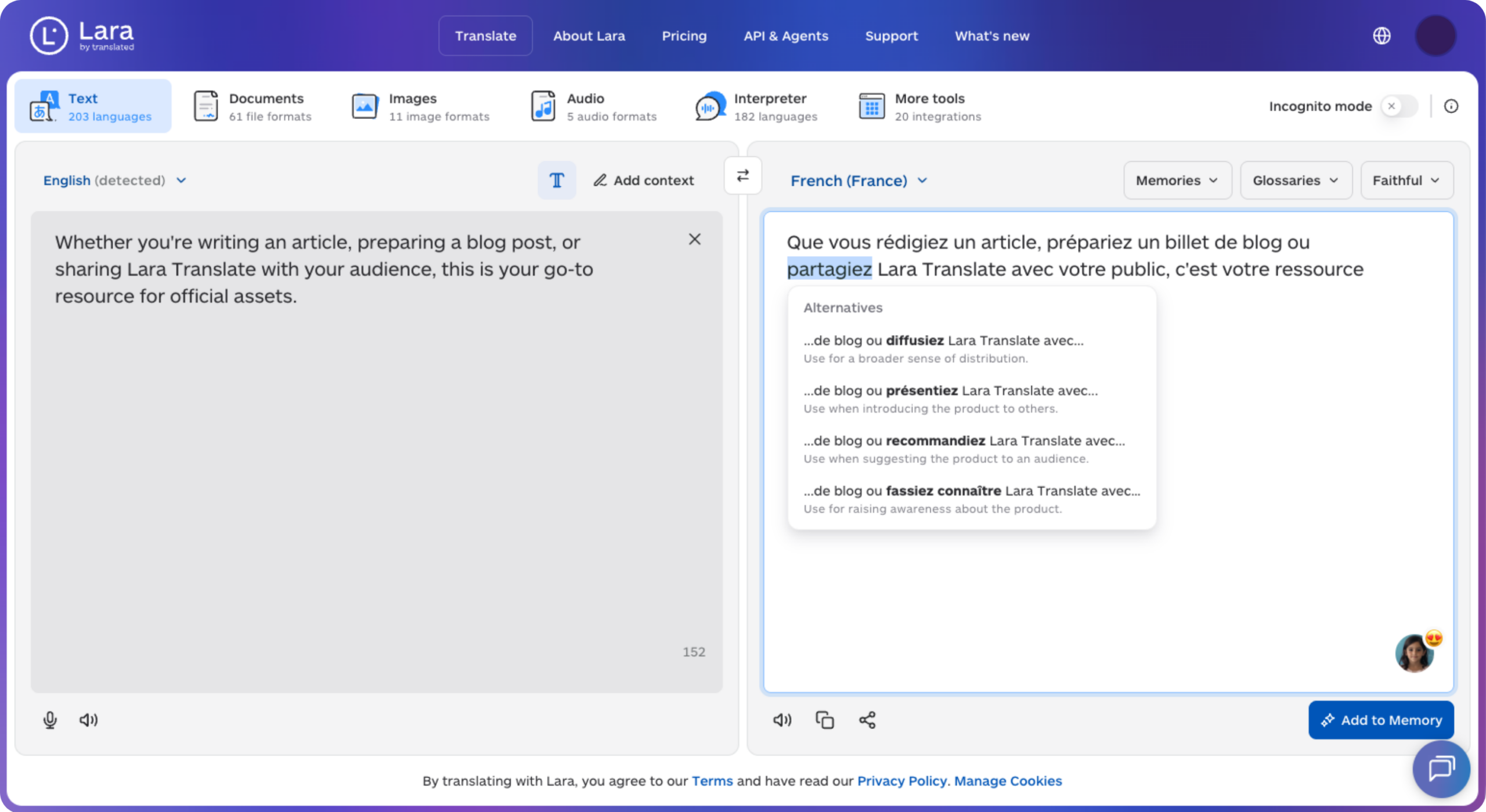
Lara Translate is an AI translation platform built by Translated, with more than 25 years of experience in professional translation. It translates documents across 60+ file formats, including DOCX, PPTX, PDF, XLIFF, and SRT, and returns them with the original layout preserved. Glossaries enforce your terminology across 200+ languages, and Translation Memories reuse approved translations, so updates only cost what changed. Three styles (Faithful, Fluid, and Creative) let each team match the tone it needs, from contracts to campaigns. Interpreter mode handles live conversations on web and mobile, and Incognito mode processes confidential content without storing it. For product catalogs and automated workflows, the API brings the same glossaries and memories into your own systems.
Localization problems and solutions at a glance
| Problem | Solution | Read more |
|---|---|---|
| Unproven new markets | Validate with light localization first | AI translation for startups |
| Translated pages don’t rank | Local keywords and hreflang | Multilingual SEO guide |
| Training in one language | Localization built into course production | Localizing training content |
| Inconsistent product data | PIM plus field-level translation | PIM software compared |
| Audio and video in one language | Transcribe, then translate with shared terms | Transcription platforms |
| Guest info not localized | Translate core materials, then automate | Hotel guest messaging tools |
| Hard language pairs | Context-aware tools, glossary, native review | English to Chinese tools |
Stop solving translation one department at a time
Give every team one translation tool with shared glossaries, layout-safe documents, and Incognito mode for anything confidential.
The bottom line
Localization problems look different in every department, but they usually come back to the same gap: no shared process. Pick the team where language is costing you the most right now, whether that’s lost rankings, stalled training, or a catalog full of inconsistencies. Fix it with shared terminology and reusable translations, then roll the same setup out to the next team. Each department you add gets cheaper.
Have a valuable tool, resource, or insight that could enhance one of our articles?
Send us an email at press@laratranslate.com
We’ll be happy to review it and consider it for inclusion to enrich our content for our readers! ✍️
FAQ
What are the most common localization problems?
The most common localization problems are inconsistent terminology, translated pages that don’t rank, outdated translations after content updates, broken file layouts, and content that only exists in one language for some audiences. Most come from treating translation as a one-off task instead of a repeatable process.
What is the difference between translation and localization?
Translation converts text from one language to another, while localization adapts the full experience for a market, including keywords, formats, currencies, cultural references, and tone. A localized page reads as if it was written for that market.
How can a startup localize on a small budget?
Start by translating only what you need to test demand, such as one landing page and a few emails, using AI translation with a glossary for product terms. Expand localization only in markets that show real signups or sales.
Is AI translation good enough for business content?
Yes, for most business content, as long as you provide context, use glossaries for key terms, and add human review for legal, medical, or high-visibility material. Lara Translate supports this workflow with glossaries, Translation Memories, and an option to request human review.
How do I keep translations consistent across departments?
Use one shared glossary and translation memory across teams, so every department pulls from the same approved terms and translations. A single translation platform makes this much easier than each team using its own tool.
This article is about
- The seven localization problems that cost companies the most in 2026, grouped by department.
- How startups can validate new markets with light localization before committing budget.
- Why translated pages often fail to rank, and how local keywords and hreflang fix it.
- What HR, ecommerce, hospitality, and content teams each need from a localization workflow.
- How Lara Translate supports every department with glossaries, Translation Memories, layout-safe documents, and live interpretation.
- Which in-depth Lara Translate guide to read next for each problem.
Sources
- Google Search Central: Localized versions of your pages
- Lara Translate Support: Request a human review on top of AI translations
This article was produced by the Lara Translate content team. Lara Translate is an AI translation platform built by Translated, with more than 25 years of professional translation experience. Teams across marketing, HR, ecommerce, and support use Lara Translate to localize content consistently, across 200+ languages and 60+ file formats.