

When marketing, ecommerce, and operations work from different versions of a product record, launches slow down and inconsistent details can reach customers. A growing catalog makes those differences harder to spot, especially when the same products appear across several sales channels.
PIM software exists to close that gap, centralizing product data in one place so every channel pulls from the same accurate, up-to-date source. This guide compares platforms in 2026, and closes with something that matters the moment a catalog needs to reach genuinely global markets: what happens once a PIM has organized which fields need a translation, but the actual translated text for each language still needs to be produced accurately.
|
TL;DR
|
What makes a PIM platform worth using in 2026?
Nearly every platform in this category shares the same underlying job: centralizing product data from scattered sources into one accessible hub, enriching it, and syndicating it consistently across every sales channel. Where these platforms genuinely diverge is implementation complexity, how IT-dependent day-to-day use actually is, and which industry or catalog structure they’re built to serve best.
Enterprise-grade flexibility and marketer-friendly simplicity represent different priorities for the same core job. Akeneo and Salsify both offer deep customization suited to large, IT-supported implementations, while Sales Layer is built specifically so marketing and product teams can manage daily operations without IT involvement.
Broad retail syndication and manufacturer or B2B distributor workflows solve different catalog structures. Salsify and Syndigo specialize in large-scale retailer syndication and digital shelf performance, while Sales Layer and inRiver are consistently identified as leaders specifically for manufacturers and B2B distributors managing more technical product data.
Self-hosted control and managed SaaS involve different operational responsibilities. Akeneo offers an open-source Community Edition, while Pimcore uses an open-core licensing model with eligibility conditions for its free Community Edition. Compare hosting, maintenance, support, and implementation costs alongside the subscription.
Data quality tooling and syndication breadth both matter, but solve different halves of the same problem. Gap-scanning and quality-scoring features catch incomplete or inconsistent data before it reaches a channel, while syndication connectors determine how quickly that corrected data actually reaches every channel a brand sells through.
Localization combines workflow management with translation and review. Some PIM platforms already offer AI translation or connections to translation providers. Assess those capabilities alongside your requirements for terminology, language coverage, and approval workflows. A dedicated translation service can complement the PIM where additional control or coverage is needed.
PIM software platforms to consider
| Platform | Best for | Model | Pricing |
|---|---|---|---|
| Akeneo | Configurable enterprise PIM with an open-source option | Open-source and SaaS PIM platform | Community Edition free; commercial packages quoted |
| Salsify | Retailer syndication and digital shelf analytics | Cloud-native PXM platform | Custom, contact sales |
| Plytix | Growing and mid-market ecommerce teams | SaaS PIM with built-in DAM | Free tier for 500 SKUs; Pro from $499/month |
| Sales Layer | Easiest-to-use PIM for manufacturers and B2B distributors | SaaS PIM for marketers and product teams | Custom, contact sales |
| inRiver | Complex B2B catalogs bundled with syndication and digital shelf analytics | Multi-tenant SaaS PIM platform | Custom, contact sales |
| Pimcore | Developer-led customization and self-hosted control | Open-core PIM and data platform | Community free for eligible use; Professional $9,900/year |
| Syndigo | Retailer and marketplace content syndication | Content syndication and PIM platform | Custom, contact sales |
| Pimberly | Enterprise catalogs needing structured support | Cloud-native enterprise PIM | Published annual tiers; Enterprise quoted |
Akeneo
Best for: Large organizations wanting deep flexibility with an open-source option.
Akeneo‘s Community Edition can be downloaded, self-hosted, and customized directly, while its SaaS tiers add continuous updates and a network of certified implementation partners, with AI-powered features that identify and correct missing or inaccurate product data.
Pricing: Community Edition is free to download and use. Commercial packages are quoted; budget separately for implementation, hosting where applicable, and integrations.
Verdict: Consider Akeneo when open-source flexibility and a large connector ecosystem outweigh the need for a fully guided, low-IT setup.

Salsify
Best for: Large enterprises focused on winning the digital shelf through retailer syndication.
Salsify combines PIM, enhanced content, and digital shelf analytics in one cloud-native platform, with comprehensive syndication capabilities that keep product listings synchronized across many ecommerce channels at once.
Pricing: Custom, contact sales.
Verdict: Consider Salsify when large-scale retailer syndication and digital shelf performance tracking are the primary requirements.
Plytix
Best for: Growing and mid-market ecommerce teams wanting a shared product content workspace.
Plytix combines PIM and digital asset management with product organization, team workflows, and channel output options. Shopify and BigCommerce connections are available, while product feeds and other outputs can be separate add-ons.
Pricing: The free Standard plan covers 500 SKUs. Pro starts at $499 per month, with some output tools and additional AI credits priced separately. Confirm your billing currency and required add-ons.
Verdict: Consider Plytix when a shared catalog workspace and a modular pricing model fit your growing team.
Sales Layer
Best for: Manufacturers and B2B distributors wanting the easiest PIM to use without heavy IT involvement.
Sales Layer has been voted the easiest PIM to use in the industry by G2, built specifically for marketing and product teams to manage product content directly through an intuitive interface, workflows, and role-based permissions rather than routing daily operations through IT. The platform includes a Gap Scanner and Quality Score feature to identify missing fields and measure data completeness, bulk editing tools to enrich large catalogs quickly, and was among the first PIM platforms to offer ChatGPT as well as AI agents that generate product descriptions, localize content, and validate data. Sales Layer connects to marketplaces, websites, and procurement platforms through native connectors, including Shopify, Magento, and WooCommerce, and supports print catalog automation through integration with InDesign. Average onboarding takes around six weeks, using guided setup and flexible data modeling rather than long custom development cycles.
Pricing: Custom, contact sales.
Verdict: Consider Sales Layer when ease of use for marketing and product teams, without heavy IT dependency, matters more than the deepest enterprise customization.
Turn approved product data into multilingual content
Lara Translate helps product and marketing teams translate catalog descriptions and other product text across 200+ languages. Add translation and review to your publishing workflow so each market receives consistent, useful content.
inRiver
Best for: Brands and manufacturers with genuinely complex B2B product catalogs.
inRiver bundles product information management, product data syndication, and Digital Shelf Analytics into one multi-tenant SaaS platform, appealing specifically to brands managing complex, technical product data across multiple channels and regions.
Pricing: Custom, contact sales.
Verdict: Consider inRiver when complex B2B catalog structures and bundled syndication and analytics fit your organization’s scale.
Pimcore
Best for: Technical teams wanting extensive customization and control over their product data platform.
Pimcore combines PIM with master data and digital asset management capabilities. Its current editions use an open-core model, and free Community use has eligibility conditions; commercially licensed and managed options are also available.
Pricing: Community Edition is free for eligible use, including commercial entities with annual revenue below EUR/USD 5 million, as described in the edition documentation. Professional is listed at $9,900 per year. Include development, hosting, and maintenance in your budget.
Verdict: Consider Pimcore when developer-led customization and deployment control justify the implementation effort and applicable licensing.
Syndigo
Best for: Brands needing retailer and marketplace content syndication.
Syndigo connects product information and digital assets with retailer requirements and distribution destinations. Evaluate its coverage against the specific channels, content types, and markets your brand needs.
Pricing: Custom, contact sales.
Verdict: Consider Syndigo when matching retailer requirements and distributing product content are central to your channel strategy.
Pimberly
Best for: Enterprises wanting catalog management with structured support.
Pimberly combines cloud PIM, digital asset management, localization, and import and export channels. Its published tiers include technical account management, with onsite support in higher tiers. Confirm response commitments and service levels in the contract.
Pricing: Published annual tiers vary by currency, catalog size, and user allowance. Enterprise pricing is quoted; confirm implementation, support, and optional products in the proposal.
Verdict: Consider Pimberly when a larger catalog and defined support arrangements are key requirements.

How to choose the right PIM platform
Step 1: Match implementation complexity to your team’s actual IT resources. Akeneo and Salsify suit organizations with dedicated IT support; Sales Layer and Plytix are built for marketing and product teams to manage independently.
Step 2: Confirm whether your catalog structure fits a manufacturer, B2B, or retail syndication profile. Sales Layer and inRiver lead among manufacturers and B2B distributors; Salsify and Syndigo lead for large-scale retail syndication.
Step 3: Check whether self-hosted control or managed SaaS fits your team better. Compare implementation, maintenance, and licensing obligations, including eligibility for any free edition.
Step 4: Verify data quality tooling actually catches gaps before they reach a channel. Sales Layer’s Gap Scanner and Quality Score, along with similar tools across the category, help prevent incomplete data from ever going live.
Step 5: Plan for translating catalog content once a PIM has organized which fields need it. A dedicated translation tool can help produce that content accurately, so the fields a PIM has structured for translation actually get filled with trustworthy text.
Connecting product information management with translation
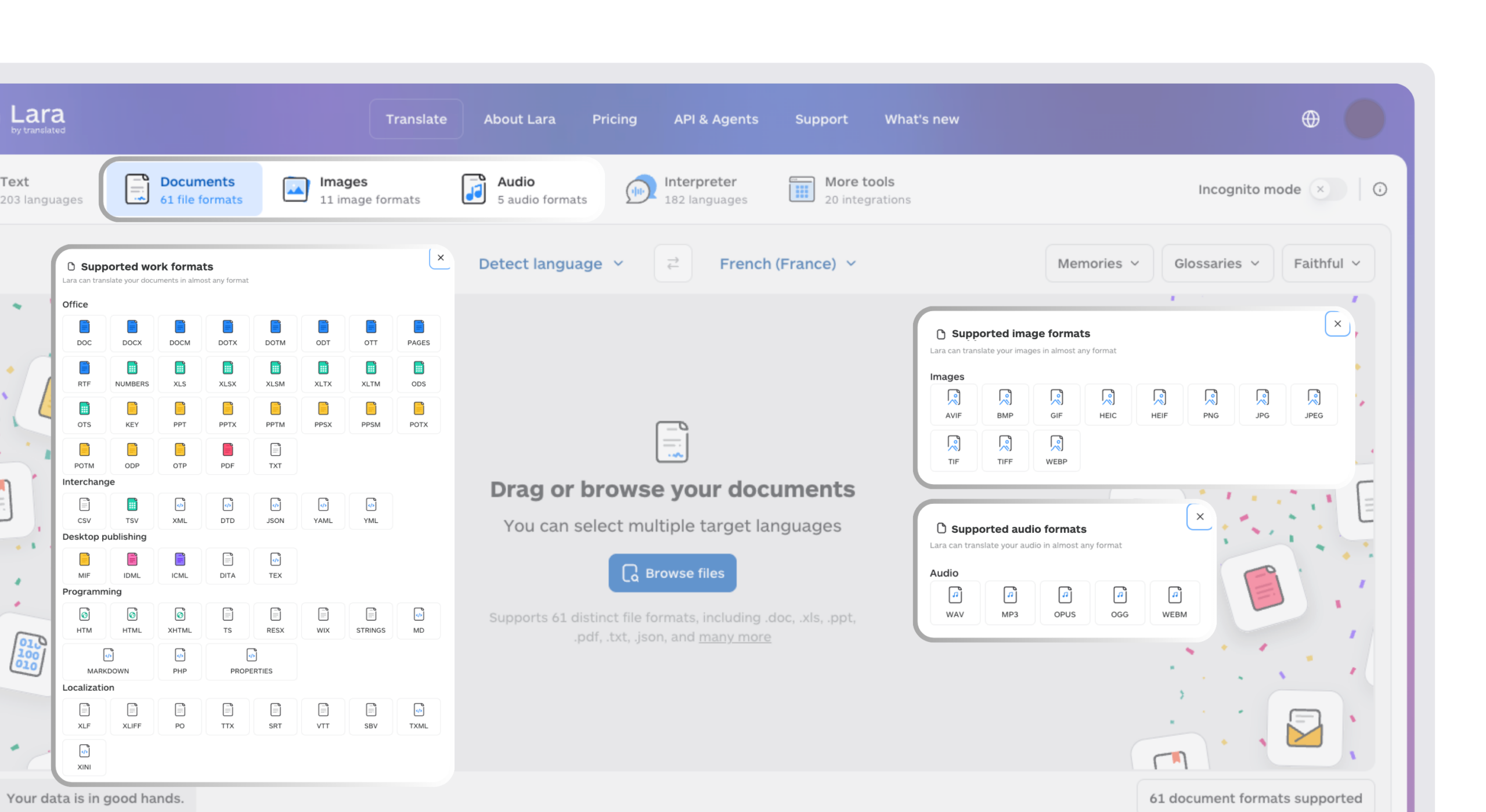
Use the PIM as the source of approved product content. A practical workflow is to export the fields that need translation, translate them with Lara Translate, then return reviewed text to the matching product and language fields. Lara Translate supports document translation and an API with glossaries and translation memories for consistent terminology. Keep product identifiers and non-translatable specifications separate, and confirm your PIM’s import and export requirements before automating the workflow.
Give every market the product content it deserves
Whichever platform above centralizes your catalog, Lara Translate can help translate product content accurately across 200+ languages.
Conclusion
The right PIM platform depends on your catalog structure, available IT resources, and whether you’re serving manufacturers, B2B distributors, or large-scale retail syndication. Whichever platform you choose, an organized translation workflow only helps once the translated content itself is actually accurate.
Have a valuable tool, resource, or insight that could enhance one of our articles?
Send us an email at press@laratranslate.com
We’ll be happy to review it and consider it for inclusion to enrich our content for our readers! ✍️
Frequently asked questions
What does PIM software do?
PIM software centralizes product information so teams can enrich, validate, approve, and distribute it to sales channels. It typically manages attributes, descriptions, variants, and links to assets. The goal is to give each channel consistent product content suited to its requirements.
When does a business need a PIM system?
A PIM becomes useful when spreadsheets and manual updates make product content difficult to manage across teams, channels, or languages. Repeated data errors, unclear ownership, and slow launches are practical signals. Catalog complexity and workflow demands matter more than a fixed SKU threshold.
How is PIM different from an ERP or DAM system?
A PIM manages product content for marketing and selling. An ERP usually manages operational information such as stock, purchasing, and orders, while a DAM manages assets such as images, videos, and documents. The systems can exchange data, with ownership defined for each field.
How much does PIM software cost?
Costs depend on the edition, catalog size, channels, users, and required integrations. Include data preparation, implementation, training, hosting, support, and ongoing maintenance alongside the license. A free edition can still require technical work, and commercial use may have eligibility conditions.
What should I test before choosing PIM software?
Use a representative set of products, including variants, technical attributes, images, and multiple languages. Test imports, bulk updates, validation, approvals, and exports to your actual channels. Ask the teams who will maintain the catalog to complete routine tasks during the evaluation.
How does a PIM support multilingual product catalogs?
A PIM can organize locale-specific fields, track completeness, and manage approval before publishing. Translation may be built in, connected through an integration, or handled through file exchange. Review terminology, units, formatting, and market-specific requirements, then keep translated versions aligned with source updates.
This article is about
- Centralizing product attributes, descriptions, variants, and assets
- Matching PIM capabilities to catalog complexity and team resources
- Comparing data quality checks, approvals, and channel distribution
- Budgeting for licensing, implementation, integrations, and maintenance
- Choosing between self-hosted and managed deployment options
- Translating and reviewing product content for multilingual catalogs
Useful links
- 6+ Best AI Tools for Product Teams
- Localization Teams: Translation Quality Assurance Cuts Review Time
- Lara Translate document translation
- Lara Translate API, glossaries, and translation memories
This article was produced by the Lara Translate content team. Lara Translate is an AI translation platform built by Translated, with more than 25 years of professional translation experience. Product and marketing teams use Lara Translate to translate catalog content accurately, across 200+ languages and 60+ file formats.