

A broker’s dispatcher spends the afternoon juggling a dozen open loads, three carriers who haven’t confirmed pickup, and a shipper asking for a status update that nobody has time to compile. The margin between a profitable lane and a losing one increasingly comes down to whether the software behind that dispatcher can actually keep pace with how fast freight moves.
AI-powered TMS platforms for freight brokers can automate parts of load creation, procurement, matching, and visibility. This guide compares broker-focused systems alongside shipper-oriented tools and visibility platforms, so you can separate core dispatch requirements from complementary services and plan for multilingual driver and carrier communication.
|
TL;DR
|
What makes an AI-powered TMS worth using for freight brokers in 2026?
Collaborative, multi-party platforms and broker-only dispatch tools solve different coordination problems. Turvo puts brokers, shippers, carriers, and 3PLs into one shared workspace, a different model than a TMS confined to a broker’s own internal dispatch queue.
Network access and operational software address different needs. Assess the carrier capacity available to your business separately from the TMS features used to build loads, manage exceptions, and reconcile invoices.

Software-only vendors and brokerage-plus-software vendors carry different incentive structures. Transfix divested its own brokerage operations to NFI Logistics in 2024 specifically to focus on software and data, while a platform still running its own brokerage business may prioritize its own freight before a customer’s.
Vendor continuity deserves diligence. Flexport acquired Convoy technology in 2023, and the platform subsequently moved to DAT in 2025. Ask vendors how ownership changes, support arrangements, and data-export rights would affect your business.
Multilingual communication needs its own workflow check. Ask vendors to demonstrate translated dispatch instructions, detention notices, and ETA updates, including any partner integrations. Where that workflow is missing, a dedicated translation tool can help.
Platform comparison at a glance
| Platform | Best for | Model | Pricing |
|---|---|---|---|
| Turvo | Shared collaboration across brokers, shippers, and carriers | Collaborative TMS | Contact sales |
| Uber Freight | Shipper-oriented transportation management and capacity access | TMS and managed transportation | Contact sales |
| Loadsmart | Shipper procurement and execution | ShipperGuide TMS | Contact sales for full TMS |
| Transfix | A pure-software platform built by former brokers, exit | Intelligent Freight Platform (TMS) | Custom, contact sales |
| Transfix | A pure-software platform built by former brokers, post-brokerage exit | Intelligent Freight Platform (TMS) | Custom, contact sales |
| Revenova | Salesforce-based brokerage operations | Salesforce-based TMS | Contact sales |
| AscendTMS | Browser-based operations with published pricing | Cloud TMS | From $69 per user/month |
| FourKites | Visibility and automated exception workflows | Visibility and orchestration platform | Contact sales |
| project44 | Shipment visibility and predictive ETAs | Decision intelligence and visibility platform | Contact sales |
| Descartes | Brokerage or wider international logistics requirements | Logistics product portfolio | Contact sales |
| Princeton TMX | Industrial shipper operations | Multimodal TMS | Contact sales |
Pricing checked September 22, 2026. Confirm the full cost of users, integrations, implementation, and optional AI features with each vendor.
Best AI-powered TMS platforms and related tools for freight brokers in 2026
Turvo
Best for: Brokers and 3PLs wanting a collaborative, multi-party TMS rather than a broker-only dispatch tool.
Turvo, the technology behind Ryder’s RyderShare platform, connects brokers, 3PLs, shippers, and carriers through a collaborative workspace. Its TMS brings shipment information and connected logistics workflows together, helping teams coordinate across company boundaries.
Pricing: Contact sales for a quote.
Verdict: Consider Turvo when shared, multi-party visibility across every stakeholder in a shipment matters more than a broker-only internal tool.
Uber Freight
Best for: Teams evaluating a shipper-oriented TMS alongside managed transportation and capacity services.
Uber Freight combines transportation management software with managed transportation and freight capacity services. Its TMS supports procurement, execution, visibility, payments, and insights. The product is marketed primarily to shippers, so brokers should confirm that the proposed setup supports their own brokerage workflows.
Pricing: Contact sales for a quote.
Verdict: Consider Uber Freight when shipper transportation management and access to capacity fit your service model.
Loadsmart
Best for: Teams managing shipper procurement and execution within the Loadsmart ecosystem.
Loadsmart offers ShipperGuide TMS for freight procurement, planning, execution, and visibility. The shipper-oriented platform includes automation and AI-backed optimization. ShipperGuide Instant Rates is a separate free entry point for comparing freight quotes, and should be distinguished from a full TMS deployment.
Pricing: Contact sales for full TMS pricing. ShipperGuide Instant Rates is free to use.
Verdict: Consider Loadsmart when shipper procurement and transportation execution are central to the workflow you need to support.

Transfix
Best for: Brokers and 3PLs that want pricing, RFP, and execution in one TMS, built by a team that ran a digital brokerage for a decade before exiting to focus on software.
Transfix, originally launched as Aptive Systems in 2012 and formally established as Transfix in 2014 by co-founders Drew McElroy and Jonathan Salama, is headquartered in New York City and has raised more than $125 million across eight funding rounds, including a $40 million Series F led by New Enterprise Associates and G Squared. In June 2024, Transfix divested its own freight brokerage operations to NFI Logistics to focus exclusively on its SaaS and data solutions, and launched its flagship TMS in December 2025, with NFI adopting it as an enterprise-wide platform. The Transfix TMS covers the full shipment lifecycle in one interface: quoting, RFP management, tendering, scheduling, tracking, invoicing, and reporting. It integrates with partners including DAT Freight & Analytics, Sonar, Drumkit, Vooma, BitFreighter, and more.
Pricing: Custom, contact sales.
Verdict: Consider Transfix when native TMS pricing intelligence, built by people who ran their own brokerage before focusing purely on software, matters to your vendor selection.
Revenova
Best for: Brokers already running their sales and operations on Salesforce.
Revenova is built natively on Salesforce and supports multimodal transportation operations. Its Artimus AI add-on can turn incoming emails and text prompts into load and capacity records, reducing manual data entry. Confirm the required modules, AI add-ons, and Salesforce setup during evaluation.
Pricing: Contact sales for a quote.
Verdict: Consider Revenova when bringing customer relationships and transportation operations onto Salesforce is a priority.
Make dispatch instructions easier to understand
Lara Translate helps you translate driver and carrier messages across 200+ languages. Use it to prepare pickup instructions, delivery updates, and other written communications.
AscendTMS
Best for: Brokerages wanting browser-based load management and transparent per-user pricing.
AscendTMS covers load management, dispatch, and related operational workflows in a cloud TMS. Its current pricing page lists Basic, Premium, and Pro plans, with AI included among the Pro features. The plans have no user limit and do not charge by truck or load; assess integrations and workload fit in a trial.
Pricing: Basic: $69 per user/month. Premium: $119 per user/month. Pro: $149 per user/month. A 30-day free trial is advertised; connected third-party services can require separate subscriptions.
Verdict: Consider AscendTMS when you want published subscription costs and a browser-based platform that you can test before committing.
FourKites
Best for: Brokers wanting shipment visibility and automated workflows alongside their existing TMS.
FourKites provides shipment visibility, predictive arrival information, and AI-powered orchestration. Its offering now extends into automated exception handling and carrier workflows. Evaluate the specific capabilities alongside your current TMS, including how tracking events trigger follow-up actions.
Pricing: Contact sales for a quote for the required products and scope.
Verdict: Consider FourKites when visibility and exception management are the gaps you need to address.
project44
Best for: Brokers comparing shipment visibility and predictive arrival tools alongside their TMS.
project44 connects shipment data across transportation modes and provides visibility and predictive ETAs. Its wider platform adds decision intelligence around logistics events. Assess carrier coverage, data quality, and integrations against your actual lanes and customer commitments.
Pricing: Contact sales for a quote.
Verdict: Consider project44 when comparing visibility and decision-support options alongside your core TMS.
Descartes
Best for: Brokers and logistics teams needing a TMS within a wider logistics software portfolio.
Descartes offers transportation management, broker and forwarder systems, visibility, and customs-related solutions. Descartes Aljex is a freight broker TMS, while other products address different operating models. Map your requirements to the specific product and integrations, including any language, currency, or trade-compliance needs.
Pricing: Contact sales for product-specific pricing.
Verdict: Consider Descartes when you need brokerage software or a broader combination of logistics products, and can define the modules your operation requires.
Princeton TMX
Best for: Industrial shippers managing multimodal complexity in North America.
Princeton TMX focuses on industrial shippers, combining workflow automation, multimodal execution, and network optimization. Its platform supports truck, rail, fleet, barge, and intermodal transportation. Brokers evaluating it should confirm how its shipper-oriented workflows fit their own service model.
Pricing: Contact sales for a quote.
Verdict: Consider Princeton TMX when industrial shipper operations and multimodal coordination are the primary challenge.

How to choose the right AI-powered TMS for freight brokerage
Decide how much multi-party collaboration you need. Ask each vendor to demonstrate what your team, shippers, and carriers can see and update within the same shipment workflow.
Weigh capacity access against software fit. Test integrations, load creation, tendering, invoicing, and exception handling with examples from your own operation.
Check vendor continuity before committing your dispatch workflow. Ask about support commitments, product ownership, implementation responsibilities, and data export.
Confirm whether the vendor still runs its own competing brokerage. Transfix’s 2024 exit from brokerage removes a potential conflict of interest that platforms still operating their own freight desk may carry.
Plan for multilingual driver and carrier communication. Test the messages and document types your team actually sends, and review translated addresses, appointment times, amounts, and operational terminology before use.
Translate the communication around each load
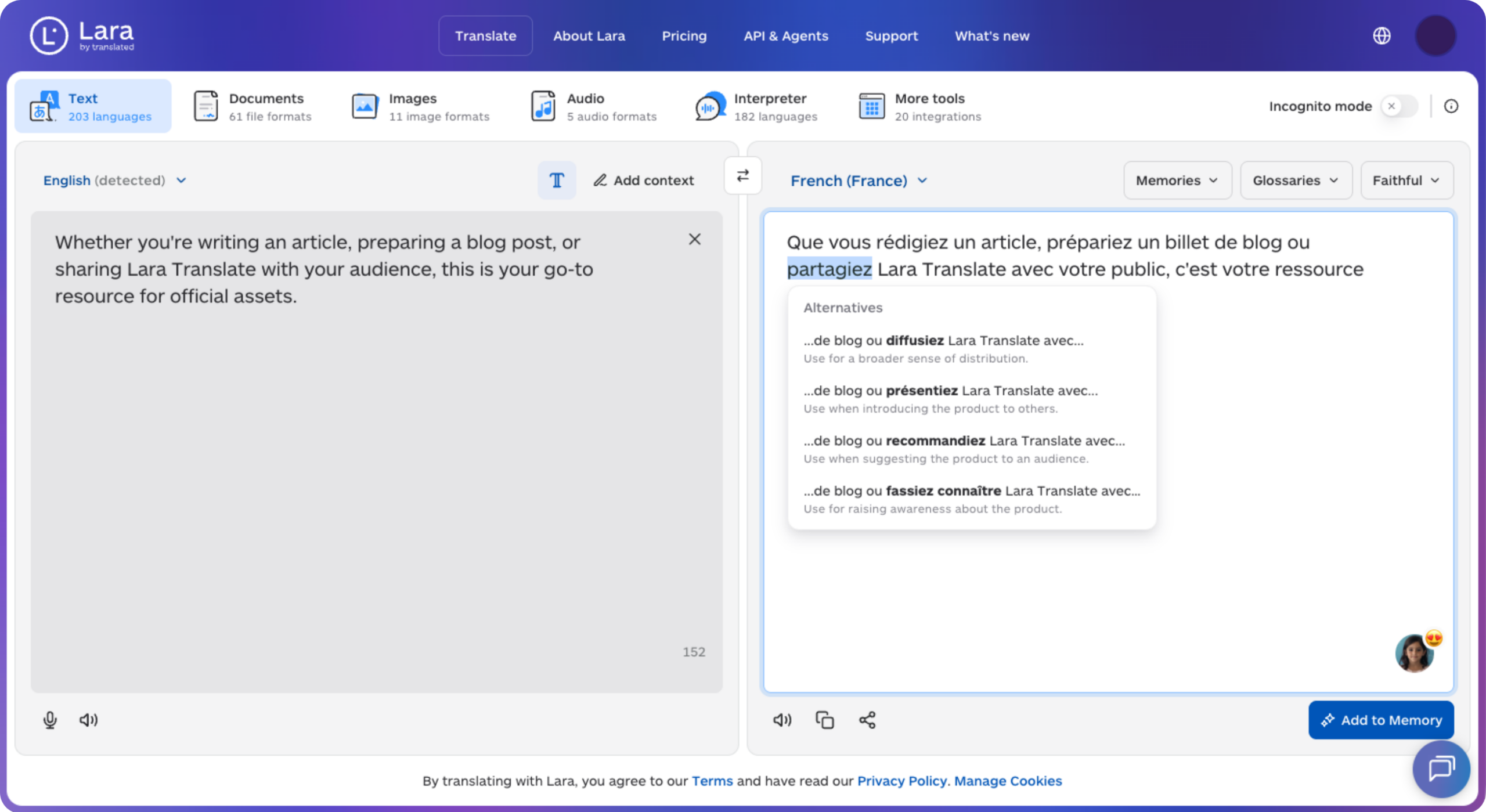
Lara Translate can help teams translate dispatch instructions, detention notices, ETA updates, and supporting documents across 200+ languages and 60+ file formats. Include translation in your communication process wherever your TMS or messaging tools leave a language gap.
Keep every carrier in the loop, in their own language
Use Lara Translate to prepare multilingual messages and documents alongside the platform that runs your dispatch.
Conclusion
Choose the platform that fits your actual operating model, then validate it with a representative load from booking through settlement. Include carrier communication in that test: a useful dashboard should lead to clear, actionable information for the people moving the freight.
Have a valuable tool, resource, or insight that could enhance one of our articles?
Send us an email at press@laratranslate.com
We’ll be happy to review it and consider it for inclusion to enrich our content for our readers! ✍️
Frequently asked questions
What is the best AI-powered TMS for freight brokers in 2026?
The best fit depends on your workflows. Turvo emphasizes collaboration, Revenova supports Salesforce-based operations, and AscendTMS offers published per-user pricing. Transfix stands out as built by former brokers who exited brokerage in 2024.
The best fit depends on your workflows. Turvo emphasizes collaboration, Revenova supports Salesforce-based operations, and AscendTMS offers published per-user pricing. Transfix stands out as for native AI pricing and RFP automation built by former brokers who exited brokerage in 2024.
What happened to Convoy, and is it still an option in 2026?
Convoy’s technology continued under new ownership. Flexport acquired the technology in 2023 and launched it as a freight-matching service for brokers in 2024; the platform subsequently moved to DAT in 2025. Evaluate DAT’s current Convoy offering separately from the former standalone brokerage.
What’s the difference between a TMS and a shipment visibility platform?
A TMS, like Turvo or Transfix, plans routes, assigns loads, and executes dispatch. A visibility platform focuses on shipment tracking, predictive arrival times, and related exceptions. Products such as FourKites and project44 also offer broader automation, so compare the specific modules and integrations you need.
How much does an AI-powered TMS cost for a freight broker in 2026?
Pricing depends on the product and deployment. AscendTMS publishes plans at $69, $119, and $149 per user/month and advertises a 30-day free trial. For the other full-platform deployments here, request a quote that identifies implementation, integrations, and optional AI charges.
Why does language matter for a TMS beyond the software interface itself?
Drivers and carriers need to understand the messages associated with each load. A translated interface alone does not establish that dispatch instructions, detention notices, or ETA updates are translated. Test those workflows and use a dedicated translation tool where needed.
Should a broker choose a vendor that still runs its own brokerage business?
It’s worth weighing carefully. A vendor that still operates its own competing brokerage, alongside licensing TMS software to other brokers, could theoretically prioritize its own freight. Transfix’s 2024 decision to divest its brokerage operations to NFI Logistics removed that potential conflict, positioning it as a software-only vendor.
This article is about
- Broker TMS products, shipper-oriented systems, and visibility platforms solve different operational problems.
- Transfix differentiates itself by exiting its own brokerage business in 2024 to focus purely on software, launching its flagship TMS in December 2025
- Published subscription costs and custom quotes need to be compared with implementation, integration, and AI charges included.
- Vendor ownership, support commitments, and data export deserve a place in the buying process.
- Shipment visibility and AI-driven exception workflows can complement an existing TMS.
- Multilingual driver and carrier communications should be tested alongside load-management workflows.
This article was produced by the Lara Translate content team. Lara Translate is an AI translation platform built by Translated, with more than 25 years of professional translation experience. Freight brokers can use Lara Translate to translate driver and carrier communications and supporting documents, across 200+ languages and 60+ file formats.