

Imagine a marketing director asking which channel drove last quarter’s growth and receiving different answers from dashboards built on different definitions. Before the team can act, someone has to reconcile the sources, metrics, and reporting logic.
AI data platforms help businesses connect data, prepare it for analysis, and support reporting or machine learning. The products in this guide cover different parts of that workflow, from data movement to governed analytics and managed intelligence. The right fit depends on your team’s skills, existing systems, and the decisions you need to support.
|
TL;DR
|
What makes an AI data platform worth using in 2026?
These products cover different layers of a data stack. Some specialize in moving data, others provide transformation or business intelligence, and others combine several capabilities with managed services. Compare them against a defined workflow rather than treating every product as a direct substitute.
Composable, engineering-led stacks and fully managed, single platforms represent different trade-offs between flexibility and simplicity. Fivetran paired with dbt gives analytics engineering teams a flexible foundation, while Kleene.ai bundles ingestion, transformation, BI, and AI analytics into one managed product for teams without that internal capacity.
Custom machine learning and business-user analytics require different capabilities. Teams building models should assess development, evaluation, deployment, and monitoring tools. Teams focused on reporting should test governed metrics, dashboard usability, and access controls.
Marketing-specific data integration and general-purpose business intelligence solve different scopes of the same underlying problem. Improvado and Adverity concentrate specifically on marketing and campaign data, while Domo and Kleene.ai serve broader, cross-departmental data unification across marketing, finance, and operations together.
Open-source flexibility and managed services involve different operational responsibilities. Self-hosted tools give technical teams more control over deployment, while managed services can reduce infrastructure maintenance. Compare both subscription charges and the work your team will still own.
Language needs continue beyond the dashboard. Check which languages each platform supports for its interface, natural-language queries, and generated explanations. Teams distributing reports across markets may also need translated summaries, presentation decks, and metric definitions, with review to preserve the original meaning.
AI data platforms compared
Prices and plan details were checked in October 2026. Compare the complete workflow, including storage, compute, implementation, and any separate reporting tools.
| Platform | Best for | Model | Pricing |
|---|---|---|---|
| Fivetran (+ dbt) | Managed ELT with a separate transformation and reporting layer | Managed ELT plus transformation framework | Free allowance; usage-based paid plans; dbt costs depend on deployment |
| Databricks | Custom data engineering and machine learning workflows | Unified data and AI platform | Usage-based, varies by workload and cloud |
| Domo | Broad data integration paired with governed self-service BI | Data integration and business intelligence platform | Credit-based, contact sales |
| Kleene.ai | Fully managed platform from ingestion through AI-driven decisions | End-to-end data and decision intelligence platform | Custom, published tiers |
| Improvado | Marketing-specific data aggregation with built-in reporting | Marketing intelligence and analytics platform | Custom, contact sales |
| Adverity | Agency-focused marketing data integration with white-label reporting | Marketing data integration and analytics platform | Custom, contact sales |
| Airbyte | Open-source flexibility for technical teams wanting full control | Open-source and managed ELT platform | Self-hosted Core; managed Standard from $20/month |
| Microsoft Fabric | Teams deeply embedded in the Microsoft ecosystem | Unified analytics platform within Microsoft’s stack | Capacity-based, pay-as-you-go or reservation |
| ThoughtSpot | AI-assisted data exploration with governed dashboards | Search-driven analytics platform | Published editions; request a quote for requirements |
| Portable | Specialist connectors and managed data flows | ELT platform for uncommon data sources | Standard $1,800/month; higher tiers available |
Fivetran (with dbt)
Best for: Analytics engineering teams wanting managed extraction and loading with control over transformations.
Fivetran automates data movement into a destination and supports integration with dbt Core for transformations. Teams still need to define their models, tests, and reporting layer, making this a fit for organizations with analytics engineering capacity.
Pricing: Fivetran offers a free allowance and usage-based paid plans. Connection pricing uses monthly active rows; transformations use monthly model runs. Include warehouse, dbt deployment, and reporting costs in your estimate.
Verdict: Consider Fivetran with dbt when your team has the analytics engineering capacity to build and maintain the transformation and reporting layer separately.

Databricks
Best for: Organizations building custom data engineering and machine learning workflows.
Databricks combines data processing, analytics, and AI development in a unified platform. Teams can use its model development, evaluation, and deployment capabilities while managing the data and governance needed to support production workloads.
Pricing: Usage-based, with rates varying by product, workload, cloud, and region. Estimate platform consumption and any associated infrastructure charges.
Verdict: Consider Databricks when deep, custom ML pipeline control justifies the internal engineering investment it requires.
Domo
Best for: Organizations wanting broad data integration paired with governed self-service BI.
Domo connects to more than 1,000 data sources with automated ingestion, a SQL-based and no-code transformation layer, and built-in business intelligence with governed self-service access for broader teams.
Pricing: Credit-based consumption pricing; contact sales for a package based on expected usage.
Verdict: Consider Domo when broad source coverage and governed self-service BI across a larger organization are the priority.
Kleene.ai
Best for: Businesses wanting the full journey from raw data to AI-driven decisions in one managed platform, without needing a dedicated data engineering team.
Kleene.ai automates extraction, cleaning, transformation, and modeling from more than 200 pre-built connectors, with free custom connector builds included as part of a subscription, and structures raw data through a defined transformation layer until it reaches a clean, reporting-ready state. Its intelligence layer produces forecasts, segmentation, attribution modeling, churn prediction, and price elasticity analysis, and includes a plain-English assistant that lets non-technical users ask questions directly against the data. The platform serves cross-departmental needs spanning marketing, finance, supply chain, and operations, with a fully managed setup that pairs the technology with data expertise rather than requiring the customer to hire and run an internal data engineering function.
Pricing: Custom, published tiers.
Verdict: Consider Kleene.ai when a fully managed, end-to-end platform outweighs assembling and maintaining a composable stack of separate tools.
Improvado
Best for: Marketing teams wanting data aggregation and reporting built specifically for their channels.
Improvado offers connectors for marketing, advertising, sales, and commerce platforms, with data preparation and reporting workflows designed for marketing analysis. Confirm that the specific sources, fields, and destinations you need are supported.
Pricing: Custom, contact sales.
Verdict: Consider Improvado when marketing-specific data aggregation and reporting depth outweigh a broader, general-purpose data platform.
Make analytical findings easier to share across markets
Translate reviewed report summaries and presentation text with Lara Translate so regional teams can work from the same findings.
Adverity
Best for: Agencies and enterprise marketing teams wanting branded reporting alongside data integration.
Adverity combines marketing data integration with preparation, quality controls, and dashboards. Its dashboard white-labeling options allow teams to customize the interface for their organization or brand.
Pricing: Custom quotes based on requirements; contact sales for scope and contract terms.
Verdict: Consider Adverity when marketing data integration and branded reporting for multiple clients are priorities.
Airbyte
Best for: Technical teams wanting control over data movement and deployment.
Airbyte offers self-hosted Airbyte Core alongside managed cloud and enterprise options. Its connector tooling supports teams that need to configure or extend pipelines, with infrastructure and maintenance responsibilities varying by deployment.
Pricing: Self-hosted Airbyte Core is available without a managed-service subscription, with hosting and operations costs borne by your team. Managed Standard starts at $20/month and Plus at $189/month; Pro and Enterprise Flex use custom pricing.
Verdict: Consider Airbyte when open-source flexibility and direct control over your data pipeline outweigh a fully managed platform.
Microsoft Fabric
Best for: Organizations embedded in the Microsoft ecosystem.
Microsoft Fabric combines data integration, engineering, warehousing, real-time analytics, and Power BI around OneLake. It can suit teams seeking shared analytics infrastructure and integration with existing Microsoft services.
Pricing: Capacity-based pay-as-you-go or reservation pricing. Storage, workload consumption, and applicable Power BI licenses also affect total cost.
Verdict: Consider Microsoft Fabric when integration with an existing Microsoft or Azure environment is a priority.
ThoughtSpot
Best for: Teams wanting AI-assisted data exploration alongside governed dashboards.
ThoughtSpot supports natural-language analysis and interactive reporting on connected business data. Teams should assess its modeling and governance requirements alongside the questions business users need to answer.
Pricing: Editions and commercial terms vary by analytics or embedded use case. Request a quote based on users, consumption, and required capabilities.
Verdict: Consider ThoughtSpot when natural-language, search-driven data exploration matters alongside traditional governed reporting.

Portable
Best for: Teams needing specialist connectors and managed data flows.
Portable provides data integrations with source coverage and services that vary by plan. It can help fill a connector gap or operate managed source-to-destination flows, while transformation and reporting requirements should be assessed separately.
Pricing: Standard $1,800/month for 6 enabled data flows, Pro $2,800/month for 15, and Advanced $4,200/month for 25, billed monthly. Enterprise pricing is custom; integration services vary by tier.
Verdict: Consider Portable when a specific, uncommon data source connector is the actual gap in your current stack.
How to choose the right AI data platform
Step 1: Assess your internal data engineering capacity honestly. Fivetran with dbt and Databricks both assume meaningful internal engineering resources; Kleene.ai and Domo are built to reduce that requirement.
Step 2: Decide whether you need a composable stack or a single managed platform. A composable stack offers more flexibility for teams that want it; a fully managed platform like Kleene.ai trades some of that flexibility for speed and lower operational overhead.
Step 3: Confirm whether your primary need is general business data or marketing-specific data. Improvado and Adverity concentrate specifically on marketing and campaign data; Domo and Kleene.ai serve broader, cross-departmental needs.
Step 4: Check whether open-source control or fully managed convenience fits your team better. Airbyte offers open-source flexibility; most other platforms in this comparison run as fully managed services.
Step 5: Plan for multilingual reporting. Identify the summaries, presentations, and metric definitions regional teams need. Translate reviewed outputs, keep technical terminology consistent, and validate figures and caveats before distribution.
Connect your reporting workflow with Lara Translate
Use Lara Translate alongside your data platform to translate the outputs people read: management reports, presentation decks, metric definitions, and explanatory summaries. Export supported files or copy the approved text, translate it, and return the reviewed version to your reporting library.
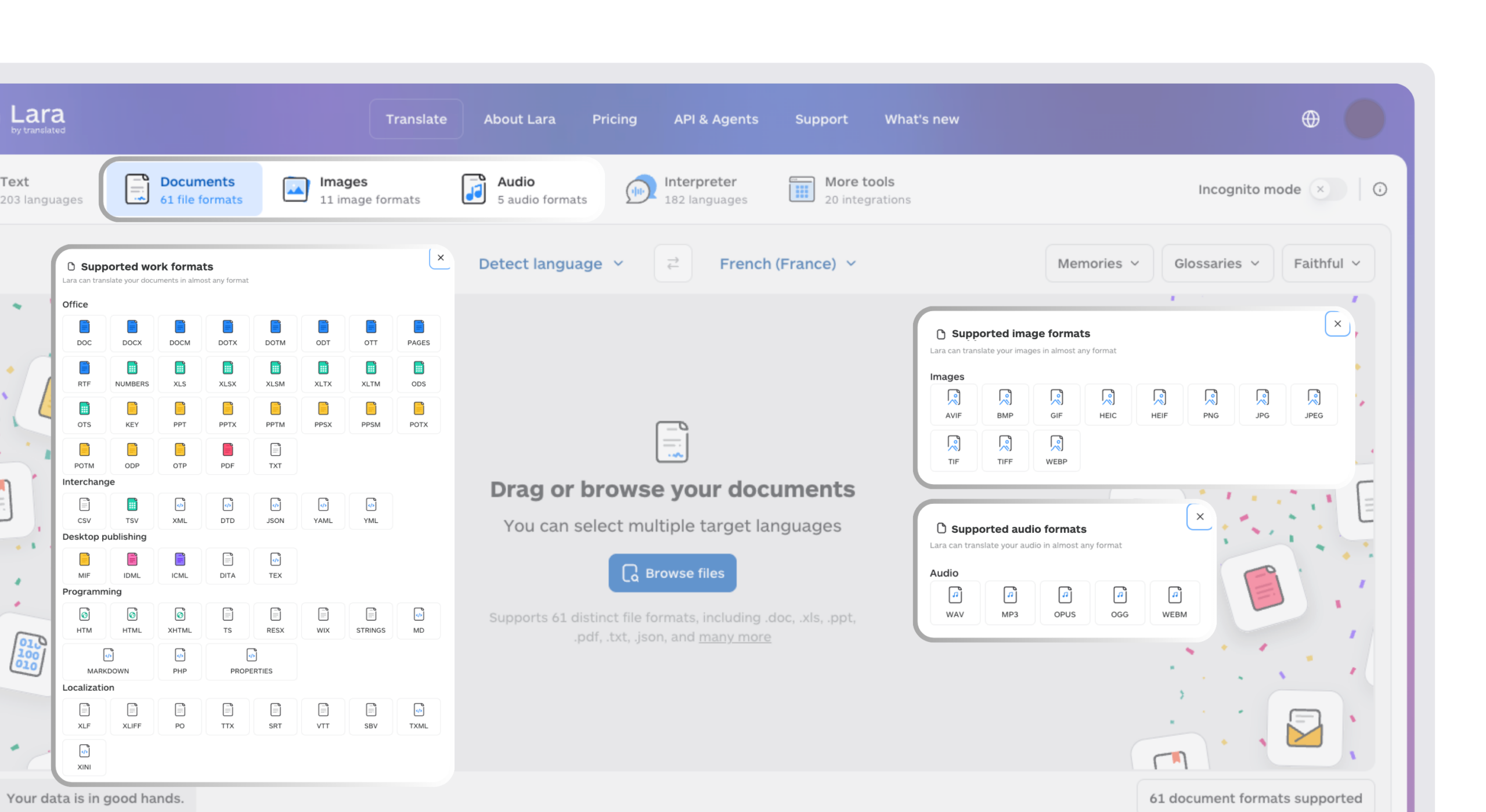
Lara Translate supports 200+ languages and 60+ file formats, with glossaries to help maintain terminology. Keep numerical validation in your analytics workflow and review translated interpretations before sharing them. Teams automating report distribution can use the Lara Translate API for a custom translation step where their reporting tools support it.
Keep report terminology consistent across languages
Use Lara Translate to prepare localized summaries and decks, then check metric names, figures, and qualifications before distribution.
Conclusion
The right AI data platform depends on how much internal engineering capacity you have, whether you want a composable stack or a single managed product, and whether your primary need is general business data or marketing-specific reporting. Whichever platform you choose, an accurate forecast only drives a decision if the person reading it can actually understand it.
Have a valuable tool, resource, or insight that could enhance one of our articles?
Send us an email at press@laratranslate.com
We’ll be happy to review it and consider it for inclusion to enrich our content for our readers! ✍️
Frequently asked questions
How do I choose the best AI data platform?
Start with your data sources, use cases, and internal capacity. Compare the work each platform handles with what your team must still build, then test data quality, governance, reporting, and AI outputs using a representative dataset.
What is the difference between a managed platform and a composable data stack?
A managed platform brings several capabilities and services under one offering. A composable stack combines specialist tools for ingestion, transformation, storage, and reporting. The trade-off is the control you gain over each component versus the integration and maintenance work you take on.
How much do AI data platforms cost in 2026?
Costs depend on data movement, compute, storage, users, connectors, and service scope. Free self-hosted software still requires infrastructure and maintenance, while managed plans may use consumption charges or fixed packages. Compare the total cost for the same workload, including implementation and reporting.
Do I need an internal data engineering team to use these platforms?
Not always, but every implementation needs someone responsible for data definitions, access, and output quality. Managed services can reduce engineering work. Custom pipelines and machine learning typically require more technical expertise, either internally or through a partner.
How can international teams use AI-generated reports in different languages?
Check native language support first, then translate the report text, summaries, and definitions your audience needs. Keep dates, units, currencies, and metric names consistent, and have a knowledgeable reviewer check that qualifications and conclusions retain their meaning.
How do I check whether AI-generated insights are reliable?
Compare outputs with trusted source data and known results. Check the underlying definitions, missing data, calculation logic, and time periods. For predictions, test performance against historical outcomes and monitor how accuracy changes after deployment.
This article is about
- How ingestion, transformation, storage, business intelligence, and AI fit into a data workflow
- The trade-offs between managed platforms and composable stacks
- How internal engineering capacity affects platform selection and maintenance
- Why connector coverage, governance, and output validation matter beyond feature lists
- How usage, capacity, connector, and service charges affect total ownership cost
- How translated reports and consistent terminology help multilingual teams use analytical findings
Useful links
- Best Global B2B and B2C Data Providers in 2026
- Translation Software Security: Protecting Sensitive Data in a Digital World
- Lara Translate: supported formats
- Lara Translate: document workflows and glossaries
- Lara Translate: translation API
This article was produced by the Lara Translate content team. Lara Translate is an AI translation platform built by Translated, with more than 25 years of professional translation experience. Businesses use Lara Translate to translate analytical summaries, business reports, and presentation decks, across 200+ languages and 60+ file formats.