

Picture a marketing team assembling a media plan and RFP response for a new campaign: pulling historical performance data, cross-referencing rate cards, and drafting proposal language from scratch. Agentic AI can help reduce this administrative work, giving marketers more time for strategy and creative decisions.
Agentic AI marketing platforms exist to automate these multi-step workflows autonomously, from media planning to campaign optimization to answer engine visibility, while keeping a human in the loop to review and approve outputs. This guide compares platforms in 2026, and closes with something that matters for any marketing or media team operating across borders: what happens to RFPs, proposals, and market research reports once a client or partner works in a language other than English.
|
TL;DR
|
What makes an agentic AI marketing platform worth using in 2026?
Fully autonomous execution and human-reviewed augmented intelligence represent different comfort levels with AI oversight. Albert.ai can run paid media largely on its own, while Kana emphasizes augmented intelligence, letting marketers review, approve, and refine AI-generated outputs before deployment.
CRM-native platforms and ecosystem-agnostic platforms serve different organizational realities. Salesforce Agentforce and HubSpot Breeze AI deliver the deepest integration for organizations already standardized on those specific CRMs, while Kana’s “loosely coupled” agents are built to integrate flexibly across whatever marketing and media systems a company already runs.
Specialized, single-function agents and broad, general-purpose platforms trade off depth against coverage. Persado focuses narrowly on emotion-optimized copy testing, while platforms like Kana and Tofu span multiple workflow types, from media planning to campaign personalization to proposal generation.
Founder pedigree and prior category-defining exits are a real signal in a crowded market. Kana’s co-founders previously built Rapt, acquired by Microsoft, and Krux, acquired by Salesforce for $700 million, giving the company a track record most seed-stage marketing AI startups don’t carry.
Document translation deserves its own workflow check. Ask whether a platform can translate complete RFPs, proposals, and research reports into the languages your clients use while preserving layout and terminology. Where the built-in features fall short, a dedicated translation tool can help.
Best agentic AI marketing platforms in 2026
| Platform | Best for | Model | Pricing |
|---|---|---|---|
| Albert.ai | Autonomous paid media management | Autonomous media buying agent | Custom, enterprise pricing |
| Salesforce Agentforce | Salesforce-native enterprises | CRM-native AI agent platform | Usage-based; product requirements apply |
| HubSpot Breeze AI | HubSpot-centric marketing teams | CRM-native AI agent platform | Subscription and credit-based usage |
| Kana | Flexible, customizable agents for marketers and media companies | Agentic marketing platform | Custom, contact sales |
| Couplero.io | AI analysis of cross-channel marketing data | Data integration and AI agent skills platform | Free plan; paid plans available |
| Tofu | B2B campaign personalization at scale | AI-native B2B marketing platform | Custom, contact sales |
| Persado | Emotion-optimized language and copy testing | AI language optimization platform | Custom, enterprise pricing |
| Jasper AI | AI content generation at scale | Marketing content and agent workflow platform | $59/seat/month annually or $69 monthly |
| Copy.ai | Automating go-to-market content workflows | AI content and workflow platform | Chat from $24/month annually; workflow plans separate |
| Smartly.io | Enterprise media-buying breadth across channels | Creative and media automation platform | Custom, enterprise pricing |
| Pixis | Enterprise media-buying breadth across channels | AI marketing infrastructure platform | Custom, contact sales |
Pricing checked September 24, 2026. Confirm billing terms, included usage, integrations, and optional features before purchasing.

Albert.ai
Best for: Enterprises wanting autonomous paid media management.
Albert.ai automates paid campaign optimization across supported search, social, and programmatic channels. Marketers supply objectives and creative assets, while the platform adjusts campaign activity and budgets. Confirm supported ad accounts, spending requirements, and oversight controls in a demo.
Pricing: Custom pricing; contact sales for a plan based on your requirements.
Verdict: Consider Albert.ai when autonomous paid media buying specifically, not broader marketing workflow automation, is the priority.
Salesforce Agentforce
Best for: Organizations already deeply standardized on Salesforce.
Salesforce Agentforce supports agents within the Salesforce ecosystem. Its marketing capabilities include campaign planning, content creation, and audience and journey workflows connected to customer data. Confirm the required marketing products, data setup, and agent entitlements for your deployment.
Pricing: Usage-based options include $500 per 100,000 Flex Credits or $2 per conversation for eligible use cases. Required Salesforce products and marketing capabilities can add costs; request a deployment-specific quote.
Verdict: Consider Salesforce Agentforce when native Salesforce integration outweighs the flexibility of a platform-agnostic alternative.
HubSpot Breeze AI
Best for: Organizations already deeply standardized on HubSpot.
HubSpot Breeze AI supports content creation, CRM tasks, and workflow automation within HubSpot. Its assistants and agents use the context already available in your CRM. Feature access and usage charges depend on the tools, seats, and subscription tier your team uses.
Pricing: Depends on your HubSpot subscription and feature usage. Some capabilities consume HubSpot Credits, with included allowances and additional credit charges.
Verdict: Consider HubSpot Breeze AI when native HubSpot integration outweighs the flexibility of an ecosystem-agnostic alternative.
Kana
Best for: Marketers and media companies wanting flexible, customizable agents rather than a one-size-fits-all suite.
Kana, founded in 2025 in San Francisco by Tom Chavez, Vivek Vaidya, and Jed Putterman, raised $15 million in seed funding led by Mayfield in February 2026, after an incubation period inside the AI-focused startup studio super{set}. Chavez and Vaidya previously co-founded Rapt, acquired by Microsoft in 2007, and Krux, acquired by Salesforce for $700 million in 2016. Kana deploys “loosely coupled” AI agents that integrate with existing marketing and media systems, covering media planning, real-time campaign optimization, RFP and proposal automation, synthetic data generation for market research and targeting, and answer engine optimization tools that help brands improve visibility in AI-generated responses. The company emphasizes augmented intelligence, requiring human review and approval of AI-generated outputs before deployment.
Pricing: Custom, contact sales.
Verdict: Consider Kana when flexible, customizable agents that integrate into an existing marketing stack matter more than adopting a single rigid platform, particularly for media planning and proposal work.
Coupler.io
Best for: Marketing teams that want AI agents to analyze live ad and campaign data from across their stack.
Coupler.io connects marketing data from ad platforms, analytics tools, CRMs, and ecommerce stores and makes it available to AI assistants such as Claude and ChatGPT. Its AI agent skills give agents repeatable workflows for PPC reporting, cross-channel performance reviews, and budget pacing, so marketers get answers from current data instead of manual exports. Teams keep their existing tools and review AI outputs before acting on them.
Pricing: Free plan available; paid plans on the Coupler.io pricing page.
Verdict: Consider Coupler.io when your agents need reliable, up-to-date marketing data from many sources rather than another standalone campaign tool.
Tofu
Best for: B2B marketing teams wanting campaign personalization at scale across multiple channels.
Tofu brings B2B campaign creation and personalization into a shared platform. Teams can repurpose source content for email, landing pages, ads, and social, then connect campaigns with their existing marketing and sales tools. Evaluate the channels and integrations needed for your account-based programs.
Pricing: Custom, contact sales.
Verdict: Consider Tofu when B2B campaign personalization across many channels simultaneously is the core workflow you need automated.
An RFP only wins the deal if the client can actually read it
Lara Translate helps marketing and media teams translate RFPs, proposals, and research reports across 200+ languages, so you can share the same core information with clients in their preferred language.
Persado
Best for: Large consumer-facing enterprises wanting emotion-optimized language testing at volume.
Persado applies its Motivation AI technology to marketing language, using audience response data and language attributes such as emotion and narrative to generate and test message variations. Its current offering also supports creative production for regulated brands. Assess the specific content channels and review workflow you need.
Pricing: Contact sales for enterprise pricing and scope.
Verdict: Consider Persado when language and messaging optimization specifically, not broader campaign workflow automation, is the priority.

Jasper AI
Best for: Teams wanting AI content generation at scale with brand consistency.
Jasper AI supports on-brand marketing content and agent-driven workflows. Its Pro plan covers core marketing workflows, while Business adds capabilities such as custom agents, broader brand controls, and scaled content execution. Compare the available workflow features alongside content quality and brand consistency.
Pricing: Pro: $59 per seat/month billed annually, or $69 per seat/month billed monthly. Business: custom pricing.
Verdict: Consider Jasper AI when on-brand content production and reusable marketing workflows are central to your needs.
Copy.ai
Best for: Teams wanting to automate go-to-market content workflows specifically.
Copy.ai automates multi-step go-to-market workflows, combining tasks such as research, content creation, personalization, and data enrichment. Its workflow tools serve sales and marketing teams that need repeatable processes across their funnel. Match your required integrations and workflow volume to the appropriate plan.
Pricing: Chat: $29/month, or $24/month billed annually. The Growth workflow plan lists $1,000/month billed annually; Enterprise pricing is custom. Confirm the workflow credits and features required for your use case.
Verdict: Consider Copy.ai when go-to-market content workflow automation, rather than broader campaign management, is the priority.
Smartly.io
Best for: Enterprise teams running media at scale across many advertising channels.
Smartly.io combines creative production, campaign management, and reporting across supported advertising channels. Its automation helps teams produce ad variants and coordinate media activity from a shared platform. Check the supported channels and approval workflow against your media plan.
Pricing: Custom, enterprise pricing.
Verdict: Consider Smartly.io when enterprise-scale media buying breadth across many channels matters more than a narrower, more specialized tool.
Pixis
Best for: Enterprise teams wanting AI marketing infrastructure with broad channel coverage.
Pixis provides AI tools for creative production, audience targeting, and performance optimization. Its Prism interface brings agents into campaign analysis and execution workflows. Ask for a demonstration using your actual ad channels, reporting needs, and budget controls.
Pricing: Custom, contact sales.
Verdict: Consider Pixis when broad AI marketing infrastructure across many channels fits your enterprise scale better than a narrower point solution.
How to choose the right agentic AI marketing platform
Step 1: Decide how much autonomy you’re comfortable granting. Albert.ai can run paid media with limited oversight; Kana emphasizes human review and approval before any AI-generated output deploys.
Step 2: Confirm ecosystem fit before committing. Salesforce Agentforce and HubSpot Breeze AI suit organizations already standardized on those CRMs; Kana’s flexible, “loosely coupled” agents suit teams running a mix of marketing and media systems.
Step 3: Match platform scope to your actual bottleneck. Persado and Jasper AI specialize narrowly in copy and content; Kana and Tofu span broader workflows including media planning and proposal automation.
Step 4: Weigh vendor track record, especially at the seed stage. Founder pedigree, like Kana’s founders’ prior exits to Microsoft and Salesforce, is a reasonable signal when evaluating a newer entrant in a crowded category.
Step 5: Plan for translating the documents your team produces for international partners. A dedicated translation tool can help translate RFPs, proposals, and market research reports accurately, so language doesn’t undercut work these platforms already help you produce faster.
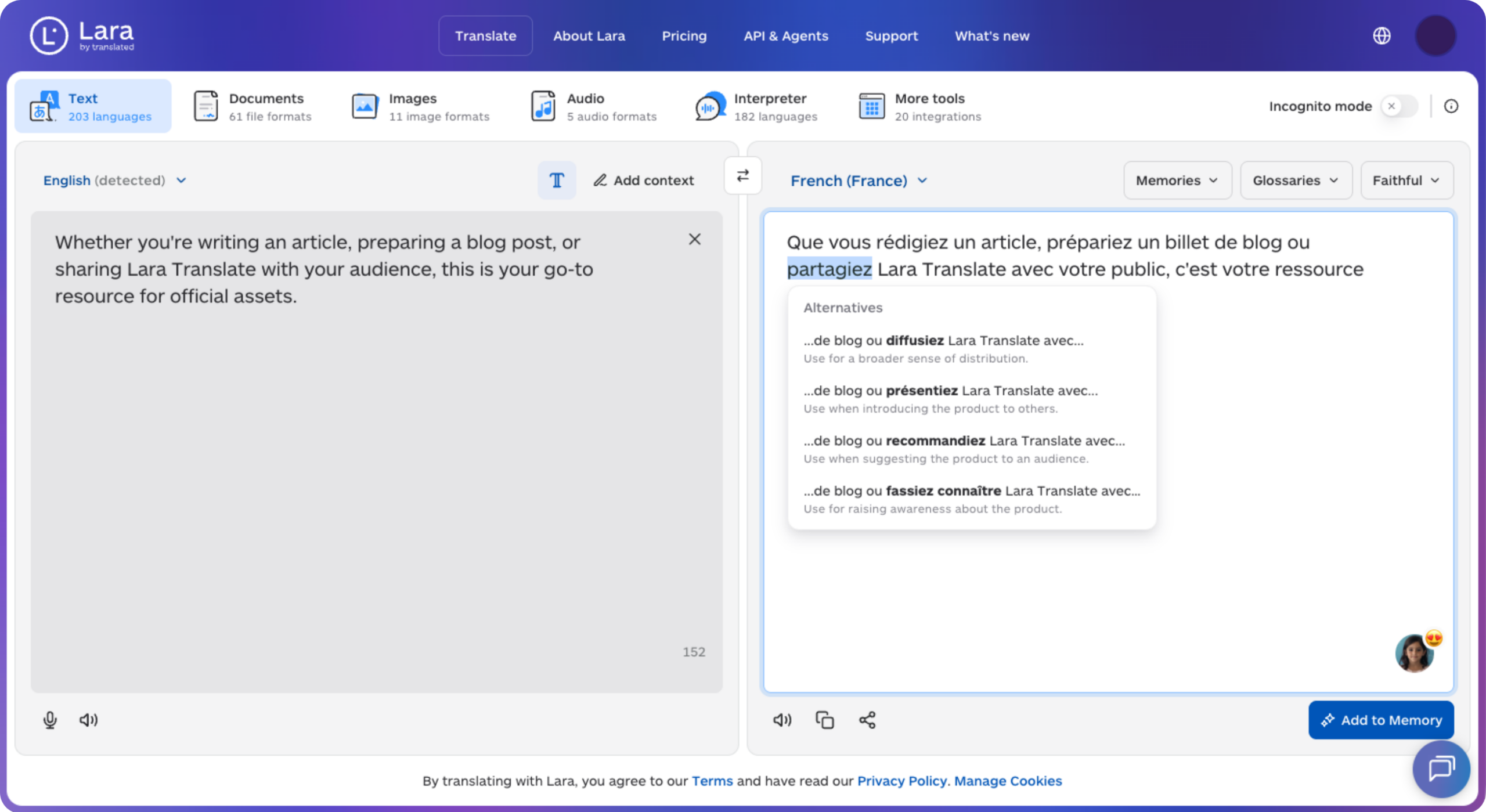
Lara Translate supports document translation across 200+ languages and 60+ file formats. Use a dedicated translation step when your chosen marketing platform does not meet the document, language, or formatting needs of an international proposal.
Win the pitch in every market you operate in
Whichever platform above powers your marketing operation, Lara Translate can help translate RFPs, proposals, and research reports accurately across 200+ languages.
Conclusion
The right agentic AI marketing platform depends on how much autonomy you want to grant, which specific workflow is actually your bottleneck, and how deeply you’re already committed to a particular CRM ecosystem. Whichever platform you choose, the proposal or campaign material it helps you produce faster still needs to land clearly with whoever’s reading it, wherever they are.
Have a valuable tool, resource, or insight that could enhance one of our articles?
Send us an email at press@laratranslate.com
We’ll be happy to review it and consider it for inclusion to enrich our content for our readers! ✍️
Frequently asked questions
What is the best agentic AI marketing platform in 2026?
It depends on your priorities. Albert.ai focuses on autonomous paid media buying. Salesforce Agentforce and HubSpot Breeze AI suit organizations standardized on those CRMs. Kana leads for marketers and media companies wanting flexible, customizable agents, particularly for media planning and RFP automation.
What’s the difference between Kana and a CRM-native platform like Salesforce Agentforce?
Salesforce Agentforce and HubSpot Breeze AI are built natively into their respective CRM ecosystems, offering the deepest integration for organizations already standardized on those platforms. Kana instead builds “loosely coupled” agents designed to integrate flexibly across whatever marketing and media systems a company already runs, without requiring a single-vendor commitment.
How much do agentic AI marketing platforms cost in 2026?
Pricing ranges from subscriptions to usage-based fees and custom quotes. Jasper AI Pro costs $59 per seat/month billed annually or $69 billed monthly. Copy.ai distinguishes its Chat subscription from workflow plans. Salesforce Agentforce and some HubSpot features use consumption-based pricing, so compare the total cost at your expected workload.
Do agentic AI marketing platforms replace marketers?
No. Most platforms in this category, including Kana, explicitly emphasize augmented intelligence, requiring human review and approval of AI-generated outputs before deployment, rather than removing marketers from strategic and creative decisions entirely.
Why does language matter for agentic marketing platforms beyond ad creative translation?
International clients may need translated RFPs, proposals, and research reports as well as localized ad creative. Check whether the platform supports your document formats, target languages, and review process. Lara Translate can help translate these documents where a separate translation workflow is needed.
Should a marketing team choose a broad platform or specialized single-function tools?
It depends on how fragmented your current stack already is. A broader platform like Kana or Tofu can reduce the “tool soup” problem many marketing teams face. Specialized tools like Persado for language optimization or Jasper for content generation can outperform broader platforms in their specific niche, at the cost of adding another point solution to manage.
This article is about
- Agentic AI marketing platforms split into CRM-native agents, flexible cross-system platforms, and specialized single-function tools, and most marketing teams end up combining more than one
- Kana differentiates itself with “loosely coupled” customizable agents built specifically for marketers and media companies, backed by $15 million in seed funding and founders with prior exits to Microsoft and Salesforce
- Albert.ai focuses on autonomous paid media management across supported channels.
- Salesforce Agentforce and HubSpot Breeze AI connect agent workflows with their respective CRM ecosystems.
- Augmented intelligence, requiring human review before deployment, is a deliberate design choice for platforms like Kana, not a limitation
- RFPs, proposals, and market research reports for international media buys require accurate translation, separate from any multi-language ad creative capabilities these platforms already offer
Useful links
- How Agentic AI is Revolutionizing Localization
- Introducing Lara 3: Translation AI That Learns by Doing
- Lara Translate: language and document capabilities
- Lara Translate: supported file formats
This article was produced by the Lara Translate content team. Lara Translate is an AI translation platform built by Translated, with more than 25 years of professional translation experience. Marketing and media teams use Lara Translate to translate RFPs, proposals, and research reports accurately, across 200+ languages and 60+ file formats.