

A mistranslated checkout label can trigger abandoned carts, refunds, and support tickets before anyone on the localization team sees the problem. Translation quality assurance (TQA) reduces that risk by combining prevention, automated checks, and human review across four dimensions: linguistic, visual, functional, and cultural. Done well, it catches mistranslations, tone drift, and cultural missteps before they reach users.
TL;DR
|
What Does Translation Quality Assurance Actually Cover?
Three terms get used almost interchangeably, and that sloppiness causes real confusion on localization teams. TQA (translation quality assurance) is the umbrella term for the whole discipline: policies, checks, and review stages that keep translated output reliable. TQC (translation quality control) usually refers to the checkpoints themselves, the specific gates content passes through. LQA (linguistic quality assurance) is narrower still: a scored evaluation, often run against the live product build rather than a spreadsheet of text strings.
A mature program checks four dimensions, and skipping any one of them is how obvious errors slip into production:
- Linguistic: grammar, terminology accuracy, register, and whether the translation reads naturally rather than sounding lifted from a dictionary.
- Visual: does the translated text fit the UI, or does German (notoriously long) truncate a button label?
- Functional: do locale-specific date formats, currency symbols, and form validations actually work after translation?
- Cultural: does an image, idiom, or color choice land the way it was intended, or does it misfire in the target market?
Marketing copy and legal disclaimers lean hardest on the linguistic and cultural dimensions. Mobile apps and e-commerce checkout flows live or die on the visual and functional ones. A complete TQA program tests all four, not just the one your last incident happened to expose.
How Do You Build a TQA Process From Scratch?
Treat quality assurance as three phases, not one inspection at the end. Errors caught during prevention cost almost nothing to fix; errors caught after launch cost a support ticket, a refund, or a bad review.
- Prevention. Lock down scope before translation starts. A style guide settles tone and formality; a glossary settles terminology so “cancel” does not become three different words across five screens; a translation memory (TM) reuses previously approved segments so translators aren’t reinventing sentences you already paid to get right.
- Detection. Configure your translation management system (TMS) to run automated checks on every submission: placeholder and tag validation, length limits, number and date format consistency, and terminology enforcement against the glossary. These catch mechanical errors instantly, before a human ever opens the file.
- Validation. Route flagged segments for human review, run a linguistic quality assurance (LQA) pass on the actual build, and finish with a cross-functional sign-off that includes someone outside the localization team.
Routing thresholds matter here. A common approach: machine translation (MT) output scoring above a set quality estimation (QE) confidence band gets auto-approved for low-stakes content; anything below it, or anything touching checkout, legal, or medical text, goes to a human translator regardless of score. Many teams sample 10 to 20% of high-volume, low-risk content for spot-checks rather than reviewing every segment, reserving full human review for content where an error is expensive.
What Tools and Metrics Actually Measure Quality?
A translation management system does the heavy lifting that used to require a full-time proofreader just to catch typos. Look for these features when evaluating one:
- Automated QA checks for tags, placeholders, and length limits
- Shared translation memory across projects and vendors
- Glossary and terminology management with enforcement, not just suggestion
- Built-in LQA modules for structured, in-context scoring
Pro Tip: Configure QA checks to fire at submission, not just before publishing. Catching a broken placeholder tag the moment a translator submits it saves an entire review cycle.
Quality estimation (QE) scoring gives MT output a confidence number, which lets you route low-confidence segments to human review automatically while letting high-confidence segments pass through untouched. For human-reviewed content, the Multidimensional Quality Metrics (MQM) framework categorizes errors by type (accuracy, fluency, terminology, style) and severity (minor, major, critical), producing a single comparable score across languages and vendors.
Track three KPIs consistently: MQM score per locale, error density (errors per thousand words), and average time to fix a flagged issue. A team that only tracks the first number misses whether their process is actually getting faster.
Keep approved terminology consistent
Use a glossary and translation memory before review begins, then reserve human attention for higher-risk content.
Is LQA the Same as Proofreading?
No, and treating them as interchangeable is one of the most common budget mistakes localization teams make. Proofreading is a platform-level text review, usually done in a spreadsheet or translation editor, checking grammar and flow in isolation. LQA is evaluated against the live build, the actual app screen or web page, where a linguist can see whether a translated label actually fits the button.
Proofreading is often sufficient for long-form static content like help articles, blog posts, and marketing PDFs, as well as internal documentation without UI constraints. LQA is highly recommended for checkout and payment flows, legal disclosures and consent screens, and sign-up and onboarding flows. A practical approach is to run full LQA on every release for checkout and legal content, and sample a portion of other UI strings per release cycle, weighted toward screens with the highest traffic. Proofreading remains cheaper per word, but skipping LQA on a checkout flow to save budget is the kind of decision that shows up in a refund queue within a month.
How Do You Run Visual and Functional Checks?
Visual checks look for truncation, text overflow, and right-to-left (RTL) layout breaks, the kind of bug that only appears once real translated strings replace English placeholder text. Functional checks verify that form validation, date pickers, and currency formatting behave correctly once locale settings change, not just that the words are right.
Every issue found should land in a structured LQA report your team can actually act on:
| Field | Purpose |
|---|---|
| Location | Screen, screen ID, or URL where the issue appears |
| Severity | Minor, major, or critical, using a consistent scale |
| Current text | What the build currently shows |
| Proposed fix | The corrected translation or layout adjustment |
| Screenshot | Visual proof, especially for truncation or overflow |
| Status | Open, assigned, fixed, verified |
Route linguistic fixes (wrong terminology, awkward phrasing) to linguists, and layout fixes (overflow, broken RTL mirroring) to engineers. Production LQA reports built this way turn a pile of screenshots into a triage queue instead of a group chat argument about who owns the bug.
Who Should Own Quality, and How Do You Measure ROI?
Four roles cover most TQA programs without creating a bottleneck: a localization manager who owns the overall process, a QA linguist who executes reviews and LQA passes, a project manager who tracks timelines and vendor SLAs, and an engineering liaison who fixes layout and functional bugs flagged during testing.
Governance runs on a small set of artifacts, and skipping any one of them creates the exact inconsistency TQA exists to prevent:
- A living style guide, updated after every major dispute
- A glossary enforced by the TMS, not just referenced by it
- Service-level agreements (SLAs) with vendors specifying turnaround and revision cycles
- An agreed MQM passing threshold below which content does not ship
Pro Tip: Run quarterly calibration sessions where linguists score the same sample segments independently, then compare results. Disagreement on severity ratings is normal at first; if it persists after three sessions, your scoring rubric needs rewriting, not your linguists.
ROI shows up in numbers finance teams actually care about: cost per error caught pre-launch versus post-launch, reduction in customer support tickets tagged as translation-related, and protected conversion rate on translated checkout flows. A structured LQA schema turns quality from opinion into trackable data, which is what lets you make that ROI case to a budget committee instead of just asserting it.
Where AI and Human Validation Fit Together
Machine translation with QE scoring handles the bulk of routine, low-risk content, freeing linguists to focus on checkout copy, legal text, and anything culturally sensitive. Platforms built around this pairing typically support the core prevention and detection layers directly:
- Shared glossaries and translation memory that stay consistent across every file
- Bulk file handling for high-volume content across more than 60 document formats
- Human validation by professional linguists layered on top of MT output for anything that needs judgment, not just fluency
How Do You Collect Feedback and Prove ROI Over Time?
Feedback has to come from three places, not one, or you end up optimizing for the wrong signal. Internal reviewers (linguists, QA leads) catch linguistic and cultural issues before launch. Customer support tickets tagged by locale reveal what actually confused real users, which is often not what internal reviewers flagged. End-user surveys, even a simple post-purchase language satisfaction question, catch tone problems that pass every automated check but still feel “off” to a native speaker.
Build a feedback loop with a fixed cadence rather than an ad hoc one. Weekly, route flagged segments and support tickets back to the linguists or vendors responsible. Monthly, review error density trends by locale, not just the aggregate number, since one underperforming language pair can hide inside a healthy overall average. Quarterly, recalibrate your MQM threshold if error density in a specific category (terminology, say) stays elevated despite fixes, that’s usually a glossary problem, not a translator problem.
Measuring ROI means comparing the cost of catching an error before launch against the cost of catching it after. A terminology error caught in an automated QA check costs a few minutes of a linguist’s time. The same error live in a checkout flow costs a support ticket, possibly a refund, and reputational damage that does not show up on any invoice. Track cost-per-error-by-stage for two or three release cycles and the case for investing in earlier detection tends to make itself. Support ticket volume tagged by language is the single most persuasive number to bring to a budget conversation, because it connects translation quality directly to a cost the business already tracks.

How Should TQA Adapt Across Different Workflows?
A TQA process that works for a quarterly marketing campaign will strangle a continuous deployment pipeline shipping five times a day. The dimensions stay the same; the cadence and automation level don’t.
For continuous localization (agile product teams shipping frequently), automate as much detection as possible. Every string submission should hit TMS QA checks immediately, with QE routing deciding what needs human eyes. Manual LQA passes happen on a fixed schedule (weekly or per major release), not per string, or your linguists become a bottleneck for every deploy.
For campaign-based localization (marketing pushes, seasonal content), front-load review. There’s no continuous pipeline to catch issues after the fact, so a single LQA pass before launch has to catch everything, including cultural fit for the specific campaign concept, which automated checks can’t evaluate at all.
For enterprise multi-brand localization, the biggest risk isn’t translation quality itself, it’s inconsistency between brands sharing a glossary that no longer fits every product line. Governance matters more than any single QA check here: separate glossary namespaces per brand, shared TM only where terminology genuinely overlaps.
Whatever the workflow, structuring source content well before translation reduces the error rate downstream more reliably than any amount of post-translation checking. Ambiguous source phrasing produces ambiguous translations no matter how good your QA process is; fixing that upstream is cheaper than catching it downstream, every time.
What Do Successful TQA Programs Actually Look Like?
The pattern across teams that get TQA right isn’t a specific tool. It’s sequencing: prevention artifacts built before the first word is translated, automated detection catching mechanical errors at scale, and human review reserved for judgment calls machines can’t make.
A software company scaling from three languages to fifteen typically hits the same wall: their original process (a bilingual reviewer reading every string) worked at three languages and collapses at fifteen, because review time scales linearly with language count while headcount does not. The fix isn’t hiring fifteen reviewers. It’s building a glossary and TM robust enough that QE scoring can auto-approve the majority of routine strings, reserving human review for the checkout flow, legal text, and anything scoring below the confidence threshold. Error density typically drops fastest in the first two release cycles after this shift, simply because the glossary catches terminology drift that used to require a human to notice.
An e-commerce team expanding into a new region often discovers the opposite failure: perfectly grammatical translations that still cause a spike in abandoned checkouts, because a currency format or a culturally loaded product image didn’t match local buying norms. That’s a cultural and functional dimension failure that a linguistic-only review would never have caught, which is exactly why the four-dimension model matters more in practice than it sounds in theory.
The common thread: programs that treat visual and functional testing as equal partners to linguistic review outperform ones that treat translation as a purely linguistic problem.
How Do You Train a TQA Team?
Linguists doing LQA work need a different skill set than translators doing first-pass translation, and treating them as interchangeable is a common early mistake. A strong LQA reviewer needs three specific competencies: fluency in the MQM (or equivalent) scoring schema so severity ratings stay consistent across reviewers, familiarity with the actual product (not just the text) so they can judge whether a translation works in context, and enough technical literacy to file a bug report an engineer can act on without a follow-up meeting.
Build training around calibration, not lectures. New reviewers should score the same sample set an experienced reviewer already scored, then compare results and discuss every disagreement. Two or three rounds of this closes most consistency gaps faster than any written guideline. For teams onboarding into a new domain (legal, medical, technical documentation), pair calibration sessions with a domain-specific glossary review before the reviewer touches live content.
Ongoing skill development matters as much as onboarding. Quarterly refreshers on updated style guide decisions, review of the highest-severity errors caught that quarter, and rotation through different content types (marketing copy one quarter, UI strings the next) keep reviewers sharp and prevent the kind of tunnel vision that comes from reviewing the same content type for a year straight.
What Tools Keep a TQA Team Coordinated?
Quality assurance breaks down fastest at handoffs, not during the actual review work. The moment a flagged issue has to move from a linguist to a project manager to an engineer, something gets lost unless the workflow is built to prevent it.
A shared TMS with built-in commenting keeps linguistic discussion attached to the actual string, rather than scattered across email threads that nobody can search six months later. Issue trackers (the same ones engineering already uses) work better for functional and visual bugs than a spreadsheet, because they integrate with the sprint the fix actually needs to land in. A shared glossary and style guide platform, updated in real time rather than as a quarterly PDF, keeps every reviewer working from the same terminology instead of relearning decisions that already got made.
For teams running frequent releases, a dedicated LQA dashboard tracking MQM scores, error density, and open issue counts by locale gives a localization manager a single view instead of five disconnected spreadsheets. For functional bugs that need engineering hands, dedicated QA and testing services can supplement an internal team during a major expansion, particularly when visual and functional testing volume temporarily outpaces internal engineering capacity.
A Working Note on Priorities and Pitfalls
Three things matter more than the rest: define scope before you translate a single word, protect checkout and legal flows with mandatory LQA, and set an MQM threshold before you need one in an argument. The most common mistake is treating a glossary as optional. This week: audit your top five error categories, check if a missing glossary term explains two of them, and set your first passing threshold.
How Lara Translate Fits a Modern TQA Workflow
Lara Translate supports several prevention and translation stages in a modern TQA program. Teams can use glossaries and translation memories to guide terminology, translate text and files in more than 60 document formats, and process 11 image formats and 5 audio formats. For sensitive or business-critical content, they can add professional human validation to the AI output. In-context visual and functional LQA still belongs in the product testing workflow.
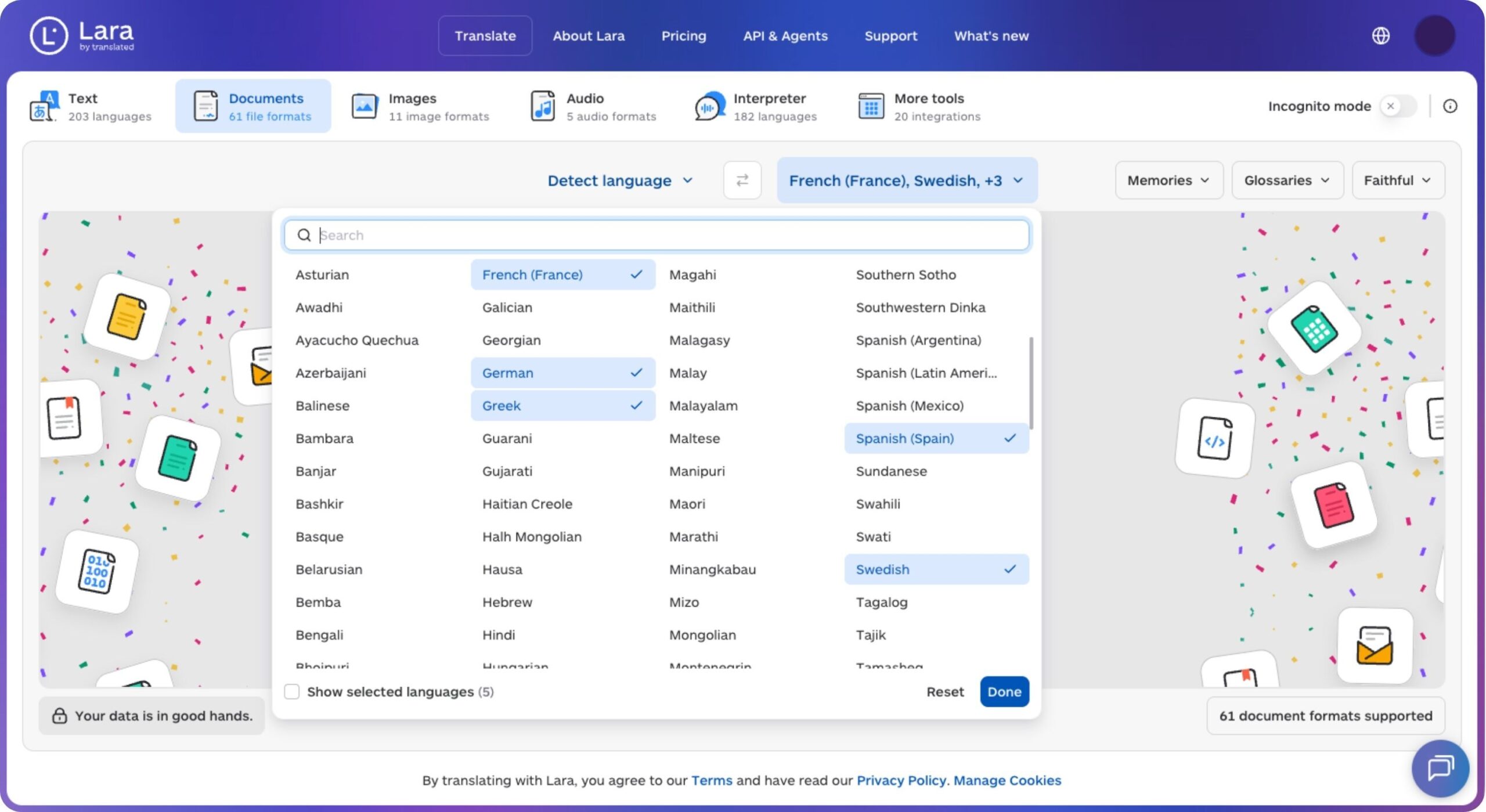
If checkout copy, legal disclosures, or a growing language list are stretching your review capacity thin, translating to and from English with Lara Translate is a reasonable place to test the workflow. Developers can also review the Lara Translate API documentation to connect translation to an existing localization pipeline.
Add human review where risk is highest
Translate routine content with AI, then request professional validation for legal, checkout, financial, or other sensitive material.
Key Standards and Practical Implementation Docs
- ISO 17100:2015 specifies requirements for the core processes and resources used to deliver quality translation services. Raw machine translation plus post-editing is outside its scope.
Conclusion
Effective translation quality assurance starts before translation and continues through the live experience. Define terminology and risk thresholds first, automate repeatable checks, reserve human review for judgment-heavy content, and test the final interface. Measure the process by locale so recurring terminology, usability, and ownership problems become visible early.
Have a valuable tool, resource, or insight that could enhance one of our articles?
Send us an email at press@laratranslate.com
We’ll be happy to review it and consider it for inclusion to enrich our content for our readers! ✍️
FAQ
What Is Translation Quality Assurance?
Translation quality assurance is the combination of prevention, automated detection, and human validation that keeps translated content accurate, consistent, and appropriate for its target audience across linguistic, visual, functional, and cultural dimensions.
What Does QA Mean in Translation?
In translation, QA refers to the automated and manual checks (terminology enforcement, tag validation, length limits, human review) that catch errors before content ships, distinct from the broader quality assurance program that governs the whole process.
What Is QC in Translation?
Translation quality control (TQC) refers to the specific checkpoints and gates content passes through during production, the concrete inspection steps that sit inside the larger translation quality assurance framework.
Do I Need LQA if I Already Proofread My Content?
Yes, for anything users interact with directly. Proofreading catches grammar and flow at the text level, but LQA evaluates the actual build, catching truncation, layout breaks, and functional errors that only appear once translated text is live.
What MQM Score Counts as Passing?
There’s no universal number since thresholds vary by content risk, but teams commonly set a stricter threshold for checkout and legal content than for internal documentation, using severity-weighted scoring from the MQM framework to decide.
This article is about: translation quality assurance, translation quality control, linguistic quality assurance, MQM scoring, automated translation checks, human validation, and localization ROI.
Sources
- What Is Translation Quality Assurance? | Kent State University MCLS
- ISO 17100:2015, Translation services requirements
Recommended
- Localization Quality Assurance: A Practical Guide
- AI Translation Quality Assurance Guide
- 7 signals of a broken translation process
- Machine translation mistakes (and how to fix them)