

A nurse photographs a wound during one visit, and another clinician documents it at the next. Differences in image angle, measurement technique, and record-keeping can make those assessments difficult to compare. A consistent capture and documentation workflow gives the team a clearer record to review over time.
AI wound care documentation and imaging platforms support image capture, measurement, and clinical records in different ways. This guide compares measurement methods, EHR connectivity, care settings, and purchasing considerations, alongside a practical approach to translating the materials that accompany care. Some products combine AI features with wider imaging or documentation tools; capabilities depend on the selected configuration.
|
TL;DR
|
What makes wound care documentation software worth using?
Measurement method: Surface area, depth, volume, and thermal data describe different aspects of an assessment. Confirm which outputs the proposed device and software configuration actually provide, and how clinicians validate wound boundaries and measurements.
Fit with the care setting: A hospital network, home health service, research team, and dedicated wound care center may need different workflows. Test image capture, patient matching, longitudinal review, and reporting in the intended setting.
Evidence behind the claims: Ask for the study behind each accuracy or outcome claim. Check the wound types, reference method, sample size, software version, and whether results concern measurement agreement or patient outcomes. Those measures answer different questions.
EHR integration: Ask vendors to demonstrate the connection to your EHR version, including images, measurements, notes, and patient identifiers. A listed integration does not establish that every required field or workflow is supported in your deployment.
Language support needs its own evaluation. Pixacare’s platform interface is published in a handful of languages. For any platform, evaluate interface languages separately from translated patient education, referral materials, and clinical documentation. An English-language website alone does not establish that a product is English-only.
Wound care documentation platforms compared
| Platform | Best for | Measurement approach | Pricing |
|---|---|---|---|
| Swift Medical | Shared wound imaging and analytics | Digital imaging and AI-assisted assessment | Contact sales |
| Tissue Analytics (Net Health) | EHR-connected wound documentation | Computer vision and tissue analysis | Contact sales |
| ARANZ Medical (Silhouette) | 3D wound measurement | Laser-based 3D measurement with SilhouetteStar | Contact sales |
| WoundZoom | Mobile capture and EHR synchronization | Digital wound imaging and measurement | Contact sales |
| eKare | Imaging and remote monitoring | inSight imaging; confirm device configuration | Contact sales |
| Pixacare | Remote wound monitoring across a multilingual platform interface | AI-powered 2D image analysis with tissue classification | Free, Independent, and Organizations tiers, contact sales for full pricing |
| Healogics WoundSuite | Dedicated wound care center workflows | Documentation and digital measurement suite | Contact sales |
| WoundVision | Visual and thermal assessment | Digital and long-wave infrared imaging | Contact sales |
Request deployment-specific quotes covering devices, licenses, integrations, onboarding, and support. Confirm the exact measurement and AI modules included.
Wound imaging and documentation platforms
Swift Medical
Best for: Health systems wanting shared wound imaging, documentation, and analytics.
Swift Medical provides digital wound imaging and assessment tools, with a portal for reviewing wound data across care teams. Its platform brings images and assessments together to support longitudinal review and operational reporting. Ask for evidence relevant to your intended setting and the specific capabilities included in the proposed configuration.
Pricing: Contact sales for a quote based on the selected configuration and deployment.
Verdict: Consider Swift Medical when centralized wound data and team-wide visibility are priorities.
Tissue Analytics (Net Health)
Best for: Health systems wanting wound imaging connected to EHR workflows.
Tissue Analytics, part of Net Health, uses machine learning and computer vision for wound measurement and tissue analysis. Its features include circumferential imaging, clinical dashboards, and EHR connectivity. Net Health also describes an offline workflow with WoundExpert that synchronizes captured information when connectivity returns.
Pricing: Contact sales for a quote based on the selected configuration and deployment.
Verdict: Consider Tissue Analytics when wound imaging needs to fit into an established EHR documentation workflow.
ARANZ Medical (Silhouette)
Best for: Clinical and research teams needing 3D wound measurement.
ARANZ Medical’s Silhouette system combines imaging, measurement, and documentation. The SilhouetteStar camera uses laser data to model the visible wound surface, with software calculating area, depth, and volume after the user traces the wound edges. SilhouetteCentral consolidates records and can share data with EHR systems. Confirm the device and measurement mode required for your use case.
Pricing: Contact sales for a quote based on the selected configuration and deployment.
Verdict: Consider Silhouette when 3D measurement and longitudinal wound records are central requirements.
WoundZoom
Best for: Care teams wanting mobile bedside documentation and EHR synchronization.
WoundZoom supports capture, measurement, and documentation on a mobile device, with completed records synchronized to the EHR. It lists HL7 and FHIR interoperability and connections to multiple EHR systems. Offline assessments can synchronize when connectivity returns; confirm the supported workflow with your own system.
Pricing: Contact sales for a quote based on the selected configuration and deployment.
Verdict: Consider WoundZoom when mobile capture and connected documentation are central to the workflow.
Make patient education easier to review across languages
Use Lara Translate to prepare translations of approved educational materials, then have qualified reviewers check clinical meaning and patient readability.
eKare
Best for: Organizations wanting wound imaging paired with remote monitoring and eVisits.
eKare combines inSight wound imaging with documentation, remote monitoring, and eVisit capabilities. It offers SMART on FHIR and RESTful interfaces and lists integrations including Epic and Cerner. Its inSight materials describe 3D measurements; confirm depth and volume support on the specific device and software configuration being purchased.
Pricing: Contact sales for a quote based on the selected configuration and deployment.
Verdict: Consider eKare when imaging belongs within a broader remote monitoring workflow.
Pixacare
Best for: Care teams wanting wound imaging combined with broader remote monitoring across a platform already available in several languages
Pixacare is a CE-certified medical photography and AI platform for wound documentation and remote monitoring, combining a photo library with automatic classification, AI-powered measurement and tissue analysis, questionnaires, and messaging between patients, caregivers, and care teams.
Notable strength: AI accuracy validated at 0.96 ICC for surface measurement, offline capture with EHR sync, and a platform interface already published in English, French, German, and Spanish, broader language coverage than most competitors in this comparison offer
Pricing: Free tier for a single user; Independent plan for solo clinicians; Organizations plan with tiered licensing for hospitals, clinics, and home healthcare; contact sales for exact quotes
Known limitation: The platform interface currently covers a handful of languages rather than the full range a hospital’s patient population or referring clinicians may need, so care teams serving patients outside English, French, German, or Spanish still need a separate solution for that documentation and communication
Scale: Used across 70-plus hospital and clinic institutions, with more than 250,000 patients monitored and 2 million-plus documented lesions
Verdict: Consider Pixacare when remote wound monitoring, patient messaging, and a platform interface already published beyond English matter alongside AI-powered measurement.
Healogics WoundSuite
Best for: Dedicated wound care centers wanting documentation and clinical workflow tools.
Healogics WoundSuite combines i-heal documentation, Healogics Photo+ digital wound measurement, and clinical process optimization. The suite is designed for Wound Care Centers and connects documentation with operational needs such as claims and care coordination. Confirm the modules and deployment arrangement included in the proposal.
Pricing: Contact sales for a quote based on the selected configuration and deployment.
Verdict: Consider Healogics WoundSuite when a dedicated wound care center needs an integrated documentation and operational workflow.
WoundVision
Best for: Facilities wanting visual imaging alongside thermal measurements.
WoundVision’s Scout combines digital photography with long-wave infrared imaging. Its FDA-cleared indications cover recording visual measurements and thermal intensity data as an adjunctive tool for trained healthcare professionals. Scout does not provide a diagnosis or therapy. Its intended settings extend beyond dedicated wound care centers.
Pricing: Contact sales for a quote based on the selected configuration and deployment.
Verdict: Consider WoundVision when thermal data alongside visual wound measurement is a specific requirement.
How to choose the right wound care documentation platform
Define the required measurements: Specify whether the workflow needs surface area, depth, volume, tissue analysis, or thermal information. Check the supported hardware and the conditions under which each measurement is valid.
Test the EHR workflow: Run a representative assessment through capture, patient matching, synchronization, review, and export. Include offline use if clinicians work with unreliable connectivity.
Examine the evidence: Compare measurement validation separately from clinical outcome studies. Ask whether results apply to your wound types, users, and clinical setting.
Compare the complete deployment cost: Include devices, subscriptions, integrations, onboarding, training, and ongoing support. Confirm ownership and export of records when the contract ends.
Plan multilingual communication: Identify which patient education and referral materials require translation, who reviews them, and how revised source documents trigger updates to every language version.
Connecting Lara Translate to the documentation workflow
Lara Translate can support a separate translation step for approved patient education, referral templates, and other written materials that accompany wound care. Export a supported document, translate it, and have a qualified reviewer check clinical meaning, instructions, and readability before publication or use. For patient-specific documents, use only an organization-approved workflow with appropriate data-handling arrangements.
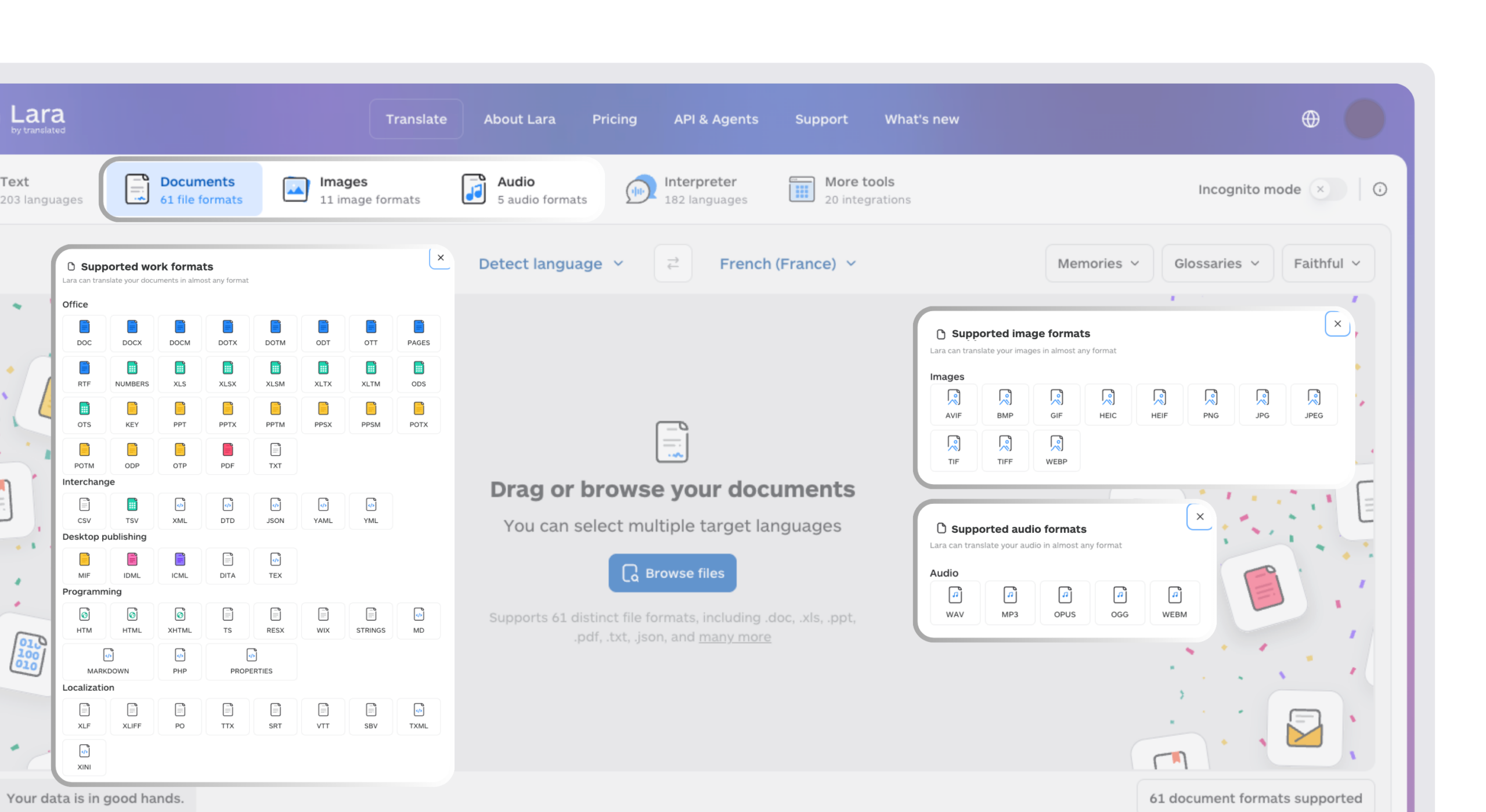
A technical team can connect the Lara Translate document translation API to an approved document workflow. This is a custom integration approach, not a claim that the wound platforms above include native Lara Translate connectors. Keep the source, translated version, and review status linked so updates remain traceable.
Build a reviewed multilingual resource library
Translate approved wound education and referral templates with Lara Translate, then maintain reviewed language versions as the source material changes.
Conclusion
Choose the platform that fits your measurement requirements, clinical setting, and EHR workflow. A practical evaluation should include representative assessments, review of supporting evidence, and a complete deployment quote. Plan translation and review alongside documentation so the written materials remain usable for their intended readers.
Have a valuable tool, resource, or insight that could enhance one of our articles?
Send us an email at press@laratranslate.com
We’ll be happy to review it and consider it for inclusion to enrich our content for our readers! ✍️
Frequently asked questions
What is AI wound care documentation software?
It is software that combines wound images and clinical records with features such as automated measurement or tissue analysis. The precise AI functions, capture hardware, and EHR connections vary by product and configuration.
How accurate is AI wound measurement?
Accuracy depends on the system, wound type, capture conditions, and reference method used in testing. Ask for validation of the exact measurement you need. Agreement statistics, percentage error, and healing outcomes are different measures and should not be treated as interchangeable.
Does wound imaging software replace clinical assessment?
No. Imaging and measurement support documentation and longitudinal review. A trained clinician still needs to interpret the results alongside the wound examination and the patient’s broader condition, within the device’s intended use.
What is the difference between 2D and 3D wound measurement?
A 2D measurement estimates dimensions such as surface area from an image. A 3D system can also derive depth or volume from a model of the visible surface, depending on the device and measurement mode. Confirm limitations for structures the imaging system cannot visualize.
What should I check in an EHR integration?
Check patient matching, image transfer, measurement fields, clinical notes, access controls, and the handling of failed or delayed synchronization. Test the exact EHR version and confirm whether integration and support are included in the quote.
How can wound care teams manage multilingual documentation?
Treat interface languages and translated documents as separate requirements. Use approved source materials, qualified review, and version control for patient instructions and referral documents. Handle patient-specific information through an organization-approved process and use language assistance appropriate to the clinical interaction.
This article is about
- Comparing wound imaging and documentation around clinical workflows rather than vendor rankings.
- Understanding the differences between surface, depth, volume, and thermal measurements.
- Evaluating validation evidence for the selected device and software configuration.
- Testing EHR connectivity, offline use, and complete deployment costs.
- Maintaining reviewed multilingual patient education and referral materials.
Sources
- Clinical Study Translation: A Regulatory-Ready Workflow
- AI Translation for Legal and Medical Documents: Liability, Accuracy, and When Human Review Is Non-Negotiable
- Lara Translate document translation API
This article was produced by the Lara Translate content team. Lara Translate is an AI translation platform built by Translated, with more than 25 years of professional translation experience. Care teams can use Lara Translate to prepare translations of written educational and referral materials for qualified review, across 200+ languages and 60+ file formats.