

Most translation errors are recoverable. Wrong word in a marketing headline, a slightly awkward product description — you fix it, move on. Legal and medical translation errors are different. A mistranslated dosage instruction can harm a patient. A misconstrued contract clause can shift liability by thousands. AI translation speed means nothing if the output can’t be trusted in the moment it matters most.
The question isn’t whether to use AI translation for legal and medical documents. It’s when AI alone is enough, and when it isn’t. That distinction is where organizations get it wrong — and where the real exposure lives.
This guide covers what the research actually says about machine translation accuracy for medical texts, how courts have ruled on AI-generated content liability, and a practical risk framework for matching translation approach to content stakes.
|
TL;DR
|
AI translation for legal documents: when terminology precision determines liability
Legal language isn’t just precise — it’s jurisdiction-specific. Every term carries a meaning within a particular legal system, and that meaning doesn’t map cleanly across borders. That’s the core problem with AI translation for legal documents: the system that works well for general content has no way of knowing when a translated phrase has just changed a contractual obligation. To fix these risky blindspots, many corporate legal departments hire a specialized legal software consultancy to build custom internal translation tools that map strictly to their specific local laws.
Terminology errors are the most common failure mode. Mistranslating contract terms can shift liability, alter payment terms, or modify dispute resolution procedures. Courts interpret contracts by exact wording. Legal translation literature documents cases like German “Gesellschaft” rendered as “society” instead of “company,” altering corporate obligations, or Spanish “su” (meaning your/his/her/their) defaulted to the wrong interpretation in a property dispute. Each of these looks like a minor lexical choice. Each had material consequences.

The liability question was clarified directly in the AI context by the 2024 Air Canada ruling. The British Columbia Civil Resolution Tribunal ruled in Moffatt v. Air Canada (2024 BCCRT 149) that Air Canada was liable for misinformation provided by its chatbot, rejecting the airline’s argument that the chatbot was “a separate legal entity responsible for its own actions.” The tribunal stated plainly: “It should be obvious to Air Canada that it is responsible for all the information on its website.” The mechanism of error — AI, static page, or human — was irrelevant. The organization remained liable for the output.
That principle applies directly to AI translation for legal documents. A mistranslated clause in a client-facing contract carries the same liability exposure whether a junior associate or a translation API produced it.
Certification requirements add a compliance layer. Many jurisdictions require certified translations for court submissions, and AI translation for legal documents cannot be certified. A human translator must attest to accuracy, accepting personal liability. Inaccurate certified translations can result in perjury, negligence, or contempt charges depending on jurisdiction — consequences that sit with the individual, not the software.
Privacy regulations constrain workflows further. Legal documents contain privileged communications subject to attorney-client privilege. Cloud-based translation services may expose that privilege without appropriate contractual safeguards and data processing agreements in place. Any AI translation tool used for legal content needs to operate with zero-retention guarantees on sensitive material.
Machine translation accuracy for medical texts: what the research actually shows
Speed claims are easy to make. The research on machine translation accuracy for medical texts is more useful — it gives specific numbers and documents where the errors occur.
 A 2019 study in JAMA Internal Medicine (Khoong et al.) evaluated Google Translate on emergency department discharge instructions — 100 sets, 647 sentences. Error rate: 8% for Spanish translations, 19% for Chinese. Within those errors, 2% of Spanish and 8% of Chinese sentence translations were classified as having potential for significant harm. The researchers concluded that machine translation accuracy for medical texts was insufficient for unsupervised clinical use, and that machine-translated instructions should include explicit warnings about potential inaccuracies.
The error categories matter. Accuracy dropped when source text contained medical jargon, long complex sentences, or colloquial English terms. Grammar or typographical errors in the original English led directly to harmful mistranslations in the target language — meaning the AI compounded an existing problem rather than flagging it.
A broader systematic review published in PMC found accuracy scores ranging from 83–97.8% when translating from English, dropping sharply to 36–76% when translating to English. That directional gap is significant: populations where English is the target language — often non-native speakers navigating healthcare systems — face the lowest machine translation accuracy for medical texts. The usability scores across nine studies ranged from 76.7–96.7%, suggesting patients could use the content, but accuracy and usability aren’t the same thing.
Gender defaults create a specific clinical problem. In domestic violence documentation, ambiguous phrases defaulting to the wrong gender potentially distort evidence and affect patient assessment. These aren’t edge cases — they’re systematic tendencies that qualified reviewers catch and AI does not.
US regulations reflect these findings. Section 1557 of the Affordable Care Act specifies that machine translation requires qualified human review when accuracy is essential, when source documents contain complex language, or when text affects patient rights or meaningful access. That’s not an advisory — it’s a compliance requirement.
The liability exposure from inadequate machine translation accuracy for medical texts runs in both directions: malpractice claims for patient harm when instructions were wrong, and regulatory penalties when review processes weren’t documented. Healthcare organizations cannot shift that liability to technology vendors.
Domain-specific translation challenges in technical documentation
Technical documentation fails differently. The errors aren’t usually terminology catastrophes — they’re consistency problems that accumulate until field technicians or end users hit something that doesn’t make sense.
Terminology consistency is the first thing to break. Technical documents use specialized vocabularies where terms have exact meanings. “Memory” means something specific in computing (RAM), something different in industrial contexts (material memory), and something else in chemistry (memory polymers). AI selecting the wrong domain variant produces documentation that’s accurate at the sentence level but wrong for the specific field. That kind of error is easy to miss in review and easy to notice in use.
Context dependency makes this worse. A single component name can appear dozens of times across a manual in different grammatical contexts. If the AI handles each instance independently rather than tracking terminology across the document, consistency breaks down — and the technician trying to follow a procedure sees different terms for the same part.
Format preservation affects usability in ways that text quality alone doesn’t capture. Numbered procedures, cross-references, embedded tables, and figure captions all need to survive translation intact. A broken step sequence renders a safety procedure unusable. These structural failures are often only caught during review by someone who actually follows the procedure as written — not someone proofreading the language.
Update management is where technical translation challenges compound at scale. Products change. Documentation changes. A hybrid workflow that uses AI for initial translation needs a process for handling incremental updates that doesn’t introduce inconsistencies between the original release and the v1.2 revision. Without version control discipline applied to translation assets, the documentation drifts.
When to use AI vs human: a risk-based decision framework
The AI vs human in specialized fields decision comes down to what happens when the translation is wrong. Not whether it could be wrong — it can always be wrong. What matters is the consequence.
| 🟢 Low risk | 🟡 Medium risk | 🔴 High risk | |
|---|---|---|---|
| Approach | AI translation + spot-check review | AI draft + mandatory expert review | Human translation; AI as assist only |
| Content types | Internal documentation, preliminary research, general industry comms, non-critical training materials | Standard commercial contracts, patient education, consumer product manuals, non-critical specifications | Court filings, regulatory submissions, patient safety info, pharma docs, medical device labeling, IP filings |
| Error consequence | Inconvenience. No claims. | Real problems — caught by review before harm occurs | Rejected filing, regulatory penalty, or patient harm |
| Qualified reviewer | Periodic quality sampling | Domain expert (legal, medical, technical) | Certified translator or licensed professional with jurisdiction expertise |
| Certification needed? | No | Rarely | Often yes — eliminates AI-only option entirely |
Speed sometimes changes the calculus. Emergency clinical situations need immediate translation, and AI with a qualified reviewer on standby can be the right choice when no alternative exists. Legal discovery under tight deadlines benefits from AI speed followed by attorney review. But speed is an input, not the deciding factor — it adjusts the workflow, not the risk tier.
Certification requirements sometimes eliminate AI options entirely. When jurisdictions require certified translations attested by a qualified professional, AI can assist but cannot replace the person who accepts personal liability for the accuracy of the output.
Volume economics also matter. Organizations translating large volumes of medium-risk content can’t rely on pure human translation affordably at scale. Hybrid workflows — AI drafts reviewed by domain experts — offer better economics than either extreme, provided the review process is actually resourced and documented.
Test Lara on specialized content
Upload a legal contract, medical document, or technical manual. Check terminology accuracy, context handling, and formatting preservation — then decide whether your content needs AI alone, AI with review, or full human translation.
How Lara Translate supports specialized content workflows
The challenge with specialized translation isn’t speed — it’s combining speed with control. That’s exactly what Lara Translate is built for: producing accurate, terminology-consistent drafts that qualified reviewers can actually work with, rather than output that needs rebuilding from scratch.
Lara processes translation across 200+ languages and 42,000+ language pairs, with 99% of translations completed in 1.2 seconds. The system trains on over 25 million professionally translated segments rather than general web data, which means it arrives at specialized content with prior exposure to formal document structures and domain-specific language.
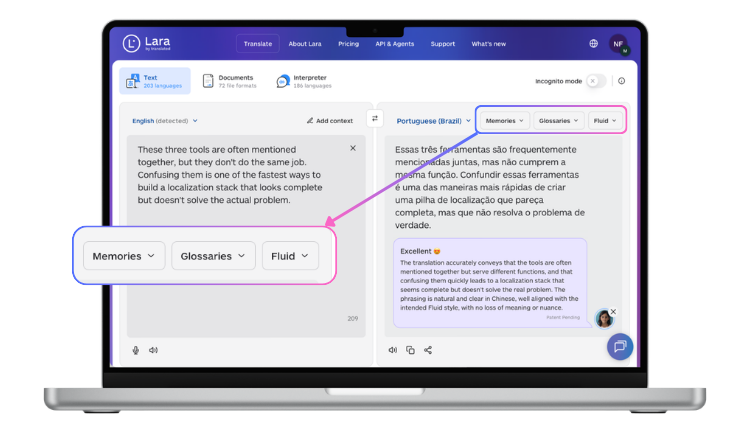
Glossary support is where terminology control actually happens. Organizations define how specific terms translate — product names, anatomical terms, legal concepts, regulatory designations — and Lara enforces those definitions automatically across every document. That consistency is what makes AI-drafted specialized content reviewable rather than a terminology cleanup job.
For confidential documents, Incognito Mode processes translation with zero data retention — no storage, no training on submitted content. That matters for privileged legal communications, protected health information, and proprietary technical documentation where cloud processing creates a compliance problem. The API equivalent is noTrace: true for programmatic workflows.
The Faithful translation style keeps output close to source structure — the right default for legal and technical content where paraphrase introduces risk. Human review on top of AI is available directly in Lara Translate, enabling a single workflow from initial translation through expert validation without switching tools.
For high-volume specialized content, the speed-to-review workflow is the practical case: Lara generates accurate, consistent drafts in seconds, qualified reviewers focus their time on verification rather than translation, and the process scales without proportional cost increase.
Building review processes that actually manage liability
AI alone won’t protect you. The review process is where liability risk actually gets managed — and it only works if it’s documented, assigned, and consistently applied.
 Review depth has to match content risk. High-stakes documents need complete subject matter expert review. Medium-stakes content needs terminology verification and accuracy spot-checks. Low-stakes material needs periodic quality sampling to catch systematic AI failures before they propagate. The mistake organizations make is applying the same review standard to everything — which either creates bottlenecks on low-risk content or leaves high-risk content underreviewed.
Reviewer qualifications matter more than reviewer availability. AI translation for legal documents needs review by attorneys or certified legal translators with specific jurisdiction expertise. Machine translation accuracy for medical texts requires review by healthcare professionals or medical translators with clinical knowledge. A bilingual employee who happens to speak the target language is not a qualified reviewer for either category.
Written policies are what turn a review process into a defensible procedure. Specify which content requires review, who is authorized to perform it, what quality standard applies, and how corrections feed back into glossaries and translation memories. Service agreements with translation providers should assign error responsibility clearly and specify what review obligations each party holds.
Error tracking closes the improvement loop. Review errors found, analyze patterns, use findings to improve glossaries and flag systematic AI weaknesses. Organizations that run this cycle consistently reduce review burden over time as the system learns from corrections — and they build the documentation trail that demonstrates reasonable care if an error is ever disputed.
Start with the right translation foundation
Lara Translate gives specialized teams accurate AI drafts with glossary enforcement, Incognito Mode for sensitive content, and optional human review — all in one workflow.
FAQs
Can AI translation safely handle legal documents?
AI translation for legal documents works for preliminary review, internal research, and high-volume discovery processing. It does not work for official submissions without human legal review. Legal terminology is jurisdiction-specific and mistranslations change contractual obligations, shift liability, or alter dispute resolution terms. Companies remain legally responsible for AI translation errors regardless of the technology used — the 2024 Air Canada tribunal confirmed that principle directly. Use AI translation for legal documents to speed up drafts, but require certified legal translators to review anything filed with courts, sent to regulators, or signed by clients.
How accurate is machine translation for medical content?
Machine translation accuracy for medical texts varies by language pair and direction. Research documents error rates of 8–19% for discharge instructions, with some mistranslations carrying potential for patient harm. Accuracy drops significantly when translating to English rather than from English. Medical terminology, dosage instructions, and clinical contexts create systematic errors that require expert review. US regulations under Section 1557 of the Affordable Care Act mandate human review when accuracy is essential to patient care. Never use machine translation accuracy for medical texts alone for medication instructions, patient safety information, or clinical documentation.
What domain-specific challenges affect technical document translation?
Domain-specific translation challenges include terminology that shifts meaning across technical fields, format preservation in complex documents with tables and diagrams, measurement conversions, and managing updates across document versions. The same word translates differently in computing, materials science, or chemistry contexts. Translation tools handle terminology consistency at scale but struggle with context-dependent selection and maintaining cross-references in structured documentation. Technical translation quality depends on domain-specific glossaries and subject matter expert review.
When should organizations use AI versus human translators for specialized content?
AI vs human in specialized fields depends on error consequences. Low-risk internal documents can use AI with spot-checks. Medium-risk commercial contracts and product manuals need AI translation with mandatory professional review. High-risk content requires human translation: court filings, regulatory submissions, patient safety materials, and critical technical specifications. Companies cannot shift liability to technology when translation errors cause harm. Let risk exposure drive the decision, not cost savings alone.
What liability risks come from using AI for specialized translation?
Liability risks from inadequate AI translation for legal documents include contract disputes, regulatory penalties, and malpractice exposure. Poor machine translation accuracy for medical texts creates patient harm claims and compliance violations. Technical translation errors cause product failures and warranty disputes. Organizations remain responsible for all translation output regardless of whether humans or AI produced it. Risk mitigation requires appropriate professional review, qualified domain experts, clear contractual protections specifying who bears responsibility for errors, and documented quality procedures that demonstrate reasonable care.
This article is about
- AI translation for legal documents — liability risks, certification requirements, and when mandatory review becomes non-negotiable for court filings and contracts
- Machine translation accuracy for medical texts — documented error rates, patient safety implications, and regulatory requirements for human oversight
- Domain-specific translation challenges — terminology consistency, context dependency, format preservation, and managing updates across technical documentation
- AI vs human in specialized fields — risk-based decision frameworks for choosing translation approaches based on content stakes and error consequences
- Professional review and liability mitigation — qualified reviewer selection, quality standards, contractual protections, and continuous improvement practices
Useful articles
Have a valuable tool, resource, or insight that could enhance one of our articles? Submit your suggestion
We’ll be happy to review it and consider it for inclusion to enrich our content for our readers! ✍️