

A single mistranslated dosing instruction in a consent form is not a copyedit problem. It is a patient safety event, an IRB finding, and a hold on your submission. That is the stakes-level clinical study translation operates at, and it is why “good enough” machine output does not clear the bar for anything a participant reads or a regulator reviews.
Clinical study translation produces conceptually equivalent, submission-ready translations of protocols, informed consent forms (ICFs), clinical outcome assessments (COAs), and related documents. The industry-standard term for the full process is “clinical trial language services,” which covers both linguistic rendering and linguistic validation. To get started correctly, follow a validated 5-step workflow (forward translation, reader review, back-translation, author reconciliation, final resolution) and use an AI-plus-human-in-the-loop provider for speed with regulatory traceability.
|
TL;DR
|
Request these three deliverables before any project closes:
- Translation certificate confirming translator qualifications and the source/target language pair
- Validation report documenting cognitive debriefing results and reconciliation decisions
- Approved glossary of study-specific terminology locked for the full trial
Pro Tip: Send your glossary and any prior translations to the vendor at scoping, not after kickoff. Vendors who receive these upfront produce first drafts with fewer terminology errors, which cuts review cycles.
Key Takeaways
Validated clinical study translation requires a documented 5-step workflow, certified deliverables, and human post-editing for any document used in regulatory submissions or participant-facing contexts.
| Point | Details |
|---|---|
| 5-step workflow is the standard | Follow forward translation, reader review, back-translation, author reconciliation, and resolution for every regulated document. |
| Linguistic validation is mandatory for COAs | Cognitive debriefing confirms conceptual equivalence; it cannot be replaced by back-translation alone. |
| MT requires human post-editing | A randomized study found 11 meaning-changing errors in unsupervised MT versus 1 in professional translation for patient-facing content. |
| Security requirements are non-negotiable | Require a HIPAA BAA, SOC 2 certification, and a written no-training-data policy before transferring any trial file. |
| Lara Translate supports the full workflow | AI drafting plus human validation, 200+ languages, memory and glossaries, and certified deliverables for IRB and FDA records. |
What does clinical study translation actually cover?
Medical research translation spans every document a trial generates that must cross a language boundary. The scope is broader than most teams initially budget for.
| Document Type | Primary Audience | Regulatory Purpose |
|---|---|---|
| Protocol and amendments | IRB, FDA, site staff | Study conduct authorization |
| Informed consent form (ICF) | Participants, IRB | Ethical enrollment, LEP compliance |
| Clinical outcome assessment (COA/PRO) | Participants, statisticians | Endpoint validity, conceptual equivalence |
| Case report form (CRF) | Site coordinators, monitors | Data integrity |
| Investigator brochure | Site investigators | Safety information |
| Regulatory correspondence | FDA, competent authorities | Submission readiness |
| Patient recruitment materials | Prospective participants | Equitable access |
Linguistic translation renders words accurately. Linguistic validation goes further: it confirms that participants in the target language interpret COA questions the same way as the source-language population, a process grounded in cognitive debriefing and clinician review. The CRISP Translation Guide formalizes this distinction, and ISPOR guidelines reinforce that conceptual equivalence, not word-for-word accuracy, is the primary standard for instrument translations. A BMJ Open Quality editorial further clarifies that “knowledge translation” and linguistic translation are separate disciplines; scoping a project requires knowing which one you need.
U.S. regulatory and IRB considerations for translated study documents
IRBs and the FDA do not prescribe a single translation method, but both expect a documented, reproducible process. During an inspection or IRB continuing review, you should be prepared to produce:
- Translator CVs showing life-sciences credentials and bilingual proficiency
- A written description of the translation method (TEP or validated workflow)
- Back-translation with reconciliation notes
- Cognitive debriefing results for any COA or patient-reported outcome measure
- A signed translation certificate
- Version-control logs for every amendment
Translated ICFs directly affect informed consent for limited-English-proficient (LEP) participants. The FDA’s guidance on informed consent and the HHS Office for Civil Rights both require that consent materials be accessible to LEP populations. Recruitment materials in participants’ languages also affect enrollment equity, which IRBs increasingly scrutinize.
Pro Tip: Treat each ICF amendment as a separate translation event. Log the amendment version, translation date, and translator ID in a chain-of-custody record. Regulators have flagged studies where the translated ICF version did not match the IRB-approved English version.
What is the recommended 5-step workflow for clinical study translation?
The CRISP Translation Guide defines a forward-and-backward procedure that has been applied to research documents across multiple languages and accepted by international communities. Adapted for clinical trials:
- Forward translation. Two independent bilingual translators with clinical subject-matter expertise each produce a target-language version. Discrepancies are flagged, not resolved yet.
- Target-language reader review. A native speaker from the target population (not a clinician) reviews for readability and natural phrasing. This step catches literal renderings that are grammatically correct but unnatural.
- Back-translation. A third translator, blind to the source, renders the reconciled target version back into the source language. This exposes meaning-changing errors before they reach participants.
- Author reconciliation. The original study author or clinical SME compares the back-translation to the source document and documents every discrepancy with a resolution decision.
- Resolution and finalization. A senior linguist or project lead resolves outstanding issues, locks the glossary, and produces the final certified translation.
For COAs and patient-reported outcomes, add cognitive debriefing between steps 3 and 4: interview 5 to 10 target-language participants to confirm they interpret each item as intended. For operational documents (CRFs, site instructions), a lighter review by a bilingual clinical coordinator is usually sufficient.
Pilot the full workflow on one document
Run an ICF or protocol section through Lara Translate’s AI plus human validation workflow, with translation memory, locked glossary, and certified deliverables for your records.
Quality assurance and linguistic validation: a practical QA checklist
QA in biomedical document translation is a pass/fail gate, not a scoring exercise. Before signing off any translation, confirm each item:
- Terminology consistency: all study-specific terms match the approved glossary throughout
- Conceptual equivalence: COA items convey the same construct in the target language (cognitive debriefing documented)
- Numeric and unit accuracy: dosages, lab ranges, and timepoints are identical to the source
- Regulatory formatting: section numbering, headers, and version identifiers match the source document
- Readability: ICF and recruitment materials are at or below an 8th-grade reading level in the target language
- Back-translation reconciliation: all meaning-changing discrepancies are resolved and documented
- Clinician sign-off: a target-language clinician has reviewed safety-critical sections
ICON plc’s language services guidance identifies ISO 17100 (translation quality) and ISO 18587 (machine translation post-editing) as the certifications that signal a vendor’s QA process is independently audited. Request evidence of both.
Pro Tip: Build a study-level translation memory from the first document translated. Every subsequent document in the same trial draws on pre-approved terminology, which reduces review time and eliminates inconsistency across amendments.
Machine translation and human-in-the-loop: where each belongs
MT is a legitimate drafting tool for clinical content, but it is not a finished product. The human-in-the-loop model, formalized under ISO 18587, routes an MT draft through post-editing by a medically experienced linguist before any clinical or regulatory use.
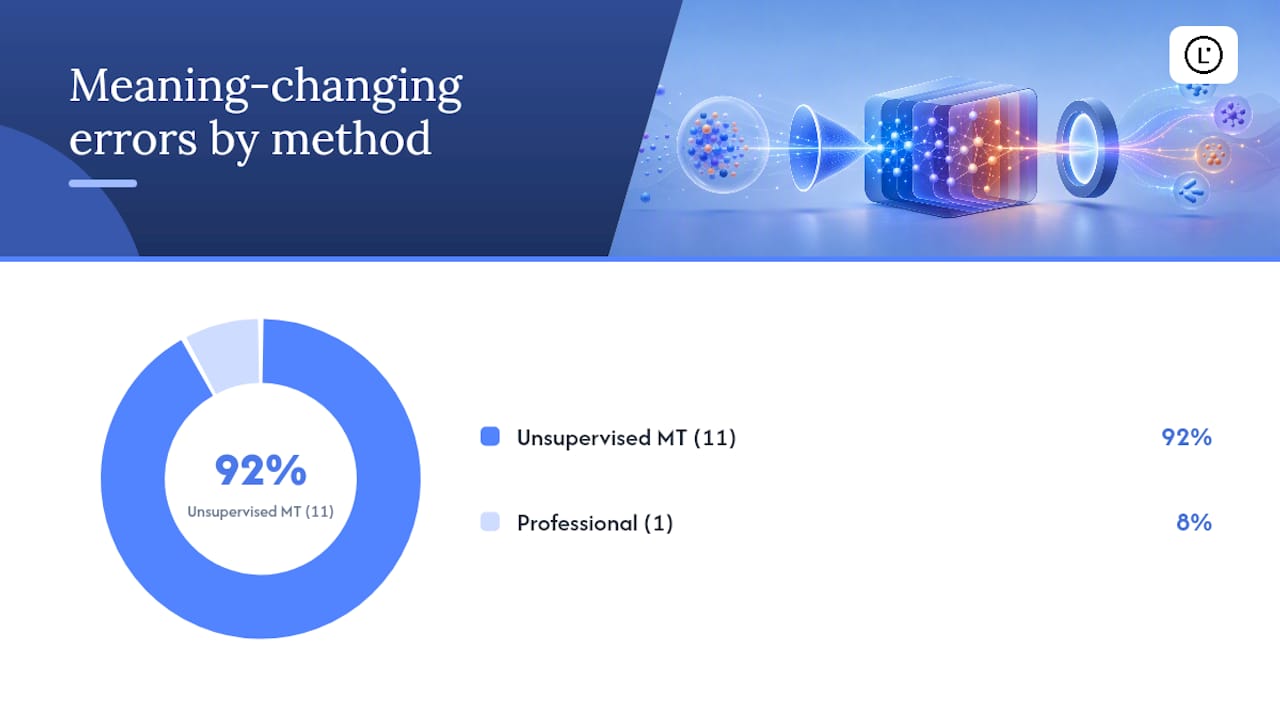
A randomized study comparing professional translation to unsupervised MT for systemic anti-cancer therapy patient information found 11 meaning-changing errors in the machine-translated booklet versus 1 in the professional translation. Bilingual consent forms produced using professional translation increased the odds of participants understanding treatment intent. Those are not acceptable error rates for adverse event descriptions or dosing instructions.
Where MT adds value without unacceptable risk:
- Bulk preprocessing of large protocol sections before human post-edit
- Draft generation for CRFs and operational site documents
- Rapid turnaround for internal communications and site newsletters not used in regulatory submissions
IQVIA’s language solutions fact sheet reports that domain-trained AI combined with human review can reduce costs and accelerate clinical operations while maintaining regulatory traceability. The key phrase is “domain-trained,” meaning a general-purpose MT engine applied to oncology consent forms has a different risk profile than a clinical-specific model with post-editing.
Security note: Any MT engine that retains input data for model training is incompatible with HIPAA. Confirm your vendor’s data-retention policy in writing before uploading any trial document.
Data privacy and secure transfer for clinical translation
Clinical documents contain protected health information (PHI) and confidential trial data. Every vendor in your translation supply chain must meet these requirements:
- HIPAA-compliant infrastructure: Business Associate Agreement (BAA) in place before file transfer
- Encryption in transit and at rest: TLS 1.2 or higher for transfer; AES-256 for storage
- Access logging: audit trail showing who accessed which file and when
- Signed NDA covering all translators, reviewers, and subcontractors
- SOC 2 Type II certification or equivalent for the translation management system
- No data retention for MT training on confidential documents
Ask vendors directly: “Does your MT engine use submitted documents to retrain its models?” A “yes” without an opt-out is disqualifying for PHI-containing files. Store all translation artifacts for the duration required by FDA regulations (typically the trial record retention period, minimum 2 years post-approval or 15 years for certain device studies).
How to scope a clinical translation project: timelines and cost drivers
| Cost Driver | Impact on Price/Timeline |
|---|---|
| Document type (COA vs. CRF) | High: COAs require linguistic validation; CRFs do not |
| Language pair rarity | Medium-High: less-common pairs have fewer qualified translators |
| Linguistic validation required | High: adds cognitive debriefing, clinician review, and reporting |
| Certified deliverables required | Medium: adds translator CV compilation and certificate preparation |
| Turnaround requirement | High: rush premiums apply below 5 business days |
| Word volume | Medium: per-word rates apply; large volumes may qualify for discounts |
A small package (ICF plus two protocol amendments, one language pair) typically takes 5 to 10 business days with a standard TEP workflow. A full COA linguistic validation for a new instrument, including cognitive debriefing with 8 participants, commonly runs 6 to 10 weeks. PPD’s integrated translation program reports that embedding translation and linguistic validation into the study start-up workflow reduces overall timeline compared to treating translation as a post-protocol step.
Vendor selection checklist and RFP questions
Capabilities to verify before awarding work:
- ISO 17100 and ISO 18587 certification (request current certificates)
- Translators with graduate-level life-sciences or clinical credentials
- Documented cognitive debriefing capability for COAs and PROs
- Secure translation management system with HIPAA BAA available
- Back-translation as a standard deliverable, not an add-on
- Sample validation report from a comparable study type
RFP questions to ask every vendor:
- “Provide three examples of study types you have translated in the past 24 months.”
- “Share a redacted sample validation report and translation certificate.”
- “Describe your back-translation reconciliation process and who resolves discrepancies.”
- “List the certifications held by your translation management system.”
Red flags: no back-translation offered, no clinical SMEs on staff, missing security certifications, and QA described only as “proofreading.” Research Gold’s medical translation guidance confirms that PhD- or graduate-level translators using TEP workflows, with certification letters accepted by major regulatory bodies, represent the baseline standard for regulatory and publication-grade work.
Recommended deliverables to retain for IRB and FDA inspections
Build an inspection-ready translation package for every study document:
- Translation certificate (signed, dated, language pair, translator name and credentials)
- Method description (workflow steps, tools used, validation approach)
- Translator CVs (bilingual proficiency, life-sciences training, relevant experience)
- Approved glossary (locked version with version number and date)
- Reconciled drafts (tracked changes from forward translation through final)
- Back-translation with reconciliation notes
- Cognitive debriefing report (for COAs and PROs: participant demographics, item-level findings, resolution decisions)
- Version-control log (document ID, version number, translation date, translator ID, approval date)
Organize files by document type and version: ICF_v2.1_Spanish_Translation_Certificate_2026-03-15.pdf. IRB reviewers and FDA inspectors work faster when files follow a predictable naming convention, and a well-organized package signals process maturity.
A quick-start vendor brief template you can copy
Use this structure to request an accurate quote:
Project Summary. Study phase and therapeutic area; regulatory use (IRB submission, FDA filing, site use); target participant population.
Document List
- Document name, version, word count, source language, target language(s)
- Repeat for each document
Required Services. Forward translation, back-translation, cognitive debriefing (yes/no), certified deliverables (yes/no), rush turnaround (yes/no).
Target Audience. Patient-facing or site-staff-facing; literacy level requirements.
Expected Deliverables. Translation certificate, validation report, translator CVs, glossary, version-control log.
Timeline. Preferred delivery date; hard deadline if applicable.
Security Requirements. HIPAA BAA required (yes/no); SOC 2 required (yes/no); no MT training on submitted files (yes/no).
Contact for Queries. Name, role, email, phone.
Attachments to include with the brief:
- Source files in native format (Word, PDF)
- Existing approved glossary or terminology list
- Prior translations of related documents for consistency reference
What the translation workflow looks like in practice
Implementing a validated translation workflow inside a running clinical program is primarily a coordination problem, not a technical one. The translators, back-translators, and cognitive debriefing participants all need to be scheduled in sequence, and the original study author must be available for reconciliation, which is rarely on their calendar by default. The practical fix is to assign a translation project manager at protocol finalization, not at database lock. Pilot the full 5-step workflow on one document (the ICF is the best candidate) before the first site opens. That pilot surfaces glossary gaps, recruits your target-language reader panel, and produces a reusable template for every subsequent document in the trial.
Lara Translate for clinical study translation: AI speed with human accuracy
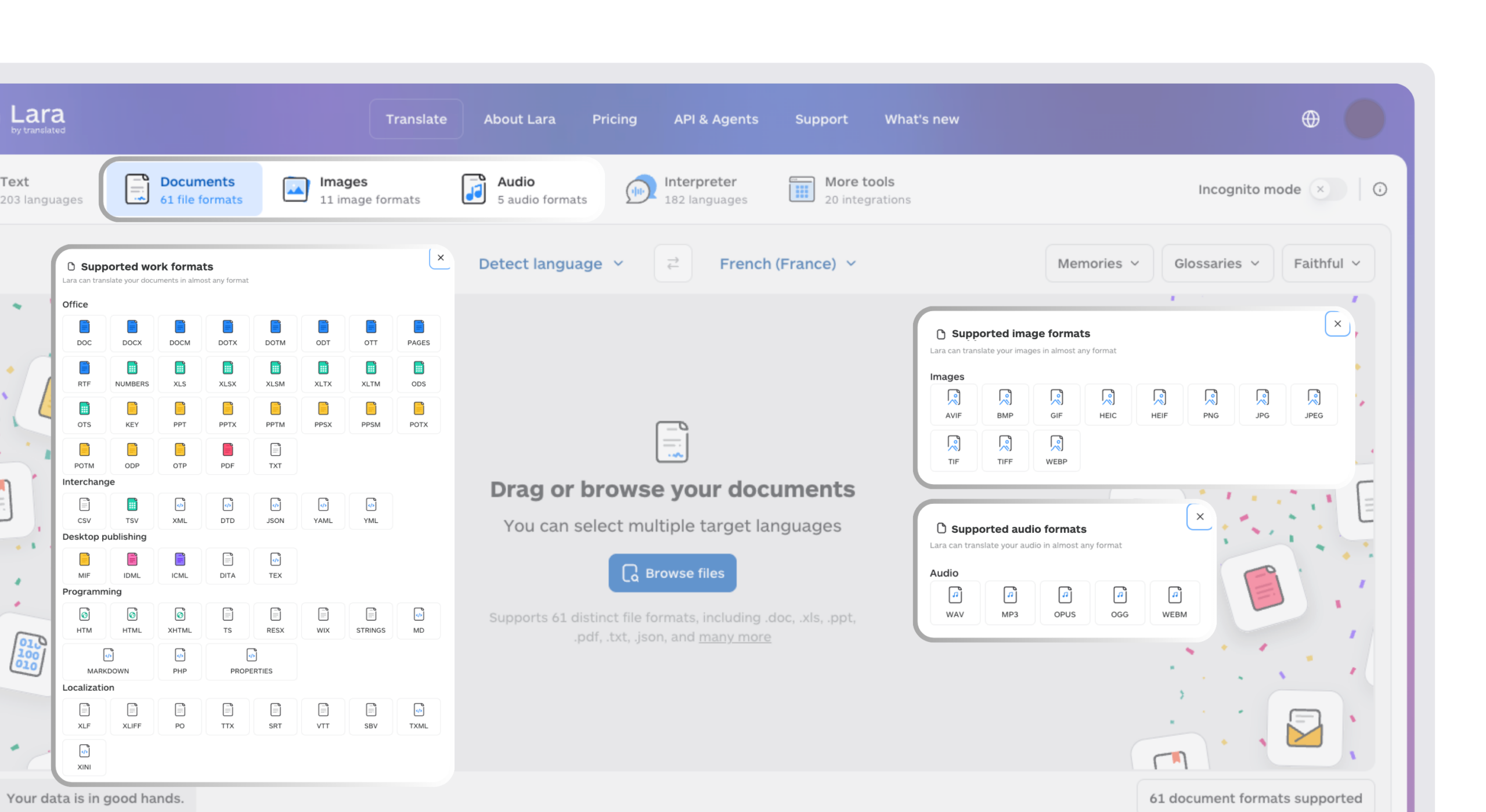
For clinical teams that need fast, secure, and regulatory-traceable translations, Lara Translate combines AI-powered drafting across 200+ languages with human validation by professional linguists. The platform supports 61 document formats, maintains translation memories and approved glossaries across a full trial, and operates under enterprise-grade security with no data retention for model training on your files.
For clinical projects, Lara Translate delivers the complete documentation package: translation certificate, validation report, translator CVs, and version-controlled glossary. The AI draft layer accelerates turnaround on bulk documents (CRFs, site instructions, protocol sections), while the human validation layer handles ICFs, COAs, and regulatory correspondence where conceptual equivalence and certification are non-negotiable.
Start with one pilot document
See the AI plus human workflow in action and request a sample validation report before committing to a full project.
Sources
- Translation approaches to support systemic anti-cancer therapy consent (Supportive Care in Cancer)
- IQVIA Language Solutions: Accelerating clinical trials operations (fact sheet)
- PPD Translate Solutions | PPD
- Language Services | ICON plc
- Medical Translation Services for Research | Research Gold
This article is general information, not a substitute for advice from a qualified doctor. Consult a qualified healthcare professional about your own circumstances before acting on anything here.
FAQ
What documents require clinical study translation?
Protocols, ICFs, COAs, CRFs, investigator brochures, regulatory correspondence, and patient recruitment materials all require translation when a trial enrolls non-English-speaking participants or submits to non-English-language regulators.
What is the difference between translation and linguistic validation?
Translation renders text accurately in a target language. Linguistic validation adds cognitive debriefing and clinician review to confirm that participants interpret COA or PRO items the same way across languages, which is required for endpoint validity.
How many meaning-changing errors does machine translation produce in clinical content?
A randomized study found 11 meaning-changing errors in an unsupervised machine-translated patient booklet compared to 1 in the professional translation, confirming that human post-editing is required for participant-facing and regulatory documents.
What certifications should a clinical translation vendor hold?
ISO 17100 for translation quality and ISO 18587 for machine translation post-editing are the standard certifications. For data security, require SOC 2 Type II and a signed HIPAA Business Associate Agreement.
Can Lara Translate handle regulatory-grade clinical translations?
Yes. Lara Translate’s AI-plus-human validation workflow supports certified deliverables, translation memories, and approved glossaries across 200+ languages, with enterprise security designed for HIPAA-sensitive clinical content.
This article is about
Clinical study translation: the validated 5-step workflow, linguistic validation and cognitive debriefing for COAs, U.S. IRB and FDA documentation requirements, where machine translation fits with human post-editing, data-privacy and security requirements, vendor selection, and how Lara Translate’s AI plus human workflow supports regulatory-grade clinical translations.
Recommended
- ШІ-перекладач Lara: Надійний, Швидкий, Безкоштовний
- Lara Traduction basée sur l’IA : Fiable, Rapide, Gratuite
- Lara Translate AI: Reliable, Fast, Free