

A customer success manager discovers that an account is leaving just as the renewal falls through. The warning signs were scattered across a CRM, support inbox, billing system, and spreadsheet. Bringing those signals together can help the team investigate risk and respond earlier.
AI-powered customer success platforms combine customer data with health scoring, summaries, and automated workflows. This guide compares their roles, pricing, and operational fit, including related tools for support and qualitative feedback. It also explains how to prepare customer-facing communications for customers who use different languages.
|
TL;DR
|
What makes an AI customer success platform worth using in 2026?
Match operational depth to your team. Check who will configure integrations, maintain health scores, and improve playbooks after launch. A platform should fit the resources available to run it.
Combine behavioral signals with direct feedback. Usage, support activity, billing, and customer conversations can provide different views of an account. Test how the platform combines them and whether a reviewer can trace a conclusion back to its evidence.
Evaluate the working environment. Check how tasks, notes, shared plans, and notifications fit into the tools your team already uses. Validate the implementation effort with your own data instead of assuming that a modern interface means a quick rollout.
AI features are increasingly table stakes across this category, but what they actually automate still varies. Custify’s recently launched CustifyAI turns customer data into playbooks, summaries, and automated tasks aimed at reducing admin work for CS teams internally, a different focus than customer-facing automation.
Check multilingual communication at the feature level. Some products already offer translation or multilingual support, while other workflows require separately prepared content. Review the languages, templates, and sending channels you actually need before adding another tool.
AI-powered customer success platforms and related tools compared
| Platform | Best for | Model | Starting price |
|---|---|---|---|
| Gainsight | Complex customer success operations | Enterprise CS platform | Custom, contact sales |
| Vitally | Teams combining CS work, collaboration, and automation | Modern, workspace-native CS platform | Contact sales |
| ChurnZero | Structured mid-market workflows for hybrid self-serve and sales-assisted models | Mid-market CS platform with in-app engagement | Contact sales |
| Custify | Most consistently recommended budget-friendly platform for small-to-midsize teams | AI-first CS platform for B2B SaaS | Custom, contact sales |
| Totango | Teams evaluating the Totango platform and its transition to Odie | Customer success platform; company now branded Odie | Confirm current plans with sales |
| Planhat | Data-driven, account-centric CS teams focused on financial outcomes | Account-centric European CS platform | Custom, contact sales |
| ClientSuccess | Teams combining relationship and usage insights | Relationship-focused CS platform | Custom, contact sales |
| Aviso | Agentic CS intelligence tied directly to revenue outcomes | Agentic revenue intelligence platform | Custom, contact sales |
| Freshdesk | Support-first teams needing ticketing and AI assistance | Support and ticketing platform | From $19/agent/month billed annually |
| Perspective AI | Teams wanting AI-led insight into why accounts churn or expand | Conversational insight layer for CS teams | Free starting credits; Pro from $99/month |
Gainsight
Best for: Teams managing complex customer success operations.
Gainsight provides customer success tools for account health, success plans, calls to action, playbooks, and renewal management. Evaluate the configuration and administration needed for your account structure and existing systems.
Pricing: Custom, contact sales.
Verdict: Consider Gainsight when enterprise-scale operational depth justifies the resources needed to staff and configure it properly.

Vitally
Best for: Teams combining customer success work, collaboration, and automation.
Vitally brings health scores, reporting, shared documents, project management, and automation into one workspace. Its Tech-Touch, Hybrid-Touch, and High-Touch plans support different service models, with AI features for account summaries and related CS work.
Pricing: Contact sales for Tech-Touch, Hybrid-Touch, or High-Touch pricing.
Verdict: Consider Vitally when shared customer work, visibility, and automation fit your team’s service model.
ChurnZero
Best for: SaaS teams wanting health scoring, automated plays, and in-app communication.
ChurnZero combines customer health scoring, journeys, renewal forecasting, surveys, and reporting. Its AI assistant and agents can summarize context, draft communications, and support actions within customer success workflows.
Pricing: Contact sales for a quote covering your required features and account scope.
Verdict: Consider ChurnZero when in-app engagement and structured mid-market workflows are a priority alongside health scoring.
Custify
Best for: Small-to-midsize B2B SaaS teams wanting budget-friendly full-featured customer success automation.
Custify centralizes in-product usage data alongside CRM, support, and billing information into one dashboard, tracking customer health scores and automatically identifying accounts stuck in onboarding, approaching trial expiration, or showing declining usage. Named it the best overall alternative to Planhat.
Pricing: Custom, contact sales
Verdict: Consider Custify when affordable, full-featured customer success automation fits a small-to-midsize team better than enterprise-tier pricing and complexity.
Totango
Best for: Teams evaluating the Totango platform and its transition to Odie.
Totango’s official site now presents the company as Odie and describes a Customer Knowledge Engine for post-sales teams and their agents. The site still links to the Totango Customer Success Platform. Confirm the product, migration path, and capabilities included in any proposal.
Pricing: Confirm current product availability and pricing with sales. Do not assume a historical free tier applies to a new subscription.
Verdict: Consider Totango after confirming how the existing platform and Odie offering fit your required workflow.
Prepare customer messages for every market
Translate onboarding emails and renewal templates with Lara Translate, then review each version before adding it to your automated workflow.
Planhat
Best for: Teams connecting customer data, commercial workflows, and account outcomes.
Planhat combines customer context, collaboration, and AI-led automation across the customer lifecycle. Its Pi customer agent works with commercial data and processes; assess how those capabilities support your renewal and expansion workflow.
Pricing: Custom, contact sales.
Verdict: Consider Planhat when account-level financial outcomes and renewal economics matter more than product adoption metrics specifically.
ClientSuccess
Best for: Teams combining relationship management, customer health, and onboarding.
ClientSuccess combines usage, adoption, feedback, engagement, and sentiment in its customer view. It also offers journey management, playbooks, health scoring, automation, and customer portals, so its scope extends beyond relationship tracking.
Pricing: Custom, contact sales.
Verdict: Consider ClientSuccess when customer health, onboarding, and relationship workflows need to work together.
Aviso
Best for: Revenue teams connecting account intelligence with forecasting.
Aviso provides AI-supported revenue forecasting, pipeline inspection, conversation intelligence, and relationship intelligence. Evaluate it as a related revenue platform and confirm the post-sales workflows you need during a demo.
Pricing: Custom, contact sales.
Verdict: Consider Aviso when tying customer success signals directly to revenue forecasting and agentic execution is the priority.
Freshdesk
Best for: Support-first teams needing ticketing and AI assistance.
Freshdesk combines a shared inbox, ticketing, knowledge base, customer portal, and reporting. Paid tiers add capabilities such as multilingual support and advanced routing; AI assistance and additional usage may carry separate charges. Evaluate it primarily as a support platform.
Pricing: Growth $19, Pro $55, and Enterprise $89 per agent per month, billed annually. Selected AI capabilities and additional usage are priced separately.
Verdict: Consider Freshdesk when resolving support requests is the main requirement; assess account health and renewal workflows separately.

Perspective AI
Best for: Teams collecting qualitative customer feedback through AI conversations.
Perspective AI offers adaptive conversations, follow-up questions, structured outputs, summaries, and analysis. It can support customer research and feedback alongside a customer success system, rather than replacing account health and renewal management.
Pricing: A free starting allowance includes 100 credits. Pro starts at $99/month with 1,000 monthly credits; enterprise plans are available. Usage consumes credits.
Verdict: Consider Perspective AI when understanding why an account is at risk, not just that it is, is worth pairing with an existing CS workflow platform.
How to choose the right AI customer success platform
Step 1: Match platform depth to your team’s size and structure. Establish who will own implementation, data quality, and ongoing workflow maintenance.
Step 2: Compare complete quotes. Include required seats, customer records, integrations, onboarding, AI usage, and contract terms. Confirm current pricing directly rather than relying on historical starting prices.
Step 3: Decide which evidence you need. Combine usage and operational signals with direct customer feedback where appropriate, and test whether the tool explains why an account was flagged.
Step 4: Check what AI actually automates. Separate summaries and suggested tasks from actions that update records or send messages, and identify where human review is required.
Step 5: Plan for translating customer-facing communications as your customer base spans more languages. A dedicated translation tool can help translate automated emails, in-app messages, and renewal communications accurately, so a well-timed intervention actually lands with the customer receiving it.
Connect your customer success content workflow with Lara Translate
Use Lara Translate alongside your customer success platform to translate onboarding emails, help content, in-app messages, and renewal communications. Copy approved text or export a supported document, translate it with a glossary for product terminology, and return the reviewed version to the relevant template or content library.
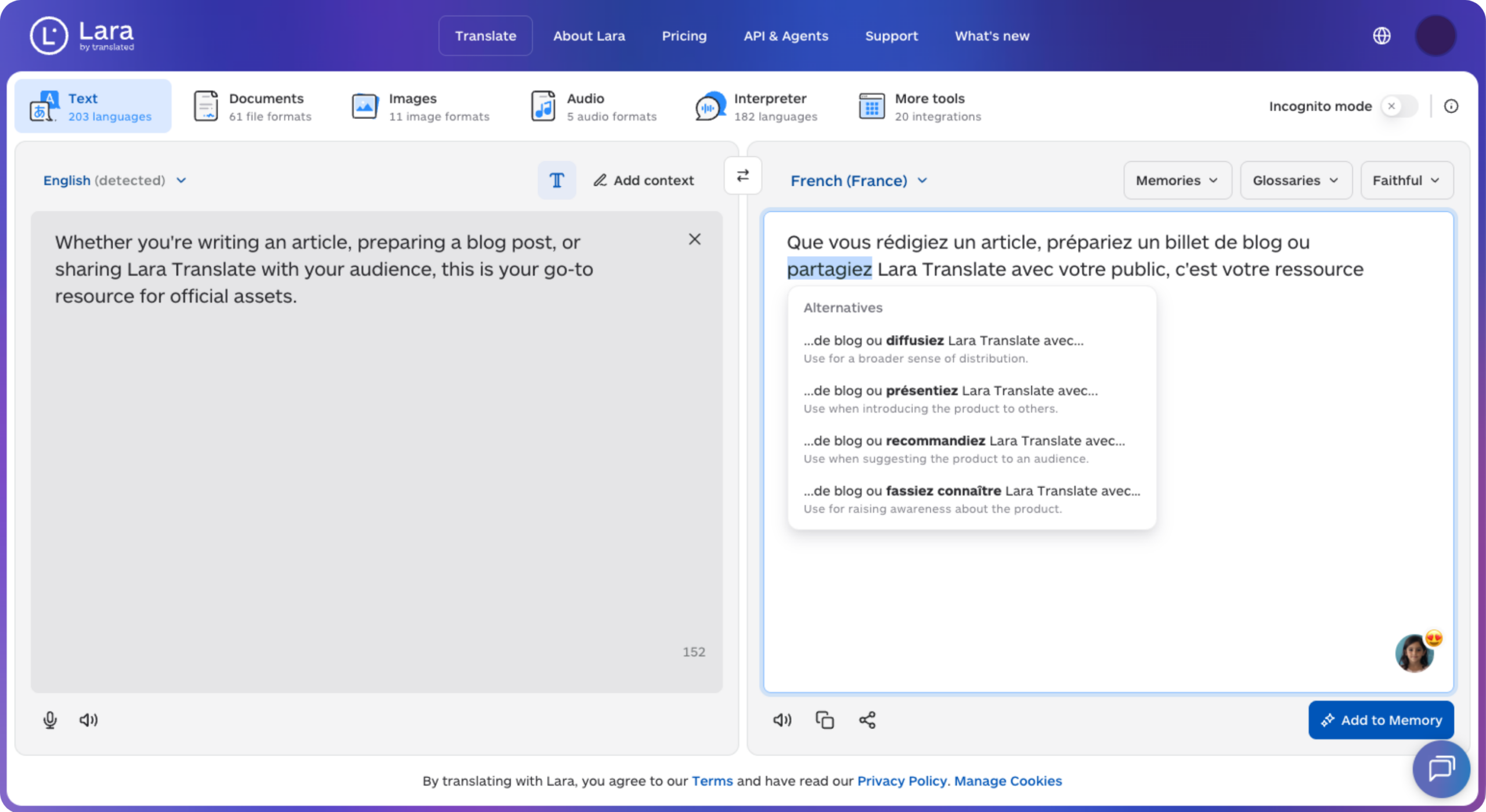
Lara Translate supports 200+ languages and 60+ file formats. Preserve personalization fields, links, product names, and commercial terms, then test the message in its sending channel. This text-and-file workflow does not assume a native integration with any platform listed here.
Make the next customer touchpoint clear
Use Lara Translate to prepare consistent language versions of customer content, with a review step before messages are sent.
Conclusion
Choose a platform that turns reliable account information into actions your team can maintain. Test it with representative customer data and a real renewal or onboarding workflow, then compare the full cost. Prepare reviewed language versions of customer-facing content before scaling automated outreach.
Have a valuable tool, resource, or insight that could enhance one of our articles?
Send us an email at press@laratranslate.com
We’ll be happy to review it and consider it for inclusion to enrich our content for our readers! ✍️
Frequently asked questions
What is the best AI customer success platform in 2026?
Choose based on your customer lifecycle, integrations, team capacity, and budget. Test health scoring, task ownership, and automation with representative data. Check whether you need a full account-management platform or a specialist tool for support or feedback.
How does customer success software differ from a CRM?
Customer success software focuses on post-sale adoption, customer health, onboarding, retention, and expansion. A CRM usually tracks broader commercial relationships and sales activity. The tools often work together, so check which system owns each field and how updates synchronize.
How much do AI customer success platforms cost in 2026?
Costs depend on seats, customer volume, modules, implementation, and AI usage. Many vendors require a quote, while some related support and feedback tools publish subscription prices. Compare the same scope and contract term, including add-ons and usage charges.
What can AI automate in customer success?
AI can summarize account information, identify patterns, draft messages, suggest next steps, and support workflow execution. Capabilities vary by product and plan. Check the source data, permissions, review steps, and logs before allowing automated actions.
Why does language matter for customer success platforms beyond the internal dashboard?
Customers need onboarding, product updates, and renewal messages in a language they understand. Check built-in language support, prepare reviewed translations where needed, and test placeholders, links, and sending rules before publishing.
How should a small team evaluate customer success software?
Start with the workflows that consume the most time or create the biggest service gaps. Pilot a limited set of integrations, health indicators, and playbooks. Assess maintenance effort and total cost as well as feature coverage.
This article is about
- How customer success platforms bring account information into health scoring and workflows
- How to distinguish AI summaries and suggestions from automated actions
- Why integrations, data quality, ownership, and ongoing maintenance affect platform fit
- How behavioral data and direct customer feedback contribute different evidence
- How to compare quotes, usage charges, and specialist support or research tools
- How reviewed translations support customer-facing onboarding and renewal communications
Useful links
- AI Translation for Customer Support: A Practical Workflow Guide
- Best Mobile CRM Apps for Instant Lead Response in 2026
- Lara Translate: document translation
This article was produced by the Lara Translate content team. Lara Translate is an AI translation platform built by Translated, with more than 25 years of professional translation experience. Customer success teams use Lara Translate to translate onboarding materials and customer-facing communications, across 200+ languages and 60+ file formats.