

Moving an AI workflow from a promising demo into production requires reliable integrations, clear ownership, and measurable results. Managed enterprise AI platforms can help teams address delivery work, while configurable platforms give internal teams more control over building and operating agents.
This guide compares managed enterprise AI platforms and configurable agent tools by use case, delivery model, governance, and pricing. It also explains how to plan multilingual knowledge content and customer communication alongside the agent rollout.
|
TL;DR
|
What makes a managed enterprise AI platform worth using?
Self-serve platforms and fully managed delivery solve different problems. Glean and Writer are platforms enterprises configure themselves. Unframe takes a different approach, scoping and building a tailored solution for each use case as a managed service.
Outcome-based pricing ties charges to defined results. Sierra offers this model, while Unframe lets customers see a working solution before making a financial commitment. Compare the contract’s definition of success, minimum commitments, and ongoing operating costs.
Specialization should match the workflow. Customer-service and contact-center platforms offer tools focused on customer conversations, while enterprise search and employee-service platforms address different operational needs.
Ownership can matter to procurement and integration planning. ServiceNow completed its acquisition of Moveworks in December 2025, and NICE completed its acquisition of Cognigy in September 2025. Ask vendors which integrations are available today and which remain planned.
Multilingual capability needs its own acceptance tests. Evaluate knowledge retrieval, terminology, workflow execution, and escalation in each required language. Translation can help maintain approved content across markets, but it does not replace testing the agent’s behavior.
Managed enterprise AI platforms compared
| Platform | Best for | Model | Pricing |
|---|---|---|---|
| Sierra | Enterprises wanting outcome-priced, branded customer service agents | Managed customer-service AI platform | Outcome-based, custom |
| Glean | Enterprises wanting agents grounded in permission-aware search across company knowledge | Work AI platform | Custom, contact sales |
| Moveworks | Large organizations wanting AI-driven IT and HR employee support | Enterprise AI assistant (ServiceNow) | Custom, contact sales |
| Unframe | Enterprises with a specific, high-stakes operational challenge that generic AI tools don’t fit | Managed AI transformation platform | Outcome-based, custom |
| Decagon | Internet-native and consumer businesses automating customer service end to end | Managed customer-service AI platform | Custom, contact sales |
| Cognigy | Large contact centers automating customer interactions across voice and chat | Conversational AI platform (NICE) | Custom, contact sales |
| Kore.ai | Enterprises orchestrating multiple AI agents across both customer and employee experience | Agentic AI platform | Custom, contact sales |
| Cresta | Contact centers wanting real-time agent coaching alongside automation | Contact-center AI platform | Custom, contact sales |
| Writer | Enterprises wanting agentic content and workflow automation with strict brand governance | Enterprise generative AI platform | Custom, contact sales |
| Ema | Employee-service automation across HR, IT, and related workflows | Enterprise AI agent platform | Outcome-based, custom |
Product and commercial details checked on October 1, 2026. Request a quote for your deployment scope, integrations, and expected usage.
Sierra
Best for: Enterprises wanting outcome-priced, branded customer service agents
Sierra builds customer-service AI agents that can answer questions and take actions through connected business systems. Its outcome-based pricing ties payment to agreed results, such as resolved support requests or other defined business outcomes.
Notable strength: Outcome-based commercial model paired with agent development and ongoing optimization support
Pricing: Outcome-based, custom-quoted; Sierra charges for results rather than a flat subscription
Evaluation point: Define billable outcomes, exceptions, minimum commitments, and expected volumes before comparing costs.
Verdict: Consider Sierra when you want a branded customer service agent and are comfortable paying for resolved outcomes rather than a flat license.

Glean
Best for: Enterprises wanting agents grounded in permission-aware search across company knowledge
Glean connects enterprise knowledge to permission-aware search, an AI assistant, and tools for building and governing agents. Teams can use information from connected systems to ground answers and automate work.
Notable strength: Permission-aware search across a wide range of internal systems, grounding agent responses in the right knowledge for each user
Pricing: Custom, contact sales
Evaluation point: Test source permissions, connector coverage, and content freshness using representative employee queries.
Verdict: Consider Glean when employees need permission-aware knowledge access and agents that work across connected enterprise systems.
Moveworks
Best for: Large organizations wanting AI-driven IT and HR employee support
Moveworks provides an AI assistant and enterprise search platform for IT and HR ticket deflection, operating within the ServiceNow portfolio.
Notable strength: Combines enterprise search with employee assistance across IT, HR, and other service workflows
Pricing: Custom, contact sales
Evaluation point: Confirm the ServiceNow integrations and support arrangements included in your proposed deployment.
Verdict: Consider Moveworks when IT and HR ticket deflection is the priority, especially for organizations already invested in ServiceNow.
Unframe
Best for: Enterprises with a specific, high-stakes operational challenge that generic AI tools don’t fit
Unframe scopes and builds a tailored, production-ready AI solution for each customer’s use case, running in the customer’s own cloud, on-premises, or as managed SaaS with no dependency on a specific LLM.
Notable strength: A fully managed build tailored to one specific use case, rather than a self-serve platform the customer has to configure themselves
Pricing: Outcome-based, custom-quoted; customers see a working solution before making a financial commitment
Known limitation: The managed, bespoke approach means less self-serve control than a configurable platform, and typically a longer initial scoping process
Verdict: Consider Unframe when your use case is specific enough that a generic, self-serve AI platform keeps falling short, and you want a managed team to build and own the solution.
Decagon
Best for: Internet-native and consumer businesses automating customer service end to end
Decagon builds customer-service AI agents using Agent Operating Procedures, natural-language instructions supported by code and conditional logic. Business teams can define workflows while technical teams connect tools and control sensitive actions.
Notable strength: Natural-language procedures with structured logic, tool connections, and workflow controls
Pricing: Custom, contact sales
Evaluation point: Test how business and technical teams will maintain procedures, integrations, and escalation rules together.
Verdict: Consider Decagon when developer flexibility and orchestration control matter alongside customer service automation.
Give multilingual agents consistent source content
Use Lara Translate to prepare knowledge articles and approved response content in the languages your customers and employees use.
Cognigy
Best for: Large contact centers automating customer interactions across voice and chat
Cognigy provides AI-first customer service automation for large-scale contact centers, operating within NICE’s contact-center portfolio.
Notable strength: Voice and chat automation for contact centers, with multilingual deployment capabilities
Pricing: Custom, contact sales
Evaluation point: Confirm channel coverage, language performance, and the NICE integrations available for your deployment.
Verdict: Consider Cognigy when multi-channel, multi-language contact-center automation at large scale is the priority.
Kore.ai
Best for: Enterprises orchestrating multiple AI agents across both customer and employee experience
Kore.ai offers customer-experience and employee-productivity applications alongside its Artemis agent platform. Use cases include voice and digital service agents, agent assistance, enterprise search, and HR or IT workflows.
Notable strength: Platform and applications spanning customer-facing and employee-service workflows
Pricing: Custom, contact sales
Evaluation point: Pilot the specific applications and integrations you need before committing to a broader platform rollout.
Verdict: Consider Kore.ai when you need one platform to govern multiple coordinated agents across both CX and internal workflows.
Cresta
Best for: Contact centers wanting real-time agent coaching alongside automation
Cresta provides real-time coaching, conversation intelligence, and automation for both human and AI agents in contact-center environments.
Notable strength: Combines live coaching for human agents with automation, rather than treating the two as separate tools
Pricing: Custom, contact sales
Evaluation point: Assess the balance of human-agent guidance, conversation analysis, and autonomous handling needed by your contact center.
Verdict: Consider Cresta when improving human agent performance matters as much as automating conversations outright.
Writer
Best for: Enterprises wanting agentic content and workflow automation with strict brand governance
Writer combines enterprise agents, playbooks, knowledge grounding, and brand controls. Its Palmyra models sit alongside support for other models, while enterprise plans add orchestration, approvals, observability, and administrative controls.
Notable strength: Governed workflows with knowledge grounding and departmental brand and voice profiles
Pricing: Custom, contact sales
Evaluation point: Test the required connectors, approval steps, and style controls against real content and business workflows.
Verdict: Consider Writer when brand-consistent, governed content generation needs to scale into full agentic workflows.

Ema
Best for: Organizations seeking employee-service automation across HR, IT, payroll, and related workflows
Ema provides enterprise AI agents for employee services, connecting business systems and handling requests across functions such as HR, IT, and payroll. Its current positioning emphasizes coordinated automation and outcome-based pricing.
Notable strength: Cross-functional employee-service workflows connected to existing enterprise systems
Pricing: Outcome-based, custom; contact sales for scope and commercial terms
Evaluation point: Validate each department’s required workflows, permissions, and handoff rules in a scoped pilot.
Verdict: Consider Ema when your priority is coordinating employee-service requests across multiple business functions.
How to choose the right managed enterprise AI platform
Decide whether you need a self-serve platform or a fully managed build. Glean and Writer are platforms your team configures; Unframe and Sierra deliver a tailored solution built and largely owned by the vendor.
Match specialization to the bottleneck. Compare platforms using the actual customer-service, knowledge-search, or employee-support workflow you need to improve.
Weigh outcome-based pricing against predictability. Sierra’s and Unframe’s commercial models should be evaluated against the defined outcome, expected volume, and total contract commitments.
Check ownership and product roadmaps. Confirm available integrations and support commitments in writing, particularly when a platform has recently joined a larger software portfolio.
Test the solution in every required language. Evaluate retrieval accuracy, terminology, completed actions, and handoffs; include translated knowledge content where it helps the workflow.
Connecting Lara Translate to enterprise AI workflows
Lara Translate can complement an agent platform by translating knowledge articles, approved response templates, and supporting documents. Start with reviewed source content and a shared glossary for product names and operational terminology, then validate the translated material before adding it to the agent’s knowledge base.
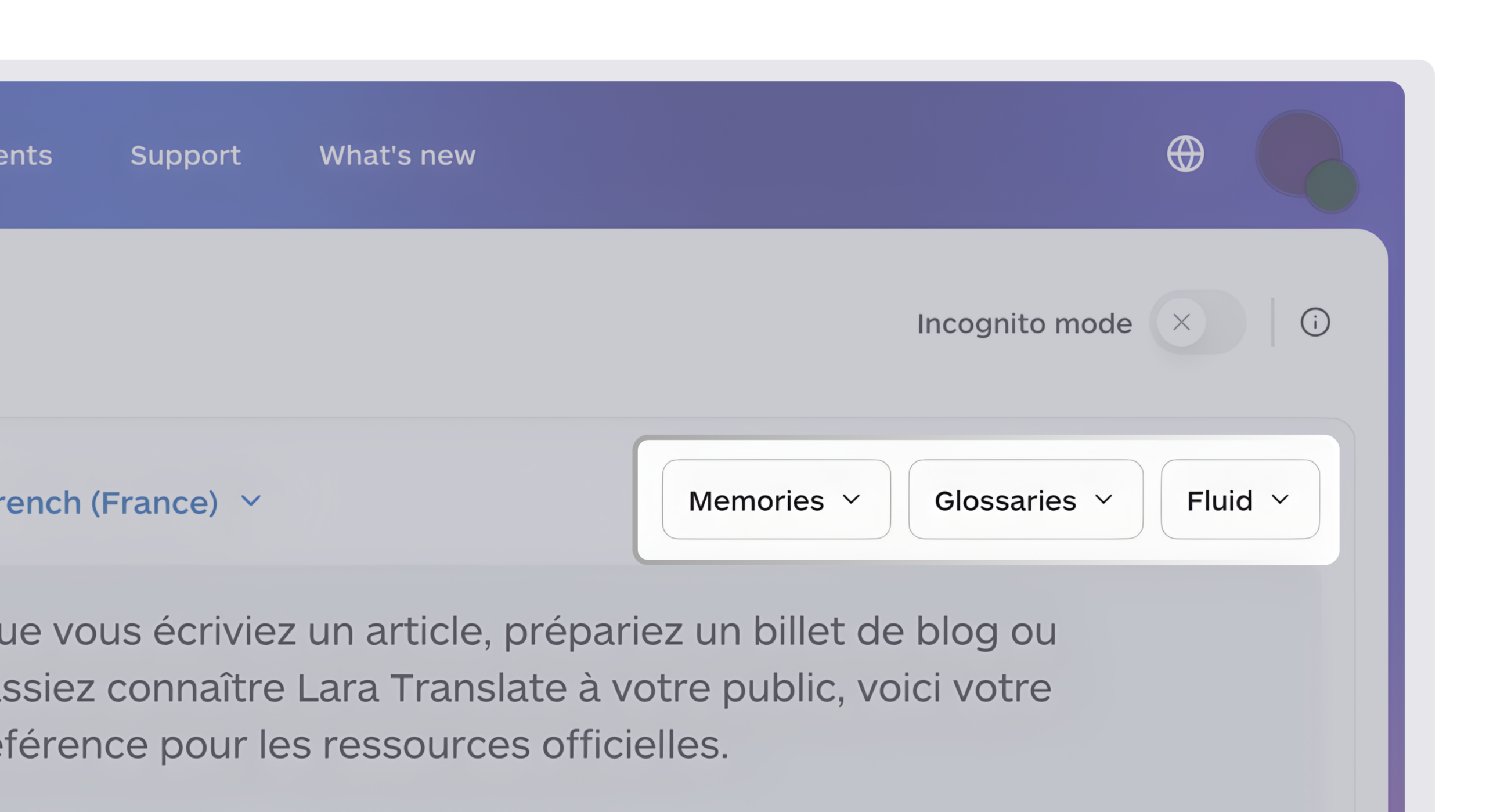
For recurring or on-demand translation, a technical team can connect the Lara Translate text translation API to an orchestration workflow and apply glossaries for consistent terminology. This is a custom integration approach, not a claim of a native connector for every platform above. Test translation quality, latency, data handling, and escalation behavior before using translated responses in live conversations.
Prepare enterprise knowledge for more markets
Translate approved support content and internal guidance with Lara Translate, then review the results as part of your agent rollout.
Conclusion
Choose a delivery model your team can operate, then prove the platform against a specific workflow. Agree on success criteria, integration responsibilities, and ongoing costs before expanding. For international deployments, include language-specific testing and a repeatable process for maintaining approved knowledge content.
Have a valuable tool, resource, or insight that could enhance one of our articles?
Send us an email at press@laratranslate.com
We’ll be happy to review it and consider it for inclusion to enrich our content for our readers! ✍️
Frequently asked questions
What is a managed enterprise AI platform?
It combines AI software with services that help scope, build, deploy, or operate business workflows. The amount of vendor involvement varies, so define who owns integrations, testing, monitoring, and ongoing changes in the contract.
How do managed AI services differ from self-service agent platforms?
Managed services place more delivery responsibility with the vendor, while self-service platforms give an internal team tools to configure and maintain agents. Many vendors offer a mix. Compare the actual responsibilities and support included in the proposal.
How much do enterprise AI agent platforms cost?
Enterprise deployments are commonly quoted for a defined scope. Costs can include licenses, usage, implementation, integrations, support, and outcome-based fees. Request comparable scenarios using the same workload and deployment requirements.
Is outcome-based pricing better than a subscription?
It depends on how clearly the result can be defined and measured. Outcome-based fees link spending to agreed results, while subscriptions can simplify budgeting. Compare minimum commitments, exclusions, volume assumptions, and the cost of unresolved or escalated work.
What should an enterprise AI pilot test?
Test the complete workflow with representative data, permissions, integrations, and edge cases. Measure task completion, answer quality, human handoffs, latency, and operating cost. Assign owners for failures and approval decisions before expanding access.
How do you evaluate multilingual enterprise AI agents?
Test each required language with realistic queries and workflows. Check knowledge retrieval, terminology, response quality, completed actions, and escalation. Translating source content can help, but every language still needs end-to-end evaluation.
This article is about
- Choosing between configurable agent platforms and managed AI delivery.
- Matching enterprise AI tools to customer-service, employee-support, and knowledge workflows.
- Comparing outcome-based fees with licenses and total operating costs.
- Assigning responsibility for integrations, governance, and ongoing maintenance.
- Testing multilingual agents and maintaining consistent translated knowledge content.
Useful links
- Best AI Teammate and Agent Platforms for Enterprise Operations in 2026
- How Agentic AI is Revolutionizing Localization
- Lara Translate text translation API
- Lara Translate glossaries
This article was produced by the Lara Translate content team. Lara Translate is an AI translation platform built by Translated, with more than 25 years of professional translation experience. Enterprises can use Lara Translate to translate agent-drafted content, knowledge bases, and customer communication, across 200+ languages and 60+ file formats.