

A coach asks a client, “What stopped you from fully embracing the action?” In English, delivered with the right pause, that reads as a textbook powerful question: open, non-judgmental, built to surface insight rather than defensiveness. Translate it literally into a language where “action” carries a different behavioral weight, or where a direct “what stopped you” lands as confrontational rather than curious, and the same question can shut a client down instead of opening them up.
Coaching runs on the assumption that a coach’s words are precise instruments, chosen deliberately to create safety, surface insight, and hold space without judgment. That precision is the whole craft. What gets discussed far less often is that the precision itself is language- and culture-specific, and it does not survive a word-for-word translation intact.
|
TL;DR
|
Coaching competency is explicitly a language competency
This is built into how coaching is formally trained and assessed. The International Coaching Federation lists “Cultivates Trust and Safety” and “Listens Actively” among its eight assessed Core Competencies, distinct skills a coach is examined against for credentialing rather than general good practice. In the current ICF model, those eight competencies are grouped into four domains, and “Listens Actively” sits inside the domain the ICF calls “Communicating Effectively.” ICF assessors are trained to evaluate a coach’s attention to a client’s own word choice, noting whether a coach picks up on the specific language a client used and reflects it back precisely, because the exact words a client chooses often reveal more than the sentiment behind them.
Active listening is culturally specific, not universal
Active listening, one of the most foundational coaching skills, is understood within the coaching field to be culturally variable. Coaches trained to notice cultural and linguistic nuance learn that a pause reading as hesitation in one cultural context can signal deep respect in another, and that a soft-spoken, brief response can carry more emotional weight than a long, detailed one, depending entirely on the client’s cultural background. This is core to what “listening well” actually means inside the coaching relationship.

Where the language gap shows up in practice
Coaching operates almost entirely through language: the specific phrasing of a question, the precise word chosen to reflect a client’s statement back to them, the tone that signals curiosity rather than judgment. Every one of these mechanisms is calibrated, consciously or not, to the coach’s native language and cultural context.
When coaching frameworks, training materials, or internal coaching guidelines get translated for global teams or international coaching programs, the risk is losing the specific quality that makes a question “powerful” or a reflection feel safe rather than exposing. A direct translation of “What would success look like here?” might read as appropriately open-ended in one language and oddly vague or even evasive in another, where clients expect more directness from a coach or leader. A reflection technique built around noticing when a client says “should” instead of “want to” only works if the target language actually carries that same subtle distinction between obligation and desire.
This matters more as organizations extend coaching skills beyond dedicated coaches. Workplace coaching training now regularly aims to build these skills into managers and team leads broadly, teaching them to ask better questions and create psychological safety through how they communicate day to day. Coach Training EDU, an ICF-accredited coach training provider that has trained more than 4,400 coaches since 2009, is one of several providers now extending coaching skills training into corporate settings. Its own materials feature corporate coaching examples, including a Roche-Genentech executive coaching case study and a testimonial from a coach working inside IBM. When that kind of training material gets deployed across a global organization, the same translation risk applies to every manager using it, not just certified coaches.
English lets a coach ask a question from the standpoint of a peer, keeping the coach and client on equal status, which is central to many coaching models. However, Spanish, Japanese, and Korean, for example, require the speaker to choose either the formal or informal form, which creates the tension of either being a formal review or uneasy familiarity. So it takes increased awareness and designed alliance on both the coach and client to navigate the nuance of language and its impact.
John Andrew Williams, Founder and CEO of Coach Training EDU
Translating coaching materials for a global team?
Lara Translate handles nuance-dependent documents like coaching frameworks and training guides, so a powerful question stays powerful in the target language.
Where translation helps, and where it should stay out of the way
This distinction matters as much here as in any other high-stakes context.
Where it helps: translating coaching frameworks, training curricula, and communication guidelines with genuine attention to how specific techniques (powerful questioning, reflective listening, feedback framing) actually function in the target language and culture, rather than a literal, word-for-word conversion. Translating internal coaching or leadership communication guidelines so a manager applying these skills across a language barrier has accurate, culturally calibrated phrasing to draw from.
Where it should stay out of the way: treating coaching language as universally translatable the way a product manual might be. The specific words in a coaching question or reflection are the mechanism, so flattening that nuance in translation undermines the technique itself.
What this means for organizations building coaching capability globally
A few direct questions are worth asking for any organization delivering coach training or workplace coaching skills across multiple languages:
- Were the specific techniques (powerful questioning, reflective listening, feedback framing) translated with attention to how they actually function in the target language, or was the translation literal?
- Do coaches or managers trained in a second language have accurate guidance on how core competencies like active listening and trust-building look different across the cultures they work with?
- When internal coaching or leadership communication materials are localized for global teams, is that translation treated with the same care as the original curriculum design, or handled generically as an afterthought?
None of this requires abandoning a proven coaching framework. It requires recognizing that the framework’s effectiveness lives in specific language choices, and that those choices need deliberate, culturally aware translation rather than a direct substitution of words.
A note on translation tooling
Document translation tools like Lara Translate are built for exactly this kind of nuance-dependent work. Coaching frameworks, training materials, and communication guidelines can be translated with attention to how specific techniques function in the target language, rather than a literal, word-for-word conversion, so organizations building coaching capability across global, multilingual teams can trust that a powerful question stays powerful and a safe space stays safe, whichever language it is delivered in. Lara Translate is built by Translated, a company that has pioneered adaptive translation since 1999, and it works across 200+ languages and 60+ file formats.
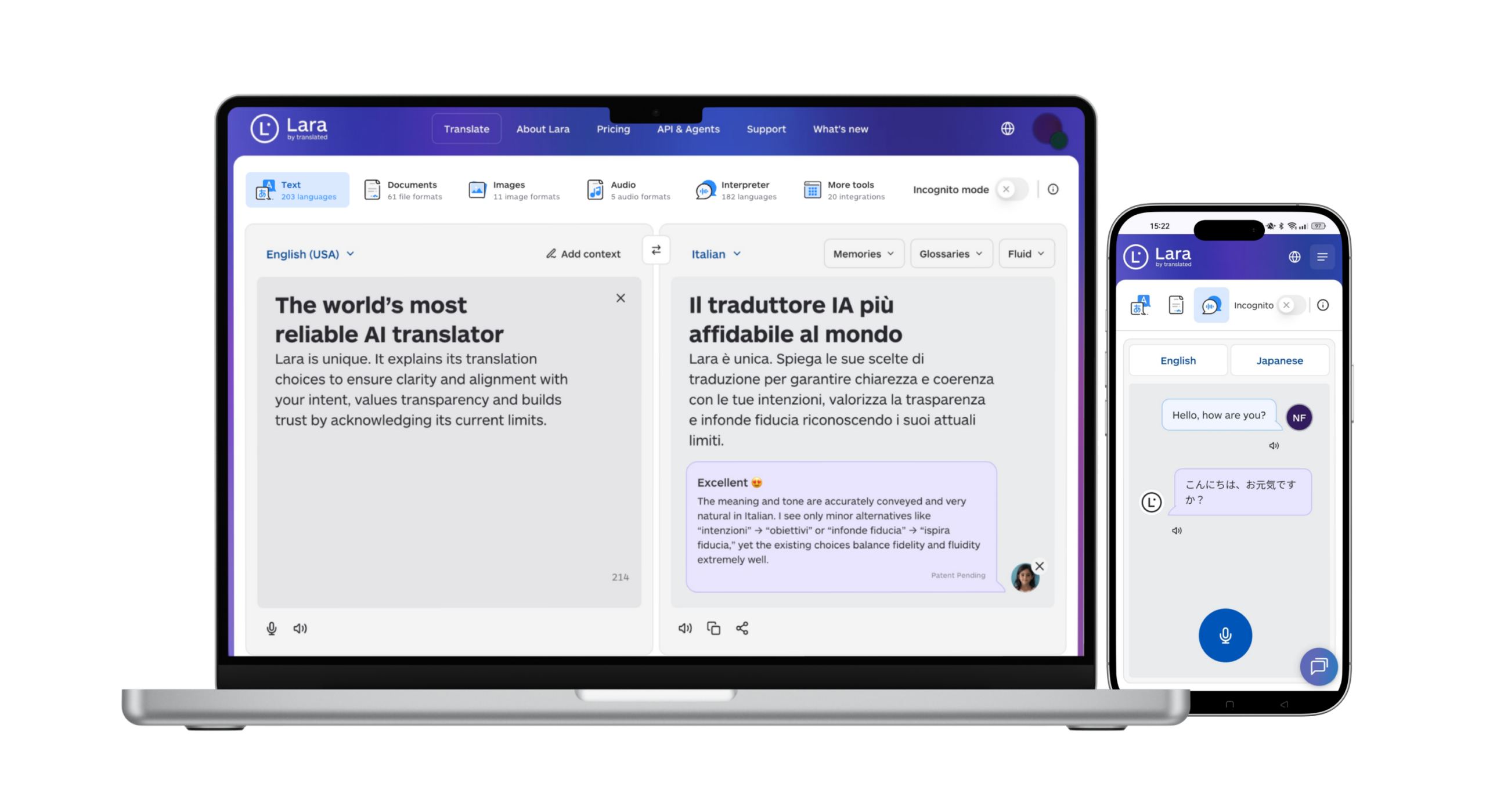
Keep coaching nuance intact across languages
From powerful questions to feedback framing, Lara Translate translates your training materials with attention to how each technique lands in the target language, not just word for word.
The bottom line for any organization scaling coaching across languages is that the framework is only as good as the language it is delivered in. A powerful question, a reflective statement, a moment of psychological safety, all of it lives in specific, culturally tuned wording. Translate that wording with the same care the original curriculum received, and the coaching keeps working across borders. Translate it literally, and the craft quietly disappears.
Have a valuable tool, resource, or insight that could enhance one of our articles?
Send us an email at press@laratranslate.com
We’ll be happy to review it and consider it for inclusion to enrich our content for our readers! ✍️
Frequently asked questions
Does coaching language translate word for word?
No. Coaching techniques such as powerful questioning and reflective listening work through precise, culturally specific wording, so a literal translation can strip a question of the exact quality that made it open and non-judgmental. The words are the mechanism, and translating them directly can make a “powerful” question read as vague, evasive, or confrontational in the target language.
What do the ICF Core Competencies say about language and listening?
The International Coaching Federation lists “Cultivates Trust and Safety” and “Listens Actively” among its eight assessed Core Competencies, grouped into four domains, with “Listens Actively” sitting inside the “Communicating Effectively” domain. Assessors evaluate how closely a coach attends to a client’s own word choice, because the exact words a client uses often carry more meaning than the general sentiment.
Why does active listening differ across cultures?
Active listening is culturally variable because the same signal can carry opposite meanings in different contexts. A pause that reads as hesitation in one culture can signal deep respect in another, and a brief, soft-spoken response can hold more emotional weight than a long, detailed one, depending on the client’s cultural background.
How should organizations translate coaching materials for global teams?
Organizations should translate coaching frameworks, curricula, and communication guidelines with attention to how each technique actually functions in the target language and culture, rather than through a literal, word-for-word conversion. That means giving managers and coaches working in a second language accurate, culturally calibrated phrasing and treating the translation with the same care as the original curriculum design.
Can translation tools handle coaching frameworks?
Translation tools built for nuance-dependent documents can handle coaching frameworks and training materials when they translate for how a technique lands in the target language rather than substituting words one for one. Lara Translate is built for this kind of work and covers coaching frameworks, training materials, and communication guidelines across 200+ languages and 60+ file formats.
This article is about
- Coaching techniques such as powerful questioning and reflective listening are precise language instruments, so their effect depends on culturally specific wording rather than the literal meaning of the words.
- Language competency is formally assessed: the ICF names “Cultivates Trust and Safety” and “Listens Actively” among its eight Core Competencies, and treats attention to a client’s exact word choice as an examined skill.
- Active listening is culturally variable, with the same pause or brevity carrying different meaning depending on the client’s cultural background.
- As coaching skills are taught to managers across global teams, literal translation of training materials can quietly break the techniques that create psychological safety.
- Coaching frameworks should be translated for how each technique functions in the target language and culture, treated with the same care as the original curriculum.
Sources
- ICF Core Competencies, International Coaching Federation
- Coach Training EDU (ICF accreditation, 4,400+ graduates trained since 2009)
- Coach Training EDU, executive coach training (Roche-Genentech case study, IBM coach testimonial)
- Lara Translate (200+ languages, 60+ file formats, built by Translated since 1999)
This article was produced by the Lara Translate content team. Lara Translate is an AI translation platform built by Translated, with more than 25 years of professional translation experience. Organizations building coaching capability across global, multilingual teams use Lara Translate to translate coaching frameworks, training materials, and communication guidelines across 200+ languages and 60+ file formats.