

Your best marketing content is already out there. The problem is that most of it is in one language, stranded in one market, invisible to the other audiences it could convert.
User-generated content (reviews, testimonials, photos, community posts) consistently outperforms brand-produced content in terms of trust. According to Bazaarvoice, 84% of consumers are more likely to trust a brand’s marketing when it features UGC. But when a company operates across multiple markets, that advantage compounds into a logistical challenge fast. You’re not just managing content volume. You’re managing language, cultural register, legal requirements, and authenticity at the same time.
UGC multilingual marketing addresses exactly this. It’s not simply running a translation tool over a batch of reviews. It’s building a systematic approach to sourcing, translating, and moderating community content (including visual content) so that what resonates in one language market can work just as hard in another, without losing the voice that made it valuable in the first place.
TL;DR
|
What is UGC multilingual marketing?
UGC multilingual marketing is what happens when brands stop treating user-generated content as a single-market asset and start treating it as a global one. The content already exists: reviews, social posts, customer photos, and community contributions. The work is building the infrastructure to source, translate, moderate, and distribute that content across language markets without losing what made it trustworthy in the first place.
The distinction from standard content localization matters. Brand-produced content starts as a controlled asset that a team writes, approves, and then translates. UGC starts as an uncontrolled signal from real customers, in their own words, in whatever language they naturally use. Handling that well requires a different approach: one that preserves authenticity, manages compliance across jurisdictions, and scales without manual bottlenecks for every piece of content.
Why UGC doesn’t scale across languages
Global brands routinely invest in producing multilingual content from scratch while overlooking the UGC they already have. The results are predictable: localized product pages that lack social proof in the local language, review sections populated only in English, and community posts that never reach audiences who don’t search in that language.
 The gap is often invisible to teams working within a single market. But for a French, Brazilian, or Japanese customer landing on a product page, a review section in English only sends a clear signal: this product isn’t for people like me. Whether or not that’s true, it affects purchasing behavior. Bazaarvoice data shows that nearly half of shoppers are less likely to buy from a brand that has no reviews on their site: remove local-language reviews from the equation, and that effect compounds.
The challenge deepens because of the nature of UGC itself. Unlike marketing copy, user-generated content carries informal language, idioms, and cultural references that require careful handling. A five-star review written in American English doesn’t automatically produce a credible, natural French translation via a generic tool. If the output reads awkwardly, the authenticity the review was supposed to provide is undermined entirely.
UGC is also not only text. Marketing assets, UI screenshots, product images with embedded copy, and visual testimonials all carry translatable content, and that content is invisible to a text-based translation workflow. A customer posts a photo with a caption overlay in English. Your Spanish audience sees an image that doesn’t speak to them. The asset exists. The reach doesn’t.
How to source UGC across language markets
Before translation enters the picture, a successful UGC multilingual marketing strategy depends on sourcing touchpoints designed for multilingual participation from the outset. Waiting for UGC to accumulate organically in each language is slow and creates uneven coverage: some markets will have abundant review depth while others have almost none.
 Proactive sourcing means designing your collection infrastructure for global participation. Review request emails sent in the customer’s preferred language generate higher response rates than English-only requests sent to non-English speakers. Post-purchase survey tools that support language targeting help segment responses by locale from day one, making the moderation step downstream significantly more manageable.
Hashtag campaigns and community challenges work well for social media UGC. A global campaign that invites participation in any language, with language-specific hashtag variants, produces a richer and more representative content pool than one that defaults to English engagement. The content collected this way is more culturally specific and, for that reason, more persuasive to local audiences.
Platform infrastructure matters too. Review aggregation tools that support Unicode character sets and right-to-left text rendering (Arabic, Hebrew, Urdu) are not niche requirements at scale. Overlooking this early leads to data loss and display issues that are expensive to fix retroactively across large content volumes.
How to translate customer reviews without losing their voice
This is where most UGC multilingual marketing programs stumble. Run reviews through a generic tool and you get output that’s technically accurate and completely unconvincing — the kind of text that reads as translated rather than written.
The core issue is the register. Customer reviews are written in spoken-language style: short sentences, colloquial vocabulary, deliberate informality. A translation approach calibrated for legal documents or product specifications produces stilted results when applied to this content type. That stilted result is visible to readers, and it erodes exactly the trust signal the review was supposed to provide.
 The practical solution is to match translation style to content type. For reviews and star-rating testimonials, a translation mode that prioritizes faithfulness to the original meaning and preserves the informal register tends to produce the most convincing output. For social captions and community posts being repurposed in paid or organic brand channels, a more fluid approach is often preferable; the priority is how the content reads to a native speaker, not strict equivalence to the source. Understanding how context-aware translation works is relevant here: a platform that distinguishes between content types produces more accurate, audience-appropriate output than one that applies a single approach to everything.
Two additional factors require attention. Volume: enterprise-scale UGC programs generate thousands of pieces of content monthly across markets, and any workflow that requires manual processing per item creates a bottleneck. Privacy: customer reviews frequently contain personal details — names, purchase contexts, location references. Translation providers handling this content need to operate under clear data retention policies that comply with GDPR and equivalent regional frameworks.
When you build a multilingual SEO strategy with translated UGC as a deliberate layer, localized review content becomes a high-value organic signal. Real customers write in natural language patterns that align with how real users search, and search engines can index that content across language markets.
Translate your UGC with Lara Translate
Test Lara Translate on a real customer review and see how Faithful style handles register, terminology, and formatting across languages.
Community content localization: the governance layer
Community content localization goes beyond translation. It’s the set of decisions and processes that determine what gets published, for which audiences, and under what conditions. Without this governance layer, multilingual UGC programs expose brands to compliance risks that grow with the number of markets they operate in.
A review that’s legally acceptable in the United States may breach advertising standards in Germany, the United Kingdom, or Australia. A testimonial referencing a specific health outcome, a price comparison, or a performance guarantee requires market-specific review before publication in that market. This doesn’t mean manually reviewing every piece of content in every language. It means designing a tiered system: automated filters catch obvious policy violations, and human review in the native language of the market is reserved for edge cases and high-profile placements.
The governance layer also covers consent management. Most jurisdictions require explicit consent before a customer’s words or image can be used in marketing materials. Multilingual UGC programs need consent infrastructure that presents terms in the customer’s language — not a universal English-language agreement attached to a review submission form. Customers who submit content in German or Korean deserve a consent process they can fully understand.
When community content localization is built as a genuine system rather than bolted on retroactively, it also signals something meaningful to customers in each market. When people see their voices represented accurately, engagement compounds over time.
Building a moderation framework that scales across languages
Moderation at scale across multiple languages is operationally intensive. Most content teams are organized by function rather than by language, which means review decisions travel through generalist workflows. The result is inconsistency: content that a native French speaker would approve gets rejected by a moderator working from an imprecise translation of the same text.

A workable framework separates moderation into three tiers.
Tier 1 — Automated screening. Language-agnostic signals — spam patterns, flagged URL structures, common-language profanity lists — pass through rule-based filters before any human review. Well-configured tools resolve a substantial share of clear-cut cases at this level without language-specific overhead.
Tier 2 — Language-aware automated review. Translation combined with sentiment analysis and policy checks runs on the localized version of the content, flagging items that pass the first tier but raise market-specific concerns. Translation quality is critical here: low-accuracy translation produces false positives that overload human reviewers downstream and slow the entire pipeline.
Tier 3 — Human escalation. Native-language reviewers handle edge cases and high-stakes placements. At scale, this typically combines in-house specialists with localization partners, operating against clear SLAs per language region.
The framework doesn’t need to be built simultaneously across every market. Prioritize by volume and risk, then expand the tier structure incrementally as your UGC multilingual marketing program grows into new regions.
How Lara Translate supports multilingual UGC workflows
For teams running UGC multilingual marketing programs at scale, translation quality and throughput are not optional criteria. They’re the foundation on which review credibility rests in every language market.
Lara Translate offers three translation styles: Faithful, Fluid, and Creative. For UGC workflows, this distinction matters in practice. Faithful style keeps the source meaning and register intact — preserving what makes a review convincing to local audiences. For social media content and community posts being repurposed across brand channels, Fluid style produces output that reads naturally in the target language rather than as a translation. Lara Translate covers 200+ languages and 42,000+ language pairs, which means most enterprise UGC programs can route all language combinations through a single translation environment rather than managing multiple providers.
Text and document UGC
Lara Translate supports 72 file formats in total — including DOCX, PDF, HTML, XLIFF, and JSON. Teams exporting bulk review data from review platforms or CMS systems can run those files directly through the translation pipeline without manual extraction or reformatting.
Visual UGC: image translation
UGC is not only text, and a text-based pipeline will miss a significant share of translatable content. Product images with embedded copy, user-submitted screenshots, marketing assets, and visual testimonials all carry text that needs to reach audiences in their own language.
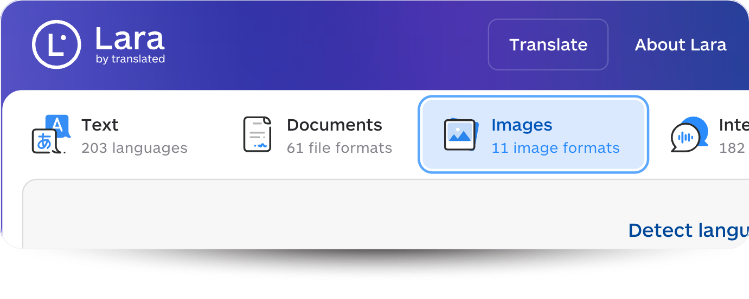
Lara Translate handles this through image-to-image translation. It extracts text from a standalone image using OCR, translates it, and returns the image in the original format — with layout and positioning preserved as closely as possible. Supported formats include AVIF, BMP, GIF, HEIC, HEIF, PNG, JPG, JPEG, TIF, TIFF, and WEBP. Image translation has its own dedicated tab in the Lara Translate navigation, separate from the document workflow, which means faster access for teams that regularly handle visual UGC.
Image translation via API
For teams automating UGC translation end to end, the Lara Translate API exposes image translation alongside text and document translation within a single integration. It supports SDKs in Python, Node.js, PHP, and Java, and is designed for context-aware output — meaning the translation adapts based on instructions, translation memories, and glossaries you provide, rather than defaulting to generic output.
Image translation via the API bills at a flat rate of 1,500 characters per image, regardless of how much text the image contains. That fixed per-image cost makes budget planning straightforward for high-volume visual UGC workflows. Full documentation is available at the Lara Translate Developer Hub.
Privacy
For content containing personal customer information — names, purchase details, location references — Lara Translate’s Incognito Mode processes translations without retaining data, making it a practical fit for privacy-sensitive UGC workflows operating under GDPR. The platform applies TLS encryption and restricted access controls across all processing, with full GDPR compliance throughout.
Making translated UGC work in practice
Having translated and moderated content is only part of the equation. The operational loop closes when translated UGC is published to the right placement, indexed appropriately for local search, and fed back into the sourcing system to fill coverage gaps in emerging language markets.
Audit the distribution of your UGC corpus regularly. Languages with thin coverage need targeted sourcing campaigns. Languages with strong review volume but inconsistent translation quality are candidates for workflow improvements at the translation stage — not the publishing stage. The program improves most quickly when the moderation and sourcing teams share data about coverage gaps, not just approved content.
UGC multilingual marketing is a compounding investment. The community content you build and localize in year one reduces acquisition costs in year two and beyond — if the translation layer is strong enough to make that content credible and trustworthy in every language market it reaches.
The UGC advantage is real. It’s just not evenly distributed across markets until someone builds the system to make it so. Start with the language markets where you have the most review volume, run it through a translation workflow designed for informal register, and build outward from there. The infrastructure is the work. The content already exists.
Scale your UGC across every language market
Lara Translate handles reviews, images, and community content in 200+ languages — with Incognito Mode for GDPR-sensitive workflows and a full API for automated pipelines.
FAQ
What is UGC multilingual marketing?
UGC multilingual marketing is the practice of sourcing, translating, and moderating user-generated content — customer reviews, testimonials, social media posts, and images — so it reaches and converts audiences across multiple language markets. It combines translation quality, cultural localization, and compliance governance into one operational system.
How do you translate customer reviews without losing authenticity?
Match translation style to content type. For reviews, a Faithful translation style preserves the original register and informal tone — the qualities that make a review feel real to the reader. Generic MT tools default to formal, document-style output, which signals “translated” to native speakers and erodes trust. Using a platform that allows style selection per content type, combined with glossaries for product terminology, produces output that reads as written rather than processed.
What are the legal risks of using UGC across different markets?
A review that’s compliant in one country may breach advertising standards in another. Testimonials referencing specific health outcomes, performance guarantees, or price comparisons often require market-specific legal review before publication. Beyond content claims, consent is a separate concern: customers must agree — in their own language — to have their words or images used in marketing materials. GDPR and equivalent frameworks in other regions impose strict rules on how personal data within UGC can be processed and retained during translation.
Can Lara Translate handle image translation for visual UGC?
Yes. Lara Translate’s image-to-image translation extracts text from images using OCR, translates it, and returns the image in the original format with layout preserved. It supports AVIF, BMP, GIF, HEIC, HEIF, PNG, JPG, JPEG, TIF, TIFF, and WEBP. For automated pipelines, image translation is also available via the Lara Translate API at a flat rate of 1,500 characters per image.
How do you build a moderation framework for multilingual UGC at scale?
A practical framework runs three tiers: automated screening for language-agnostic violations, language-aware automated review using translation plus sentiment and policy checks, and human escalation by native-language reviewers for edge cases and high-stakes placements. Build it by market priority and expand incrementally — trying to stand up all tiers across every language simultaneously is the fastest way to stall the program before it produces results.
Have a valuable tool, resource, or insight that could enhance one of our articles? Submit your suggestion
We’ll be happy to review it and consider it for inclusion to enrich our content for our readers! ✍️
This article is about
- What UGC multilingual marketing is and why it requires a different approach than standard content localization
- Why user-generated content stranded in one language fails to convert in other markets
- How to source UGC across language markets from the outset, rather than retrofitting coverage later
- How to translate customer reviews while preserving the informal register that makes them trustworthy
- How to build a tiered moderation framework that scales across languages without overloading human reviewers
- How Lara Translate handles text, document, and visual UGC translation — including image-to-image translation and API access — in one environment