

A fintech’s engineering team scopes out an integration with one accounting tool, ships it after months of work, and then discovers their next enterprise prospect uses a completely different system with its own API quirks, error codes, and field names. Multiply that across a dozen accounting platforms and the integration backlog quietly becomes the biggest drag on the product roadmap, not the product itself.
Unified API platforms for accounting integrations give teams a shared interface for supported accounting systems, reducing the number of separate integrations they maintain. This guide compares accounting APIs alongside related integration tools, with attention to connector coverage, data freshness, supported operations, and pricing. It also explains where translation can help teams working with documentation and user-facing content from local software markets.
|
TL;DR
|
What makes a unified API platform worth using in 2026?
Accounting unified APIs normalize supported systems behind a common data model. The wider integration market also includes employment-data APIs, developer infrastructure, and workflow automation platforms. These solve related problems, but they are not interchangeable: check the accounting objects and operations your product actually needs before comparing catalogue size.
Live requests and synchronized datasets offer different operating models. A live request depends on the source API’s availability and limits, while a synchronized dataset has a freshness window determined by its refresh process. Test the behavior of the particular connector and endpoint, including refresh controls and write confirmation.
Broad, US and UK-centric coverage and deep, fragmented-market specialization solve different geographic problems. Merge offer accounting connectors that should be evaluated against your customer list, while Chift specializes specifically in the fragmented European accounting landscape, where many countries rely on their own local, country-specific tools.
Horizontal, multi-category platforms and accounting-specific specialists trade off breadth against depth. Merge and Unified.to span many categories including HRIS, ATS, and CRM alongside accounting, while platforms built specifically around accounting and financial data can offer deeper coverage within that narrower scope.
Lending features and general-purpose accounting access serve different use cases. Codat provides underwriting and monitoring tools, including financial ratio calculations. If you only need invoice or payment synchronization, compare the supported objects and operations before paying for additional analytical capabilities.
Schema normalization and language translation are separate tasks. A common API model can standardize field structures, while documentation, free-text descriptions, and user-facing messages may still need localization. Check what is already available in each language, then translate the human-readable content that your team or customers need.
Unified APIs and related integration platforms compared
Kombo and Finch focus on employment data, while Nango and Workato provide broader integration infrastructure or automation. They are included for related requirements, not as equivalent accounting API replacements.
| Platform | Best for | Model | Pricing |
|---|---|---|---|
| Merge | Multi-category integrations alongside accounting | Horizontal multi-category unified API | Free linked-account allowance; paid and contract plans |
| Codat | SME lending and banking-focused financial ratios | Accounting-focused unified API for lenders | Custom, contact sales |
| Chift | Deepest coverage of fragmented, country-specific European accounting tools | European-focused unified API | Custom, contact sales |
| Rutter | Financial products connecting commerce and accounting | Commerce and accounting unified API | Custom, sales-led |
| Unified.to | Real-time integrations across multiple software categories | Real-time passthrough unified API | Grow from $750/month, including 750,000 API calls |
| Kombo | HRIS, ATS, payroll, assessment, and LMS integrations | HR-focused unified API | Custom, contact sales |
| Nango | Teams building customized API integrations | Developer integration infrastructure with self-hosting options | Free tier; pay-as-you-go from $50/month; custom Enterprise |
| Workato | Complex enterprise workflow automation across dozens of tools | Enterprise workflow automation platform | Custom, contact sales |
| Finch | Employment data specialists needing payroll and benefits sync | HR and payroll-focused unified API | Custom, contact sales |

Merge
Best for: SaaS teams wanting accounting alongside HRIS, ATS, CRM, and other integrations.
Merge provides common data models across multiple categories and tools for managing customer connections. It is relevant when one product needs several kinds of business data; confirm accounting coverage and synchronization behavior separately from the other categories.
Pricing: A free production linked-account allowance is available, followed by paid and contract-based plans. Check the current limits and pricing for your deployment.
Verdict: Consider Merge when HRIS and ATS integration depth matters as much as, or more than, accounting coverage.
Codat
Best for: Lenders and financial products needing accounting data for underwriting.
Codat connects accounting, banking, and commerce data and offers underwriting and monitoring capabilities, including financial ratio calculations. It also serves use cases such as bill pay and bank feeds, so select the product that matches your workflow.
Pricing: Custom, contact sales.
Verdict: Consider Codat when SME lending features and pre-built financial ratios directly serve your product’s core use case.
Chift
Best for: SaaS and fintech companies needing deep coverage of fragmented, country-specific European accounting tools.
Chift offers a Unified API connecting to more than 40 European accounting systems alongside point-of-sale, ecommerce, invoicing, payment, and property management software categories, standardizing data from tools that are often specific to a single country, including Sage, Cegid, ACD, Pennylane, and MyUnisoft. The platform supports bi-directional data flows, letting information sync back into accounting software to reflect payments and transfers rather than only pulling data out. Chift’s marketplace lets a one-click connector go live in minutes, with a real-time usage dashboard, transaction logs, and automated alerts for monitoring integration health, alongside AI-powered search across its unified documentation. The platform is ISO 27001 certified, GDPR compliant, and hosted within Europe.
Pricing: Custom, contact sales.
Verdict: Consider Chift when your customers rely on fragmented, country-specific European accounting tools that broader, US and UK-centric platforms don’t cover as deeply.
Rutter
Best for: Financial products connecting commerce, payments, and accounting data.
Rutter provides unified APIs for business financial workflows across these categories. Evaluate the supported objects, write operations, and completion behavior for each connector instead of assuming every operation runs synchronously.
Pricing: Custom, sales-led.
Verdict: Consider Rutter when your product needs connected commerce and accounting workflows and its supported operations meet your requirements.
Make integration guidance accessible across languages
Use Lara Translate to translate setup guides, support articles, and user-facing explanations while keeping technical identifiers and code unchanged.
Unified.to
Best for: Teams wanting real-time integrations across multiple software categories.
Unified.to provides unified endpoints and passthrough capabilities across accounting and other categories. Evaluate request behavior, logging, synchronization options, and data-handling settings for your chosen features rather than treating every part of the service as having identical storage behavior.
Pricing: Grow starts at $750 per month with 750,000 API calls included. Additional usage and higher plans affect the total.
Verdict: Consider Unified.to when broad category coverage and its real-time request model match your application.
Kombo
Best for: Products needing HRIS, ATS, payroll, assessment, or learning-system integrations.
Kombo specializes in employment and recruiting-related software. It belongs on the shortlist when those data categories are required alongside a financial product, rather than as a substitute for accounting ledger connectors.
Pricing: Custom, contact sales.
Verdict: Consider Kombo for employment and recruiting integrations; evaluate an accounting API separately when you need ledger data.
Nango
Best for: Engineering teams building customized API integrations.
Nango provides authentication, integration execution, tools, and synchronization infrastructure. It offers hosted plans and Enterprise self-hosting options. Teams should expect to design or adapt integration logic rather than assume a single accounting schema covers every required workflow.
Pricing: Free tier available. Pay-as-you-go starts at $50 per month with usage credits; Enterprise pricing is custom and includes self-hosting options.
Verdict: Consider Nango when you need control over integration logic and infrastructure, with engineering resources to maintain the implementation.
Workato
Best for: Enterprises needing complex workflow automation across dozens of tools beyond accounting alone.
Workato serves broader enterprise workflow automation needs spanning many more tool categories than accounting-focused unified APIs, suiting organizations with complex, cross-functional automation requirements.
Pricing: Custom, contact sales.
Verdict: Consider Workato when broad, cross-functional workflow automation is the actual scope of your integration needs.

Finch
Best for: Products needing employment data specifically, including payroll, benefits, and time tracking.
Finch connects to a wide range of payroll, HR, benefits, and time-tracking systems, appealing to products whose data needs center on employment information rather than accounting or commerce.
Pricing: Custom, contact sales.
Verdict: Consider Finch when employment data, not accounting or commerce data, is the core integration need for your product.
How to choose the right unified API platform
Confirm which accounting systems your actual customer base uses. Map the connectors offered by each shortlisted provider to that list; Chift specializes in fragmented, country-specific European accounting software.
Test data freshness and write behavior. Check refresh controls, source-system limits, event notifications, and confirmation that a write has completed. A platform-level architecture label does not establish how every connector behaves.
Check whether you need broad, multi-category coverage or accounting-specific depth. Merge and Unified.to span many categories at once; platforms built specifically around accounting can offer deeper coverage within that narrower scope.
Confirm whether lending-specific features matter. Financial ratios and monitoring can be useful for underwriting products. General accounting synchronization may instead depend on detailed invoice, payment, tax, and account mappings.
Plan for multilingual documentation and support. Translate the human-readable content your developers and customers need, while keeping API keys, identifiers, numerical values, and machine-readable structures unchanged.
Connecting multilingual integration workflows with Lara Translate
Lara Translate can complement an accounting integration by translating documentation, onboarding instructions, and human-readable error explanations. For a custom workflow, send only selected text fields to the Lara Translate API, apply glossaries for accounting and product terminology, then return the reviewed translation to your interface or help center.
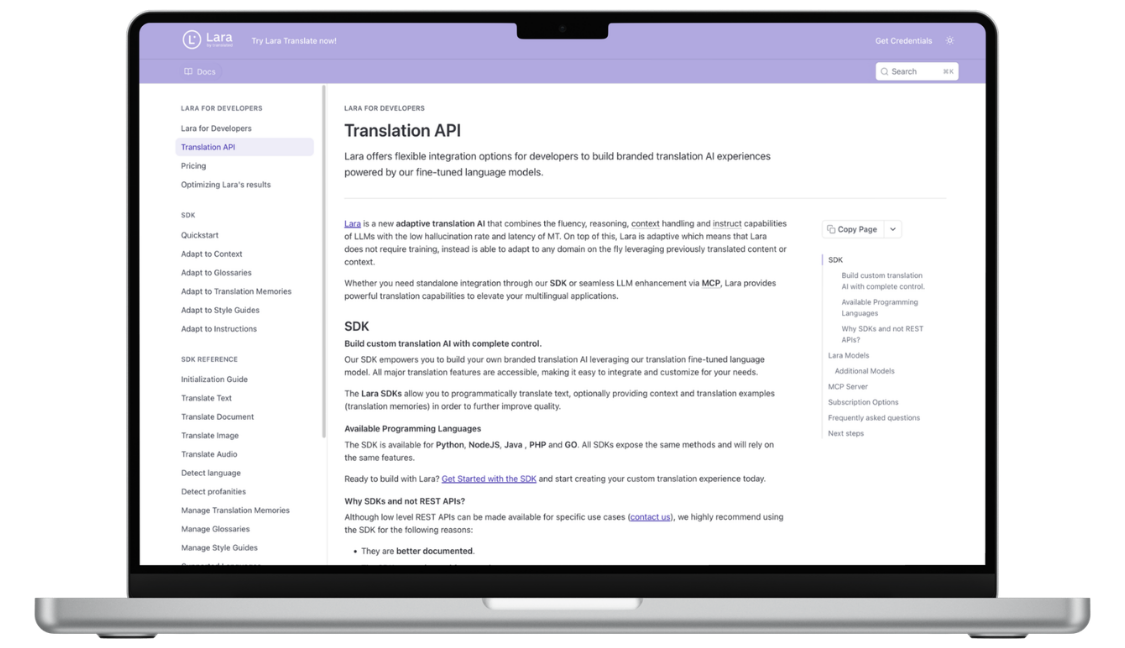
Keep the original source text available for troubleshooting. Preserve schema keys, account codes, IDs, amounts, currency codes, and dates exactly, and avoid translating machine-readable payloads wholesale. This requires implementation in your application or automation system; it does not imply a native integration with the providers above.
Support users beyond a shared data model
Prepare integration documentation and support content with Lara Translate across 200+ languages, then review terminology before publishing.
Conclusion
Choose an integration platform from the systems, objects, and operations your customers actually require. Validate the difficult cases in a pilot, including authentication, writes, refresh timing, and error recovery. For international deployments, treat documentation and user-facing translations as a separate layer with its own review process.
Have a valuable tool, resource, or insight that could enhance one of our articles?
Send us an email at press@laratranslate.com
We’ll be happy to review it and consider it for inclusion to enrich our content for our readers! ✍️
Frequently asked questions
What is a unified accounting API?
It provides a common interface and data model for supported accounting systems. Your application uses shared endpoints, while the provider handles parts of the connection and mapping work. Coverage still varies by system, object, and operation.
How do I compare accounting API connector coverage?
Check the exact systems and versions your customers use, then inspect support for invoices, payments, accounts, tax fields, and other required objects. Test both reads and writes where needed. A connector logo alone does not establish support for your complete workflow.
What is the difference between live API access and synchronized data?
Live access requests information from the source system when the request runs. A synchronized dataset reflects the latest completed refresh. Evaluate freshness, response time, source availability, rate limits, and refresh controls for the specific operation you need.
How much do unified API platforms cost?
Pricing may depend on customer connections, linked accounts, API calls, execution time, or a contract. Compare the same expected workload across providers, including overages, onboarding, support, and any infrastructure costs. Confirm how testing and inactive connections are billed.
Can an HR or payroll API replace an accounting API?
Only if the data you need is employment-related. Payroll and HR connectors may support employee or payroll records, but they do not automatically provide ledger, invoice, or payment functionality. Choose connectors according to the business objects your application requires.
How should teams translate accounting integration content?
Translate selected human-readable content such as documentation, onboarding instructions, and error explanations. Preserve numerical values, identifiers, schema keys, and machine-readable codes. Keep the original text available and review accounting terminology before showing translations to users.
This article is about
- Selecting accounting APIs by customer systems and required operations.
- Distinguishing accounting connectors from employment APIs and integration infrastructure.
- Evaluating data freshness, synchronization, and write completion.
- Testing geographic coverage at the individual software and connector level.
- Comparing pricing against connections, usage, support, and deployment costs.
- Translating human-readable integration content while preserving machine-readable data.
Useful links
This article was produced by the Lara Translate content team. Lara Translate is an AI translation platform built by Translated, with more than 25 years of professional translation experience. Engineering and support teams can use Lara Translate to translate integration documentation and human-readable support content, across 200+ languages and 60+ file formats.