

Pick the wrong translation API and you find out in production, not on the pricing page: the layout of a translated PDF collapses, a glossary term you spent a week agreeing on gets ignored across ten thousand strings, or a rate limit throttles your traffic on launch day. Comparing a dozen vendors on published specs alone surfaces none of that.
For teams shipping a product that touches real files, not just text strings, Lara Translate is the strongest all-in-one option. It pairs neural machine translation with an optional human validation layer, covers 200+ languages, and handles 61 document formats natively, which puts it ahead of single-purpose engines when documents, images, and audio all pass through the same pipeline.
That said, no single API wins every job. Your shortlist should also include:
- A hyperscaler (Google Cloud Translation, Microsoft Translator, or Amazon Translate) when raw language coverage and published SLAs matter more than nuance.
- A specialist NMT engine (DeepL API) when your traffic is concentrated in European language pairs and tone control counts.
- A self-hosted or open-source option (LibreTranslate) when data residency or per-character cost outweighs everything else.
TL;DR
|
Key Takeaways
Lara Translate wins on document fidelity and human validation, while hyperscalers win on raw language coverage and published SLAs, so the right choice depends on which trade-off your product can least afford.
| Point | Details |
|---|---|
| Match tool to job | Use NMT for volume, LLM-based translation for nuance-critical content, self-hosted for data residency. |
| Test before committing | Run glossary, document roundtrip, and concurrency tests during any trial period. |
| Free tiers shift often | Confirm current allowances directly on vendor pricing pages before budgeting. |
| Rate limits vary widely | DeepL Pro caps around 50 requests per second; hyperscalers typically offer configurable quotas. |
| Lara Translate fits document-heavy teams | Its 61 file formats and human validation option suit teams needing format fidelity and quality assurance together. |
What Is the Best Translation API for Developers Right Now?
Choosing a translation API shortlist starts with matching the tool to the job, not the other way around. Below is a practical rundown of what each API actually offers, starting with Lara Translate because its combination of document fidelity and human-in-the-loop review addresses a gap most pure-NMT services leave open.
Lara Translate supports 200+ languages and 61 document file formats, plus 11 image formats and 5 audio formats, all through an API built for developers who need format fidelity, not raw strings alone. It offers optional human validation from professional linguists, adaptive models that improve with real usage, glossary and translation-memory support, and an incognito mode for privacy-sensitive workloads. Best for: teams that need document and file-format integrity alongside a quality upgrade path via human review.

Google Cloud Translation API gives you some of the widest language coverage in the market alongside AutoML custom models and SDKs across nearly every major programming language. The free tier covers the first 500,000 characters per month, with Basic tier pricing around $20 per 1M characters and higher rates for Advanced and custom-model usage. Best for: global products that need enterprise SLAs and the broadest possible language footprint.
DeepL API is the specialist most engineering teams reach for when European language quality is the priority. Its formality controls and phrasing quality on languages like German, French, and Polish are frequently cited as a step above general-purpose engines, and its rate limits, including roughly 50 requests per second on DeepL Pro, support real production load. Best for: marketing and business content in European language pairs.
Microsoft Translator API (Azure) fits naturally into any Azure-native stack, with Custom Translator for domain-specific terminology and a recurring free tier reported around 2M characters per month in third-party comparisons (always confirm current limits on Microsoft’s own pricing page). Best for: teams already running on Azure who want predictable pricing and native integration.
Amazon Translate is built for throughput inside AWS pipelines, triggering off S3 events and Lambda functions for document-heavy batch jobs. Best for: high-volume, event-driven translation inside an existing AWS architecture.
Systran Translate API offers on-premise and cloud deployment options with a long history in enterprise and government localization work, appealing to organizations that want a vendor with deep customization tooling for regulated industries.
Smartling API ties translation directly into a broader localization management workflow, useful for teams managing ongoing multilingual content pipelines rather than one-off API calls.
Langbly API and apilayer Language Translation API serve lighter-weight integration needs, wrapping simpler REST endpoints for teams that want translation as a small feature rather than a core platform capability.
LibreTranslate API is the open-source, self-hostable option. You trade convenience for full data control and low per-character cost, but you own the infrastructure and maintenance.
MyMemory Translation API draws on a large translation memory database and works well for lightweight or low-budget prototyping.
Yandex Translate API covers Russian and Eastern European language pairs particularly well, a niche strength for regionally focused applications.
IBM Watson Language Translator brings enterprise contract terms and domain-adaptation features geared toward regulated industries already inside the IBM Cloud ecosystem.
Baidu Translate API leads on Chinese-language pairs and is often the practical choice for products targeting the Chinese market specifically.
| API | Free Tier | Price per 1M Chars | Languages | Document Support | Customization | Best For |
|---|---|---|---|---|---|---|
| Lara Translate | Free plan available | Tiered subscription | 200+ | 61 formats | Glossaries, memory, adaptive models | Document-heavy workflows needing human validation |
| Google Cloud Translation API | 500K chars/month | ~$20 (Basic) | 189+ | Docs via Advanced tier | AutoML custom models | Widest coverage, enterprise SLAs |
| DeepL API | Limited free tier | Tiered by volume | 30+ | DOCX, PPTX, PDF, more | Glossaries, formality settings | European-language business content |
| Amazon Translate | Limited free tier | Tiered by volume | 75+ | Batch document jobs | Custom terminology | AWS-integrated, high-throughput systems |
| Systran Translate API | Trial available | Custom/enterprise | 50+ | Enterprise document tools | On-prem, custom engines | Regulated enterprise localization |
| LibreTranslate API | Self-hosted, free | Infrastructure cost only | 30+ | Limited | Self-hosted models | Data sovereignty and cost control |
Test the API on your own files first
Send a real document through, glossary and all, and see whether the layout survives before you commit.
How Should You Choose a Translation API for Your Stack?
Match the decision to your actual constraints, not a features checklist. High-volume, latency-sensitive workloads point toward NMT APIs like Google, DeepL, or Lara Translate. Nuance-critical content, such as legal summaries or brand voice work, often benefits from routing through an LLM-based approach selectively, since LLM translation tends to be slower and pricier per character but more context-aware. Strict data residency requirements push you toward self-hosted options like LibreTranslate.
Before committing, run this six-step checklist during your trial period:
- Translate a real sample from your own content, not a demo string, and grade it against a human reference.
- Test glossary behavior with your actual terminology list.
- Round-trip a formatted document (DOCX or PDF) and check whether layout survives.
- Simulate concurrent requests to see how rate limits actually behave under load.
- Force an error (bad auth token, oversized payload) and check how gracefully the API responds.
- Ask sales or engineering directly about SLA terms, data residency, and whether a signed DPA is available.
Pro Tip: Build a fallback chain into your integration from day one, routing to a secondary provider if your primary API times out or hits a rate limit. This single design choice prevents a translation outage from becoming a customer-facing incident.
How We Compared These Translation APIs
This comparison relies on public, verifiable signals: official documentation and pricing pages, SDK availability across languages, published rate-limit and batch-processing documentation, sample translation output, and third-party benchmark writeups. Quality and cost were weighed against real integration patterns rather than marketing claims.
Run your own 48-hour proof of concept: translate representative documents, measure post-edit minutes per 1,000 words, and push a concurrency spike to surface hidden rate-limit or billing issues before you commit.
What Does Lara Translate Actually Offer?
Lara Translate’s API gives developers access to a full translation stack, not a bare text-in, text-out endpoint:
- 200+ supported languages with adaptive models that improve through real professional translations.
- 61 document file formats, 11 image formats, and 5 audio formats.
- Live voice interpretation across 182 languages for in-person conversations and meetings.
- Optional human validation by professional linguists for quality-critical content.
- Glossaries, translation memory, and an incognito mode for privacy-sensitive projects.
Full API documentation and sign-up details are available through Lara Translate’s developer hub.
A practitioner’s view on choosing between approaches
Most teams overthink this decision. If you already run on Azure or AWS, start with the native translator and only look elsewhere if quality complaints pile up. If compliance or terminology precision drives your product, an API with human validation and glossary control, like Lara Translate, closes gaps that pure NMT leaves open. Team size and existing cloud stack decide more of this than benchmark scores do.
The Bottom Line
There is no universal winner, only the right fit for your constraint. Hyperscalers give you coverage and SLAs, DeepL gives you European-language tone, LibreTranslate gives you data control, and Lara Translate gives you document fidelity with an optional human layer. Decide which of those you can least afford to get wrong, then trial the top candidate on your own content before you write a line of integration code.
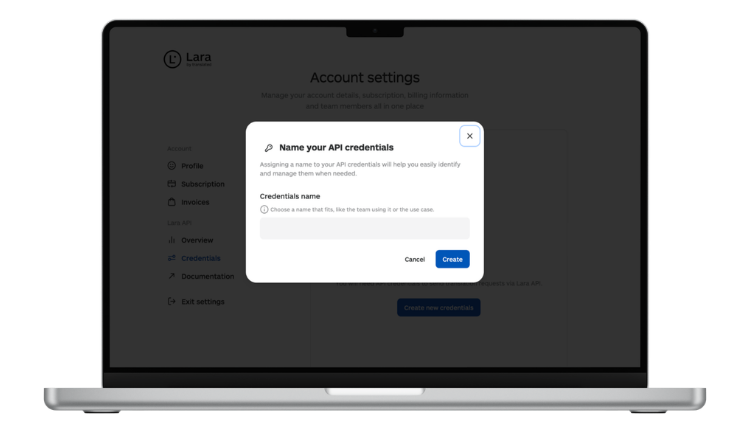
Get Started With Lara Translate’s Translation API
If you have been weighing hyperscalers against specialist engines, Lara Translate gives you a third path: translation quality backed by optional human review, without stitching together separate tools for documents, images, and audio.
For developers building anything beyond simple text strings, that combination of 61 supported document formats and an adaptive model that improves with real usage matters more than a marginally cheaper per-character rate. It also plays well with content teams thinking past translation into multilingual SEO strategy, since format-accurate translation feeds directly into how well localized content performs in search.
Grab an API key and run your first translation
Documents, images, and audio through one endpoint, with human review on demand.
Have a valuable tool, resource, or insight that could enhance one of our articles?
Send us an email at press@laratranslate.com
We’ll be happy to review it and consider it for inclusion to enrich our content for our readers! ✍️
FAQ
Is ChatGPT Better Than DeepL for Translation?
ChatGPT and similar LLMs often produce more context-aware, tone-sensitive output, but they run slower and cost more per character than dedicated NMT APIs like DeepL, which is why most production systems use NMT for volume and LLMs selectively for nuance.
Which Translation API Is Free?
LibreTranslate is free to self-host, and most major providers, including Google Cloud Translation, Microsoft Translator, and Lara Translate, offer limited free tiers or trial allowances for testing before you commit to a paid plan.
Is Microsoft Translator API Free?
Microsoft Translator offers a recurring free tier reported around 2 million characters per month in third-party comparisons, though you should confirm current limits directly on Microsoft’s pricing page since terms change.
Is the Google Translate API Free?
Google Cloud Translation’s free tier covers the first 500,000 characters per month, and Basic tier pricing runs around $20 per 1 million characters, with higher rates for Advanced and custom-model usage.
Which Translation API Handles Documents Best?
For teams whose workload is mostly formatted files, Lara Translate is built around document fidelity, supporting 61 document formats natively plus image and audio formats, with optional human validation for quality-critical content.
This article is about
This article is about choosing the best translation API for developers in 2026. It compares Lara Translate, Google Cloud Translation, DeepL, Microsoft Translator, Amazon Translate, LibreTranslate, and other engines across language coverage, document format support, pricing, rate limits, and data residency, and it lays out a trial checklist for testing any API on your own content before you integrate it.
Sources
- Cloud Translation | Google Cloud
- Best Translation APIs · APIbenchmarks
- Top 10 AI Translation APIs in 2026 (Tested & Compared) | EdenAI
- Translation AI for Developers: API Comparison and Integration Guide | NLLB
Recommended
- Adaptive Translation API | Lara Translate
- Document Translation | Lara Translate
- AI + Human Translation | Lara Translate
- Best Translation Management Systems, Compared