

You can translate a page perfectly and still have it rank for nothing. That is the trap most teams fall into: they pour budget into high-quality body copy, then leave the title tag, slug, and hreflang in English, and wonder why the page never shows up in local search.
SEO translation is the process of adapting your content and every SEO signal, title tags, metadata, URL slugs, structured data, and internal links, for a target language and market so translated pages can rank and convert. Literal translation fails because search intent rarely maps word-for-word across languages. Your three immediate next steps: audit one priority landing page for untranslated metadata, run keyword research in the target language using a tool like TheSEOLabs’ keyword translator, and configure a test hreflang tag for your highest-traffic locale.
TL;DR
|
- Audit a priority page: Check title tag, meta description, URL slug, image alt text, and schema fields for untranslated or machine-translated strings.
- Run local keyword checks: Use target-language search tools to find actual search terms, not translated versions of your English keywords.
- Set up a test hreflang: Implement
hreflangon one URL pair, verify in Google Search Console, and confirm bidirectional annotation before rolling out site-wide.
What is SEO translation and why does it matter for organic visibility?
SEO translation is the discipline of rendering content into a target language while adapting every ranking signal, keyword targeting, metadata, URL structure, and structured data, to match local search intent. It sits at the intersection of content localization and technical SEO, and it is the reason two pages with identical body copy can produce radically different organic results depending on how their metadata and signals were handled.
The scale of the opportunity is significant. Statista’s data on the number of websites online shows the web has grown to hundreds of millions of active sites, and competition for organic visibility in any single language is already intense. Expanding into additional languages multiplies your addressable audience without new product development. English accounts for a large share of online content, but the majority of internet users search in other languages, which means English-only sites leave most of the global search market untouched.
The core risk of literal translation: A page translated word-for-word may be grammatically correct but functionally invisible. If the translated title tag uses a phrase no one in the target market types into a search engine, the page will not rank for anything meaningful, no matter how strong the original English page performs.
When translated pages lose visibility, the cause is almost always one of three things: keywords that don’t match local search behavior, metadata left in the source language, or technical signals (hreflang, canonical tags) that are missing or misconfigured. Geotargetly’s SEO translation guide confirms that aligning metadata and URL slugs with local search intent is the single highest-leverage step teams consistently overlook.
How does SEO translation differ from localization and international SEO?
SEO translation, localization, and international SEO are related but distinct: SEO translation adapts content and ranking signals for the target language; localization adapts the full user experience for the target culture; and international SEO governs the global site architecture that enables both.
The practical difference matters for assigning ownership:
- SEO translation covers keyword research in the target language, on-page element adaptation (title tags, meta descriptions, alt text, slugs), and metadata alignment with local intent. Owned by the SEO team and localization PM, with input from native-language reviewers.
- Localization goes further, adapting cultural references, date and currency formats, imagery, legal disclaimers, and tone so the content feels native rather than translated. The Roadmap’s guide to SEO-friendly website translation notes that adapting visuals and units alongside text is what separates a localized page from a translated one. Owned by the localization PM, design, and legal.
- International SEO sets the structural foundation: subdomain vs. subdirectory vs. ccTLD decisions, hreflang implementation, canonical strategy, and crawl budget management. Owned by the SEO lead and engineering, with the localization PM as a stakeholder.
Where teams go wrong is treating these as sequential phases rather than parallel workstreams. Engineering ships the URL structure before SEO has finalized the hreflang strategy. Localization translates body copy before SEO has confirmed the target keywords. The fix is a shared kick-off document that locks in URL structure, target keywords, and hreflang configuration before any translation work begins.
Pro Tip: Create a single “SEO translation brief” for each target locale that specifies the URL slug, title tag, meta description, primary keyword, and hreflang value before the translation job is created in your TMS. This prevents the most common rework cycle in multilingual projects.
How do you research keywords for multilingual SEO content?
Always run keyword research in the target language and region before translating. The English keyword and its literal translation almost never share the same search volume, intent, or competitive landscape.
| Source keyword (EN) | Local keyword (ES-MX) | Intent |
|---|---|---|
| running shoes | zapatillas de running | Commercial |
| how to choose running shoes | cómo elegir zapatillas para correr | Informational |
| best trail running shoes | mejores zapatillas trail running | Commercial/Navigational |
| running shoe size guide | guía de tallas zapatillas | Informational |
The workflow that produces reliable keyword maps has three stages:
- Seed keyword generation: Start with your top-performing English keywords. Use a tool like TheSEOLabs’ free keyword translator to get an initial list of local equivalents with search volume and CPC data. Treat this as a starting point, not a final list.
- Native reviewer sign-off: Have a native speaker or professional linguist confirm that the shortlisted keywords sound natural and carry the intended commercial or informational intent. DigitalApplied’s international SEO guide warns explicitly against relying on literal keyword translation, noting that intent often shifts when a phrase crosses language boundaries.
- Volume and competition validation: Pull local search volume and keyword difficulty for the shortlisted terms, then map each approved keyword to a single target URL. This last step is what stops two translated pages from competing for the same query and confirms the demand is real before any content is created.
The Statista language distribution data is useful at the prioritization stage: languages with larger online audiences generally offer higher traffic ceilings, but your own analytics data on existing international traffic should override any generic ranking when deciding which locale to tackle first.
Pro Tip: Before committing to a full translation project, map your top 20 English keywords to local equivalents and check their search volumes. If the local volume is negligible, the market may not be ready, or you may be targeting the wrong language variant (for example es-ES vs. es-MX).
Translate a priority page without losing SEO signals
Run one landing page through Lara Translate’s AI plus human validation workflow and see how it handles metadata, glossary terms, and intent before you commit to a full rollout.
What technical SEO configuration does a multilingual site require?
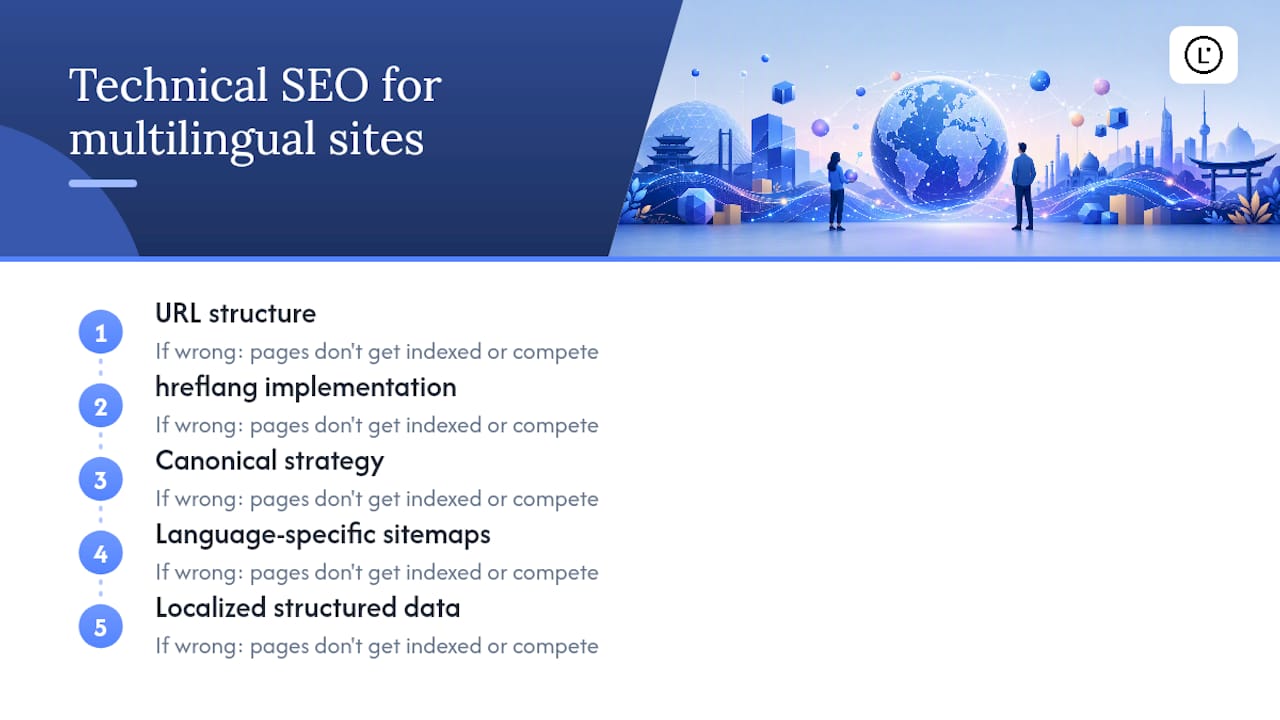
The technical foundation for a multilingual site rests on five decisions: URL structure, hreflang implementation, canonical strategy, language-specific sitemaps, and localized structured data. Get these wrong and translated pages either don’t get indexed or compete with each other.
How do you scale SEO translation without losing quality or SEO signals?
Centralize control with a Translation Management System (TMS) that exposes separate fields for title tags, meta descriptions, alt text, and schema snippets, not just body copy. Then insert human QA at the two checkpoints where SEO signals are most at risk: after the machine translation draft, and before staging deployment.
The workflow that scales: Content selection, keyword mapping, TMS job creation (with SEO metadata fields populated), machine translation draft, human edit focused on search intent and keyword placement, SEO QA review (metadata, slug, hreflang values), staging deployment, Search Console index coverage check, production publish.
This sequence matters because the human edit stage is where literal keyword translations get corrected and where a reviewer confirms that the target-language title tag actually contains the mapped keyword, not a synonym that doesn’t rank. HBR’s practical guide for marketers using generative AI makes the case that combining AI-generated drafts with targeted human expertise produces better outcomes than either approach alone, a principle that applies directly to translation workflows where speed and local accuracy are both required.
Your TMS requirements for SEO translation at scale:
- Separate metadata fields (title, meta description, alt text, schema) that are included in every translation job
- Translation memory (TM) that stores approved keyword translations and prevents inconsistency across pages
- Glossary enforcement for brand terms, product names, and SEO-critical phrases
- API access for integration with your CMS and SEO tooling
- Human validation workflow with a linguist review step before publish
Lara Translate’s AI plus human validation workflow maps directly to this model: machine translation handles the draft at scale, and professional linguists review for search intent, keyword accuracy, and cultural fit before the content goes live. The platform’s translation memory and glossary features keep keyword choices consistent across languages and across publishing cycles.
Pro Tip: Lock your glossary before the first translation job runs. If “running shoes” maps to “zapatillas de running” in your glossary, every page in every job will use that term consistently. Changing a core keyword term after 200 pages have been published requires a full re-translation of metadata, a costly rework that a pre-approved glossary prevents.
How do you measure whether translated pages are actually gaining visibility?
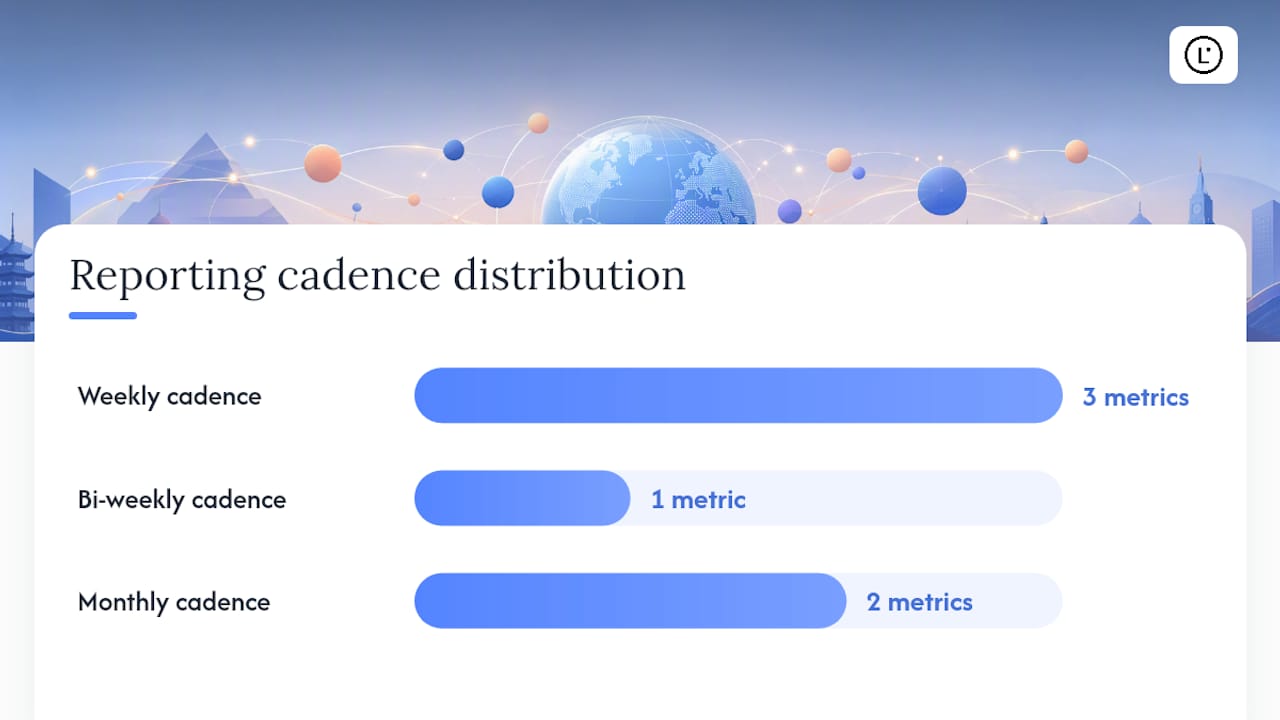
Prioritize organic clicks by locale, impressions, CTR, average position, and conversions as your primary KPIs. Google Search Console’s country filter and the “Search results” report broken down by country are the most direct measurement tools available without additional spend.
| Metric | Tool | Cadence | Alert threshold |
|---|---|---|---|
| Organic clicks by locale | Google Search Console (country filter) | Weekly | Drop week-over-week |
| Impressions by language | GSC Performance report | Weekly | Flat for 4+ weeks post-launch |
| Average position by locale | GSC + rank tracker | Bi-weekly | Position >20 for target keywords |
| CTR by language | GSC Performance report | Monthly | CTR <1% on indexed pages |
| Conversions by locale | Google Analytics 4 (language segment) | Monthly | Conversion rate below English baseline |
| Index coverage by language | GSC Coverage report | Weekly post-launch | Any “Excluded” spike |
The staging and verification step before production publish is where most indexing problems get caught. Deploy translated pages to a staging environment, submit the staging sitemap to a test Search Console property, and confirm that hreflang annotations resolve correctly before pushing to production.
Pro Tip: Use GSC’s “International Targeting” report to confirm that Google has recognized your hreflang configuration. If the report shows errors, fix them before measuring organic performance. Impression data for a locale with broken hreflang is not a reliable baseline.
For A/B testing metadata, run controlled experiments by language: change the title tag on the Spanish version of a page, hold the English version constant, and measure CTR change in GSC over a 4-week window. This isolates the effect of the metadata change from broader ranking fluctuations.
What mistakes kill multilingual SEO visibility, and how do you fix them fast?
The five errors that most reliably destroy organic performance for translated pages:
- Literal keyword translation: The translated keyword exists in the target language but no one searches for it. Fix: run keyword research in the target language before translating metadata.
- Missing or one-way hreflang: Google ignores incomplete hreflang clusters. Fix: audit with Screaming Frog or a dedicated hreflang checker, and confirm bidirectional annotations on every URL pair.
- Untranslated metadata: Body copy is translated but title tags and meta descriptions remain in English. Fix: add metadata fields to every TMS job template so they cannot be skipped.
- Duplicate content across language versions: Two pages with near-identical content and no differentiating hreflang or canonical signal. Fix: self-canonicalize each language version and confirm hreflang is in place.
- Wrong URL structure mid-project: Switching from subdirectory to subdomain after pages are indexed causes redirect chains and authority loss. Fix: decide on URL structure before any translation work begins and treat it as a locked architectural decision.
Fast QA audit checklist (10 to 30 minutes per locale):
- Crawl 10 to 20 translated URLs with Screaming Frog; check title tags and meta descriptions for source-language strings
- Verify hreflang annotations are present and bidirectional on all crawled URLs
- Check the GSC Coverage report for “Excluded” or “Crawled, not indexed” errors in the target locale
- Confirm canonical tags on translated pages self-reference, not pointing to the English URL
- Spot-check three schema blocks for the
inLanguageattribute and correct language code - Verify that the XML sitemap includes all translated URLs and has been submitted to GSC
Troubleshooting by symptom:
- Low impressions in a locale: Check hreflang configuration and GSC index coverage. If pages are excluded, diagnose the exclusion reason (canonical mismatch, noindex tag, crawl error).
- Impressions but low CTR: Title tag and meta description are likely not matching local search intent. Re-run keyword research and rewrite metadata.
- Rankings but no conversions: The page is visible but the content or CTA is not resonating locally. Escalate to a full localization review, not just SEO translation.
How does multilingual SEO connect with PPC and other marketing channels?
Multilingual SEO and paid search share the same keyword intelligence, and teams that run them in silos waste both budget and data. The most direct integration point: use your paid search campaigns in a new language as a keyword research accelerator. Run a modest PPC campaign in the target locale for 4 to 6 weeks before investing in full SEO translation. The search term reports from that campaign reveal exactly which phrases local users type, at what conversion rate, and with what intent, data that would take months to accumulate organically.
The reverse flow matters too. Once translated pages start ranking organically, reduce PPC spend on those exact-match terms and reallocate budget to terms where organic coverage is still thin. This requires a shared keyword tracking sheet that both the SEO and paid teams update weekly, with columns for organic position, paid impression share, and a “reduce PPC” flag triggered when organic position reaches the top five.
Email and social channels benefit from the same localized content assets. A translated landing page that ranks organically can also serve as the destination for a localized email campaign or a paid social ad in the target language, compounding the return on the translation investment. The key discipline is treating the translated page as a channel-agnostic asset rather than an SEO-only deliverable.
How do you build backlinks in target languages and regions?
Backlink acquisition in a target language requires a different outreach strategy than English link-building, and the tactics that work in the US market often don’t transfer directly. The most reliable approach is to identify local publishers, industry associations, and directories in the target market and build relationships with them before pitching content.
Digital PR in the target language is the highest-leverage tactic for most teams. Publish original research or data that is relevant to the local market, in the local language, and pitch it to local journalists and bloggers. A study about consumer behavior in Mexico, published in Spanish and pitched to Mexican business media, will earn links that no amount of English-language outreach can replicate. The translated content itself becomes the link asset.
Local directory listings and industry association memberships are lower-effort but still valuable, particularly for geographic targeting. A listing on a country-specific business directory with a link to your localized subdirectory sends a geographic relevance signal that supports your hreflang configuration. Partner with local distributors, resellers, or affiliates and request that their sites link to your localized pages rather than your English homepage. These partner links carry strong geographic relevance signals and are often easier to acquire than editorial links from publishers.
Broken link building works across languages: find resource pages on local-market sites that link to dead pages, create a better local-language resource, and pitch the replacement. Tools like Ahrefs let you filter link prospecting by country and language, making it practical to run this workflow in a target locale even if your team doesn’t speak the language fluently.
What legal and compliance requirements apply to localized content?
Content published in a target market must comply with that market’s laws, and the requirements vary significantly by country, content category, and audience type. This is general information, not legal advice; confirm current rules with a qualified attorney or the relevant regulatory body for each market.
The most common compliance areas that affect localized web content in the US and internationally:
Privacy and data collection: The EU’s GDPR applies to any site that collects data from EU residents, regardless of where the site is hosted. California’s CCPA applies to businesses meeting certain thresholds that collect data from California residents. Localized pages that include contact forms, analytics tracking, or cookie banners must comply with the rules of the jurisdiction where the user is located, not just where the business is incorporated.
Advertising and claims: Regulated industries (financial services, healthcare, supplements, legal services) face country-specific restrictions on what claims can be made in advertising and on-page copy. A product claim that is legal in the US may require a disclaimer or be prohibited outright in Germany, France, or Australia. Legal review of translated content is not optional for these categories.
Consumer protection: Price display rules, return policy disclosure requirements, and mandatory warranty language vary by country. An e-commerce page translated for the German market, for example, must comply with German consumer protection law on price display and cancellation rights, which differ from US requirements.
Intellectual property: Translating content that includes third-party trademarks, images, or licensed text requires confirming that the license covers the target language and market. A stock photo licensed for US use may not be licensed for use on a German-language page targeting EU users.
Build a legal review checkpoint into your localization plan and treat it as a blocking step before any localized page goes live in a regulated category.
Key Takeaways
Effective SEO translation requires adapting every ranking signal, keywords, metadata, URL slugs, hreflang, and structured data, to local search intent, not just translating body copy.
| Point | Details |
|---|---|
| Metadata is the highest-leverage element | Title tags, meta descriptions, and URL slugs translated to match local search intent drive the fastest visibility gains. |
| Hreflang must be bidirectional | Every URL pair in a multilingual cluster must annotate each other; one-way hreflang is ignored by Google. |
| Keyword research precedes translation | Run target-language keyword research before creating any TMS job; literal translations frequently miss actual search demand. |
| Human QA protects SEO signals at scale | Insert a linguist review step after machine translation to verify keyword placement and intent alignment before publishing. |
| Lara Translate fits the AI plus human workflow | Lara Translate’s translation memory, glossary enforcement, and human validation layer integrate directly into an enterprise SEO translation pipeline. |
The gap between “translated” and “findable”
The most persistent misconception in multilingual SEO is that translation and SEO translation are the same task with different names. They are not. A translated page is linguistically correct. An SEO-translated page is linguistically correct and findable by the people it was built for.
What teams consistently underestimate is how much of a page’s organic performance lives outside the body copy. In practice, the title tag, meta description, URL slug, and hreflang configuration account for a disproportionate share of whether a translated page ranks at all. Body copy quality matters for engagement and conversion, but it rarely determines whether a page appears in the SERP in the first place. Teams that invest heavily in high-quality body translation and then leave metadata in English are doing the expensive work while skipping the work that actually drives impressions.
The other underestimated factor is the ongoing nature of the commitment. SEO translation is not a one-time project. Search behavior in a target market shifts, competitors publish new content, and Google’s understanding of local intent evolves. Translation memory and glossaries need updating as keyword strategy changes. KPIs need review monthly, not just at launch. The teams that sustain multilingual organic growth treat their TMS and their Search Console locale reports as living systems, not project deliverables.
Lara Translate cuts time-to-publish while preserving your SEO signals
Getting translated pages live faster is only half the problem. The other half is making sure the SEO signals survive the translation process intact: that the title tag contains the right keyword, the slug is correct, the schema has the inLanguage attribute, and the glossary term is consistent across 200 pages.
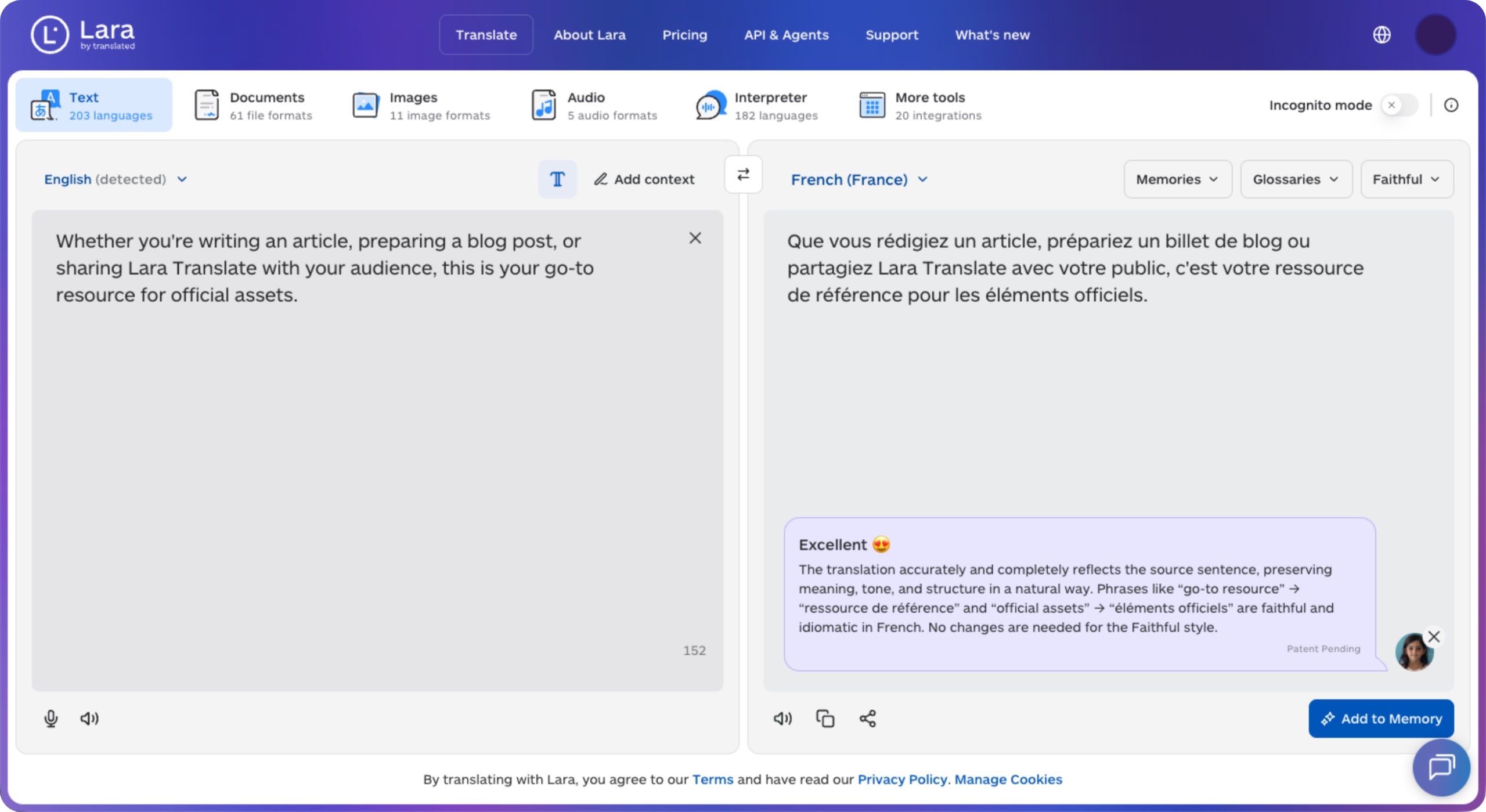
Lara Translate’s AI plus human translation workflow handles both sides of that problem. The platform supports 70+ file formats, maintains translation memory and glossaries across jobs, and routes content through professional linguist review before publish. For teams managing metadata-heavy translation projects, the API integration means your CMS can push content directly to Lara Translate and pull back reviewed translations without manual file handling. The human validation layer is where keyword accuracy and search intent get confirmed, not assumed.
For English-first teams starting their first multilingual expansion, the English translation product page is the fastest entry point. Enterprise teams with existing TMS workflows can connect via API and use Lara Translate’s human validation as a QA layer on top of their existing machine translation output.
Run your first priority page through the full workflow
Test AI translation with professional linguist review, translation memory, and glossary control before committing to a full-site rollout.
Useful sources and tools
| Resource | Type | Use case |
|---|---|---|
| Google Search Console | Free tool | Organic performance by locale, hreflang error reports, index coverage |
| TheSEOLabs Keyword Translator | Free tool | Initial keyword translation with search volume and CPC data |
| Strapi Multilingual SEO Guide | Reference | Workflow and technical configuration for multilingual sites |
| Geotargetly SEO Translation Guide | Reference | Metadata and URL localization best practices |
| DigitalApplied Hreflang Guide | Reference | Hreflang implementation and common pitfalls |
| The Roadmap: SEO-Friendly Translation | Reference | Cultural adaptation and localization beyond literal translation |
| Statista: Languages on the Internet | Data | Language prioritization for multilingual expansion |
| HBR: GenAI for Marketers | Reference | AI plus human workflow guidance for marketing and translation teams |
| Screaming Frog SEO Spider | Paid/free tool | Hreflang audit, canonical verification, metadata crawl |
| Google Analytics 4 | Free tool | Conversion tracking by locale and language segment |
FAQ
What is SEO translation?
SEO translation is the process of adapting content and all ranking signals, title tags, meta descriptions, URL slugs, structured data, and internal links, into a target language so that translated pages rank in local search results and convert local visitors.
How is SEO translation different from regular translation?
Regular translation converts text from one language to another. SEO translation also adapts keywords to match local search intent, localizes metadata, configures hreflang tags, and adjusts URL slugs, the technical and strategic layer that determines whether a page appears in search results at all.
What does SEO stand for?
SEO stands for Search Engine Optimization, the practice of improving a website’s visibility in organic (unpaid) search engine results through content, technical configuration, and authority signals.
Which pages should you translate first for SEO?
Translate your highest-traffic landing pages, primary category or product pages, and checkout flows first. These pages have the greatest revenue impact and the most to gain from local keyword alignment, making them the fastest path to measurable organic growth in a new locale.
Can Lara Translate support an SEO translation workflow?
Yes. Lara Translate’s AI plus human validation workflow includes translation memory, glossary enforcement, support for 70+ file formats, and professional linguist review, the core components of an enterprise-grade SEO translation pipeline.
This article is about
SEO translation: how to adapt content and every ranking signal (keywords, metadata, URL slugs, hreflang, and structured data) for a target language so translated pages rank and convert, including keyword research, technical configuration, scaling with a TMS, measurement, common mistakes, and how Lara Translate’s AI plus human workflow fits the pipeline.
Recommended
- AI + Human Translation | Lara
- Lara Translate AI: Reliable, Fast, Free
- Translate to and from English with Lara Translate