

A bakery gets a 200-box catering order for 9 a.m. and its only driver calls in sick at 7. Without a backup, the order is late and the client does not reorder.
Same-day local delivery platforms help businesses arrange couriers or manage their own delivery operations. This guide compares delivery networks, courier services, and dispatch software by service type, coverage, integrations, and pricing, with a parcel-shipping alternative for businesses whose orders can arrive later.
|
TL;DR
|
What makes a local delivery platform worth using?
The driver model defines your control. DoorDash Drive and Uber Direct draw on large courier networks, Metrobi lets businesses build a preferred driver network and ban poor performers, and Shipday and Onfleet dispatch your own drivers.
Compare per-delivery charges with software subscriptions and the cost of supplying drivers. DoorDash Drive lists $6.99 to $10.99 per delivery, while other services calculate prices from shipment details. Include waiting time, extra stops, failed deliveries, and any software or integration fees in your estimate.
Integrations decide how much manual work remains. Confirm how orders enter the platform and how tracking updates return to your shop or POS. Metrobi connects to Shopify, Squarespace, WooCommerce, Wix, and Olo. Test the connector required for your own ordering system before adoption.
Tracking and proof of delivery protect the relationship. Live tracking, photo or signature confirmation, and automated customer updates are listed by Metrobi, Dropoff, Shipday, and Onfleet.
Check app language support and customer-facing content separately. A translated interface does not establish that delivery instructions, notification templates, menus, or invoices will be translated. Metrobi lists English. Plan how your business will maintain the messages it controls in the languages customers need.
Local delivery platforms compared
| Provider | Best for | Model | Pricing |
|---|---|---|---|
| DoorDash Drive | Restaurants and retailers wanting on-demand drivers | Delivery network | Flat fee $6.99-$10.99 per delivery |
| Metrobi | Local food and beverage businesses wanting preferred drivers | Courier marketplace | Single delivery: Starting at $18 Routed (batch deliveries): $8–$18 per delivery |
| Uber Direct | Businesses offering white-label delivery | Delivery network | Per-delivery pricing; varies by service and mileage |
| Roadie | Retailers with bulky or scheduled orders | Crowdsourced delivery network | Quoted, see site |
| Dropoff | Healthcare, retail, and industrial deliveries | Courier service | Custom quotes |
| GoShare | Businesses moving bulky items | Delivery marketplace | Upfront estimates per job |
| Shipday | Businesses with their own drivers | Delivery management software | Free version; Professional from $39/month |
| Onfleet | Fleets needing routing and proof of delivery | Delivery management software | Launch from $619/month |
| Veho | E-commerce brands shipping parcels | Parcel network, next-day/two-day alternative | Quoted, see site |
| Reliable Delivery | Businesses in Michigan and northwest Ohio | Regional courier service | Quote by request |
Prices are in US dollars. Confirm local availability, service eligibility, and the total charge for your routes before booking.
DoorDash Drive
Best for: Restaurants and retailers that want on-demand drivers through their own ordering channel.
DoorDash Drive On-Demand lets merchants arrange delivery for orders placed through their own website, app, or ordering channel. Customers can view order status, estimated arrival, and driver location. The service connects through ordering providers such as Square, Toast, and Olo, or via its API. Confirm onboarding eligibility and local coverage for your business.
Pricing: Flat fee of $6.99-$10.99 per delivery, with no signup or subscription fees.
Verdict: Consider DoorDash Drive when a restaurant or retailer wants on-demand drivers connected to its existing ordering system.
Metrobi
Best for: Local food and beverage businesses that want to choose their own drivers.
Metrobi is a courier marketplace that connects local businesses with vetted delivery drivers. Its features include preferred driver networks, a route planner, GPS tracking, photo proof of delivery, and automated customer notifications. It connects to Shopify, Squarespace, WooCommerce, Wix, and Olo, offers an API and Chrome extension, and operates in English.
Pricing: Rates (2026): Single delivery: Starting at $18; Routed (batch deliveries): $8–$18 per delivery, depending on batch size and ZIP codes
Verdict: Consider Metrobi when driver selection and control over quality matter more than the lowest per-delivery fee.
Uber Direct
Best for: Businesses that want delivery under their own brand.
Uber Direct offers white-label delivery for orders placed through a business’s own channels, with on-demand and scheduled options, tracking, and integration or dashboard-based ordering. Its US page lists packages up to 50 pounds. Confirm the available delivery window, distance, item eligibility, and integration for your location.
Pricing: Per-delivery fees vary by product, channel partner, and mileage. Uber lists no startup costs, commissions, or monthly minimums.
Verdict: Consider Uber Direct when brand control and a wide set of integrations matter more than a dedicated driver team.
Roadie
Best for: Retailers with bulky, scheduled, or multi-store orders.
Roadie is a last-mile delivery platform for same-day and local delivery. Its features include 2-hour, 4-hour, and end-of-day windows, big and bulky delivery for items up to 144 inches and 300 pounds, ship-from-store fulfillment, and customer return pickups. It offers cross-dock solutions and API connections for high-volume businesses.
Pricing: Request a delivery quote or contact Roadie for business pricing.
Verdict: Consider Roadie when delivery windows and large items matter more than a low-volume courier.
Dropoff
Best for: Healthcare, retail, and industrial businesses needing scheduled courier routes.
Dropoff provides same-day courier services for healthcare, retail, and industrial operations. Its tools include live-map tracking, text or email updates, photo or signature confirmation, and an online scheduling portal. Discuss the required schedule and handling requirements when requesting a service proposal.
Pricing: Custom quotes through the Dropoff team.
Verdict: Consider Dropoff when regulated or scheduled deliveries need a managed courier service.
Keep delivery messages clear across languages
Translate approved order updates and delivery instructions with Lara Translate, then check that addresses, time windows, and item details remain correct.
GoShare
Best for: Businesses that move bulky items, furniture, or pallets.
GoShare connects businesses with delivery professionals for same-day or scheduled transport of bulky items. Vehicle options include pickup trucks, cargo vans, and box trucks. Teams can request an upfront estimate and use tracking and messaging to coordinate the job; confirm load capacity, assistance, and coverage for the booking.
Pricing: Free upfront estimates per job, paid through the app.
Verdict: Consider GoShare when the load needs a truck or van rather than a courier car.
Shipday
Best for: Businesses that manage their own drivers or use several delivery services.
Shipday helps businesses dispatch in-house drivers and connect to third-party delivery services. It provides routing, driver tracking, customer updates, and proof of delivery. Its integration directory includes Shopify, Toast, Square, DoorDash Drive, and Uber delivery services. Features and third-party access depend on the plan.
Pricing: A free version is available. Professional starts at $39/month with 300 included orders and $0.10 per additional order in the US and Canada. Other plans, countries, and courier services have different costs.
Verdict: Consider Shipday when a business wants one dashboard for its own drivers and third-party couriers.
Onfleet
Best for: Fleets that need routing, tracking, and proof of delivery.
Onfleet provides routing, dispatch, driver tracking, customer notifications, and delivery records for last-mile operations. Launch includes photo and signature proof of delivery, basic route optimization, and API access. Higher plans add features such as barcode scanning and advanced routing; confirm the tier needed for your workflow.
Pricing: Launch starts at $619/month with 2,500 delivery or pickup tasks. Scale starts at $1,349/month with 5,000 tasks; Enterprise starts at $3,099/month. Confirm task counting, extra usage, and add-ons.
Verdict: Consider Onfleet when a business runs its own drivers and needs strong routing and delivery records.
Veho
Best for: E-commerce brands shipping parcels to customers’ homes.
Veho provides parcel delivery for e-commerce brands, including next-day and two-day services, package tracking, and customer support. It is included here as an alternative for parcel-shipping workflows, rather than an on-demand same-day courier. Confirm service levels and coverage for the destination ZIP codes.
Pricing: Contact Veho for a shipping quote.
Verdict: Consider Veho when parcels rather than same-day local orders are the main volume.

Reliable Delivery
Best for: Businesses in Michigan and northwest Ohio.
Reliable Delivery provides same-day, on-demand, and routed courier services in Michigan and northwest Ohio. Its services include medical transport, freight and air cargo, and local package delivery. It advertises delivery within two hours; confirm availability and the applicable service commitment for the route.
Pricing: Quotes through the online portal or by phone.
Verdict: Consider Reliable Delivery when a regional courier fits your delivery area and required schedule.
How to choose a local delivery platform
Map your deliveries. Note the typical order size, distance, and time window, because parcels, bulky items, and hot food need different services.
Decide who supplies the drivers. Compare local courier availability, control over assignments, and backup arrangements. Dispatch software still requires a plan for driver capacity.
Check integrations with your shop or POS. Confirm the platform connects to your ordering system, so orders flow in without re-typing.
Compare the pricing model at your volume. Flat per-delivery fees, distance-based rates, and subscriptions give different costs at the same order count, so model a typical month.
Plan for the languages your customers read. Check which languages the platform supports, then decide how order confirmations, delivery notes, and invoices will be translated. A dedicated translation tool can help translate them accurately.
Connecting Lara Translate to delivery communications
Lara Translate can help translate the content your business controls, including order confirmations, delivery instructions, menus, and invoices. Start with approved message templates, use a glossary for product names and recurring terms, and review the translations before making them available to dispatchers or customers.
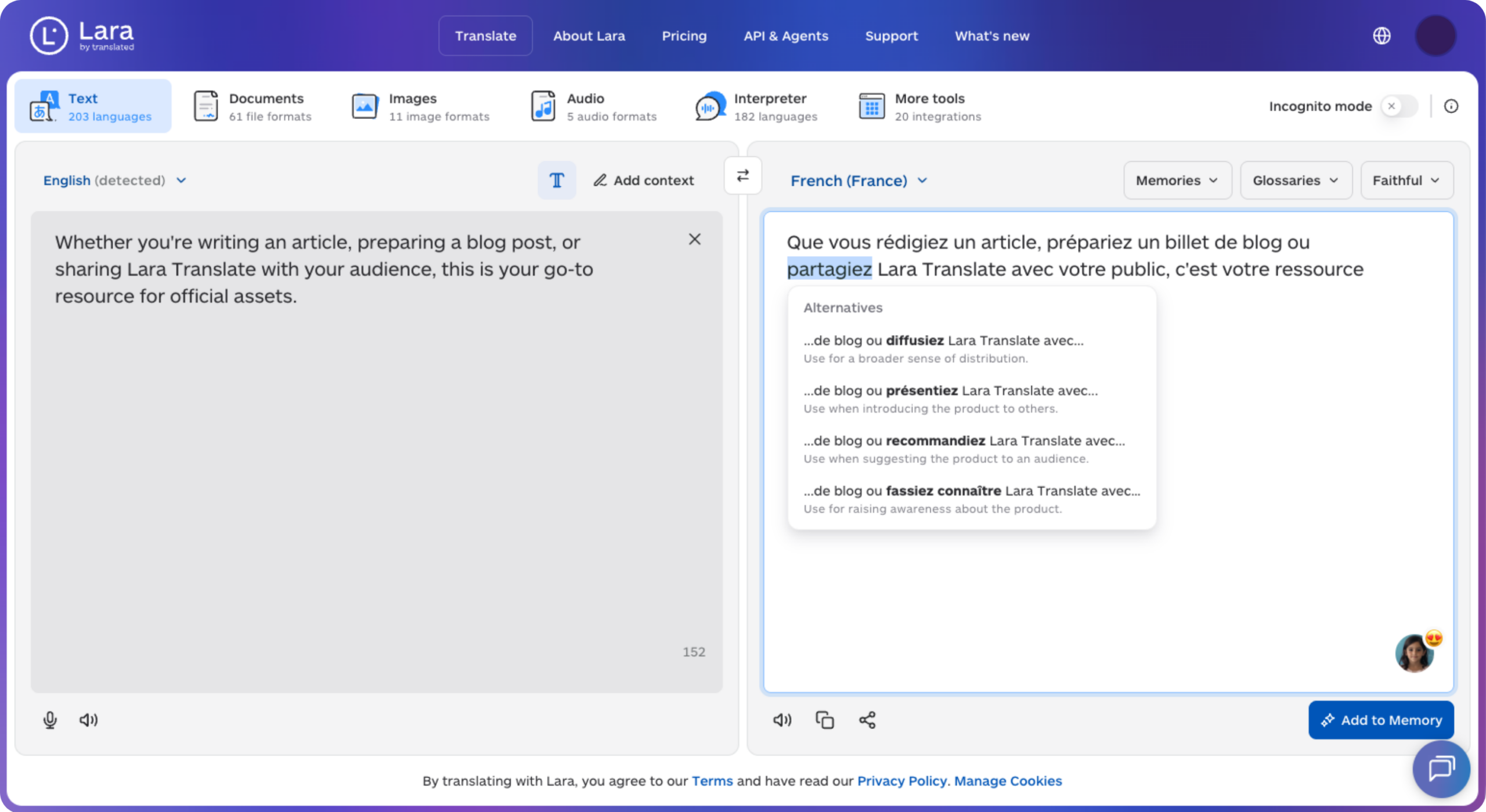
For recurring notifications, a technical team can connect the Lara Translate text translation API to an order-management or messaging workflow. Keep order numbers, addresses, access codes, and tracking links unchanged, and validate delivery times and instructions. Documents can be handled through the document translation API. This is a proposed custom workflow; it does not imply a native connector with every delivery platform listed here.
Prepare delivery content for multilingual customers
Use Lara Translate to create reviewed language versions of customer messages and supporting documents, with consistent terminology across updates.
Conclusion
The right platform depends on what you deliver, who drives, and how orders reach the platform. Whichever you choose, the messages your customers receive work best when they can read them.
Have a valuable tool, resource, or insight that could enhance one of our articles?
Send us an email at press@laratranslate.com
We’ll be happy to review it and consider it for inclusion to enrich our content for our readers! ✍️
Frequently asked questions
What is same-day local delivery for businesses?
It is delivery to a nearby recipient on the day an order is dispatched or accepted, subject to the service’s cutoff and availability. Businesses can use courier services, delivery networks, or their own drivers to fulfill these orders.
What is the difference between a delivery service and dispatch software?
A delivery service supplies transport capacity. Dispatch software helps assign, route, and track deliveries, usually with drivers the business manages. Some software also connects to outside couriers, whose charges are separate.
How much does local delivery cost?
Costs depend on distance, shipment size, timing, stops, and service requirements. Compare per-delivery quotes with any software subscriptions, driver costs, waiting charges, and failed-delivery fees using a typical month of real orders.
What should proof of delivery include?
It should provide a usable record of completion, such as a timestamp and a photo, signature, or scan appropriate to the shipment. Check how records are stored, retrieved, and shared when a customer reports a problem.
How do I check whether a delivery platform covers my business?
Verify pickup and destination ZIP codes, operating hours, order cutoffs, vehicle capacity, and item restrictions. Run a pilot across typical and difficult routes, including busy periods and failed-delivery scenarios.
How can delivery businesses support multilingual customers?
Check which parts of the platform and customer notifications support each required language. Translate and review the content your business controls, while preserving addresses, order identifiers, time windows, and tracking links. Provide a clear way for customers to ask for help.
This article is about
- Distinguishing courier services and delivery networks from dispatch software.
- Matching delivery windows, item sizes, and vehicle requirements to local coverage.
- Comparing per-delivery fees with subscriptions and the cost of driver capacity.
- Testing order integrations, tracking, proof of delivery, and exception handling.
- Preparing clear, reviewed customer communications in multiple languages.
Useful links
This article was produced by the Lara Translate content team. Lara Translate is an AI translation platform built by Translated, with more than 25 years of professional translation experience. Delivery businesses can use Lara Translate to translate order confirmations, delivery notes, menus, and invoices, across 200+ languages and 60+ file formats.