

Imagine a demo request from a prospect whose company is already a customer. It lands in a shared queue while the account owner remains unaware. Clear matching and assignment rules help avoid that handoff gap.
Lead routing software matches inbound leads to existing accounts, assigns them to the right rep, and often books the meeting. This guide compares lead routing tools in 2026 on matching, routing rules, scheduling, CRM support, and pricing.
|
TL;DR
|
What makes lead routing software worth using in 2026?
Matching and routing are separate jobs. LeanData, LeadAngel, and Openprise list lead-to-account matching, while Calendly and Cal.com route bookings through forms and round robin.
CRM support differs. LeadAngel lists Salesforce, HubSpot, Microsoft Dynamics 365, and Marketo, RevenueHero lists HubSpot, Salesforce, Zoho, and Attio, and Kubaru and Distribution Engine are built for Salesforce.
Scheduling is built in or sold separately. Chili Piper and RevenueHero include scheduling in their routing plans, LeadAngel offers ScheduleNow as an add-on or included feature by plan, and Distribution Engine sells Booking Engine separately.
Pricing models vary widely. Chili Piper and Default list annual platform plans, RevenueHero, Kubaru, and Distribution Engine list per-user prices, and LeanData, Openprise, and LeadAngel ask you to contact sales.
Language support needs its own check. Test the languages available for forms, booking pages, and notifications separately from the administrator interface. Record each prospect’s preferred language and decide who will translate and review follow-up messages and sales materials.
Best lead routing software in 2026
Prices and plan details were checked in October 2026. Compare platform fees, paid seats, implementation, and add-ons when calculating your total cost.
| Provider | Best for | Model | Pricing |
|---|---|---|---|
| LeanData | Teams that want routing, matching, and scheduling together | Go-to-market orchestration platform | Contact sales for a tailored quote |
| Chili Piper | Teams that want form-to-calendar routing and handoff | Routing and scheduling platform | From $15,000/year |
| RevenueHero | Teams that want per-user routing on HubSpot or Salesforce | Routing and scheduling platform | $25/user/month plus $79/month platform fee, billed yearly |
| Default | Teams that want routing, scheduling, and enrichment workflows | Go-to-market workflow platform | From $1,250/month billed annually, plus routing seats |
| LeadAngel | Teams that want lead-to-account matching and routing in the CRM | Lead routing and matching platform | Contact sales |
| Distribution Engine | Salesforce teams that want rule-based assignment | Salesforce-native lead routing app | From $20/user/month billed annually |
| Kubaru | Salesforce teams that want one all-inclusive plan | Salesforce-native assignment app | $20/user/month |
| Openprise | Operations teams that want data cleanup with routing | Data orchestration platform | Contact sales |
| Calendly | Teams that need scheduling with routing forms | Scheduling platform | Free plan; Teams $16/seat/month billed yearly |
| Cal.com | Teams that want round robin and routing forms | Scheduling platform | Free plan; Teams $12/user/month billed yearly |
LeanData
Best for: Teams that want routing, matching, and scheduling together.
LeanData is a go-to-market orchestration platform. Its features include lead routing and assignment, lead-to-account matching, the BookIt scheduling tool, and handoff automation between sales and customer success. It integrates with Salesforce, Slack, Outreach, Salesloft, 6sense, and Clearbit.
Pricing: Contact sales for a tailored package. BookIt scheduling is available separately or as an add-on, and setup and onboarding are billed separately.
Verdict: Consider LeanData when routing, matching, and scheduling in one platform matter.

Chili Piper
Best for: Teams that want form-to-calendar routing and handoff.
Chili Piper is a routing and scheduling platform. Its features include form-to-calendar automation, lead distribution, SDR-to-AE handoff, and AI credits. It supports Salesforce and HubSpot and integrates with Marketo for email routing. Annual billing is required.
Pricing: Routing & Scheduling from $15,000/year with 15 seats; Experiences from $42,000/year with 30 seats.
Verdict: Consider Chili Piper when form-to-calendar routing and handoff matter.
RevenueHero
Best for: Teams that want per-user routing on HubSpot or Salesforce.
RevenueHero is a routing and scheduling platform. Its features include instant scheduling on web forms, round-robin routing, domain-based matching, and workflow automation across the meeting lifecycle. It integrates with HubSpot, Salesforce, Zoho, and Attio, and Enterprise adds fuzzy matching and white-labeling.
Pricing: Inbound Essentials $25/user/month and Inbound Enterprise $35/user/month, both billed yearly, plus a $79/month platform fee.
Verdict: Consider RevenueHero when per-user pricing with scheduling and routing matters.
Default
Best for: Teams that want routing, scheduling, and enrichment workflows.
Default is a go-to-market workflow platform. Its features include lead routing, meeting scheduling, enrichment, CRM sync, website visitor identification, and unlimited workflow builds. It works with Salesforce and HubSpot, and seats for routing and scheduling are sold as add-ons.
Pricing: Growth $1,250/month billed annually; Scale $3,000/month billed annually; Routing + Scheduling seats $45/user/month.
Verdict: Consider Default when routing, scheduling, and enrichment workflows in one place matter.
LeadAngel
Best for: Teams that want lead-to-account matching and routing in the CRM.
LeadAngel is a lead routing and matching platform. Its features include lead-to-account matching, rule-based routing by round robin, territory, availability- based, product interest-based, real-time handoff, or custom criteria, calendar scheduling, and data deduplication. It integrates natively with Salesforce, HubSpot, and Microsoft Dynamics 365. Language support was not stated on the pages reviewed.
Pricing: Professional and Professional Plus plans; contact sales for prices.
Verdict: Consider LeadAngel when matching leads to accounts and routing them in your CRM matters.
Follow up in your prospect’s language
Use Lara Translate to prepare follow-up emails, one-pagers, and sales collateral for international prospects, then review the wording before sharing.
Distribution Engine
Best for: Salesforce teams that want rule-based assignment.
Distribution Engine is a Salesforce-native lead routing app. Its features include round-robin distribution, territory management, SLA tracking, and workload-based caps, with routing for leads, cases, and custom objects. Booking Engine handles meeting scheduling and is sold separately. Plans require a minimum of 5 licenses, and language options were not shown on the page reviewed.
Pricing: Starter $20/user/month; Advanced $35/user/month; Unlimited $55/user/month, billed annually.
Verdict: Consider Distribution Engine when rule-based assignment inside Salesforce matters.
Kubaru
Best for: Salesforce teams that want one all-inclusive plan.
Kubaru is a Salesforce-native assignment app. Its features include round robin, load balancing, territory management, skill-based assignment, duplicate matching, and SLA management. All plans include the same features and work with Professional, Enterprise, Unlimited, and Performance editions.
Pricing: Standard $20/user/month; Enterprise custom; 30-day free trial.
Verdict: Consider Kubaru when one all-inclusive plan inside Salesforce matters.
Openprise
Best for: Operations teams that want data cleanup with routing.
Openprise is a data orchestration platform. Its features include list loading, data cleansing, deduplication, lead and account scoring, matching and routing, and multi-vendor enrichment. It connects CRM, marketing automation, ERP, and data warehouse systems.
Pricing: Contact sales for a quote based on your requirements.
Verdict: Consider Openprise when data cleanup and orchestration alongside routing matter.
Calendly
Best for: Teams that need scheduling with routing forms.
Calendly is a scheduling platform. Its features include round-robin and team scheduling, lead qualification and routing, and Marketo, Pardot, and Salesforce integrations on the Teams plan. Enterprise adds routing with Salesforce lookup. The free plan covers one event type and one calendar connection.
Pricing: Free plan; Standard $10/seat/month and Teams $16/seat/month with yearly billing. Enterprise starts at $15,000/year.
Verdict: Consider Calendly when scheduling with routing forms matters.

Cal.com
Best for: Teams that want round robin and routing forms.
Cal.com is a scheduling platform. Its features include round-robin scheduling, routing forms, shared availability, and booking analytics from the Teams plan. Organizations adds sub-teams, SAML SSO, and SCIM.
Pricing: Free plan for individuals; Teams $12/user/month; Organizations $28/user/month, billed yearly.
Verdict: Consider Cal.com when round robin and routing forms with open pricing matter.
How to choose lead routing software
Step 1: Map your routing rules. List how leads should be assigned, such as round robin, territory, account owner, or skill, and which fields decide it.
Step 2: Check CRM support. Confirm that the tool works natively with your CRM and marketing automation platform, and what needs the API.
Step 3: Decide on scheduling. Check whether meeting booking and handoff are included in the plan or sold as an add-on.
Step 4: Test matching on real data. Run a sample of leads and contacts and check how the tool handles duplicates and existing accounts.
Step 5: Plan for languages. Check which languages the tool supports for forms and scheduling pages, and decide how confirmations, follow-ups, and handoff documents will be translated and reviewed for each market.
Connect lead follow-up with Lara Translate
Use Lara Translate alongside your routing workflow to prepare the messages and documents a rep sends after assignment. Record the prospect’s preferred language in your CRM, translate approved email templates and collateral, and place the reviewed versions in the relevant sales sequence or content library.
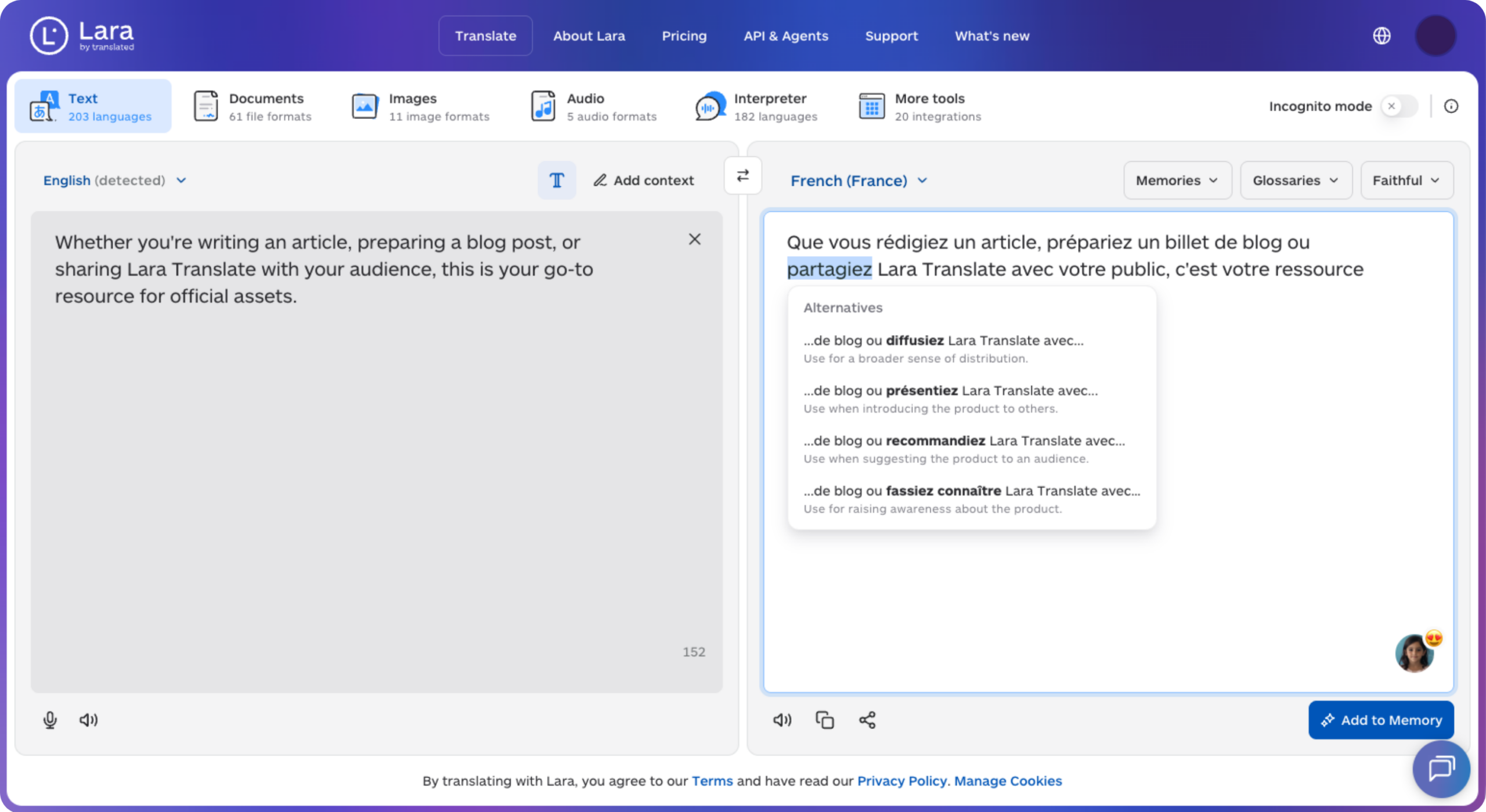
Lara Translate supports 200+ languages and 60+ file formats, while glossaries help keep product names and terminology consistent. Teams building a custom workflow can use the Lara Translate API to add a translation step, with implementation depending on the CRM or automation tools they use.
Keep sales handoffs clear across markets
Translate sales decks, proposals, and handoff documents with Lara Translate so teams can prepare consistent materials for each market.
Conclusion
The right tool depends on your CRM, the routing rules you need, and whether scheduling sits in the same product. Decide those three first, then test with real leads.
Have a valuable tool, resource, or insight that could enhance one of our articles?
Send us an email at press@laratranslate.com
We’ll be happy to review it and consider it for inclusion to enrich our content for our readers! ✍️
Frequently asked questions
What is lead routing software?
Lead routing software assigns inbound leads to the right sales rep or team based on rules such as territory, round robin, or account ownership. Many tools also match leads to existing accounts and book meetings.
What is lead-to-account matching?
Lead-to-account matching links an inbound lead to the company account it belongs to in your CRM. It helps identify existing account ownership so routing rules can send the lead to the appropriate rep. Deduplication is a related capability that should be evaluated separately.
What is the difference between round robin and territory routing?
Round robin distributes leads evenly across reps in turn, while territory routing assigns leads by region, industry, or other fields. Many teams combine both.
How fast should a team respond to inbound leads?
Faster is better, and routing rules plus instant scheduling remove the manual steps that cause delays. Set a response target and use SLA tracking or reports to measure it.
Do I need a separate tool for lead routing if my CRM has assignment rules?
Native assignment rules cover simple cases. A separate tool helps with account matching, complex rules, workload limits, scheduling, and audit logs.
How do I handle inbound leads in several languages?
Capture the prospect’s preferred language, use it in assignment rules where supported, and test forms, booking pages, and notifications in each target language. Prepare translated follow-up templates and sales materials, have customer-facing wording reviewed, and assign responsibility for keeping every version current.
This article is about
- Lead routing software matches leads to accounts, assigns them to reps, and often books the meeting
- How platforms compare on matching, routing rules, scheduling, CRM support, and pricing
- Pricing ranges from per-user plans to annual platform contracts, so model the cost at your team size
- Some tools suit Salesforce-native assignment, others combined routing and scheduling or data orchestration
- Multi-market lead follow-up also needs documents and emails translated and reviewed
Useful links
- Best B2B Appointment Setting and Lead Generation Agencies in 2026
- Add-to-Calendar and Calendar Marketing Tools in 2026: 9 Options Compared
- Lara Translate: supported formats and languages
- Lara Translate: document translation and glossaries
- Lara Translate: translation API
This article was produced by the Lara Translate content team. Lara Translate is an AI translation platform built by Translated, with more than 25 years of professional translation experience. Sales and revenue teams use Lara Translate to translate follow-up emails, sales collateral, and handoff documents, across 200+ languages and 60+ file formats.