

An AI startup ships an agent that calls three model providers. Within a month, the team has separate API keys everywhere, a surprise bill nobody can explain, and a support ticket about a wrong answer that no one can trace. AI gateways centralize model access and routing, while LLM observability platforms help teams trace requests and investigate cost, latency, and quality. Some products combine both roles.
This guide compares AI gateways and observability platforms in 2027 on model access, tracing, evaluations, deployment, and pricing, so engineering teams can build a shortlist.
|
TL;DR
|
What makes an AI gateway or observability platform worth using in 2027?
Model access matters. One API for many providers makes it easier to switch models and add fallbacks.
Tracing is essential. Every call, tool use, and retry should be visible when you investigate a failure.
Evaluations help measure quality. Datasets, automated scoring, human review, and experiments help teams assess whether a change improved the behaviors they care about.
Cost controls help manage spending. Compare usage tracking, budget enforcement, and routing policies, and test how each behaves when limits are reached.
Language coverage matters when your users are global. Test sets and prompts should include the languages your users write in.
Lara Translate helps teams translate prompts, test sets, and documentation across 200+ languages and 60+ file formats while keeping formats intact. Native speakers should review samples that will be used for evaluation.
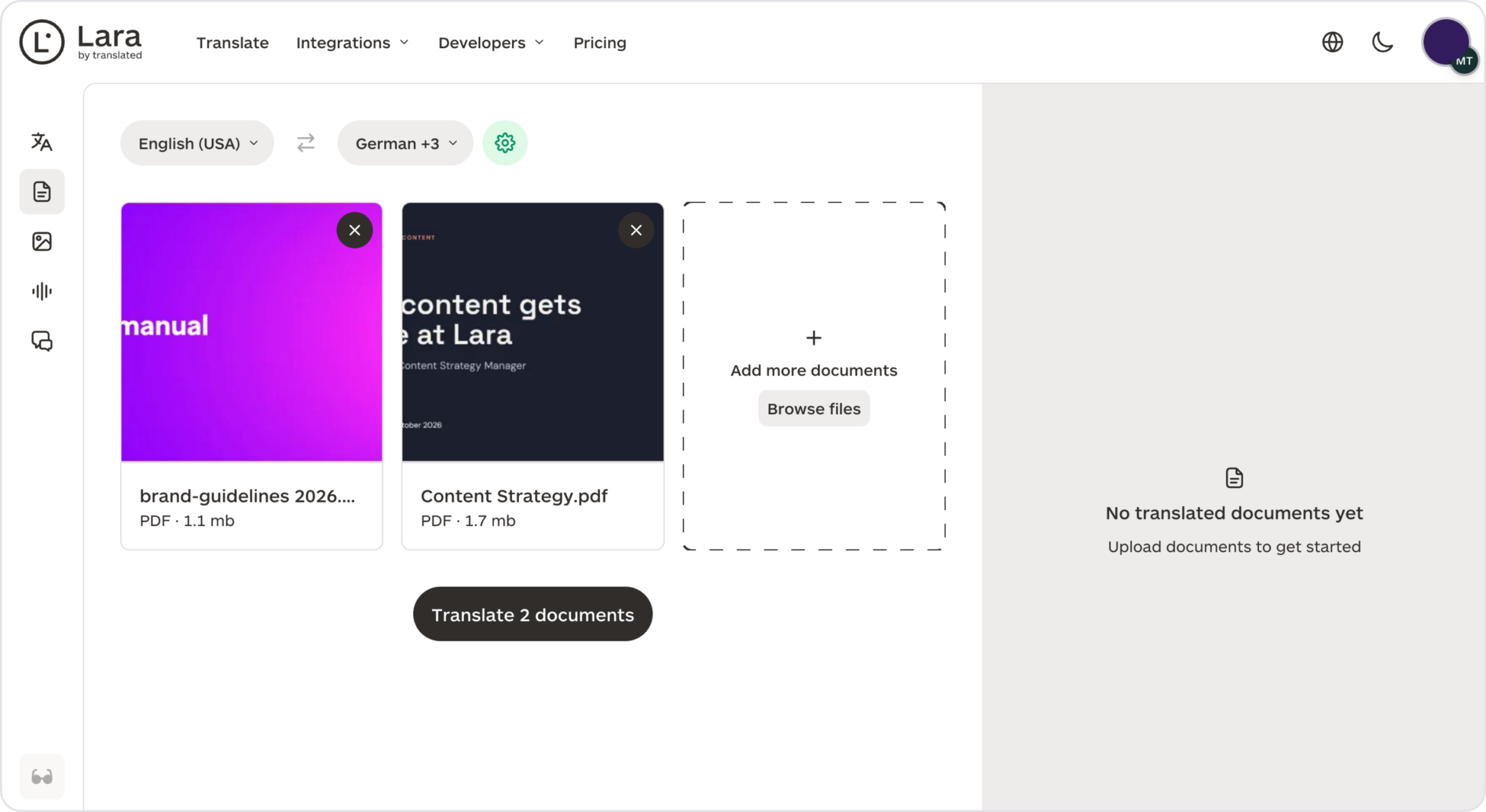
Connect translation to your evaluation workflow by exporting the natural-language parts of prompts, test cases, and documentation into a working file. Translate them with Lara Translate, review the results with language specialists, and import approved variants into your dataset or prompt manager. Preserve code, JSON keys, placeholders, tool names, and scoring rules. Check that expected answers remain valid after localization; this workflow does not require a native platform integration.
Best AI gateways and LLM observability platforms in 2027
| Provider | Best for | Model | Pricing |
|---|---|---|---|
| OpenRouter | Teams that want one API for many hosted models | Multi-model platform for 600+ models | Usage-based by model |
| LiteLLM | Platform teams that want to self-host | Open-source AI gateway and LLM proxy | Open source, free; enterprise via sales |
| Langfuse | Teams that want open-source tracing and evals | Open-source agent observability and evaluations | Hobby free; Core $29/month; Pro $199/month; usage charges apply |
| Respan | Teams that want gateway, tracing, and evals together | Open-source AI gateway with observability and evaluations | Free; Team $199/month billed yearly |
| Helicone | Teams that want simple observability | AI gateway and LLM observability | Hobby free; Pro $79/month; Team $799/month |
OpenRouter
Best for: Teams that want one API for hundreds of hosted models.
OpenRouter offers one API for 600+ models for text, images, video, audio, and more from 80+ providers. It can pick the model and provider for each request using live data from its marketplace, and it reports 800T+ monthly tokens and 10M+ users.
Pricing: Usage-based, depending on the model.
Verdict: Consider OpenRouter when you want fast access to many hosted models without managing providers.
LiteLLM
Best for: Platform teams that want a free, self-hosted gateway.
LiteLLM is an open-source, self-hosted AI gateway and LLM proxy. It puts your AI stack behind one key, with spend tracking, auth, guardrails, routing, and observability, and its Python SDK calls 100+ LLMs in the OpenAI format. Its open-source edition includes 140+ LLM provider integrations.
Pricing: The open-source edition is free to use; infrastructure and model-provider costs are separate. Enterprise plans are available through sales.
Verdict: Consider LiteLLM when you want full control of the gateway on your own infrastructure.
Langfuse
Best for: Teams that want open-source tracing, prompt management, and evaluations.
Langfuse is an open-source platform for agent evals and observability, with tracing, prompt and skill management, evaluation, metrics, and a new AI gateway. It can be self-hosted with Docker Compose, Kubernetes, or Terraform. Langfuse says it is used by 21 of the Fortune 50 and has joined ClickHouse.
Pricing: Langfuse Cloud Hobby is free, Core is $29 per month, and Pro is $199 per month. Usage above included allowances adds charges. Self-hosting is available, with infrastructure costs managed separately.
Verdict: Consider Langfuse when you want open-source observability that you can host yourself.
Extend your evaluations across languages
Translate natural-language test content, then review each localized case and its expected answer before adding it to your evaluation dataset.
Respan
Best for: Teams that want an open-source gateway with tracing and evaluations in one platform.
Respan is an open-source AI gateway that gives teams 1,000+ models through one API key, traces every call, and offers up to 40% off tokens with a 0% fee. Beyond the gateway, it includes agent tracing, cost and usage tracking, prompt management with version control and experiments, and evaluations with datasets, LLM-as-judge evaluators, and annotation queues. It works with the OpenAI and Anthropic SDKs, the AI SDK, and LangChain.
- 1,000+ models behind one API key
- Up to 40% off tokens, with a 0% fee
- Agent tracing and OpenTelemetry support
- Prompt management, experiments, and evaluations
- Free plan with 100k logs; SOC 2 report on Team; HIPAA BAA on Enterprise
Pricing: Free plan with no credit card required; Team is $199/month billed yearly ($249 billed monthly); Enterprise is custom.
Verdict: Consider Respan when you want routing, observability, and evals from one platform without stitching tools together.

Helicone
Best for: Teams that want simple observability with predictable plans.
Helicone is an AI gateway and LLM observability platform that helps teams route, debug, and analyze AI applications. It includes request logs, sessions, user tracking, prompts, datasets, a playground, rate limits, and alerts. Helicone is now part of Experiential Labs.
Pricing: Hobby is free with 10,000 requests; Pro is $79/month and Team is $799/month, with usage-based pricing and a 7-day free trial.
Verdict: Consider Helicone when you want quick setup and clear plans for a growing team.
How to choose an AI gateway or observability platform
Step 1: Map your models. List the providers and models you use now and expect to use.
Step 2: Decide where it runs. Compare hosted and self-hosted deployment, then check the software license, operational requirements, and available support.
Step 3: Test tracing. Investigate a real failure and see how quickly you find the cause.
Step 4: Check evaluations. Confirm support for datasets, scoring, and experiments.
Step 5: Compare total cost. Include token prices, fees, logs, and seats.
Prepare your AI product for more markets
Bring documentation, interface text, and prompt content into a reviewed translation workflow while preserving technical identifiers and variables.
Conclusion
The right platform depends on your stack and scale. Run the same traffic through two options and compare the results.
Have a valuable tool, resource, or insight that could enhance one of our articles?
Send us an email at press@laratranslate.com
We’ll be happy to review it and consider it for inclusion to enrich our content for our readers! ✍️
Frequently asked questions
What is an AI gateway?
It is a layer that sends requests to many model providers through one API, with routing, fallbacks, and spend controls.
What is LLM observability?
It is the tracing and monitoring of model calls, tools, and outputs, so teams can debug and improve AI apps.
Are there open-source options?
Yes. Open-source gateways and observability tools are available, but licensing, supported features, and deployment requirements vary. Compare the community edition with paid features and include hosting, maintenance, and model usage in the total cost.
How do teams evaluate LLM quality?
Build representative datasets, score outputs with task-specific checks, model judges, and human review, then compare versions in repeatable experiments. Validate automated judges against human judgments and examine failures by task and language.
How can teams test AI apps in other languages?
Build evaluation cases for each target language, including realistic user phrasing and local context. Translated cases can extend coverage, but include cases originally written in each language and have qualified reviewers check both prompts and expected answers. Report results by language so an overall score does not hide weaker performance.
This article is about
- AI gateways put many models behind one API
- Comparing model access, tracing, evaluation tools, deployment, and total cost
- Well-instrumented traces help investigate costs, latency, and failures
- Testing with real traffic gives the clearest answer
- Multilingual AI products need representative test cases and language-specific evaluation
Useful links
This article was produced by the Lara Translate content team. Lara Translate is an AI translation platform built by Translated, with more than 25 years of professional translation experience. Product and engineering teams use Lara Translate to prepare interfaces, documentation, and test content for review, across 200+ languages and 60+ file formats.