

A shopper asks an AI assistant to recommend running shoes, but a relevant brand does not appear in the answer. The cause may involve source coverage, retrieval, product information, or the specific question. Understanding that gap requires more than checking a single response.
AI answer engine optimization (AEO) and agentic commerce platforms help teams measure visibility, improve content, and prepare product information for AI-assisted discovery and purchasing. This guide compares their scope, pricing, and workflows, including how translated product content fits into a multilingual publishing process.
|
TL;DR
|
What makes an AEO or agentic commerce platform worth using in 2026?
Define the job before comparing platforms. Monitoring shows how a brand appears for sampled questions, content tools help teams make changes, and commerce infrastructure connects product information with purchasing workflows.
Broad brand visibility tracking and ecommerce-specific product data structuring solve genuinely different problems. Profound and Peec AI both track how a brand appears across AI-generated answers broadly, while DeepLumen concentrates specifically on structuring product information for AI agents in a commerce context.
Check how technical changes are delivered. Some platforms recommend improvements; others help publish content or serve an AI-facing representation. Review implementation requirements and keep product facts consistent across versions.
Examine execution and review controls. Content workflows can connect insights to research, drafting, updates, and publishing. Confirm which steps require approval, what systems are connected, and how changes can be reversed.
Compare coverage against your target markets. The useful measure is whether a platform supports the models, regions, languages, and questions your audience uses. Confirm what is included in the selected plan rather than choosing by the largest advertised engine count.
Plan multilingual content alongside technical structure. Structured fields and translated product descriptions address different needs. AI systems may retrieve across languages, but customers still benefit from accurate local product information, terminology, and commercial terms. Check existing localization features before adding another tool.
AEO and agentic commerce platforms compared
| Platform | Best for | Model | Pricing |
|---|---|---|---|
| Profound | Enterprise AI visibility and marketing workflows | AEO monitoring, auditing, and optimization platform | Free trial; Enterprise custom |
| Scrunch AI | AI-crawler-specific content delivery via its Agent Experience Platform | AEO monitoring plus structured AI content delivery | From $250/month |
| Peec AI | Clean, transparent, affordable AI visibility analytics | AI search analytics platform | Check current plans and regional pricing |
| DeepLumen | Ecommerce brands wanting product data structured specifically for AI agent discovery and checkout | Agentic commerce infrastructure platform | Custom, contact sales |
| AirOps | Connecting AI visibility tracking directly to content execution | AEO monitoring with content production and refresh | Custom, contact sales |
| Brandlight | Enterprise multi-region brands needing a unified dashboard | Enterprise AEO and agentic commerce platform | Custom, contact sales |
| AthenaHQ | Enterprises wanting AI visibility tied to revenue attribution | AEO platform with revenue attribution | Starter $295/month; Enterprise custom |
| Semrush AI Visibility Toolkit | Teams already using Semrush’s broader SEO suite | AI visibility add-on to an existing SEO platform | Check current standalone or bundle pricing |
| Adobe LLM Optimizer | Enterprises evaluating AI visibility in Adobe workflows | AEO tool within Adobe Experience Cloud | Custom, contact sales |
| Otterly.AI | Teams starting with prompt-based AI visibility monitoring | AI search visibility monitoring | Lite from $29/month |
Profound
Best for: Enterprises combining AI visibility measurement with marketing workflows.
Profound tracks structured prompts across AI platforms and analyzes brand presence, citations, sentiment, and competitors. Its current offering also includes marketing agents, shared context, and workflow tools. Coverage and usage depend on the plan.
Pricing: The brand pricing page offers a free trial and custom Enterprise packages. Confirm prompt coverage, regions, models, and agent credits in the quote.
Verdict: Consider Profound when enterprise visibility analysis and marketing workflows need to work together.

Scrunch AI
Best for: Teams evaluating AI visibility alongside crawler access and content delivery.
Scrunch combines prompt-level monitoring and site audits with tools for understanding how AI systems access a website. Its AI-facing delivery capabilities require a separate implementation review; confirm availability and scope in your plan.
Pricing: Core starts at $250/month with 125 unique prompts, 5,000 monthly responses, and 5 site audits per month. Confirm pricing for broader coverage and content-delivery capabilities.
Verdict: Consider Scrunch AI when measurement and technical access are both part of your AI discovery work.
Peec AI
Best for: Teams wanting focused AI search analytics.
Peec AI tracks brand performance across selected models, prompts, and projects. Its plans vary by prompt volume and reporting scope, with features for regions, languages, competitors, and source analysis. Check the coverage available on the selected plan.
Pricing: Starter, Pro, and Advanced plans have different prompt and project allowances; Enterprise is custom. Confirm the current amount and billing currency on the pricing page.
Verdict: Consider Peec AI when prompt-based visibility and source analysis are the main requirements.
DeepLumen
Best for: Ecommerce brands wanting product data structured specifically for AI agent discovery and checkout.
DeepLumen‘s flagship product, Agentic Page, automatically transforms a merchant’s product information into structured, AI-readable pages engineered to be retrieved and cited by major answer engines, including ChatGPT, Claude, Gemini, and Perplexity, as well as emerging models serving the Chinese market, such as DeepSeek, Kimi, and Doubao. The platform is built specifically around ecommerce and agentic commerce rather than general brand visibility, canonicalizing the AI-facing version of a page back to the merchant’s primary site so existing SEO rankings aren’t harmed. DeepLumen’s broader stack also includes Agentic Sales and support for the Open Commerce Protocol, aimed at letting AI agents complete a purchase directly rather than only recommending a product.
Pricing: Custom, contact sales.
Verdict: Consider DeepLumen when structuring product data specifically for AI-driven discovery and purchase, rather than broader brand AEO, is the priority.
AirOps
Best for: Teams connecting AI search insights with content workflows.
AirOps supports content research, production, and refresh workflows, with review and publishing steps. Evaluate its integrations and task usage against the volume of content your team intends to maintain.
Pricing: Request current pricing for your workflow volume, integrations, and service requirements. Task usage can affect total cost.
Verdict: Consider AirOps when you want visibility tracking connected directly to bulk content updates rather than a report you have to act on manually.
Prepare product content for each market
Translate product descriptions and supporting documents with Lara Translate, then review terminology and specifications before publishing.
Brandlight
Best for: Enterprise teams comparing AI visibility across brands and regions.
Brandlight combines visibility and source analysis with technical-health, content, agentic-commerce, and advertising tools. Confirm the engines, markets, and modules included in a proposal; do not assume every capability is included by default.
Pricing: Custom, contact sales.
Verdict: Consider Brandlight when consolidated brand and regional reporting fits an enterprise workflow.
AthenaHQ
Best for: Teams combining AI visibility analysis with content actions and business reporting.
AthenaHQ offers prompt and response analysis, source and competitor insights, and content optimization capabilities. Check which integrations and attribution data are available for your plan and analytics setup.
Pricing: Starter is listed at $295/month with 3,600 credits; Enterprise is custom. API access and additional credits can carry separate charges. A free starting credit allowance is offered.
Verdict: Consider AthenaHQ when connecting AI visibility directly to revenue attribution is a genuine reporting requirement.
Semrush AI Visibility Toolkit
Best for: Teams already using Semrush for search reporting.
Semrush AI Visibility adds AI-focused brand analysis and monitoring to its broader search offering. Compare the available toolkit and bundle options, including prompt allowances and site-auditing capabilities.
Pricing: Check current AI Visibility toolkit and bundle pricing directly with Semrush; availability and allowances depend on the subscription.
Verdict: Consider Semrush AI Visibility Toolkit when you’re already using Semrush and want to avoid adding another separate platform.
Adobe LLM Optimizer
Best for: Enterprises evaluating AI visibility within Adobe-oriented marketing operations.
Adobe LLM Optimizer focuses on understanding and improving visibility in AI-driven discovery. Confirm deployment requirements, supported content systems, and the scope of automated changes during evaluation.
Pricing: Custom, contact sales.
Verdict: Consider Adobe LLM Optimizer when its implementation and governance fit your existing content operations.

Otterly.AI
Best for: Teams starting with prompt-based AI search monitoring.
Otterly.AI offers scheduled tracking of brand mentions and citations, with different prompt allowances across plans. Some AI engines and additional prompt capacity are priced separately.
Pricing: Monthly plans start at $29 for Lite, $189 for Standard, and $489 for Premium. Annual options and engine add-ons have separate pricing; compare the complete configuration.
Verdict: Consider Otterly.AI when a defined prompt-monitoring plan matches your initial visibility goals.
How to choose the right AEO or agentic commerce platform
Step 1: Decide whether you need broad brand visibility or ecommerce-specific product structuring. Profound and Peec AI track broad brand visibility; DeepLumen focuses specifically on structuring product data for AI-driven commerce.
Step 2: Confirm whether monitoring is enough or technical changes are also needed. Check data collection, site auditing, publishing, and delivery capabilities separately.
Step 3: Review the execution workflow. Test how recommendations become changes, who approves them, and whether your team can inspect the underlying evidence.
Step 4: Match coverage to your market. Compare relevant models, regions, languages, prompt frequency, and historical data rather than relying on a headline coverage count.
Step 5: Plan localization with your content workflow. Translate and review product information for each market, preserving identifiers and factual specifications across language versions.
Connect your product content workflow with Lara Translate
Use Lara Translate alongside your AEO or commerce platform to prepare product descriptions, specifications, FAQs, and buying guides in your target languages. Copy approved text or export a supported file, translate it with a glossary for product terminology, and return reviewed content to your CMS or catalog.
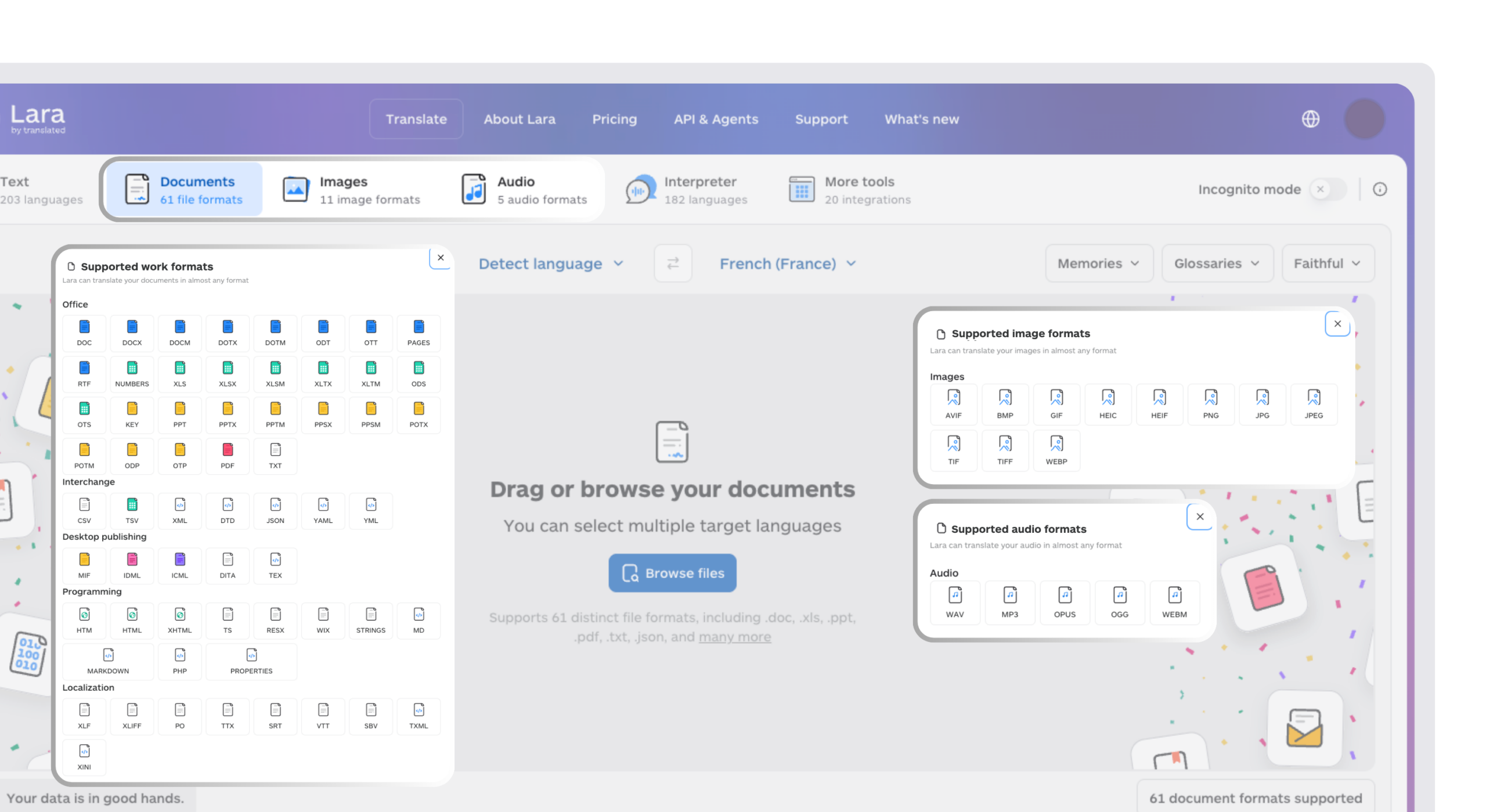
Lara Translate supports 200+ languages and 60+ file formats. Preserve product identifiers, prices, units, links, and technical attributes, and keep visible copy consistent with structured data. This text-and-file workflow does not assume a native integration or guarantee an increase in AI citations.
Keep product information consistent across languages
Use Lara Translate to prepare local-language content, then review each version before it enters your publishing and discovery workflow.
Conclusion
Choose around the outcome you can measure and the work your team can maintain. Pilot a consistent prompt set, inspect the cited sources, and connect changes to traffic or commercial evidence where possible. Keep product facts accurate and local-language content reviewed as the workflow scales.
Have a valuable tool, resource, or insight that could enhance one of our articles?
Send us an email at press@laratranslate.com
We’ll be happy to review it and consider it for inclusion to enrich our content for our readers! ✍️
Frequently asked questions
What is the best AI answer engine optimization platform in 2026?
Choose according to your main task: monitoring brand presence, improving content, diagnosing technical access, or enabling product discovery and transactions. Test representative prompts and markets, then compare evidence quality, integrations, review controls, and the full cost.
What is the difference between AEO and agentic commerce?
AEO focuses on how information appears in AI-generated answers. Agentic commerce concerns software agents discovering products and assisting with or executing purchasing steps. A visibility dashboard alone does not provide checkout infrastructure.
How much do AEO and agentic commerce platforms cost in 2026?
Pricing can depend on tracked prompts, AI models, regions, response frequency, workflow credits, and enterprise support. Some vendors publish monthly subscriptions, while others require a quote. Compare equivalent coverage and include add-ons and implementation costs.
Does structuring product data for AI systems also help traditional SEO?
Accurate, accessible product information can support discovery, but structured data does not guarantee rankings or AI citations. Google says its AI search features require no special schema or AI-specific markup. Canonical signals help indicate preferred URLs, but do not guarantee which page a search engine will select.
Why does language matter for AEO and agentic commerce platforms beyond structuring product data?
Translation helps shoppers read product details, specifications, and purchase terms in their preferred language. AI systems can work across languages, so translation should not be presented as a guaranteed route to citations. Publish reviewed local content and monitor each target market separately.
How should I measure whether an AEO platform is working?
Track a consistent set of relevant prompts over time and separate mentions from citations, referral visits, and conversions. Record the model, location, language, and collection date. Compare trends and business outcomes rather than treating a single answer as proof of success.
This article is about
- How visibility monitoring, content execution, and commerce infrastructure serve different goals
- Why prompts, models, regions, and language coverage affect the usefulness of AI visibility data
- How to connect recommendations with reviewed content and technical changes
- Why structured data and canonical signals do not guarantee rankings or citations
- How subscriptions, usage credits, and implementation affect total cost
- How reviewed translations support product communication across markets
Useful links
- Main SEO problems in 2026 and how to solve each one
- Best AI SEO Content Automation Platforms in 2026
- Lara Translate: supported file formats
This article was produced by the Lara Translate content team. Lara Translate is an AI translation platform built by Translated, with more than 25 years of professional translation experience. Ecommerce teams use Lara Translate to translate product content for review and publication, across 200+ languages and 60+ file formats.