

Security reviews usually start with a simple question: Can we trust you with our data?
The problem is that most vendors answer with vague promises and a logo wall. The Translated Trust Center exists to do the opposite: show your security posture clearly, publish what can be public, and provide a structured way to request the documents your security team needs.
Why it matters
Most vendor risk reviews do not get stuck on “security basics”. They get stuck on missing evidence, unclear ownership, and slow back-and-forth.
The Translated Trust Center helps teams complete a Translated Trust Center security review faster by keeping the review flow in one place, then mapping that posture to Lara Translate data security choices like Learning vs Incognito mode.
|
TL;DR
|
Short answer
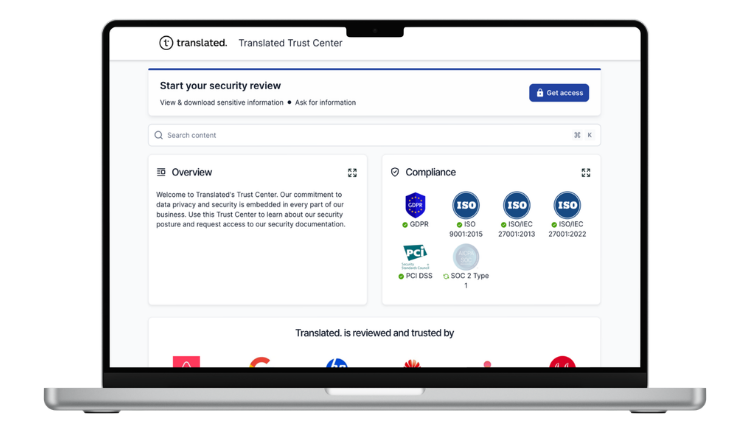
What is the Translated Trust Center? It’s Translated’s security and compliance hub for vendor due diligence, where teams can review listed standards (like ISO 27001 and PCI DSS), download what’s public, and request security documentation through a structured path.
The Trust Center also removes three of the most common friction points in vendor reviews: NDA signing is handled digitally and instantly within the platform, granting access to gated documents without back-and-forth; customers can subscribe to automatic notifications when new certifications or reports are added; and the hub is designed to pre-answer up to 80% of standard security questionnaire questions (SIG, CAIQ, and similar frameworks), reducing the time needed to close procurement cycles.
What is the Translated Trust Center?
The Translated Trust Center is a dedicated hub designed to support procurement, IT, and security teams during vendor due diligence.
Instead of scattering security answers across PDFs, sales decks, and email threads, the Trust Center provides:
- A clear overview of Translated’s security posture and compliance.
- A place to view public documents and request access to private security documentation when needed.
- A structured path to ask questions and complete a security review with fewer back-and-forth steps.
If your organization runs a formal vendor risk process, this matters because it helps you move from “marketing answers” to “reviewable evidence” faster.
Which certifications and compliance items are listed in the Trust Center?
 In the Trust Center, Translated lists multiple compliance items and standards that commonly appear in security reviews, including:
- GDPR
- ISO 9001
- ISO/IEC 27001:2013
- ISO/IEC 27001:2022
- PCI DSS
- ISO 17100:2015 (listed under reports)
- SOC 2 Type 1 (listed, not yet available)
In practice, these cover different parts of the “trust puzzle”. Some focus on how information security is managed (ISO/IEC 27001).
Others speak to payment security controls (PCI DSS). Others are attestation-style reporting for controls (SOC 2 Type 1).
Quick guide: what these standards mean in plain English
| Standard | What it signals | Why a translation buyer should care |
|---|---|---|
| GDPR | A framework for lawful, transparent personal data processing and user rights. | Translation data can include personal data (emails, tickets, contracts). GDPR alignment reduces compliance risk. |
| ISO 9001 | Quality management system discipline and continuous improvement. | Consistency matters in localization. Strong processes reduce “surprise outcomes” in delivery and support. |
| ISO/IEC 27001 | A structured information security management system (ISMS) with risk-based controls. | If you translate sensitive business content, you want security to be managed systematically, not ad hoc. |
| PCI DSS | Controls for handling payment card data. | Reassures you that payment flows are treated with strict security expectations. |
| ISO 17100 | A standard for translation services processes, resources, and quality management. | Signals managed service delivery and documented processes, useful when localization is business-critical. |
| SOC 2 Type 1 (listed) | An independent report on control design at a point in time. | Useful for enterprise vendor reviews that require formal assurance reports. |
Important note: certifications are not “magic shields”. They are evidence of a managed program and specific controls. The Trust Center is valuable because it helps you verify details and request the documentation your process requires.
1-minute decision: what should your security team check or request?
| If your review asks… | Do this in the Trust Center | Then validate for Lara Translate |
|---|---|---|
| “Show me your certifications and what they cover.” | Open the Compliance list and download what is public. | Review Lara Translate privacy controls (Learning vs Incognito) and data security notes. |
| “Where is data processed and who are the subprocessors?” | Use the privacy sections and request any gated docs your process requires. | Capture Lara Translate subprocessors + data processing locations and attach them to your vendor record. |
| “What’s your data retention and deletion process?” | Request the legal/privacy documentation required by your policy. | Document retention by mode and the steps to request deletion of Learning Mode data. |
How does this reflect on Lara Translate?
Lara Translate is built by Translated, so the Trust Center is relevant to Lara Translate in two concrete ways:
- Governance and controls: the security and compliance program reflected in the Trust Center provides the foundation for how products are built, operated, and reviewed.
- Product-level privacy and transparency: Lara Translate adds practical controls and visibility for users who translate real, sensitive content.
Here is how security teams typically connect the dots during vendor due diligence:
- Choose the right privacy mode: Learning Mode stores translation texts securely (encrypted) to improve quality. Incognito Mode stores no translation texts for maximum confidentiality.
- Verify retention and deletion: if you used Learning Mode and need deletion, Lara Translate provides a support-based deletion request flow.
- Confirm operational transparency: review the published subprocessors and data processing locations, and keep the list in your vendor risk file.
Helpful Lara Translate references for a security review:
- Data Security in Lara Translate
- Translation modes: Learning vs Incognito
- How to delete translation data
- Data Processing Addendum (DPA)
Subprocessors and data processing locations: the transparency piece
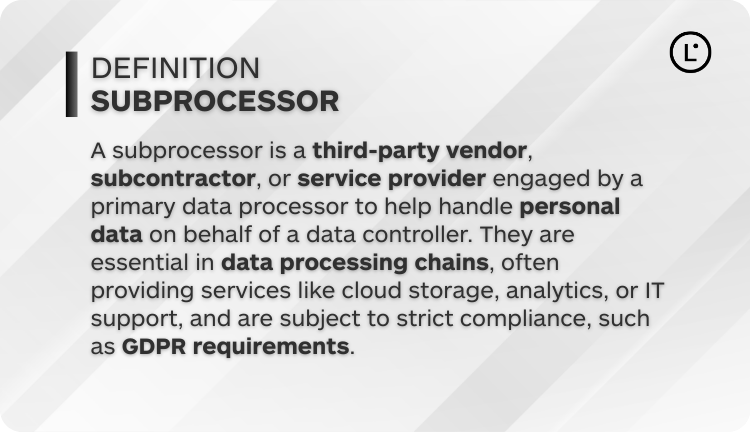
A strong trust story is not only about certifications. It is also about operational transparency, especially when third-party vendors process data.
Lara Translate publishes an up-to-date page describing its subprocessors and data processing locations, including what each provider does, where processing takes place, and the safeguards used for international transfers (when applicable).
If you are doing vendor due diligence, this helps answer questions like:
- Which vendors are involved in hosting, monitoring, payments, analytics, or support?
- Where can processing take place?
- What legal safeguards are referenced for cross-border processing?
Start here: Subprocessors and Data Processing Locations
How to use the Trust Center in a real security review
Here is a practical way teams typically use the Trust Center during procurement:
- Start with the overview to map Translated’s listed standards to your internal requirements.
- Download what is public to speed up your initial assessment.
- Sign NDAs digitally on the spot to unlock access to private documentation without waiting for legal back-and-forth. The platform handles the process directly, so your review does not stall on a paperwork step.
- Request access to any additional private documentation your process requires.
- Cross-check product specifics for Lara Translate, including privacy modes and the subprocessor list.
- Document your findings in your vendor risk workflow and capture any open questions for support.
If your review is blocked by one missing detail, the Trust Center is designed to reduce that friction: one hub, one request path, fewer scattered documents.
Need to complete a security review fast?
Use the Translated Trust Center to view public compliance information and request the security documentation your team needs.
Go to the Translated Trust Center
and see how it supports Lara Translate due diligence.
Automation and speed: how the Trust Center reduces review time
Most security reviews do not stall because of technical complexity. They stall because of waiting: waiting for NDAs to be signed, waiting for documents to be shared, waiting for answers to questions that should already be documented somewhere.
The Translated Trust Center addresses this directly:
- Instant NDA signing for gated documents, handled digitally within the platform — no separate legal process required.
- Subscribe to updates and receive automatic notifications when new certifications or reports are published, including transitions between standards (for example, from ISO 27001:2013 to 2022).
- Pre-answered questionnaires: the Trust Center is structured to cover the majority of standard SIG, CAIQ, and similar security questionnaire items upfront, so your team spends less time chasing answers and more time closing the review.
FAQ
Is Lara Translate trusted?
For security and privacy due diligence, start with the Translated Trust Center for organization-level posture, then validate Lara Translate product controls like privacy modes, data deletion, DPA, and subprocessors.
Does Lara Translate publish its subprocessors?
Yes. Lara Translate publishes a list of subprocessors and data processing locations, including what each provider does and where processing can take place.
Where should my security team start?
Start from the Translated Trust Center to map listed certifications and posture to your requirements, then review Lara Translate privacy controls (Learning vs Incognito) and the subprocessors page for operational detail.
This article is about:
- What the Translated Trust Center is and how to use it in vendor security reviews
- Which certifications and compliance items are listed by Translated (and what they mean)
- How those controls reflect on Lara Translate privacy, transparency, and subprocessors
Useful article
- Lara Translate Adaptive Translation API: The Complete Guide
- Gemini vs GPT for translation in 2026: what benchmarks and teams see