

Some words carry entire worlds inside them. Saudade holds a particular Portuguese grief-that-is-also-longing. Hiraeth is a Welsh ache for a home you cannot fully return to — a place, a time, a version of yourself. Hygge describes a Danish feeling of warmth that has no English counterpart. Mamihlapinatapai — from the Yaghan language of Tierra del Fuego — names a silent shared glance between two people who both want the same thing but neither will say it first. No English word does any of that.
These are the words translators lose sleep over. They are also the words that expose a hard truth about machine translation: if your tool translates word by word, it will always get them wrong. Meaning is not stored in words. It is stored in context. And the only AI translator that can handle these words well is one that actually understands it.
|
TL;DR
|
|
Quick answer What are untranslatable words? They are words whose meaning cannot be captured by a single equivalent word in another language. The concept can be expressed — but only through a phrase, a cultural explanation, or a creative rendering. Examples include Saudade (Portuguese), Hygge (Danish), Schadenfreude (German), and Wabi-sabi (Japanese). These words do not need to be lost in translation — they need context-aware AI that understands what surrounds them, not just what they say. |
What Makes a Word “Untranslatable”?
No word is completely untranslatable. You can always explain what it means. The problem is that explaining takes a sentence, and translation is supposed to give you a word. That gap — between meaning and the single lexical item — is where untranslatability lives.
A word becomes untranslatable when it encodes something that another language simply never needed to name. This happens for three main reasons.

The first is cultural specificity. Some concepts are so tied to a particular way of life, climate, or social code that other languages never developed a word for them. Hygge describes a very specific Danish and Norwegian experience of cosiness-as-social-ritual — candles, good company, no pressure. English has “cosy,” but that is an adjective describing a physical state. Hygge is a practice, a value, a whole philosophy of comfort. “Cosy” doesn’t touch it.
The second is emotional precision. Some languages have words for feelings that others smear into vague approximations. Saudade in Portuguese is not “nostalgia” and not “longing.” It is a melancholic love for something absent — a person, a place, a time — with the simultaneous awareness that what is absent may never return, and that this ache is itself something to be cherished. “Nostalgia” is too shallow. “Longing” is too simple. Saudade is both and neither.
The third is situational precision. Some words describe very specific situations that other languages only approximate. Mamihlapinatapai — from the nearly extinct Yaghan language of Tierra del Fuego — names the silent look exchanged between two people who both want the same thing but neither will make the first move. There is no English word. There is barely even a phrase.
A Dictionary of the Untranslatable
The table below collects some of the most remarkable untranslatable words from around the world — what they mean, why they resist translation, and how a context-aware AI should approach them.
| Word | Language | What it means | Closest English rendering |
|---|---|---|---|
| Saudade | Portuguese | A melancholic longing for something or someone absent, tinged with the knowledge it may never return — and the bittersweet love of that ache | “A nostalgic longing” — but this loses the acceptance of loss that defines saudade |
| Hygge | Danish / Norwegian | The warm, convivial feeling of cosiness shared with others — candles, blankets, good food, no urgency | “Cosy togetherness” — though hygge is a philosophy as much as a feeling |
| Schadenfreude | German | Pleasure derived from another person’s misfortune — usually minor, not malicious | English now borrows the German word directly; “gloating” is the closest native equivalent but misses the enjoyment without guilt |
| Wabi-sabi | Japanese | The beauty found in imperfection, impermanence, and incompleteness — a cracked bowl, a weathered face, autumn leaves | “The beauty of imperfection” — but this is a description, not the word itself |
| Mamihlapinatapai | Yaghan (Tierra del Fuego) | A shared, meaningful look between two people who both want the same thing but neither will initiate | No equivalent; must be described in full |
| Toska | Russian | A deep spiritual anguish — a longing with nothing to long for, a restless craving, an ache without a clear object | “Anguish” or “longing” — but toska is vaguer and deeper; Nabokov called it “a sensation of great spiritual ache” |
| Fernweh | German | A longing to travel to faraway places — not homesickness, but its opposite: a yearning for the distant and unknown | “Wanderlust” is the closest English term (also German) — though fernweh has more melancholy, less adventure-seeking |
| Forelsket | Norwegian | The euphoric feeling of falling in love — specifically the early, giddy, disorienting rush before love settles | “Falling in love” describes the event; forelsket captures the sensation in that first moment |
| Jayus | Indonesian | A joke so unfunny, so badly told, that you end up laughing at it anyway | “So bad it’s funny” — a phrase, not a word |
| Dépaysement | French | The feeling of being a foreigner — disoriented but also stimulated by the unfamiliarity of a new place | “Culture shock” is too negative; dépaysement can be pleasant |
| Meraki | Greek | Doing something with love, creativity, and total devotion — leaving a piece of yourself in your work | “With heart and soul” — a phrase that captures the spirit but not the specificity |
| Tsundoku | Japanese | Buying books and letting them pile up unread — the practice of accumulating more books than you will ever finish | No English equivalent; usually borrowed directly or described |
| Sobremesa | Spanish | The time spent lingering at the table after a meal — talking, drinking coffee, in no hurry to leave | “After-dinner conversation” — but sobremesa is the entire slow, warm ritual, not just the talking |
| Iktsuarpok | Inuit | The restless anticipation of going to the door again and again to check if someone is coming | Needs a full sentence to describe; some call it “host anxiety” |
| Ya’aburnee | Arabic | Literally “may you bury me” — an expression of deep love meaning “I love you so much I hope I die before you, so I never have to live without you” | No equivalent; an entire philosophy of love in two words |
| Hiraeth | Welsh | A longing for a home you cannot fully return to — a place, a time, or a version of life that may no longer exist | “Homesickness” misses its depth; hiraeth is grief for something that may never have existed exactly as remembered |
| Kintsugi | Japanese | The art of repairing broken objects with gold, making the repair visible and the object more beautiful and valuable for having been broken | “Golden repair” describes the craft; kintsugi also names the philosophy that breakage and repair are part of history, not something to hide |
| Friluftsliv | Norwegian | “Open-air life” — the philosophy that life is better lived outside, and that spending time in nature is essential to wellbeing, not optional | “Outdoor lifestyle” reduces it to a hobby; friluftsliv is a cultural value and way of being |
| Uitwaaien | Dutch | To walk in the wind specifically to clear your head and refresh your spirit — a deliberate act of wind-exposure as mental reset | “Going for a walk” omits the wind and the intention; “blowing off steam” is the closest in spirit but points inward rather than outward |
| Gökotta | Swedish | The act of rising early in the morning specifically to go outside and listen to the first birds sing — a deliberate practice of quiet attention to nature at dawn | No English equivalent; “dawn birdsong walk” describes the action without the ritual reverence the word carries |
| Abbiocco | Italian | The heavy, pleasant drowsiness that washes over you after eating a large, satisfying meal — the post-lunch sleepiness that makes you want to close your eyes | “Food coma” is the closest slang equivalent, but abbiocco has no negative connotation — it is a cherished, almost indulgent state |
Translate nuance, not just words
Lara Translate reads context, tone, and audience before it translates. Try it on a text that matters — and see the difference.
Why Word-for-Word Translation Always Fails Them
The standard approach to machine translation — map each source word to its closest target equivalent — collapses when applied to words like these. There is no target word. The mapping doesn’t exist. So a literal system does one of two things: it either borrows the foreign word unchanged (correct, but unhelpful to the reader without an explanation), or it picks the closest word in the target language and silently drops everything that made the original word worth using in the first place.

Take Saudade. A word-for-word system will render it as “nostalgia” in English. That is technically in the right emotional neighbourhood. But nostalgia is about fondly remembering the past. Saudade is about loving something that is absent with the awareness that it may be gone forever — and accepting that ache as its own kind of beauty. A Portuguese speaker reading “nostalgia” as a translation of saudade will feel, correctly, that something profound has been lost.
Or consider Sobremesa. A literal system translating from Spanish to English might produce “after the table” (a direct calque) or “after-dinner” (a near-guess). Neither captures the ritual slowness, the warmth, the deliberate refusal to hurry that the word names. The word is not just a noun; it is a cultural instruction about how to behave after a meal.
This is where context-aware AI changes everything.
How Context-Aware AI Handles Untranslatable Words
A context-aware translator does not ask “what is the equivalent of this word?” It asks “what is this text trying to communicate, to whom, and in what register?” That shift in question changes the entire output.
Consider the difference in these two scenarios.
| Source word | Word-for-word output | Context-aware AI output (marketing copy) | Context-aware AI output (literary text) |
|---|---|---|---|
| Saudade (PT) | Nostalgia | A longing you never quite shake | That bittersweet ache for what is gone and loved still |
| Hygge (DA) | Coziness | The kind of warmth you don’t want to leave | A shared stillness, lit and unhurried |
| Sobremesa (ES) | After the table / after-dinner | That unhurried hour after the meal | The long, unrushed after — coffee going cold, no one moving |
| Fernweh (DE) | Far-pain / wanderlust | That pull toward somewhere you’ve never been | A homesickness for places you have never been |
| Ya’aburnee (AR) | May you bury me | My love for you is bigger than my own life | I love you enough to ask the world that I go first |
The difference is not just stylistic. In every case, the context-aware output preserves the emotional charge of the original word — its weight, its register, its cultural intent — while the word-for-word output strips it away.
This is exactly what Lara Translate is built to do. Its AI reads the full surrounding text before deciding how to render any single word or phrase. You can also add context about the audience, the industry, and the tone — and Lara will calibrate accordingly. Choose the Fluid style for natural, readable output; the Creative style for marketing and editorial content where the emotional resonance of the original needs to carry across. For texts that use untranslatable words deliberately — literature, brand storytelling, cultural content — Creative style paired with a context note is the most powerful combination.
The Languages That Are Richest in Untranslatables
 Every language has words that resist translation. But some languages are particularly notable for their density of untranslatable concepts — usually because their culture has developed especially precise vocabulary for emotional states, social situations, or relationships with nature.
| Language | Known for | Example |
|---|---|---|
| German | Compound words for precise emotional states and abstract concepts | Schadenfreude, Fernweh, Weltschmerz (“world-pain” — sadness from the gap between the world as it is and as it should be) |
| Japanese | Aesthetic and emotional precision; concepts tied to impermanence and beauty | Wabi-sabi, Tsundoku, Kintsugi, Mono no aware (the bittersweet awareness that all things pass) |
| Portuguese | Rich emotional vocabulary, especially around longing and love | Saudade, Desenrascanço (improvising a clever solution to an impossible problem) |
| Russian | Depth of emotional and existential states | Toska, Pochemuchka (someone who asks too many questions) |
| Arabic | Dense, layered expressions of love, time, and social bonds | Ya’aburnee, Tarab (a musical ecstasy or enchantment that transcends the performance itself) |
| Scandinavian languages | Social, atmospheric, and emotional states tied to Nordic life and nature | Hygge (DK/NO), Forelsket (NO), Friluftsliv (NO), Gökotta (SE), Lagom (SE — “just the right amount”) |
| Welsh | Deep emotional and spiritual states, often tied to place, identity, and belonging | Hiraeth (longing for a home or version of life you cannot return to) |
| Dutch | Practical wellbeing; relationships with weather, nature, and everyday comfort | Uitwaaien (walking in the wind to clear your head), Gezelligheid (cosy social warmth — a Dutch cousin of hygge) |
| Italian | Sensory pleasure, food culture, and the art of living well | Abbiocco (the drowsy bliss after a big meal), Sprezzatura (effortless grace that conceals the effort behind it) |
| Indonesian / Malay | Humour, social nuance, and collective experience | Jayus, Malu (a complex shame-embarrassment that prevents social transgression) |
Translate into 207 languages — including the ones hardest to get right
Lara Translate supports every major language and dozens of smaller ones. When the meaning is subtle, it uses full context — not just the word. Free plan available, no credit card required.
What This Means for Translation in Practice
If you are translating content that contains untranslatable words — or content that carries the same kind of cultural weight even if it uses ordinary vocabulary — there are practical steps that make a real difference.
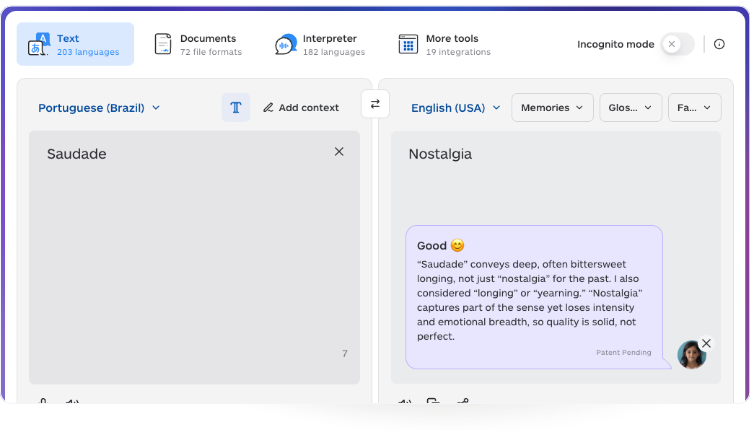
Choose your translation style. Lara Translate offers three styles. Faithful stays close to the source structure, which is right for legal and technical documents but wrong for emotionally loaded content. Fluid produces natural, idiomatic output — the right default for most communication. Creative gives the AI genuine latitude to find the most expressive rendering, which is what you want for brand content, editorial writing, or any text where the emotional effect of the words matters as much as their literal meaning.
Add context. The Add Context feature in Lara lets you supply a brief description of the content’s purpose, audience, and tone before translation begins. This is particularly valuable for untranslatable words because it tells the AI which register to work in. A description like “marketing copy for a luxury travel brand, international audience, evocative tone” will produce a very different rendering of Fernweh than a description like “internal company newsletter, conversational, no jargon.”
Review the alternatives. Lara’s Alternative Translations feature lets you click any word in the output and see a dropdown of different renderings, each with an explanation of why it was chosen. For words like these, reviewing the alternatives is often where you find the rendering that feels exactly right — the one that would have taken a human translator a paragraph to explain.
Build your glossary. If your content regularly uses specific culturally loaded terms — a brand name, a recurring concept, a word you have decided to keep in the source language — add it to a Lara glossary. The glossary enforces that decision across every translation job, so you are not re-making it from scratch every time.
Conclusion
Untranslatable words are not a problem to be solved. They are a reminder of what language actually does: it encodes the way a community sees the world, names what matters to it, and draws distinctions that other communities never thought to make. The fact that Saudade exists in Portuguese is not an accident — it reflects something real about Portuguese-speaking cultures and their relationship with longing and loss.
What this means for translation is that the words hardest to translate are often the most important ones. They carry the highest semantic load. They are the ones that, if rendered carelessly, drain all the meaning from a text.
Getting them right requires reading context. Not just the word — the sentence, the paragraph, the genre, the audience, the intention. That is what context-aware AI does. It is the same thing a skilled human translator does, and it is why the gap between word-for-word machine translation and contextual AI translation is nowhere more visible than in the words that have no translation at all.
Your words carry meaning. Make sure the translation does too.
Lara Translate reads the full context of your text before translating. Add tone, audience, and style guidance — and get output that actually sounds like it was written for your readers.
FAQ
What does “untranslatable” mean?
A word is considered untranslatable when no single equivalent word exists in another language. The concept itself can usually be expressed — but only through a phrase, a sentence, or a cultural explanation, not a one-to-one word swap. True untranslatability is rare; approximate untranslatability, where something significant is always lost, is common.
Can AI translate untranslatable words?
Context-aware AI can handle untranslatable words far better than word-for-word translation tools. By reading the surrounding sentence, the specified tone, and the target audience, a good AI translator can find the closest natural equivalent in the target language rather than producing a literal rendering that sounds wrong or loses the original meaning entirely.
What are the most famous untranslatable words?
Some of the most cited examples are Saudade (Portuguese — a melancholic longing for something absent), Hygge (Danish/Norwegian — cosy convivial warmth), Schadenfreude (German — pleasure at another’s misfortune), Wabi-sabi and Kintsugi (Japanese — beauty in imperfection; the art of repair with gold), Hiraeth (Welsh — longing for a home you cannot fully return to), Sobremesa (Spanish — the unhurried time at the table after a meal), Friluftsliv (Norwegian — the philosophy that life is better lived outside), Abbiocco (Italian — the blissful drowsiness after a big meal), Uitwaaien (Dutch — walking in the wind to clear your head), and Gökotta (Swedish — rising early to hear the first birds sing).
Why are some words untranslatable?
Words become untranslatable when they encode concepts that are culturally specific, emotionally layered, or situationally precise in a way that other languages never needed a single word for. Language reflects how a culture carves up reality — and different cultures carve it differently. Some feelings are named only by the communities that felt them most urgently.
How should untranslatable words be handled in translation?
The best approach depends on context. Common strategies include: borrowing the original word as a loanword (often the right choice when the word is culturally significant and readers can learn it), providing a brief descriptive equivalent, using a parenthetical explanation, or finding the closest natural expression in the target language. Context-aware AI can judge which approach fits best for any given text and register.
Does Lara Translate handle culturally specific or untranslatable words?
Yes. Lara Translate uses contextual AI that reads the surrounding text, the specified tone, and the target audience to produce translations that capture meaning — not just words. You can add explicit context about audience, industry, and purpose using the Add Context feature, and choose a translation style (Faithful, Fluid, or Creative) to guide how Lara handles culturally loaded or emotionally complex terms. The Creative style gives Lara the most latitude to find expressive, culturally resonant renderings.
Are untranslatable words always borrowed into other languages?
Sometimes, but not always. Schadenfreude has entered English almost completely. Hygge has been widely borrowed in English over the past decade. But most untranslatable words remain niche, and competent translators — human or AI — need to decide case by case whether to borrow the original word, explain it, or find the closest available equivalent in the target language.
Which language has the most untranslatable words?
No definitive ranking exists, and the question depends on which target language you are translating into. German is widely celebrated for its compound words encoding precise emotional and philosophical states. Japanese has an exceptionally rich vocabulary for aesthetic experience and impermanence. Portuguese and Russian are noted for their depth in emotional states. Every language has untranslatable concepts — they are unevenly distributed, not absent from any language.
|
This article is about Untranslatable words — words from languages around the world that carry concepts, emotions, or cultural meanings that resist direct translation into other languages. The article covers why words become untranslatable, examples from Portuguese, German, Japanese, Norwegian, Russian, Arabic, Spanish, and other languages, and why context-aware AI translation produces better results for culturally complex or emotionally layered vocabulary than word-for-word machine translation tools. |
Useful links
- Lara Translate is a DSLM: why this beats a GenAI (or. general LLM for translation?
- Context-Aware Text Translation API: How Lara Translate’s Adaptive API Works
- Transcreation vs Translation: When to Use Each (and What Happens When You Pick Wrong)