

Quick Answer
Transcreation adapts marketing content creatively to preserve emotional impact in new markets. Translation converts text accurately between languages for informational content. The decision comes down to intent: if success depends on information transfer, translate. If it depends on emotional resonance, transcreate. Most global campaigns need both, applied to different content types.
TL;DR
|
Why it matters: Every dollar spent on international marketing depends on language getting the emotion right. Translated words that carry no emotional weight will not convert, and no optimization after the fact can fix that. Choosing between transcreation and translation is not a linguistic decision — it is a revenue decision.
What is the core difference between transcreation and translation?
 Translation converts text from one language to another while maintaining meaning and accuracy. Translators work with glossaries, translation memory systems, and term bases to maintain consistency across documents. The process prioritizes linguistic precision, grammatical correctness, and fidelity to the source. Translation works exceptionally well for technical documentation, legal contracts, user manuals, product specifications, and any content where deviation from the source creates compliance risk or information loss.
Transcreation adapts content creatively for new markets while preserving intent, emotional impact, and brand voice. Rather than translating word-for-word, transcreators receive creative briefs explaining campaign objectives, target audience psychographics, desired emotional responses, and brand positioning. They recreate the concept in the target language, often changing the messaging entirely to resonate with local cultural references, humor, values, and communication styles. The distinction matters most for advertising slogans, taglines, social media campaigns, video game narratives, and any persuasive content where emotional connection drives results.
The practical difference shows up in deliverables. Translators return translated text aligned with source content. Transcreators return recreated messaging plus back-translations that explain creative choices, alternative options, and the cultural considerations that shaped their decisions. When evaluating which approach fits a project, ask: does success depend on precise information transfer or emotional resonance?
Translation converts text from one language to another while maintaining meaning and accuracy. Translators work with glossaries, translation memory systems, and term bases to maintain consistency across documents. The process prioritizes linguistic precision, grammatical correctness, and fidelity to the source. Translation works exceptionally well for technical documentation, legal contracts, user manuals, product specifications, and any content where deviation from the source creates compliance risk or information loss.
Transcreation adapts content creatively for new markets while preserving intent, emotional impact, and brand voice. Rather than translating word-for-word, transcreators receive creative briefs explaining campaign objectives, target audience psychographics, desired emotional responses, and brand positioning. They recreate the concept in the target language, often changing the messaging entirely to resonate with local cultural references, humor, values, and communication styles. The distinction matters most for advertising slogans, taglines, social media campaigns, video game narratives, and any persuasive content where emotional connection drives results.
The practical difference shows up in deliverables. Translators return translated text aligned with source content. Transcreators return recreated messaging plus back-translations that explain creative choices, alternative options, and the cultural considerations that shaped their decisions. When evaluating which approach fits a project, ask: does success depend on precise information transfer or emotional resonance?
When to use transcreation over translation
The case for transcreation becomes clear when content success depends on emotional impact rather than information accuracy. Marketing materials designed to persuade, entertain, or build brand affinity require creative adaptation that respects cultural context. Below are the scenarios where transcreation consistently outperforms translation.Brand slogans and taglines
 Slogans compress brand positioning into memorable phrases that must work across cultures. Nike’s “Just Do It” translates literally in some languages but requires transcreation in others to maintain motivational impact. When Mercedes-Benz entered China, direct translation of their name yielded “Bensi” — rush to die. They transcreated to “Ben Chi” (dashing speed), avoiding brand disaster. Any slogan carrying wordplay, cultural references, or idiomatic expressions needs transcreation, not translation.
Advertising campaigns with humor or wordplay
Humor rarely translates literally. What makes people laugh in London might confuse audiences in Tokyo or offend communities in Dubai. Puns, double meanings, and cultural references that drive engagement need complete recreation. Transcreators understand local humor patterns, taboos, and what resonates emotionally in target markets — allowing campaigns to maintain entertainment value without falling flat or causing offense.Social media content and influencer collaborations
 Social platforms thrive on authentic, culturally relevant communication. Posts that generate likes, shares, and comments in one market need transcreation to achieve similar engagement elsewhere. Trending topics, memes, slang, and communication norms vary dramatically between cultures. Generic translation produces content that feels foreign and fails to spark conversation. Transcreation helps social presence feel native to each market.
Video game narratives and character dialogue
Gaming localization demands transcreation for immersive player experiences. Character personalities, plot references, humor, and emotional story beats must resonate with players in every market. Direct translation creates stilted dialogue that breaks immersion. Transcreators adapt character voices, jokes, cultural references, and even plot elements to maintain narrative impact while respecting local sensitivities.Product naming and packaging copy
 Product names carry brand identity and must work linguistically and culturally in new markets. Colgate launched “Cue” toothpaste in France, unaware it is slang for a pornographic word. Packaging copy describing benefits, usage occasions, and brand stories requires transcreation to connect emotionally while avoiding cultural missteps that damage brand perception.
Email marketing subject lines and calls-to-action
Email engagement depends on subject lines that grab attention in crowded inboxes. What works in English may not trigger opens in Spanish, Mandarin, or Arabic. Calls-to-action that drive clicks need emotional urgency that varies across cultures. When open rates, click-through rates, or conversion metrics justify the investment, transcreation beats basic translation for email marketing every time.When translation works better than transcreation
Not every content type justifies transcreation’s higher cost and longer timelines. Translation delivers superior results when accuracy, consistency, and information transfer matter more than emotional impact. Here is where creative freedom becomes a liability rather than an asset.Legal documents and compliance materials
 Contracts, terms of service, privacy policies, and regulatory disclosures require word-for-word accuracy. Legal translation demands precision because ambiguity creates liability. Courts scrutinize translated legal documents for fidelity to the source language. Transcreation’s creative freedom is a compliance risk in this context. Certified translators with legal expertise ensure regulatory requirements are met across jurisdictions.
Technical documentation and user manuals
Product specifications, assembly instructions, troubleshooting guides, and technical manuals prioritize clarity and precision. Users need exact information to operate products safely. Translation maintains consistency across instruction types and product lines. Transcreation introduces variability that could confuse users or create safety hazards. Technical translation with glossaries supports consistent terminology throughout.Financial reports and data-heavy content
 Earnings reports, financial statements, audit documents, and data analysis require accurate number translation and precise terminology. Stakeholders need identical information across languages for compliance and decision-making. Creative adaptation serves no purpose here and introduces error risk. Translation with subject matter expertise supports financial data integrity.
Software UI strings and error messages
Interface text, button labels, menu items, and error messages need consistent translation across platforms. Users expect familiar terminology throughout applications. Translation memory systems ensure buttons say the same thing in every context. Transcreation creates inconsistency that degrades user experience and increases support burden.Product specifications and ingredient lists
 Technical specifications, materials lists, ingredient disclosures, and warranty information require literal translation. Regulatory agencies mandate specific language for product labeling. Creative adaptation could trigger compliance violations or safety concerns. Translation supports regulatory alignment while maintaining the accuracy these documents legally require.
Test creative adaptation vs precision translation
Try Lara Translate’s three translation styles on your actual marketing content. Switch between Faithful, Fluid, and Creative to see which approach fits each content type.
How creative copy localization bridges the two approaches
Creative copy localization sits between pure translation and full transcreation, adapting marketing content to local markets while balancing brand consistency with cultural relevance. This approach works for content requiring more cultural adaptation than translation provides but less creative freedom than transcreation demands. Many global brands use creative copy localization for website copy, product descriptions, email templates, and campaign materials targeting multiple regions. The process maintains core messaging and brand voice while adjusting cultural references, tone, examples, and communication patterns for local audiences. Localizers work from brand guidelines and style guides, ensuring adaptations stay within brand parameters while resonating culturally. Think of the spectrum this way: translation at one end with maximum fidelity to the source, transcreation at the other with maximum creative freedom, and creative copy localization in the middle. Teams choose their position based on brand control needs, market maturity, and content type. Operationally, it requires clear briefs specifying which elements stay fixed (brand values, product benefits, factual claims) and which elements allow adaptation (tone, examples, cultural references).How to structure transcreation and translation workflows
Mixing the two processes on the same project creates confusion, delays, and suboptimal results. Successful global content operations keep them separate from the start.Translation workflow for precision content
- Source content preparation: finalize source text, lock formatting, provide context on technical terms.
- Glossary and style guide alignment: share approved terminology, formatting rules, tone guidance.
- Translation memory leverage: use existing translations for consistency across projects.
- Quality assurance review: check accuracy, terminology consistency, formatting preservation.
- Delivery and integration: return translated content in source format for immediate use.
Transcreation workflow for persuasive content
- Creative brief development: document campaign objectives, target audience insights, emotional goals, brand positioning, and budget parameters.
- Transcreator selection: engage native copywriters with marketing expertise in the target market.
- Concept adaptation: transcreators recreate messaging to achieve emotional impact in local culture.
- Back-translation and rationale: receive recreated content plus explanation of creative choices and alternatives considered.
- Stakeholder review and iteration: marketing teams evaluate emotional impact, brand alignment, cultural appropriateness, and revise as needed.
- Market testing (optional): test adapted messaging with focus groups before full rollout.
- Final approval and launch: sign off on creative execution and deploy in target market.
Hybrid approach for mixed content
Most product launch campaigns contain both precision and persuasion elements. A single launch package might include taglines (transcreate), hero copy (transcreate or creatively localize), product specifications (translate), legal disclaimers (translate), and testimonials (creatively localize). Tag each content element with the appropriate approach before routing to linguists. That tagging step is the one most teams skip, and it is where the confusion starts.How technology supports both approaches at scale
Translation management systems for translation workflows
Translation benefits from automation, consistency enforcement, and workflow efficiency. TMS platforms provide translation memory to reuse previous translations, terminology management to ensure consistent term usage, machine translation integration for speed on low-stakes content, quality assurance tools to catch errors, and project management features to track progress across languages. These systems excel at high-volume translation where consistency and speed matter most.Creative platforms and collaboration tools for transcreation
Transcreation requires creative collaboration, not automation. Transcreators need access to brand guidelines, creative briefs, visual context, back-translation templates, and stakeholder feedback loops. Platforms supporting transcreation prioritize creative brief management, visual context sharing, multichannel content preview, collaborative review workflows, and approval routing.How Lara Translate supports both precision and creative adaptation
Most translation tools force you to choose: either you get precision, or you get flexibility. Lara Translate is built to handle both within a single platform, which matters when your content mix includes product specs and ad copy in the same project. For translation workflows requiring accuracy, Lara Translate applies contextual understanding to analyze entire documents and maintain consistent terminology and tone across languages. You can upload and manage custom glossaries to enforce specific terminology, and add context instructions around audience, domain, or preferred phrasing to sharpen output for specialized content. The platform supports 200+ languages and handles 70+ file formats, so technical documentation, legal files, and UI strings all come back in the original format — no layout reconstruction required.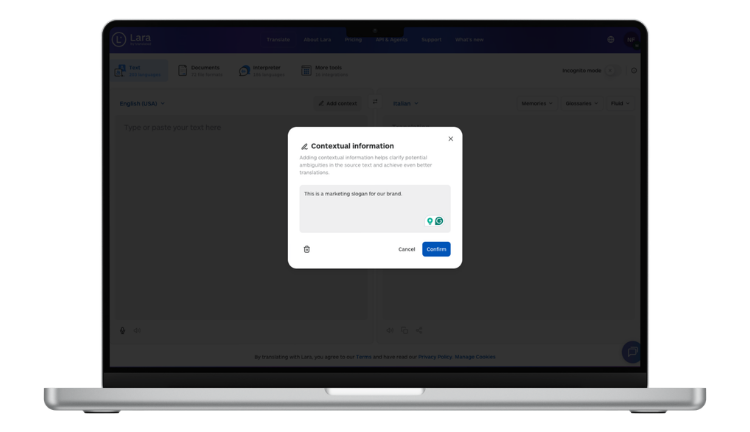
Try using Styles and Context to get where you want
Try Lara Translate’s three translation styles and use the context box on your actual marketing content. Give further hints to Lara and see the magic!
Real-world transcreation failures and successes
Coca-Cola’s transcreation success in China
When Coca-Cola entered China, direct phonetic translation produced “Keke Kenla,” which meant “tadpoles bite wax” in Mandarin. The company transcreated their name to “Kekou Kele,” meaning “delicious happiness,” preserving brand essence while resonating culturally. Similarly, their “Open Happiness” slogan required transcreation to convey joy and celebration in ways that connect with Chinese cultural values around family and togetherness. This investment in transcreation helped Coca-Cola become one of the most recognized brands in China.KFC’s localization strategy across markets
KFC demonstrates sophisticated understanding of the transcreation vs translation decision by maintaining core brand identity while adapting menu items, messaging, and visual identity for local tastes. In Japan, KFC positioned itself as a Christmas dining tradition through transcreated marketing that connected fried chicken with holiday celebration. In India, vegetarian menu options and transcreated messaging respect cultural dietary preferences while maintaining KFC’s brand personality.HSBC’s expensive translation mistake
HSBC’s “Assume Nothing” campaign translated to “Do Nothing” in multiple languages, forcing a $10 million rebrand. This failure occurred because translators worked without creative briefs explaining campaign intent. Transcreators with proper context would have recreated messaging to preserve the intended meaning — challenging assumptions, not avoiding action. The cost of that mistake exceeded transcreation fees by orders of magnitude. It is the cleanest possible illustration of why high-stakes persuasive content demands transcreation.Netflix’s content localization
Netflix invests heavily in transcreation for original content, adapting show titles, descriptions, and marketing materials for cultural resonance. “Money Heist” was “La Casa de Papel” in Spanish markets but transcreated for English audiences to emphasize action over artistry. Thumbnail images, show descriptions, and promotional copy all receive transcreation to maximize appeal in each market, which is part of how Netflix drives global subscriber growth with locally relevant content.How to decide between transcreation and translation for your content
| Content type | Approach | Why |
|---|---|---|
| Brand taglines and slogans | Transcreation | Emotional impact drives brand recognition; literal translation kills meaning |
| Marketing campaign copy | Transcreation or creative localization | Persuasive intent requires cultural adaptation; success measured by engagement |
| Social media posts | Transcreation | Platform norms and trending topics vary by market; native voice is essential |
| Product specifications | Translation | Accuracy and consistency matter; deviation creates confusion or compliance risk |
| Legal documents | Translation | Regulatory requirements demand precision; creative freedom introduces liability |
| Video game dialogue | Transcreation | Character voice and narrative immersion depend on cultural authenticity |
| Technical documentation | Translation | Users need exact instructions; terminology consistency prevents errors |
| Email subject lines | Transcreation or creative localization | Open rates depend on attention-grabbing relevance; what works in one culture may not transfer |
| Financial reports | Translation | Data accuracy and terminology precision are non-negotiable for stakeholders |
| Website product descriptions | Creative localization | Balance brand consistency with cultural appeal; core benefits stay fixed while examples adapt |
What is the future of transcreation vs translation?
AI and machine learning are improving translation speed and accuracy fast, making basic translation increasingly automated. Neural machine translation handles informational content well, freeing human translators for complex terminology and nuanced context. Transcreation remains fundamentally human because creativity and cultural intuition resist automation. AI can suggest alternative phrasings or highlight cultural considerations, but recreating emotional impact requires understanding cultural psychology, market positioning, and brand strategy in ways that current technology cannot replicate. The most sophisticated AI translation models still struggle with humor, wordplay, and cultural references that transcreators handle naturally. The divide between the two approaches may actually widen as AI handles more translation volume while human transcreators focus exclusively on high-value creative work. Teams will increasingly use AI for first-pass translation with human review for accuracy, reserving human creativity for persuasive content where emotional connection drives business results. Platforms combining AI translation with human transcreation workflows will enable global content strategies that scale efficiently across both content types. Teams that master this hybrid approach will outpace competitors stuck in one-size-fits-all language services.Thank you for reading 💜
As a thank you, here’s a special coupon just for you: IREADLARA26.
Redeem it and get 10% off Lara PRO for 6 months.
If you already have a Lara account, log in here to apply your coupon. If you are new to Lara Translate, sign up here and activate your discount.
FAQs
What is the main difference between transcreation and translation?
Translation accurately converts text between languages while preserving the original meaning, structure, and terminology. Transcreation adapts content creatively to preserve emotional impact and cultural resonance, often changing the messaging entirely to achieve the same effect in a different market. The choice depends on whether the content must be accurate or persuasive. For a user manual, translation is correct. For a campaign tagline, transcreation is the only approach that works. Most global content operations need both, applied to different content types within the same project.How much more does transcreation cost than translation?
Transcreation typically costs 2-5 times more than translation because it requires more time, research, and creative expertise. Transcreators charge by project or hourly rate rather than per word, reflecting the creative work involved rather than word count efficiency. Translation scales well at volume because per-word pricing rewards repetition and consistency. The cost difference reflects value: transcreation drives conversions for persuasive content, while translation efficiently handles informational content at scale. For high-stakes campaigns, the ROI on transcreation frequently exceeds the premium paid for it — the HSBC rebranding example makes that math very clear.Can machine translation handle transcreation work?
No. Machine translation excels at informational content requiring accuracy but cannot recreate the emotional impact or cultural nuance that defines transcreation. AI lacks the cultural psychology understanding, creative judgment, and strategic brand knowledge that transcreators apply to every project. Current technology can support transcreators with alternative phrasings or cultural flag suggestions, but human creativity remains essential for effective transcreation. That is unlikely to change in the near term, because humor, wordplay, and culturally specific emotional resonance are the areas where AI translation models consistently underperform.Which content types require transcreation versus translation?
Transcreation suits marketing campaigns, brand slogans, advertising copy, social media content, video game narratives, and any persuasive material where emotional connection drives results. Translation works for legal documents, technical manuals, product specifications, financial reports, and informational content where accuracy matters more than emotional impact. The distinction is not always clean — website product descriptions often fall in the middle, which is where creative copy localization as a hybrid approach becomes the right answer. When in doubt, ask what failure looks like: if bad translation creates legal risk, translate precisely. If it just produces copy that fails to convert, you needed transcreation.How do I brief a transcreation project effectively?
Effective transcreation briefs explain campaign objectives, target audience demographics and psychographics, desired emotional response, brand positioning, cultural sensitivities to consider, and success metrics. Include visual context, original campaign performance data, and budget parameters. Treat transcreation briefs like creative briefs for original copywriting — because transcreators function as copywriters adapting concepts for new markets, not translators converting words between languages. The more context you provide upfront, the fewer revision rounds you go through, which is where most of the time and cost in transcreation projects actually gets lost.This article covers
- The core difference between transcreation and translation and what each approach is actually built for in global content operations
- When to use transcreation for marketing materials that must convert emotionally, versus translation for informational accuracy where deviation creates risk
- How creative copy localization bridges the gap between the two approaches for content that needs measured cultural adaptation without full creative freedom
- How to structure separate workflows for translation and transcreation so the right method gets applied to the right content type from the start
- How Lara Translate’s translation styles — Faithful, Fluid, and Creative — support both precision and creative adaptation in a single platform across 200+ languages
Have a valuable tool, resource, or insight that could enhance one of our articles? Submit your suggestion
We’ll be happy to review it and consider it for inclusion to enrich our content for our readers! ✍️
Useful articles
- Best LLMs for translation: the complete guide to top-performing language models
- What is a locale? Locale vs. languages
- Translation mistakes in the legal industry: what goes wrong and how to avoid it