

When a policy changes, outdated translations can leave employees following different instructions. Internal communications translation needs a clear process for deciding what to translate, who reviews it, and when each language version must be updated.
Start with messages employees need to work safely, understand critical policies and meet deadlines. Then build a repeatable workflow for employee handbooks, onboarding, training and routine announcements.
TL;DR
|
Which internal communications should you translate first?
Translate safety instructions, critical policies and time-sensitive messages requiring employee action first. Next, prioritize the handbook, onboarding and training content employees use most often. Treat this as a suggested framework: urgency and the consequences of misunderstanding should determine the final order.
Assess the message, not just the document type. A safety procedure inside an employee handbook belongs in the highest-priority group, while an announcement about a benefits deadline may need translation before routine training content. Identify language needs by employee audience rather than assuming that everyone in a country uses the same language.
Safety information and critical policies
Begin with emergency instructions, safety procedures and policies that explain important responsibilities or required actions. Assign reviewers who can check both the translation and the subject matter. Depending on the content, this may involve a qualified linguist, a safety specialist, HR or local legal counsel.
Define any applicable local requirements before setting the workflow. A translation process should support that assessment, not substitute for it.

Employee handbooks, onboarding and training
Prioritize the sections employees need to start work and carry out their roles. These may include reporting procedures, system instructions and mandatory training. Review sensitive policy sections separately from lower-risk material such as a welcome message.
Use approved translations for department names, job titles, internal systems and recurring HR terms across all three content types. Employees should not have to work out whether different labels refer to the same process.
Announcements and operational updates
Give messages with deadlines a clear translation and approval window. A short announcement about a site closure or required employee action can be more urgent than a long document.
Before publication, check dates, time zones, links and the action employees must take. If the source changes late, identify the affected passage and send it back through the necessary review.
Intranet stories and employee engagement content
Schedule lower-risk culture stories, community updates and evergreen intranet pages around higher-priority work. These messages may allow more flexibility in tone, but still need accurate names, facts and links.
Reassess the priority if a leadership message includes a major organizational change or sensitive employee-relations information.
How to translate an employee handbook and keep it current
Treat an employee handbook as a maintained document. Give the approved source a version number or publication date, and record which source version each translation reflects.
Before translating, separate company-wide guidance from sections that need local HR or legal review. Translation conveys the source policy in another language; adapting a policy for a different location requires a separate content decision.
Prepare a glossary of approved terms and use a Translation Memory where suitable reviewed translations already exist. A glossary defines preferred translations for terms, while a Translation Memory stores previously translated segments. Reused wording still needs checking against the current policy and context.
When the source changes, identify the revised sections and related content before commissioning updates. A policy may appear in the handbook, an onboarding slide and an intranet page. Updating only the handbook leaves employees with conflicting information.

Example: updating a leave-policy section
Suppose HR approves a revised leave-request procedure. The change affects one handbook section, two onboarding slides and an intranet page. A practical update sequence is:
- Approve the source: HR confirms the wording, effective date and affected employee groups.
- Identify the changes: the content owner lists each affected passage and required language version.
- Translate and review: translators use approved terminology, and the assigned reviewers check the revised procedure in context.
- Publish together: the channel owners replace outdated copies and check links between the handbook, slides and intranet.
- Record completion: the owner logs the source version, reviewer, publication date and location of each translation.
This illustrative workflow keeps the update focused while making related content and publication responsibilities visible.
Bring approved terminology into your next handbook update
Use Lara Translate with your glossary and Translation Memories, then send sensitive policy sections to the appropriate reviewers.
Build a repeatable internal communications translation workflow
Before requests arrive, assign a source owner, required languages, reviewer and publication deadline to each recurring communication flow. Keep those decisions in a shared tracker that the content and language teams can access.
- Approve the source. Resolve ambiguous instructions, unexplained acronyms and unfinished policy decisions before translation starts.
- Define the audience and deadline. Identify who needs the message, which languages they need and when they must receive it.
- Prepare language resources. Supply the relevant glossary, reviewed Translation Memory and guidance on tone and names that should remain unchanged.
- Translate and review. Match the review to the consequences of an error. Check meaning, terminology, dates, numbers, links and required actions.
- Check the published format. Inspect headings, tables, slide labels and text inside images so employees can use the translated material.
- Publish and maintain. Record the source version and publication location, replace outdated copies and define what triggers the next update.
Use a simple status sequence such as source approved, translating, in review and published. A document is not ready for employees merely because translation is complete.
For policy updates, the trigger may be any approved source change. For announcements, it may be the publication deadline. Lower-risk evergreen pages can follow a scheduled review cycle, with earlier updates when their information changes.
Keep tone and terminology consistent across languages
Set the tone for each communication type. Policies need precise instructions, onboarding messages should be welcoming and clear, and leadership announcements need a register suited to their subject.
A short style brief should explain how to address employees, the expected level of formality, approved department and system names, and how to present dates and times. For example: “Use direct, respectful language. Keep the internal portal name unchanged. Make the required action and deadline explicit.”
Natural wording can differ between languages while conveying the same meaning. Ask reviewers to check that the translation preserves obligations, options and deadlines, especially when a seemingly small wording change could alter an instruction.
How Lara Translate supports recurring employee communications
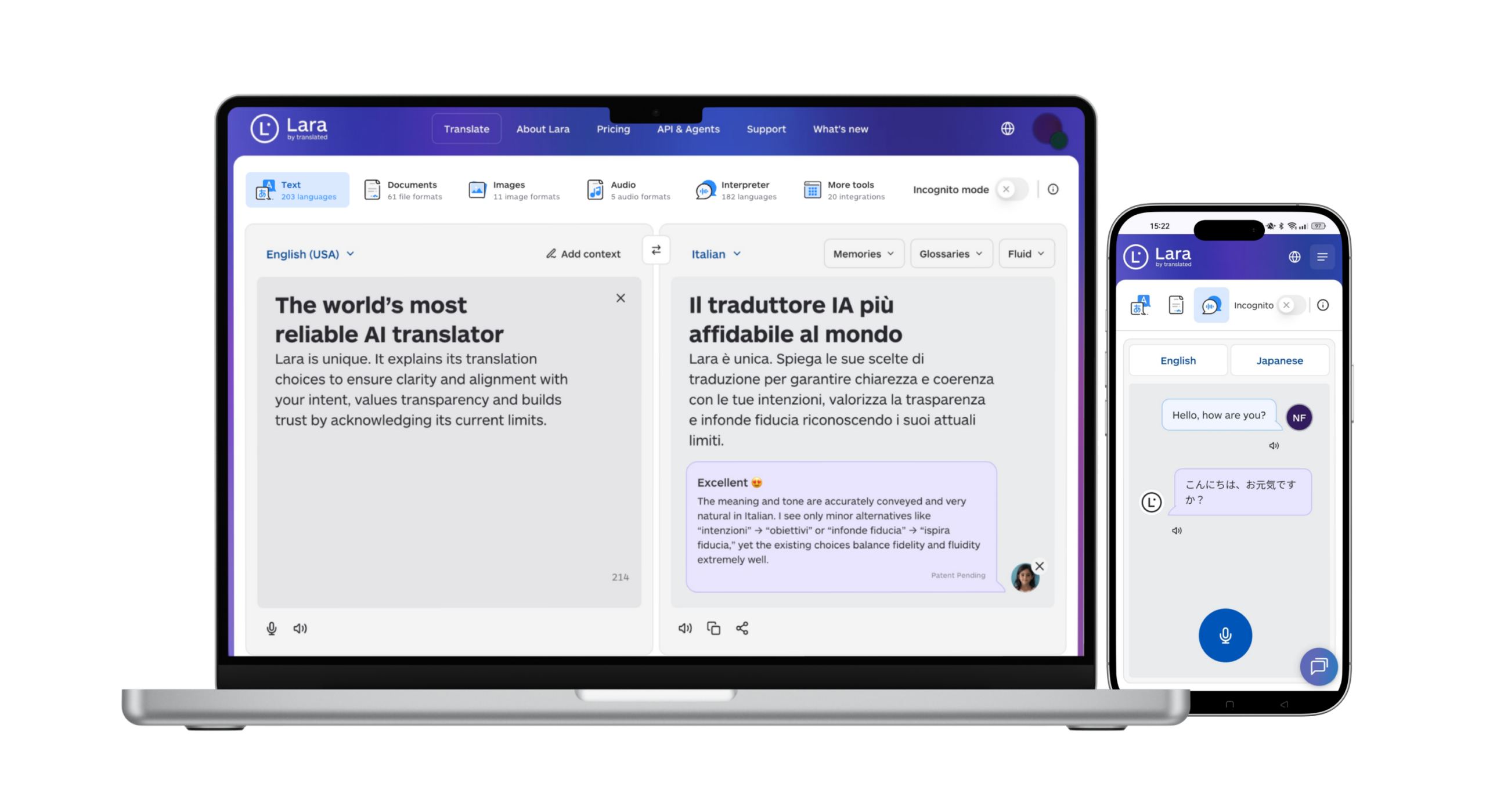
Lara Translate supports translation into more than 200 languages and works with 70+ file formats, including common handbook, spreadsheet and presentation formats. These capabilities let teams work with the files they use for employee communications. Sources: Lara Translate Support: Supported languages and Lara Translate: Supported File Formats.
Reuse terminology across handbooks and training
Teams can create, import, export and select Translation Memories for text and document translation. Glossaries also apply to text and documents, helping prioritize approved translations for recurring terms such as department names and internal processes. Sources: Lara Translate Support: Translation Memories and Lara Translate Support: Glossaries.
Guide short messages and choose a translation style
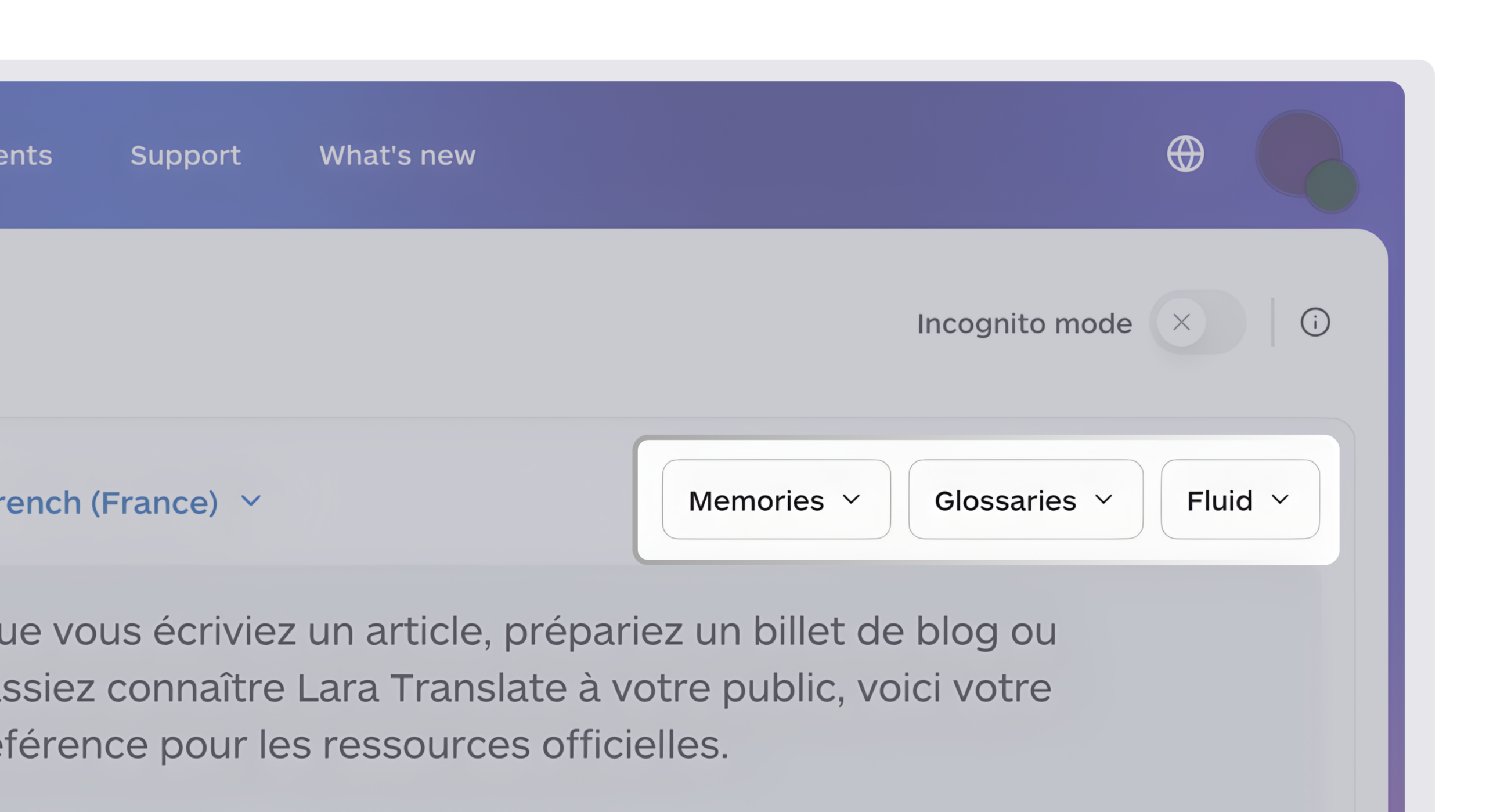
For text translation, the Context feature lets teams provide information about the audience, tone or abbreviations. This interface feature does not apply to document translation. Faithful, Fluid and Creative translation styles are available for both text and documents. Sources: Lara Translate Support: How to Use Context for Better Text Translations and Lara Translate Support: Translation Styles.
For this workflow, Faithful is a useful starting point for controlled policy wording, while Fluid can suit general employee messages. Whatever the style, review sensitive instructions before distribution.
Choose the appropriate privacy mode
According to the support documentation, Incognito Mode does not store translation texts. Learning Mode stores translation texts securely and may use them to improve the model. Choose the mode in line with your organization’s policies for the content being translated. Source: Lara Translate Support: Learning or Incognito Mode.
Include image text in employee PDFs
Training PDFs may contain instructions inside diagrams or screenshots. Lara Translate supports translating text embedded in PDF images when the image translation option is enabled during upload. Check those translated labels alongside the surrounding instructions before publishing. Source: Lara Translate Support: Supported Document Formats.
These features support translation. Your team still owns source approval, specialist review, version tracking and distribution to employees.
Start with your next employee communication
Translate an approved onboarding document, training file or announcement with Lara Translate. Check the result with your designated reviewer before sharing it with employees.
Start with one recurring communication flow, such as handbook updates. Assign an owner, agree on terminology and review requirements, and track each published language version against the approved source. Apply the same process to additional content as the team’s capacity grows.
Have a valuable tool, resource, or insight that could enhance one of our articles?
Send us an email at press@laratranslate.com
We’ll be happy to review it and consider it for inclusion to enrich our content for our readers! ✍️
FAQs
Should companies translate internal communications?
Companies should prioritize translation where employees need another language to understand instructions, policies, training or required actions. The scope should reflect workforce language needs, content risk and any applicable local requirements.
Which HR documents should be translated first?
Start with safety information, critical policies and messages with urgent employee actions, then assess handbook, onboarding and training content. Review individual sections: a document’s title alone does not determine its priority.
How do you translate an employee handbook?
Approve the source, identify the required languages, prepare terminology and assign reviewers before translating. Check sensitive sections with the appropriate specialists, inspect the final document and link each published translation to its source version.
Can AI translate internal communications?
AI translation can support employee documents and messages, especially when teams provide approved terminology and relevant language resources. Set the review level according to the content, with qualified human review for high-impact or sensitive communications.
How do you keep translated employee handbooks up to date?
Track one authoritative source and identify every language version affected by an approved change. Update the revised passages and related materials, review them in context, replace outdated copies and record when each version was published.
How do you keep employee communications consistent across languages?
Use approved terminology, reviewed Translation Memories and a short style guide for each communication type. Ask reviewers to preserve the message’s meaning, required actions and level of formality while using natural wording for the audience.
This article is about
- Prioritizing internal communications translation by risk, urgency and employee language needs.
- Keeping employee handbooks and related onboarding content aligned with an approved source.
- Assigning ownership and review before translating recurring HR communications.
- Using terminology resources and style guidance across multilingual employee content.
- Applying Lara Translate features within a workflow that includes review and publication checks.
Sources
- Lara Translate Support: Supported languages
- Lara Translate: Supported File Formats
- Lara Translate Support: Translation Memories
- Lara Translate Support: Glossaries
- Lara Translate Support: How to Use Context for Better Text Translations
- Lara Translate Support: Translation Styles
- Lara Translate Support: Learning or Incognito Mode
- Lara Translate Support: Supported Document Formats
This article was produced with AI assistance for the Lara Translate content team. Lara Translate supports the translation of employee handbooks, onboarding materials, training content and company announcements.