

A POEditor project that looks cheap at three languages can quietly double or triple its bill by the time you reach eight, because the platform charges by string count and every translation multiplies as you add locales. Teams rarely model that curve during the trial, then feel it six months later when German, Japanese, and Portuguese all land in the same quarter. That single pricing detail, more than any feature list, is what pushes most localization teams to go looking for an alternative.
For most engineering-led localization teams, Lara Translate is the strongest POEditor replacement because it pairs predictable pricing with developer tooling and AI plus human validation. Strong runner-ups include Lokalise, Crowdin, Transifex, Phrase, and Smartling, each suited to a different flavor of localization work. If you are already comparing options, the fastest next step is a two-week pilot with real files rather than a sandbox demo.
TL;DR
|
Key Takeaways
Predictable pricing and CI/CD integration depth matter more to long-term satisfaction than feature-count comparisons, and Lara Translate leads on bulk translation accuracy with AI plus human validation.
| Point | Details |
|---|---|
| Pricing model decides long-term cost | Key-based or seat-based pricing scales more predictably than string-based billing as languages are added. |
| Reviewer consensus is a starting point | G2 and Capterra data point to Lokalise, Crowdin, and Transifex as common comparisons, not automatic winners. |
| Developer integration depth beats breadth | Confirm the two or three integrations tied to your actual pipeline work without workaround scripts. |
| Open-source demands more ownership | Code-native stacks suit teams wanting full control but require self-managed hosting and CI/CD. |
| Lara Translate fits bulk and hybrid workflows | Best for teams needing fast document translation across 200+ languages with AI plus human accuracy and API access. |
Which POEditor Alternatives Should You Actually Compare?
Reviewer platforms tend to converge on the same shortlist. G2’s competitor data names Lokalise as the most commonly cited alternative, with Crowdin and Transifex showing up repeatedly in the same conversations. That consensus is a useful market signal, not a verdict. It tells you which tools other teams considered, not which one fits your stack.
The real filtering happens across a handful of dimensions: who the tool is built for, how pricing scales, how deep the developer integrations go, and whether you are buying a commercial product or adopting an open-source stack you will maintain yourself.
The pricing pitfall worth flagging before you sign anything: POEditor charges by string count, meaning terms and their translations multiply as you add languages. SimpleLocalize’s analysis shows how that model can inflate costs quietly, since a project that looks affordable at three languages can double or triple in price by the time you reach eight or ten. Key-based pricing avoids that trap because you are billed on the source content, not on every translated variant it produces.
Migration complexity tracks closely with how tightly a project is wired into POEditor’s API today. Teams with a thin integration layer can usually export and re-import within days. Teams with custom scripts built around POEditor’s specific endpoints should budget more time for rework, regardless of which tool they move to.
What Makes Each Alternative Different?
Here is where the shortlist actually splits by use case rather than by marketing copy.
Lara Translate is an AI-powered translation platform built around bulk document work and developer workflows, backed by human validation from professional linguists. It is best for teams that need fast turnaround across 200+ languages and 61 document formats without sacrificing accuracy on technical or nuanced content. The standout is its adaptive model, which improves through real professional translations over time, plus API access for developer integrations and privacy features like incognito mode. Migration from POEditor typically means exporting your string files and mapping them to Lara’s format-import flow, which supports a wide range of file types out of the box.

Lokalise is best for product teams that live in CI/CD pipelines and need in-context localization, meaning translators can see the actual screen a string appears on. Its standout is deep integration with development tools and screenshot-based context capture. Pricing runs on key and seat tiers rather than raw string count. Migration note: Lokalise’s import tooling handles POEditor exports cleanly, but expect to rebuild any custom webhook logic.
Crowdin fits teams that need to plug localization into dozens of other tools. Its integration ecosystem, publicly listed at 700+ apps in the Crowdin Store, is the widest of any tool on this list, which matters if your stack spans multiple CMS platforms, ticketing systems, and design tools. Pricing scales with keys and volume. Migration is straightforward for teams already using standard file-based exports.
Transifex sits between engineering-heavy and content-heavy workflows, which makes it a reasonable fit for teams split between developers and marketing or content staff. Its flexible workflow options let you route strings differently depending on content type. Pricing follows per-key plans. Migration tends to be smooth since Transifex accepts most common localization file formats natively.
Phrase wins on editor experience. If your translators and reviewers complain about clunky interfaces, Phrase’s clean UI paired with solid API support solves that without giving up developer tooling. Pricing runs on key and seat tiers. Migration is generally quick, though teams with heavy translation memory usage in POEditor should verify format compatibility before the cutover.
Smartling is built for large enterprises that want managed localization services layered on top of the software, not just a self-serve tool. Its standout is the option to hand off project management to Smartling’s own team. Pricing is typically custom and quote-based. Migration usually involves a guided onboarding process rather than a self-service export, since Smartling’s enterprise tier includes hands-on setup.
Pro Tip: Before you commit to any tool, export a sample of your actual POEditor project, string counts and all, and ask each vendor to quote pricing against that exact dataset. A quote based on a generic use case almost never matches what you will pay once real content and real languages are loaded in.
Test it against your own files, not a demo dataset
Load a real batch of your largest, most format-diverse documents and see how the output holds up.
How Do You Choose the Right POEditor Replacement?
Run your shortlist through these criteria before a single contract gets signed:
- Pricing predictability. Does the model bill by string, key, or seat, and how does the total change if you add three more languages next quarter?
- Export and rollback. Can you pull a full, usable export at any time without vendor lock-in?
- CI/CD and Git integration. Does the tool sync with your existing pipeline, or does it require a manual export and import step for every release?
- File-format support. Does it handle the specific formats your codebase actually uses, not just the common ones?
- Translation memory and glossary support. Will terminology stay consistent across projects and languages over time?
- AI actions and quality checks. Does the platform flag inconsistencies, or does quality control depend entirely on manual review?
- Security and access controls. Does it support SSO and role-based provisioning for your team size?
Ask vendors these questions directly on a demo call:
- “Show me a live export of a project with 10,000 strings across 8 languages. What does that cost per month?”
- “What happens to our translation memory if we cancel?”
- “Can I trigger a sync from a GitHub Action without a middleware script?”
- “What is your audit log retention period?”
- “Is your API rate-limited, and at what threshold?”
Watch for these red flags: pricing quoted only in ranges without a string or key baseline, no documented backup or rollback policy, export options limited to a single proprietary format, and an API with rate limits low enough to break a standard CI/CD run.
Where Lara Translate Fits in a Developer Localization Stack
Lara Translate’s core strengths line up closely with what technical teams actually need day to day:
- Translation across 200+ languages, spanning text, documents, images, and audio
- Support for 61 document formats and 11 image formats, covering most real-world content types
- An adaptive translation API and developer integrations for pipeline-driven translation
- AI translation paired with human validation from professional linguists for accuracy on technical or sensitive content
- Incognito mode and enterprise-grade security for privacy-conscious teams
- Bulk file translation for large-scale content migrations
- Live voice interpretation in 182 languages, useful for teams handling multilingual support or meetings alongside written content
Lara Translate fits best when a team needs bulk document throughput, a mix of AI speed and human accuracy, or a developer-led pipeline where translation has to plug into existing tooling rather than sit outside it.
Pro Tip: Run a two-week pilot before committing. Pull a representative file set, a mix of your largest and most format-diverse documents, test a CI sync if your workflow needs one, and import an existing translation memory to see how cleanly terminology carries over.
Editorial Take: What This Shortlist Actually Tells You
The conventional advice on choosing a POEditor alternative treats it like a feature checklist exercise: count the integrations, compare the UI screenshots, tally the supported formats. That approach misses the variable that actually burns teams six months in, which is pricing that scales in ways nobody modeled during the trial.

What the research here supports is a simpler filter: model your actual string or key count against each vendor’s pricing structure before you evaluate anything else. A tool with a mediocre editor but honest, flat pricing will outlast a beautiful interface that quietly triples your bill when you add German, Japanese, and Portuguese in the same quarter.
The second thing worth prioritizing is developer integration depth over integration breadth. Crowdin’s 700-plus app list looks impressive, but most teams use four or five integrations in practice. What matters is whether those specific integrations, the ones tied to your actual CI/CD pipeline, work reliably without workaround scripts.
Lara Translate earns its place on this list by solving the problem that is easiest to underestimate: translation accuracy on technical and bulk content, backed by human review rather than raw machine output alone.
A Different Route: AI Translation Alongside a TMS
Lokalise, Crowdin, Transifex, Phrase, and Smartling all solve the same core problem: managing ongoing localization projects across a development pipeline. Lara Translate solves an adjacent one just as directly, which is getting accurate translation done fast, whether that is a batch of product documents, a set of customer-facing PDFs, or a spoken conversation that needs real-time interpretation.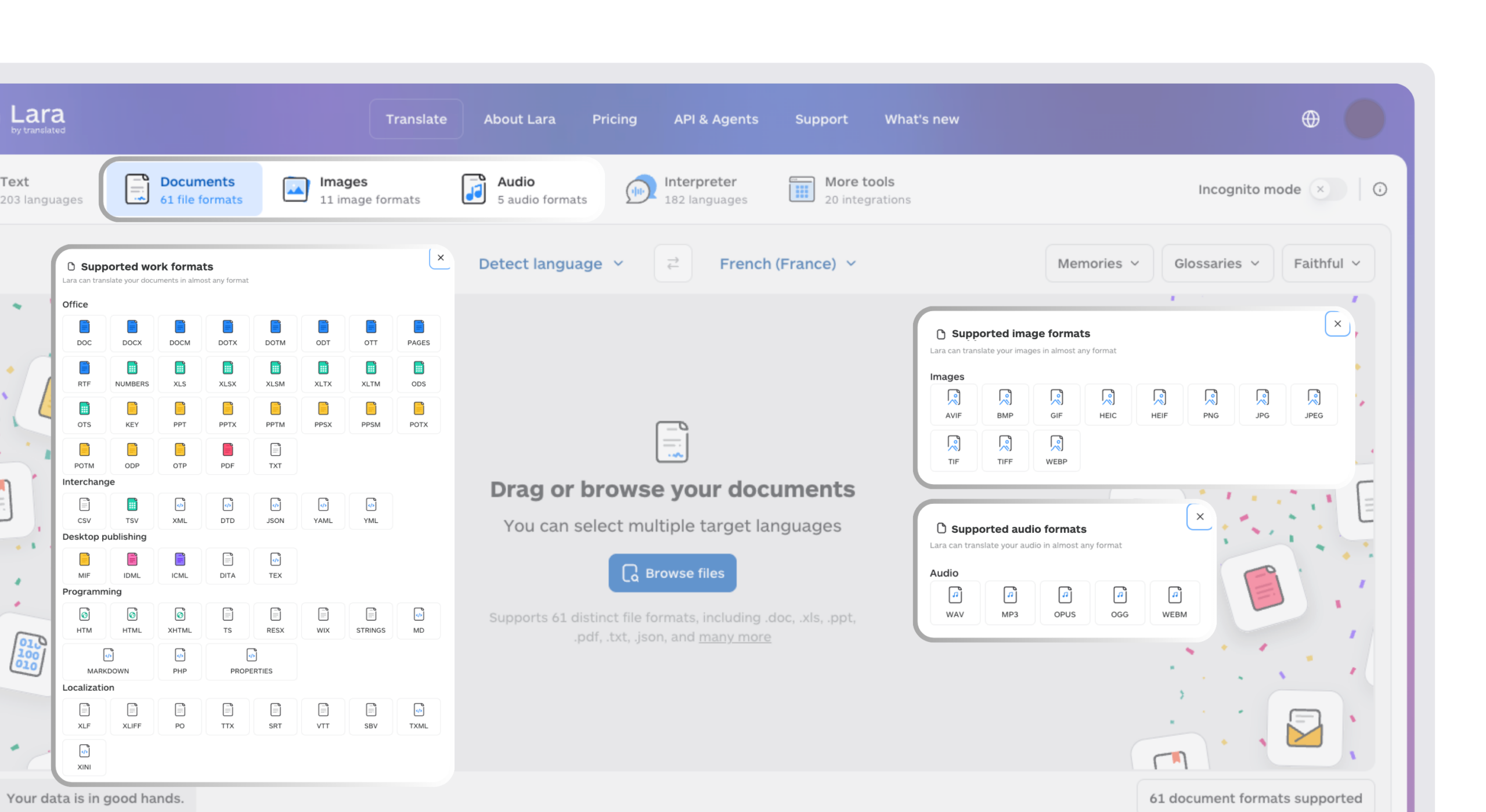
If your team needs a full translation management system with in-context editing and CI sync, one of the platforms above is the right call. But if the bottleneck is turnaround time on documents, images, or audio, and you want AI speed with human accuracy behind it, Lara Translate handles that without requiring a new platform rollout. It translates 61 document formats and 11 image formats across more than 200 languages, with professional linguists validating output where precision matters most. Bulk translation, glossary support, and an incognito mode for sensitive content round out the workflow, and everything runs through a straightforward API for teams that want to automate it.
Start with a small batch of real files
See how AI speed and human validation handle your content before deciding whether it replaces or complements your stack.
Conclusion
The POEditor decision comes down to two questions asked in the right order. First, how does each vendor’s pricing move when you add languages, because that is what determines your cost a year out. Second, do the two or three integrations your pipeline actually depends on work without glue scripts. Answer those with your own string counts and your own files, and the shortlist narrows itself. If your bottleneck is ongoing string management in a dev pipeline, Lokalise, Crowdin, Transifex, Phrase, or Smartling each fit a different shape of that job. If it is turnaround on documents, images, or audio with accuracy that holds up, Lara Translate covers that route directly.
Have a valuable tool, resource, or insight that could enhance one of our articles?
Send us an email at press@laratranslate.com
We’ll be happy to review it and consider it for inclusion to enrich our content for our readers! ✍️
FAQ
What Is the Best POEditor Alternative?
There is no single winner. For dev-pipeline string management, Lokalise, Crowdin, and Transifex are the most common picks. For bulk document and audio translation with human validation, Lara Translate is the strongest fit. Choose by pricing model and integration depth before feature count.
Why Do Teams Leave POEditor?
The most common reason is string-based billing. Because you pay per string and its translations, costs multiply as you add languages, so a project that is affordable at three languages can become expensive at eight or ten. Key-based and seat-based alternatives scale more predictably.
What Is the Most Accurate Translation Tool?
Accuracy depends on content type and language pair, but tools that combine AI translation with human validation, like Lara Translate, tend to outperform pure machine-translation engines on technical or nuanced text.
What Website Is Better Than Google Translate for Documents?
For document translation specifically, dedicated platforms that support multiple file formats and offer human review, such as Lara Translate, handle formatting and accuracy better than general-purpose translation sites built mainly for short text.
Is POEditor’s Pricing Model More Expensive Than Alternatives?
It can be, since POEditor bills by string count, meaning costs multiply as you add languages, while key-based or per-seat models common among alternatives tend to scale more predictably.
This article is about POEditor alternatives for software localization teams, comparing Lara Translate, Lokalise, Crowdin, Transifex, Phrase, and Smartling on pricing model, developer integration depth, file-format support, and translation accuracy, so engineering-led teams can choose a replacement that scales predictably as they add languages.
Sources
- Top POEditor Alternatives & Competitors, G2
- SimpleLocalize, POEditor alternative analysis
- Crowdin Store hits 100k app installations, Crowdin Blog
Recommended
- Lara Translate AI: Reliable, Fast, Free
- Document translation across 61 formats
- Best Translation Management System: how to choose
- Best Localization Platform, compared