

A translation can sound natural and still miss the meaning. A team can find the right tool and still need to connect it to everyday work. October’s updates address both: improving how Lara translates, and making it easier to use those translations where you need them.
Lara 3 became generally available, while Lara Think added more control over reasoning and support for visual context. SOC 2 Type II is another headline for organizations evaluating Lara Translate for business use.
The integrations announced last month also moved forward: Lara Translate is now publicly available for Slack and published in the Make Marketplace. Audio Translation arrived on iOS and Android, and TBX glossary import and export reached the web app.
Here are the Lara Translate October 2026 updates: what shipped, and why it matters.
TL;DR
- Lara 3: Our latest translation model is generally available through Lara Translate, the Lara API, and TranslationOS.
- Lara Think: New reasoning effort levels and image context give developers more control over complex translations.
- Security: SOC 2 Type II is a leading milestone for enterprise security reviews.
- Integrations: Lara Translate for Slack is publicly available, and Lara for Make is listed in the Make Marketplace.
- Mobile: Record, upload, translate, play, and share audio on iOS and Android.
- Terminology: Import and export TBX glossaries directly in the web app, alongside existing API and SDK support.
Short Answer
October 2026 brings Lara 3’s general release, improvements to Lara Think, a SOC 2 Type II milestone, Slack and Make integrations, Audio Translation on mobile, and TBX glossary exchange in the web app.
Why it matters: Better translation quality helps reduce review work. Reasoning and visual context help resolve difficult meanings. Integrations bring translation into existing workflows, while mobile audio and TBX support make it easier to work with the content and terminology you already have.
Lara 3 is now generally available
When you translate professionally, a fluent sentence is only the starting point. The terminology, meaning, and tone also need to survive the move into another language.
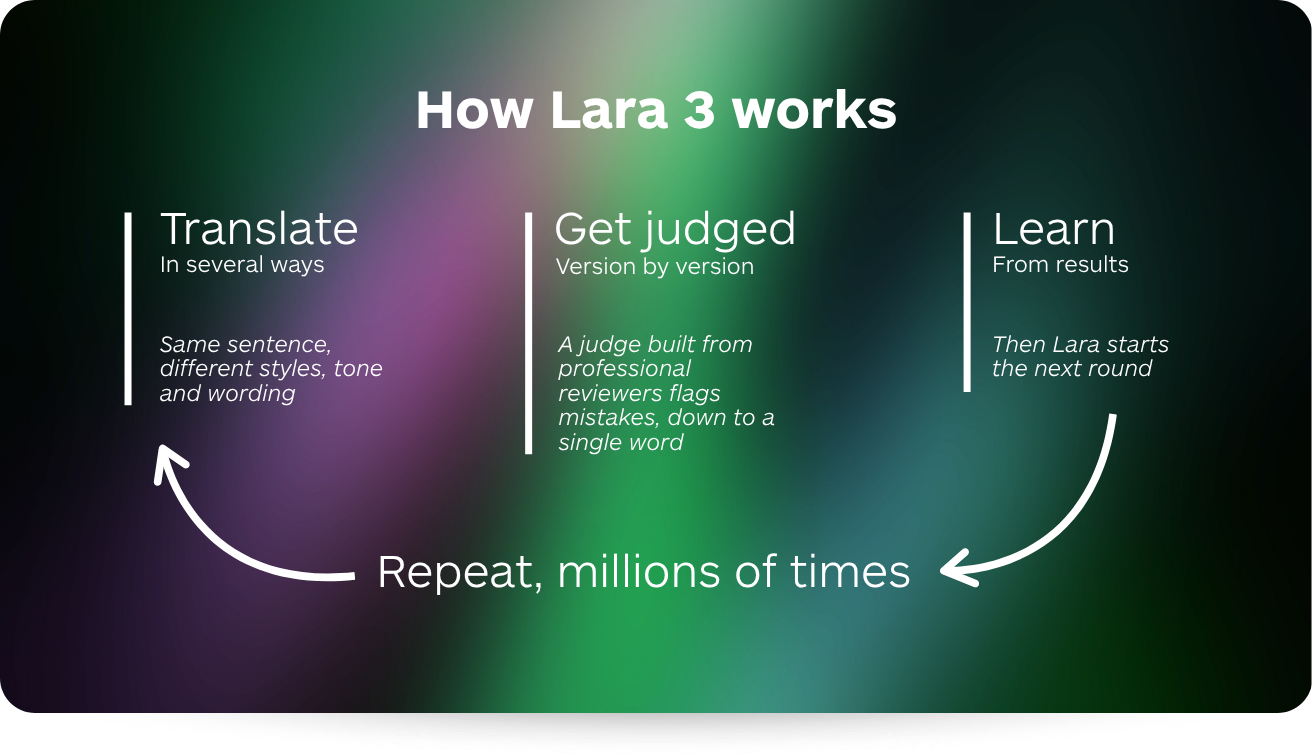
Lara 3, the third generation of Translated’s translation-specialized AI model, became generally available in October through Lara Translate, the Lara API, and TranslationOS.
In Translated’s blind evaluation of 16,800 translations from English into 21 enterprise languages, professional translators judged around 82% of Lara 3 translations accurate without edits. Lara 3 ranked first in 20 of the 21 language pairs tested.
For translators and localization teams, the practical question is how much work remains after the first translation. These results provide a useful starting point for testing Lara 3 against your own content and review standards.
Read the Lara 3 announcement and evaluation results.
Lara Think: more control over reasoning, with visual context
Some translation decisions need a closer look. An expression may carry a cultural meaning, or a short product label may be impossible to interpret without seeing what it describes.
Lara Think analyzes the source before producing and revising a translation. October adds selectable reasoning effort levels, allowing developers to balance deeper analysis with processing time.
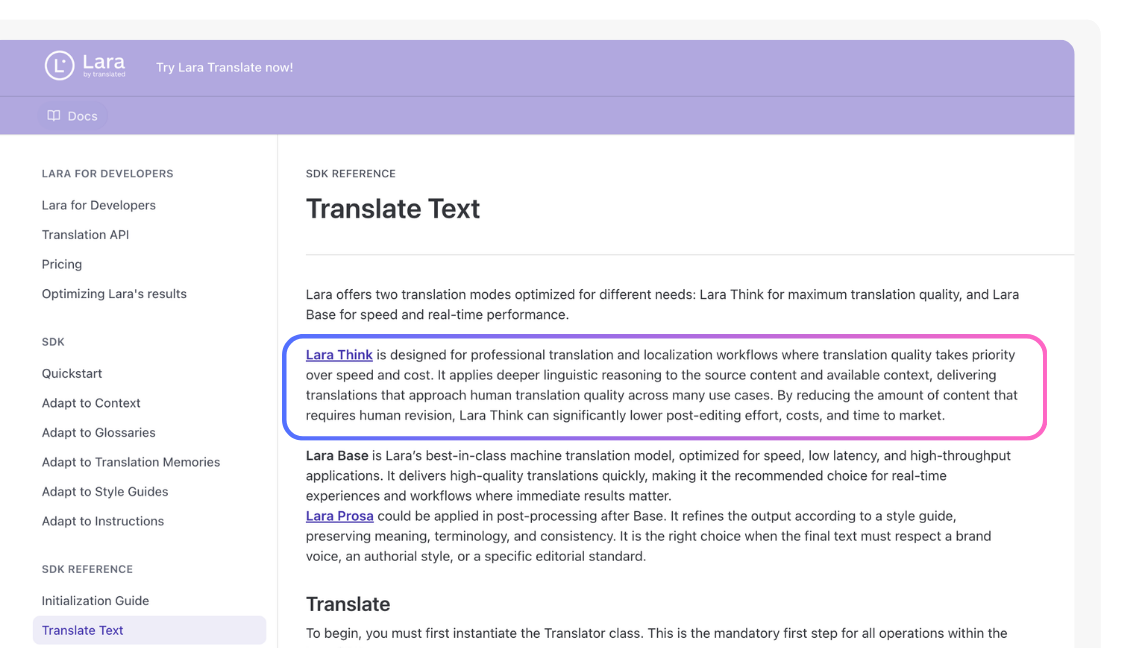
Lara Think text translation also accepts an accompanying image or image URL through the API and supported SDKs. A screenshot, packaging image, or product photograph can provide context that the words alone leave out. Image context is currently exclusive to Lara Think.
There is benchmark news, too. As of October 20, 2026, Lara 3 Think ranked first on the Last Translation Benchmark’s Blind leaderboard, with a 56.09% pass rate on its 911-item evaluation set. The test focuses on difficult examples that leading translation systems had failed, including slang, idioms, and cultural references.
Read more about Lara Think and the benchmark.
SOC 2 Type II: supporting enterprise security reviews
 Translation quality is one part of choosing a service for business use. Security teams also need evidence about how the provider manages and protects the information entrusted to it.
SOC 2 Type II is another major milestone this month. For organizations evaluating Lara Translate, it supports the due diligence process that accompanies the adoption of a new translation service.
The Translated Trust Center is the starting point for reviewing published security information and requesting access to supporting documentation. Procurement, IT, and security teams can use it to assess the relevant evidence and clarify how it applies to their intended use of Lara Translate.
Explore the Translated Trust Center.
Lara Translate reaches Slack and Make
September’s article introduced Slack and Make as integrations going through review. October brings both into users’ workflows.
Translate within Slack conversations
 Lara Translate for Slack is now publicly available. Multilingual teams can access Lara within Slack, reducing the need to move content between a workplace conversation and a separate translation tool.
This is particularly useful when translation is part of an ongoing exchange: understanding a colleague’s message, preparing a reply, or sharing information across teams working in different languages.
The app is available for public distribution. A Slack Marketplace listing is still pending, so public availability and Marketplace listing remain separate milestones.
Add translation to Make automations
 Lara for Make is approved and published in the Make Marketplace. You can now incorporate Lara translation capabilities into automation scenarios connecting your applications and business processes.
For teams with repeatable translation tasks, this provides a way to make translation one step in a broader workflow, without building a custom integration from scratch.
Explore Lara Translate in the Make Marketplace.
Bring Lara into your workflow
Try Lara with content you already work on, from a short message to a document that needs your team’s terminology.
Audio Translation arrives on iOS and Android
A voice message or interview recording should be as easy to translate as a paragraph of text.
Audio Translation is now available on both iOS and Android. You can record directly in Lara, choose an existing audio file, or send audio from another app through your phone’s sharing options. Once translated, the audio can be played and shared from the mobile experience.
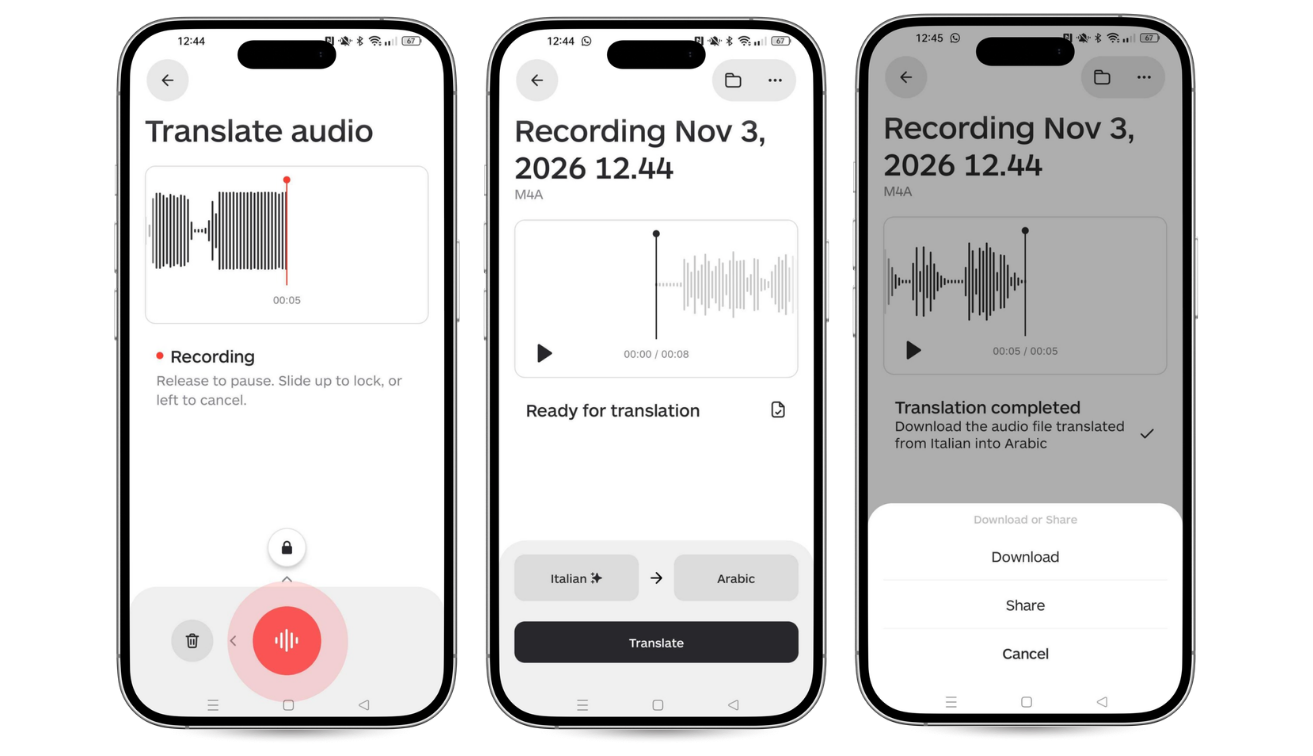
This makes the feature useful for voice messages, interviews, and other recordings where the voice is part of the experience.
Each app also makes use of its platform’s native controls. On Android, recording supports press-and-hold capture, hands-free operation, and background recording with a persistent notification. You can pause, preview, and resume a recording.
On iOS, Live Activities and Dynamic Island let you follow recording, upload, and translation progress after leaving the app.
Get Lara Translate on your phone
Download the app and keep translation ready when you need it.
 |
 |
TBX glossary import and export, now in the web app
If your team already maintains a termbase, bringing that terminology into Lara should fit the way you work.
You can now import and export glossaries in TBX format directly through the Lara Translate web app. TBX, short for TermBase eXchange, is a format used to exchange terminology databases between translation and localization tools.
September introduced TBX support through the API and SDK. October brings the same capability to people managing glossaries through the web interface.
For translators and terminology managers, this removes the need to convert a TBX termbase into CSV before importing it into Lara. You can also export Lara glossaries in TBX format for use elsewhere in your localization workflow.
For developers, existing API and SDK support continues to provide a programmatic route for exchanging terminology. Teams can work through the web app or their own integrations using the same exchange format.
Explore the Lara Translate developer documentation.
Try October’s updates with your own content
Start with a translation you know well: a product description with specific terminology, a passage with an ambiguous expression, or a voice message you need to share in another language.
Use it to assess Lara 3, explore Lara Think’s reasoning capabilities, or try the new mobile audio workflow. If translation is a recurring part of your team’s work, Slack, Make, and TBX glossary exchange give you more ways to connect Lara to that process.
FAQ
Are Slack and Make both available?
Yes. Lara Translate for Slack is publicly available, although its Slack Marketplace listing is still pending. Lara for Make is published in the Make Marketplace.
What changed for Lara Think in October?
Developers can choose reasoning effort levels and provide an image or image URL as context for text translation through the API and supported SDKs.
Can I translate audio on my phone?
Yes. Both the iOS and Android apps support recording or importing audio, translating it, and playing or sharing the result.
Is TBX support new this month?
TBX import and export is new in the web app. Support through the API and SDK was introduced previously.
This article is about
- Lara 3’s general availability
- Lara Think reasoning controls, image context, and benchmark results
- SOC 2 Type II and enterprise security reviews
- Lara Translate integrations for Slack and Make
- Audio Translation on iOS and Android
- TBX glossary import and export in the web app