

A translation can read perfectly and still be unusable. One wrong term, one ambiguous meaning, one missed cultural cue, and it goes back for another round of edits. So when professional translators reviewed 16,800 translations without knowing which system had written them, that’s exactly what they were hunting for. When paired with GPT-5.6 Sol, Claude Fable 5, DeepL, and Google Translate, they picked Lara 3’s translations more often than any of the others.
Lara is the translation model behind Lara Translate, built by Translated. Its third generation, Lara 3, became generally available in October 2026, after a first release to selected partners in July. You can now use Lara 3 in Lara Translate, the Lara API, and TranslationOS. Here’s what the evaluation found, why it matters if you translate for a living or at scale, and where to try it.
|
TL;DR
|
How do you test a translation model fairly?
Grading your own homework is easy. It’s also not very convincing. So the evaluation put Lara 3’s output in front of professional translators, blind: they saw each translation without knowing whether it came from Lara 3, GPT-5.6 Sol, Claude Fable 5, DeepL, or Google Translate.
The test covered 16,800 translations from English into 21 enterprise languages. Part of the material came from WMT25, the 2025 edition of a standard public machine translation benchmark that spans books, news, and user conversations. The rest was proprietary enterprise content from travel, technology, and finance, which is the kind of text companies actually send out for localization.
How often did Lara 3 translations need no edits?
Translators care about one practical question: can I use this as it is? Around four in five Lara 3 translations were judged accurate, meaning they needed no edits at all. For the strongest general-purpose model in the test, the figure was roughly two in three.
Averaged across all 21 language pairs, the scores came out like this.
| System | Type | Avg. score |
|---|---|---|
| Lara 3 | Translation-specialized model | 82% |
| GPT-5.6 Sol | General-purpose AI model | 69% |
| Claude Fable 5 | General-purpose AI model | 67% |
| DeepL | Machine translation tool | 57% |
| Google Translate | Machine translation tool | 53% |
Average scores from blind professional evaluations of 16,800 translations, English into 21 enterprise languages. Source: Translated, October 2026.
Lara 3 ranked first in 20 of the 21 language pairs.
Where does Lara 3 make the biggest difference?
Enterprise localization is where most translation tools start to wobble. The approved term every single time, the same product name across hundreds of strings, a voice that sounds like the brand in every market: that’s a lot to hold at once. According to Translated, Lara 3’s advantage was most evident in exactly this kind of work, where terminology, context, consistency, and brand voice matter most.
This is the job Lara was built for. In Lara Translate, Lara works with your glossaries and translation memories, so the terms and phrasing your team has already approved carry over into every new translation.
Run your own test
Take a text you know well, full of your own terminology, and count how many edits the Lara 3 translation actually needs.
What happens when you need to translate a lot, fast?
Localizing a product catalog, a help center, or a steady stream of support tickets turns speed and budget into hard limits. A model that translates well but slowly, or well but expensively, forces you to pick which content gets translated at all. Nobody likes that trade-off.
In a separate single-thread benchmark, Lara 3 delivered 23 times the throughput of Claude Fable 5. For the same budget, it translated 3.75 times as many characters. For teams working at volume, that means more content shipped per day and per euro.
How was Lara 3 trained?
Most translation models learn by imitating. They study translations people have already made and learn to do the same. The problem is that a sentence can often be translated correctly in more than one way, so a model that only copies can only be as good as the examples it learned from.
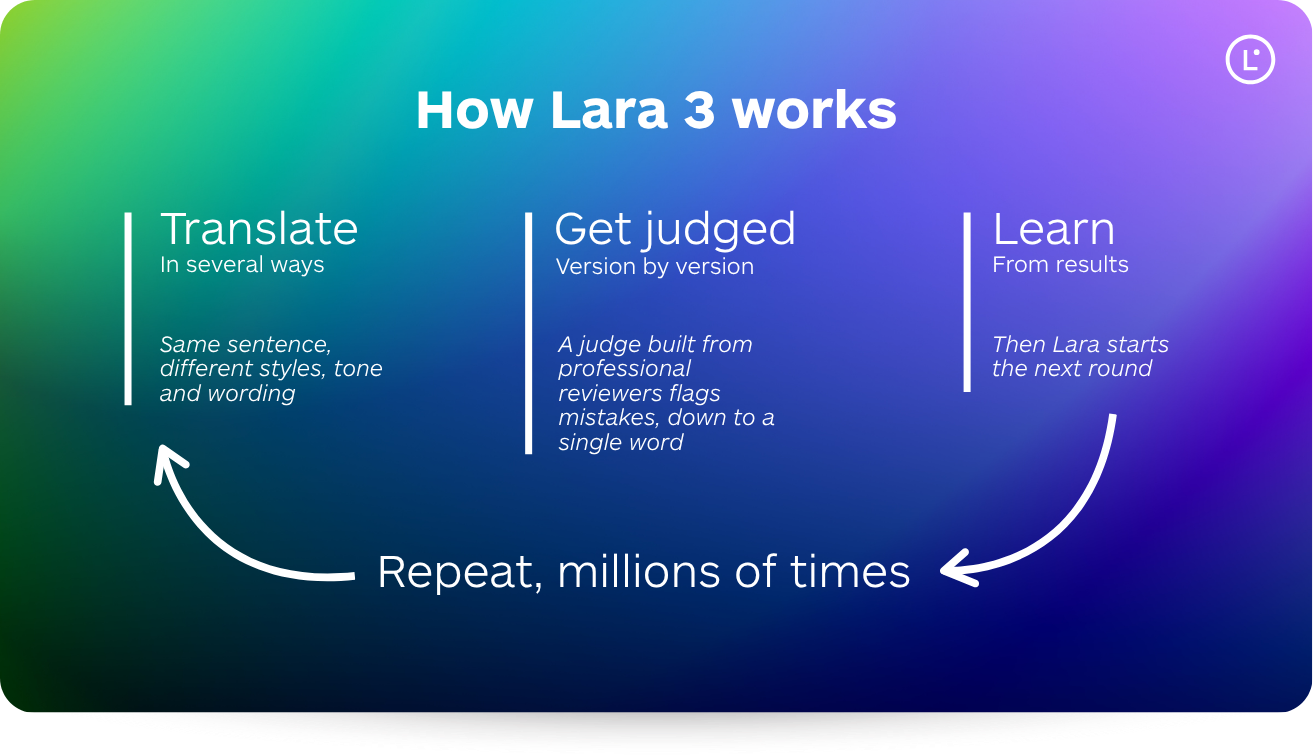
For Lara 3, Translated added one more step to the model’s training, and it works a lot like practice. Lara translates the same sentence in several different ways. A judge, built from the work of professional reviewers, scores each version and points out every mistake, down to a single word that doesn’t fit. Lara learns from the versions that scored well, corrects the mistakes, and starts again. Millions of times. You can read the full technical story in our introduction to Lara 3.
Why build a model only for translation?
Lara is built to do one thing: translate. Translated has been building language technology since 1999, and designing a model around a single purpose was a bet the company made early. The Lara 3 results show that a translation-specialized model can outperform the largest general-purpose AI models in a field where accuracy is non-negotiable.
Marco Trombetti, founder and CEO of Translated, put it this way:
Translation is a particularly unforgiving domain for AI as technical fluency alone is not enough. An ambiguous meaning, an incorrect term or a missed cultural cue can render a translation inaccurate and unusable. We’ve always believed that understanding these intricacies deeply and building a model specifically designed to grapple with them, is the only way to deliver genuinely quality translation. Lara 3’s performance is proof that our approach works. These results show what is possible when you commit to developing AI with one defining purpose. You don’t need to be the biggest player in AI to lead, you need to know exactly what problem you’re addressing and how to solve it.
Where can you use Lara 3?
If you translate on your own or as part of a team, you’ll find Lara 3 in Lara Translate, the online AI translator for text and documents in 200+ languages.
Enterprises and professional translators can also work with Lara 3 through the Lara API, which plugs the model into your own products and pipelines, and through TranslationOS, Translated’s AI service delivery platform. Building with the API? Start with the Lara Translate developer documentation.
Send Lara 3 your next document
Upload a file in one of 70+ supported formats and get it back translated, with the layout you sent.
The bottom line
Reading blind, professional translators preferred Lara 3 over the biggest general-purpose AI models and the best-known translation tools. It gets more translations right the first time, it’s faster, and it stretches the same budget further. The quickest way to judge it is to hand it something you actually need translated.
Have a valuable tool, resource, or insight that could enhance one of our articles?
Send us an email at press@laratranslate.com
We’ll be happy to review it and consider it for inclusion to enrich our content for our readers! ✍️
FAQ
What is Lara 3?
Lara 3 is the third generation of Lara, the translation-specialized AI model developed by Translated. It powers Lara Translate and is also available through the Lara API and TranslationOS.
When was Lara 3 released?
Lara 3 became generally available in October 2026. Translated first released it to selected partners in July 2026.
Is Lara 3 better than DeepL and Google Translate?
In blind evaluations by professional translators, yes: Lara 3 averaged 82% across 21 language pairs, against 57% for DeepL and 53% for Google Translate. It also scored ahead of GPT-5.6 Sol (69%) and Claude Fable 5 (67%), and ranked first in 20 of the 21 pairs.
How was Lara 3 evaluated?
Professional translators reviewed 16,800 translations from English into 21 enterprise languages without knowing which system produced each one. The content combined the WMT25 public benchmark (books, news, and user conversations) with proprietary enterprise material from the travel, technology, and finance sectors.
Is Lara 3 faster than general-purpose AI models?
Yes. In a single-thread benchmark, Lara 3 delivered 23 times the throughput of Claude Fable 5 and translated 3.75 times as many characters for the same budget.
How can I start using Lara 3?
Open Lara Translate, the online AI translator, to use Lara 3 for text and documents. Enterprises and professional translators can also access Lara 3 through the Lara API and TranslationOS.
This article is about
- Lara 3, Translated’s translation-specialized AI model, reaching general availability in October 2026
- A blind evaluation in which professional translators scored 16,800 translations into 21 enterprise languages
- Lara 3’s 82% average score against GPT-5.6 Sol, Claude Fable 5, DeepL, and Google Translate
- Why enterprise localization, with its terminology and brand voice demands, showed the widest gap
- Throughput and cost results against Claude Fable 5, plus the “learning by doing” training phase
- Using Lara 3 in Lara Translate, the Lara API, and TranslationOS
Sources
- Translated Announces General Availability of LARA 3, MultiLingual
- Introducing Lara 3, Translated
- Lara 3 Overview (benchmark methodology), Translated
This article was produced by the Lara Translate content team. Lara Translate is an AI translation platform built by Translated, with more than 25 years of professional translation experience. Individuals, teams, and enterprises use Lara Translate to translate text and documents with Lara 3, across 200+ languages and 70+ file formats.