

If your company uses AI to translate anything you publish, Article 50 of the EU AI Act is now a compliance question you cannot skip. The transparency obligations in Article 50 of the EU AI Act (Regulation (EU) 2024/1689) apply from 2 August 2026. On 20 July 2026, the European Commission published the approved content of its guidelines on the Article 50 transparency obligations. The Guidelines are non-binding and may be revised, but they provide the Commission’s current practical interpretation alongside the binding Regulation and the voluntary Code of Practice. What follows sticks to what those texts actually say, in particular the link between the EU AI Act Article 50 and AI Translation, then sets out practical steps to comply. It is written for business teams. It is general information, not legal advice, so for your specific situation, confirm with qualified counsel.
|
TL;DR
|
Short answer
The EU AI Act does not ban AI translation. The Regulation itself does not mention translation, but the Commission’s July 2026 Guidelines expressly list AI-generated translations as an example benefiting from the Article 50(2) exception. That generally removes the provider-side machine-readable marking duty for translation outputs. A separate Article 50(4) disclosure duty may still apply when translated text is published to inform the public on matters of public interest, unless substantive human review or editorial control is carried out and a natural or legal person assumes editorial responsibility. Material rewriting, summarisation or adaptation may fall outside the translation exception.
Why it matters: The obligations apply from 2 August 2026, while the Commission’s published Guidelines remain non-binding and pending formal adoption in all language versions. Most ordinary translation outputs should benefit from the Article 50(2) exception, but teams still need to identify public-interest publications, substantive adaptations and the person or entity holding editorial responsibility. The general maximum fine is EUR 15,000,000 or 3% of worldwide turnover, whichever is higher, with the lower maximum applying to SMEs.
What is Article 50 of the EU AI Act?
Article 50 is a transparency rule, not a ban. It sits in Chapter IV of the AI Act, the chapter on transparency obligations for providers and deployers of certain AI systems. Its purpose is disclosure: in defined situations, people have to be told when they are dealing with AI, or with AI-generated or manipulated content. It does not prohibit using AI to generate or translate content. It sets out when, and how, that use has to be made transparent.

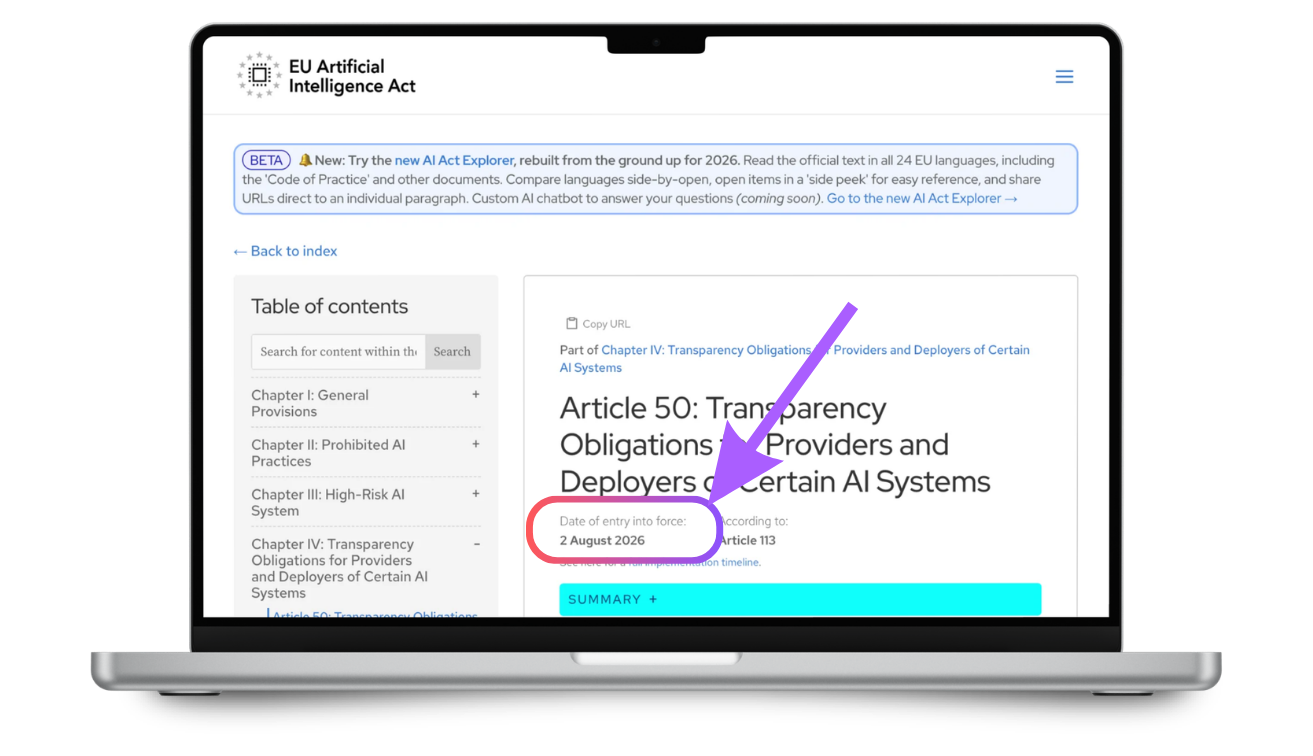
The Regulation entered into force in 2024 and applies in stages, as set out in Article 113. The transparency obligations in Article 50 apply from 2 August 2026. The Commission published a Code of Practice on the transparency of AI-generated content in June 2026, then its final Article 50 guidelines on 20 July 2026. The accompanying Communication states that formal adoption will follow once all language versions are available. The Guidelines are non-binding, but they are an important practical reference for competent authorities, providers and deployers.
What does Article 50 actually require?
Article 50 sets out several distinct duties, and they fall on different actors and cover different content. Read them separately, and the picture is clearer than a single “label your AI” headline suggests. Here is what each paragraph says.
| Provision | Who | Content | Duty |
|---|---|---|---|
| 50(1) | Providers | AI that interacts directly with people | Inform people they are dealing with AI, unless obvious |
| 50(2) | Providers | Synthetic audio, image, video or text | Machine-readably mark in-scope output, unless an exception applies |
| 50(3) | Deployers | Emotion recognition, biometric categorisation | Inform the people exposed to it |
| 50(4) | Deployers | Deep fakes; public-interest text | Disclose it is AI-generated or manipulated |
| 50(5) | Providers and deployers | Any required disclosure | Clear, distinguishable, at first exposure, accessible |
A few of these deserve their exact wording. Article 50(1) requires providers to ensure that AI systems intended to interact directly with natural persons are designed so people are informed they are interacting with an AI system, unless that is obvious to a reasonably well-informed person given the context. That is the basis for a customer-service chatbot disclosing that it is AI. Note one timing point the guidelines stress: this interaction duty has no grace period. It applies from 2 August 2026 even to chatbots already live.
Article 50(2) requires providers of AI systems generating synthetic audio, image, video or text to ensure that in-scope outputs are marked in a machine-readable format and detectable as artificially generated or manipulated. The AI Act does not mandate a single watermarking technology. For signatories and outputs falling within Article 50(2), the voluntary Code of Practice provides a recognised implementation framework: digitally signed and time-stamped metadata where the format supports it, together with imperceptible watermarking, subject to special rules for free-form and very short text. These measures apply only where the output falls within Article 50(2). The Regulation excludes systems to the extent that they perform an assistive function for standard editing or do not substantially alter the deployer’s input data or its semantics. The Commission’s Guidelines expressly list AI-generated translations of text among the examples benefiting from that exception.
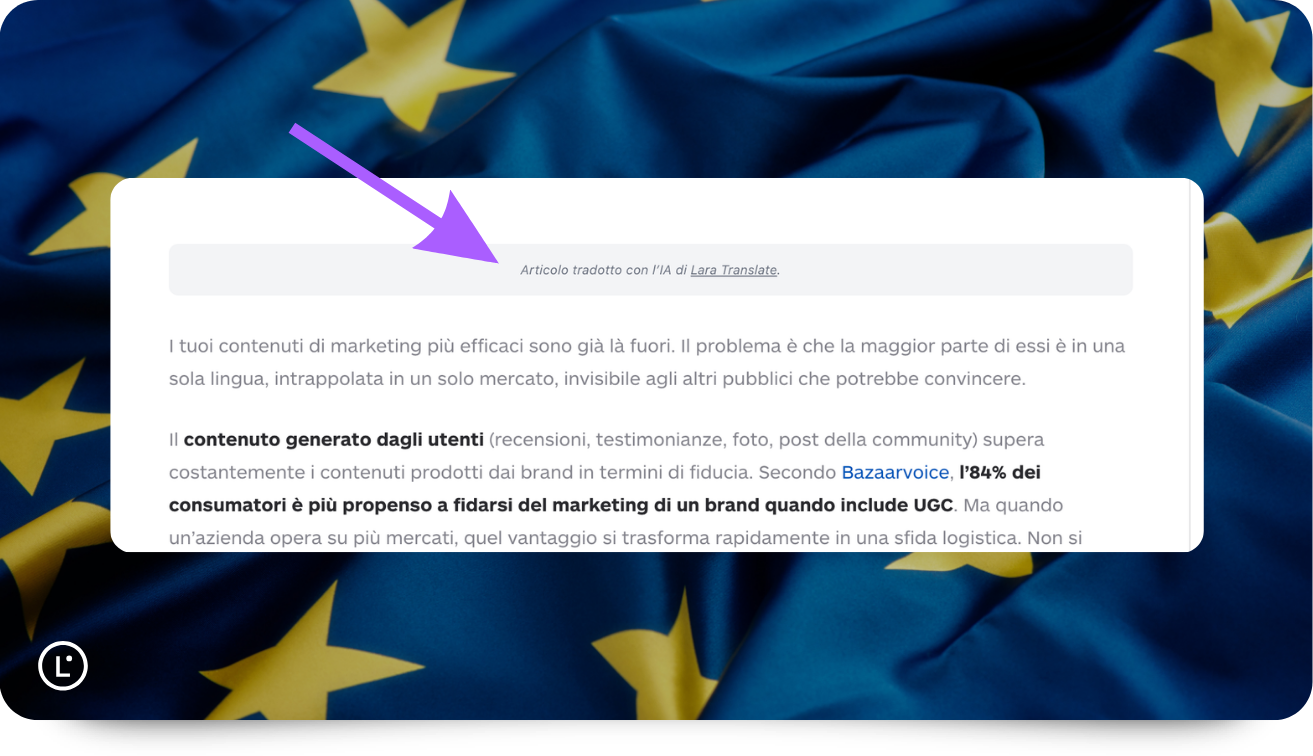
Article 50(3) requires deployers of an emotion recognition system or a biometric categorisation system to inform the people exposed to it. Article 50(4) then contains two separate duties for deployers. First, a deployer of an AI system that generates or manipulates image, audio or video content constituting a deep fake must disclose that the content has been artificially generated or manipulated. Where the content is part of an evidently artistic, creative, satirical or fictional work, the duty is limited to disclosing the existence of such content in a way that does not hamper the enjoyment of the work. Second, a deployer of an AI system that generates or manipulates text published to inform the public on matters of public interest must disclose that the text has been artificially generated or manipulated. This second duty does not apply where the AI-generated content has undergone a process of human review or editorial control and a natural or legal person holds editorial responsibility for the publication. Recital 134 states the same conditions.
Article 50(5) ties it together: the information must be provided to the people concerned in a clear and distinguishable manner, at the latest at the time of the first interaction or exposure, and it must conform to applicable accessibility requirements. A “deep fake” is defined in Article 3(60) as AI-generated or manipulated image, audio or video content that resembles existing persons, objects, places, entities or events and would falsely appear to a person to be authentic or truthful. Note the limit built into that definition. It is about image, audio and video, not text.
When do the Article 50 duties actually start?
The headline date is 2 August 2026. Article 50(1) applies from that date without a transitional period, including to systems already on the market. The separate transition to 2 December 2026 comes from the Digital Omnibus on AI, Regulation (EU) 2026/1744, and applies only to the Article 50(2) marking duty for generative AI systems placed on the market before 2 August 2026. It does not postpone the duties in Article 50(1) or Article 50(4). Text generated before 2 August but published on or after that date must still be disclosed where Article 50(4) applies.
Enforcement sits mainly with national market surveillance authorities, with the AI Office covering systems built on general-purpose AI models from the same provider. Article 99 sets the fines. Non-compliance with the Article 50 transparency obligations is subject to administrative fines of up to EUR 15,000,000 or, for an undertaking, up to 3% of its total worldwide annual turnover for the preceding financial year, whichever is higher. For SMEs, including start-ups, the lower of the amount and percentage maximums applies. The Code of Practice is voluntary. Signatories may rely on it as a recognised way to demonstrate compliance, while non-signatories remain free to use other adequate measures and may be asked to explain how those measures compare with the Code.
EU AI Act Article 50 and AI Translation: does it apply?
The Regulation itself does not expressly mention translation. The Commission’s July 2026 Guidelines do: they identify AI-generated translations of text as an example benefiting from the Article 50(2) exception. Because the Guidelines are non-binding and the classification depends on the function actually performed and the resulting output, the conclusion should be framed as a strong general position rather than an absolute rule.
A translation is text, not image, audio or video. The deep fake duty in Article 50(4) and the definition in Article 3(60) are limited to image, audio and video content. On the face of the Regulation, translating text does not fall within the deep fake provisions at all.
For Article 50(2), the Guidelines define standard editing as preparing existing content for publication or distribution without generating new content. They add that editing goes beyond the exception where the content is materially changed in a way that affects its meaning, style or intent. AI-generated translations of text are expressly included among the examples benefiting from the exception. Accordingly, an AI system used to produce a translation will generally not trigger the provider-side marking obligation. The result should still be assessed where the workflow includes summarisation, substantive rewriting, transcreation or instructions that materially change the source’s meaning, style, intent or message.
This interpretation changed materially during the Commission process. The consultation draft of 8 May 2026 listed AI-generated translations and summaries among the semantic changes requiring marking. In the text published on 20 July, translations were moved to the examples benefiting from the exception, while AI-generated summaries remained among the examples requiring marking. That change provides strong support for treating translation differently from content generation, but it also shows why the conclusion should not be described as permanently settled.
The Article 50(2) exception does not itself remove the separate deployer duty in Article 50(4). That duty can reach translated text where it is text published to inform the public on matters of public interest. The guidelines read “matters of public interest” broadly, covering areas like public health, consumer protection, the environment and significant scientific or economic developments, which can pull in some institutional and corporate communication. Even there, the duty falls away under the human-review exemption. Where that duty could apply, the exemption is the important part: it does not apply where the content has undergone substantial human review or editorial control and a natural or legal person holds editorial responsibility for the publication. In plain terms, the publication needs a deliberate, substantive review process and a natural or legal person assuming ultimate editorial responsibility. Lara Translate’s own AI Act translation guidelines walk through how to keep a translation workflow on the safe side of these questions.

When should you involve legal?
For most AI translation, the standard-editing reading means you are outside the marking duty and no lawyer needs to sign off on every file. Two situations are worth a legal check as a safety guardrail, and they often overlap:
- Sensitive content. Anything touching health, legal, financial, regulatory or otherwise high-stakes subject matter, where a mistranslation carries real consequences.
- Content meant to be published. Text that will inform the public, especially on matters of public interest, is where the Article 50(4) duty and its human-review exemption actually live.
When both are true, loop in counsel, keep a competent human reviewer in the process, and record who holds editorial responsibility. That is the guardrail, not a blanket rule for internal or routine translation.
Build a translation process you can stand behind
Test Lara Translate on a real document and see how it handles your terminology, context, and human review.
How do you keep AI translation compliant?
The steps below follow directly from the obligations above, and none of them require a legal team to start. They do require you to know your own content.
Map your AI systems and your role. List where you use or provide AI, split into interactive, generative, and emotion or biometric systems, and mark whether you are the provider, the deployer, or both for each one. The duties follow that split.
Fix your interactive systems first. If you run AI chatbots, voice assistants, or agents that deal with people, make sure they disclose that they are AI, clearly, at the latest at first interaction, as Article 50(1) requires. There is no grace period here, and a line buried in your terms and conditions does not count.
Separate your content types. For translation, ask two different questions. First, does the output benefit from the Article 50(2) exception from provider-side machine-readable marking? Second, is the translated text being published to inform the public on a matter of public interest under Article 50(4), and if so, does the human-review and editorial-responsibility exception apply? Deep-fake disclosure remains limited to image, audio, and video.
Keep human review and clear editorial responsibility on any content that could fall within the text duty. The review must be deliberate and substantive and performed by a competent person; a spell-check, automated review, or cursory approval is not enough. Record who assumed editorial responsibility. The Guidelines also recommend making the responsible person, entity or function and its contact details easy to find. Any substantive AI intervention after editorial sign-off causes the exception to become void.
Disclose clearly where a duty applies, following Article 50(5): the disclosure must be clear and distinguishable, provided no later than the first interaction or exposure, and meet applicable accessibility requirements. The voluntary Code of Practice is a recognised implementation route for signatories, but other adequate compliance measures remain possible. The EU icons are optional disclosure tools and are not, by themselves, proof of compliance.
Do not overlook data protection. Article 50 is about transparency, but AI translation still processes personal and confidential data, and the GDPR continues to apply independently. Where your content is processed and stored stays relevant.
Set up governance. A single approved tool, shared glossaries, controlled context and documented human review can make it easier to show what was reviewed, by whom and under whose editorial responsibility. Use an actual review or sign-off record in your workflow rather than assuming that the translation platform itself creates a legally sufficient audit trail. This also supports the AI literacy obligations applying to providers and deployers.
Why does the type of AI model matter for safe translation?
Article 50 exists because AI-generated content can mislead people. Recital 133 names the reasons behind the marking obligation directly:
Risks of misinformation and manipulation at scale, fraud, impersonation and consumer deception.
In translation, the version of that risk is the hallucination, where the model adds, drops, or changes meaning that was never in the source text. A translation that remains faithful to the source is more likely to stay within the standard-editing exception; an output that materially changes the source requires a separate assessment.
This is where the type of model makes a practical difference. General-purpose LLMs such as ChatGPT, Gemini and Claude are built to be broadly helpful across any task, which means they can fill gaps and, when the input is ambiguous, produce fluent output that is not faithful to the source. For a translation, that is not a harmless slip. As Lara Translate’s analysis of the problem sets out, a translation hallucination can turn into a compliance issue, a product misrepresentation, a contractual change or a support escalation.
A Domain-Specific Language Model, or DSLM, is optimised for a narrower task than a general-purpose model and may therefore support more predictable translation workflows and reduce the operational risk of additions, omissions or hallucinations. Model architecture does not, however, determine the legal classification under Article 50. The assessment depends on the function actually performed and whether the resulting output remains a translation or becomes a material rewriting, summary or adaptation.
Lara Translate is a DSLM. According to its developer documentation, it is designed to combine fluent translation with low hallucination rates and machine-translation latency, and it provides controls such as glossaries, translation memories, style modes and contextual instructions. These features can support review and consistency, but they do not guarantee an Article 50 exception. In particular, style modes and contextual instructions should be checked to ensure that the output remains a translation rather than a material adaptation.
Why Lara Translate is a strong partner for Article 50 compliance
Getting ready is not about avoiding AI translation. It is about running it through a process that the organisation can document and stand behind. Lara Translate can support a reviewable workflow, but the Article 50(4) exception ultimately depends on the review actually performed and on a natural or legal person assuming editorial responsibility; it does not arise merely from the tool selected.
Lara Translate explains translation choices and flags ambiguous terms, and translations can be edited directly in the platform. These functions can give reviewers concrete material to assess. Centralised glossaries, translation memories and context controls can also support terminology consistency across Lara’s 207 supported languages. Because style modes and contextual instructions may affect the output, teams should verify that the result remains a translation and does not become a material rewriting or adaptation. Lara’s public documentation says that its API can operate within EU-based data centres, while its subprocessor list states that AWS processing may take place in the EU or the USA. Customers should therefore confirm the applicable processing region and contractual safeguards for their specific plan rather than describing the service generally as EU-only (visit our Trust Center).
Used this way, AI translation becomes a process you can point to when you need to show human review, editorial responsibility and sound data handling. Whether you are still preparing or already operating under Article 50, standardizing on a tool built for reviewed, owned translation is a practical move. That is what Lara Translate is for.
Make your translation workflow Article 50-ready
Set up glossaries, context, human review in one place, document human review and editorial sign-off through your governance process.
This guide summarises provisions of Regulation (EU) 2024/1689, including Articles 3(60), 50 and 99 and Recitals 133 and 134, together with Regulation (EU) 2026/1744, the final voluntary Code of Practice and the Commission-approved content of the July 2026 Article 50 Guidelines. It is general information, not legal advice. The AI Act Regulation itself does not expressly mention translation, but the Commission’s non-binding Guidelines expressly identify AI-generated translations as an example benefiting from the Article 50(2) exception. Confirm the position for material adaptations and public-interest publications with qualified counsel and check for the formal adoption or later revision of the Guidelines.
Have a valuable tool, resource, or insight that could enhance one of our articles?
Send us an email at press@laratranslate.com
We’ll be happy to review it and consider it for inclusion to enrich our content for our readers! ✍️
FAQs
Does the EU AI Act ban AI translation?
No. Article 50 is a transparency rule, not a prohibition. The Regulation itself does not expressly mention translation, while the Commission’s July 2026 Guidelines expressly list AI-generated translations among the examples benefiting from the Article 50(2) exception. That generally removes provider-side machine-readable marking for translation outputs. Separate obligations may still apply to interactive systems or to public-interest text under Article 50(4), and material rewriting, summarisation or adaptation should be assessed separately.
Do I have to label AI-translated text under Article 50?
Usually not under the provider-side marking duty in Article 50(2), because the Guidelines expressly list AI-generated translations among the examples benefiting from the exception. However, a separate visible disclosure duty may apply under Article 50(4) when translated text is published to inform the public on matters of public interest, unless it undergoes substantive human review or editorial control and a natural or legal person assumes editorial responsibility. Deep-fake disclosure remains limited to image, audio and video. Summaries, substantive rewrites and material adaptations should not be treated automatically as translations for this purpose.
What is the human-review exemption in Article 50(4)?
It is the exception that removes the Article 50(4) disclosure duty for covered public-interest text when two cumulative conditions are met: the content undergoes human review or editorial control, and a natural or legal person holds ultimate editorial responsibility for its publication. The Guidelines set a substantive threshold: the review must be deliberate and performed by a competent person, and superficial checks, spell-checking or automated review are insufficient. The Guidelines recommend making the responsible person, entity or function and contact details easy to find. Any substantive AI intervention after sign-off makes the exception unavailable.
When does Article 50 start to apply, and are the rules final?
The transparency obligations in Article 50 apply from 2 August 2026. The final voluntary Code of Practice was published on 10 June 2026. On 20 July, the Commission published the approved content of its Article 50 Guidelines; the accompanying Communication states that formal adoption will follow once all language versions are available. Regulation (EU) 2026/1744 gives generative AI systems placed on the market before 2 August until 2 December 2026 to comply with Article 50(2) only. Article 50(1) and Article 50(4) are not covered by that transition. Text generated before 2 August but published on or after that date must be disclosed where Article 50(4) applies.
What are the fines for breaching Article 50?
They are set in Article 99 of the Regulation. Non-compliance with Article 50 can attract administrative fines of up to EUR 15,000,000 or, for an undertaking, up to 3% of its total worldwide annual turnover for the preceding financial year, whichever is higher. For SMEs, including start-ups, the lower of the amount and percentage maximums applies. The fine in an individual case must still be effective, proportionate and dissuasive. Adherence to the voluntary Code of Practice may help demonstrate compliance and may be taken into account as a mitigating factor, but it does not establish compliance automatically.
This article covers: what Article 50 requires, how the Commission-approved July 2026 Guidelines interpret it, why AI-generated translations generally benefit from the Article 50(2) exception, how the treatment changed from the May consultation draft, when provider marking and deployer disclosure must be assessed separately, how the human-review exception works, the Digital Omnibus transition, penalties including the SME rule, and the limits applicable to substantive rewriting, summarisation and adaptation.
Official sources
- Commission page on the Article 50 Guidelines and press release (20 July 2026): ec.europa.eu
- Full Article 50 Guidelines, Commission-approved content (20 July 2026): ec.europa.eu
- Communication C(2026) 5054 on approval and formal-adoption status: ec.europa.eu
- Consultation draft of the Article 50 Guidelines (8 May 2026): ec.europa.eu
- Digital Omnibus on AI, Regulation (EU) 2026/1744: eur-lex.europa.eu
- Full Regulation (EU) 2024/1689, EUR-Lex: eur-lex.europa.eu
- Article 50, AI Act Service Desk (European Commission, DG CONNECT): ai-act-service-desk.ec.europa.eu
- Article 3, Definitions (deep fake, point 60): ai-act-service-desk.ec.europa.eu
- Article 99, Penalties: ai-act-service-desk.ec.europa.eu
- Article 113, Entry into force and application: ai-act-service-desk.ec.europa.eu
- Recital 133 (marking of synthetic content and the standard-editing carve-out): ai-act-service-desk.ec.europa.eu
- Recital 134 (deep fakes and public-interest text disclosure): ai-act-service-desk.ec.europa.eu
- Final Code of Practice on Transparency of AI-Generated Content (10 June 2026): : digital-strategy.ec.europa.eu
- AI Act, European Commission policy page: digital-strategy.ec.europa.eu
Lara Translate references
- Lara Translate is a DSLM: why this beats a general LLM for translation: blog.laratranslate.com
- Lara Translate developer documentation (adaptive translation, low hallucination rate): developers.laratranslate.com
- Translated’s Trust Center: trust.translated.com
- How to use Lara Translate safely under the AI Act: support.laratranslate.com
- Lara Translate subprocessors and data-processing locations: support.laratranslate.com
- Lara Translate supported languages (207): support.laratranslate.com