

You have 47 language apps on the App Store telling you they will get you to fluency. Most of them will not. The challenge is not finding a platform. It is figuring out which one actually fits how you learn, how much time you have, and what “good enough” means for you.
This article breaks down the best online language learning platforms for casual learners. No fluff, no paid rankings. Just a clear look at which are the best language learning platforms out there, and what each platform is for, what it does well, and what it costs.
|
TL;DR
|
Short Answer
What is the best language learning platform? There is no single answer, because the right platform depends entirely on how you learn. Duolingo is the best zero-cost habit-builder for total beginners. Babbel works better if you want a classroom-style structure without a classroom. If speaking is your goal, nothing replaces live practice with a real person, and italki or Preply give you that flexibility for around $10 a session. For audio-only learning during a commute, Pimsleur is the strongest option. The pattern that works for most casual learners is starting with a free app to build vocabulary, then adding one or two live tutor sessions per week once you have enough foundation to make conversation worthwhile.
Why it matters
Most language learning content either reviews apps uncritically or ignores the practical gap between studying a language and actually using one in a work context. Picking the wrong platform costs you months of wasted habit-building. And once you start needing to read, translate, or share content across languages in a professional context, a learning app is no longer the right tool for that job.
Quick Comparison
| Platform | Languages | Best for | Free tier | Paid price (approx.) |
|---|---|---|---|---|
| Duolingo | 40+ | Building a daily habit | Yes | from $12.99/month |
| Babbel | 14 | Structured beginners | First lesson only | from $14.95/month |
| Rosetta Stone | 25 | Immersive self-study | No | from $8/month (annual) |
| Papora | 1 (EN) | Who wants to learn English | Yes (Limited) | from €7,70/month (annual) |
| italki | 150+ | Live speaking practice | No | from ~$10/lesson |
| Preply | 50+ | Flexible tutoring | No | from ~$10/lesson |
| Pimsleur | 51 | Audio learners, commuters | 1 week trial | from $14.95/month |
| Lingoda | 4 (EN, ES, FR, DE) | Live classes, certification | No | from ~$65/month |
| Busuu | 14 | Community feedback | Limited | from $12.95/month |
| Mondly | 41 | Budget-friendly basics | Limited | from $9.99/month |
| Promova | 12 | Bite-sized + AI tutor | Limited | from $39.99/3 months |
1. Duolingo
 Duolingo is where most casual learners start. It is free, available on every device, and built entirely around the idea that learning something every day matters more than learning a lot at once. Lessons run five to ten minutes, the interface is gamified with streaks and leaderboards, and the barrier to entry is essentially zero.
Languages: 40+
What works: It is genuinely useful for vocabulary building and consistency. The free tier gives you access to every course and every lesson — you are not locked out of content behind a paywall.
What to watch for: Duolingo changed its practice model in mid-2025. The old “hearts” system penalized wrong answers. The new “energy” system limits how much you can practice per day even when you answer correctly, which cuts into free daily practice on mobile. Desktop is less restrictive. At higher levels, depth drops off sharply — Duolingo gets you started, but it does not take you all the way.
Pricing: Free with ads. Super Duolingo (ad-free, unlimited practice) costs around $12.99/month or $59.99/year. Check Duolingo’s pricing page for current rates.
Best for: Total beginners who want to build a habit before committing to a paid platform.
2. Babbel
 Babbel takes a more structured approach than Duolingo. Courses are designed by professional language teachers, follow a clear progression, and focus on practical vocabulary you would actually use in conversation. Lessons run around 10 to 15 minutes, which fits easily into a lunch break or a commute.
Languages: 14, with a strong focus on European languages.
What works: The curriculum is coherent and progressive. You are not just learning isolated words — you are learning how sentences work, how grammar connects, and how to put things together in real situations. That structure is hard to find at this price point.
What to watch for: Language selection is limited. If you want to learn Korean, Japanese, or Arabic, Babbel is not the right tool. The platform discontinued its live classes in mid-2025, so it is now purely self-paced.
Pricing: First lesson free. Subscription from $14.95/month, or $89.40/year. Check Babbel’s pricing page for current rates.
Best for: Beginners who want a classroom-style structure without the classroom.
3. Rosetta Stone
Rosetta Stone has been around since 1992. The method has not changed much: total immersion, no translation, learning through images and audio the way a child learns their first language. That approach has real merit. TruAccent, its pronunciation technology, remains genuinely impressive.
Languages: 25
What works: If you want to think in a language rather than translate from your own, Rosetta Stone trains you to do exactly that. The lifetime plan ($219 for all 25 languages) is also exceptional value if you plan to learn more than one language over time.
What to watch for: It moves slowly and can feel repetitive. There is no grammar explanation, which frustrates some learners. Best treated as a supplement or immersion tool rather than a standalone course.
Pricing: No free tier. Monthly subscriptions from around $8/month on an annual plan. Lifetime access for all 25 languages at $219. Check Rosetta Stone’s pricing page for current rates.
Best for: Visual learners who want to develop an intuitive feel for a language.
4. Papora
 Papora is an online English learning platform that combines self-guided lessons with live English classes, allowing learners to study at their own pace while regularly practicing speaking with teachers and other learners. Its approach focuses on practical English and real-life communication, making it a suitable option for learners who want to build their English skills while also gaining more confidence using the language in conversation.
What works: Combines self-guided English lessons with live classes. Focuses on practical English and real-life communication. Provides regular opportunities to practice speaking. Allows learners to study at their own pace alongside live practice.
What to watch for: Papora focuses specifically on English rather than offering multiple languages. Learners looking exclusively for one-on-one tutoring may prefer a platform built around private lessons
Best for: Learners who want to learn English while combining self-paced study with regular speaking practice and live classes.
5. italki
 italki is not an app with lessons. It is a marketplace connecting you with language tutors for one-on-one video sessions. You browse profiles, check reviews, book a session, and learn from a real person. Some tutors are certified teachers. Others are community tutors — native speakers who are not formally trained but offer cheaper sessions and relaxed conversational practice.
Languages: 150+
What works: Nothing replaces actual conversation with a human. If speaking is your goal, no app gets you there faster than regular sessions with a tutor who can correct you in real time. That is the whole point of italki.
What to watch for: Quality varies. Some tutors are exceptional; others are not well-suited to casual learners. You may need to try a few before you find a good match. There is no built-in curriculum, so you need to show up with a goal or let the tutor lead.
Pricing: No platform fee. Tutors set their own rates, ranging from around $2 to $80+ per hour depending on experience and language. Check italki’s tutor listings for current rates.
Best for: Anyone who wants to practice speaking and is comfortable directing their own learning.
6. Preply
 Preply works similarly to italki: you browse tutor profiles, book sessions, and learn through one-on-one video calls. The difference is that Preply is more platform-led. Tutors create structured learning plans, track your progress, and adapt sessions to your goals. The matching system is more guided, which helps if you are not sure what to look for.
Languages: 50+
What works: The structured approach makes sessions feel more purposeful than a casual conversation exchange. Preply also offers business language courses, which is useful if you are learning for work.
What to watch for: Lesson quality still depends on the individual tutor. Pricing can add up quickly if you book multiple sessions per week. Some learners report needing to supplement with other materials between sessions.
Pricing: No free tier. Tutor rates start from around $10/lesson, but typical rates are higher. Check Preply’s tutor listings for current rates.
Best for: Learners who want the accountability of live sessions with more platform structure than italki.
Already working across languages?
Learning a language takes months. Translating a document, email, or audio file with Lara Translate takes seconds. Try it on a real text and see how it handles your terminology and context.
7. Pimsleur
 Pimsleur is audio-first. Each lesson is a 30-minute spoken session designed to be done without looking at a screen. You listen, you repeat, you respond. The method is based on spaced repetition and active recall, and it is built specifically for pronunciation and speaking confidence.
Languages: 51
What works: It is the strongest option for people who want to learn while doing something else — driving, commuting, running. The method builds speaking instinct faster than most visual platforms. That is a real advantage most apps cannot match.
What to watch for: There is no reading or writing component, so Pimsleur alone will not make you literate in a language. It is also more expensive than most app-based alternatives. Best used alongside a platform that covers the written side.
Pricing: 7-day free trial. All-Access subscription from around $14.95 to $21/month. Check Pimsleur’s pricing page for current rates.
Best for: Commuters and audio learners who want to use otherwise dead time.
8. Lingoda
 Lingoda offers live, teacher-led classes in small groups (typically three to five students) or one-on-one. Lessons follow a CEFR-aligned curriculum from A1 to C1, and you earn a certificate on completion. It is the closest thing to a proper language school you will find online.
Languages: 4 (English, Spanish, French, German)
What works: The structure is genuinely rigorous. You are not learning in isolation — you are in a class, speaking, listening, and being corrected in real time. Certificates carry weight for visa applications and professional purposes.
What to watch for: This is the most expensive option on this list, and the language selection is the most limited. If you are a casual learner who just wants to get by on holiday, Lingoda is probably more than you need. It is designed for people who take language learning seriously.
Pricing: No free tier. Classes cost up to $23 each; serious learners typically spend $65 to several hundred per month depending on class frequency. Check Lingoda’s pricing page for current rates.
Best for: Learners with a structured goal, a timeline, and a budget to match.
9. Busuu
 Busuu sits between a self-study app and a community platform. You work through structured courses with vocabulary exercises, grammar lessons, and quizzes. The distinctive feature: you can submit written and spoken exercises to native speakers in the Busuu community for correction and feedback.
Languages: 14
What works: Getting real feedback from native speakers on your written output is genuinely valuable and hard to find at this price point. Busuu also offers McGraw Hill certificates on course completion, which some learners find motivating.
What to watch for: The free tier is quite limited. Community feedback can be inconsistent in quality and timing — if you want regular, reliable corrections, you may need to be patient.
Pricing: Free with limited access. Premium from $12.95/month or around $71.40/year. Check Busuu’s pricing page for current rates.
Best for: Learners who want structured courses plus the occasional reality check from a native speaker.
10. Mondly
 Mondly covers a lot of ground for a relatively low price. Lessons are gamified and built around conversational vocabulary. The app includes an AR mode, a VR mode, and an AI chatbot for conversation practice. Wide rather than deep — which is fine for a casual learner who wants a broad introduction.
Languages: 41
What works: Language breadth and price. If you want to pick up the basics in a less common language before a trip, Mondly is one of the few affordable options that goes beyond the European mainstream.
What to watch for: Mondly will carry you through a restaurant menu or a hotel check-in. Sustained conversation at B1+ level is not where it ends up. The exercises follow a similar format across all languages, which can feel repetitive after a while.
Pricing: Free with limited features. Premium from $9.99/month for one language or $47.99/year for all languages. Check Mondly’s pricing page for current rates.
Best for: Budget-conscious learners who want quick conversational basics, especially in less common languages.
11. Promova
 Promova is built around two honest observations: most people do not have much time, and most people are afraid to speak. The platform addresses both with bite-sized daily lessons and an AI tutor that lets you practice real conversations in a low-pressure environment.
Languages: 12, including English, Spanish, French, German, Italian, Portuguese, Chinese, Korean, Arabic, Ukrainian, American Sign Language, and variants.
What works: The onboarding is genuinely personalized. You tell Promova why you are learning, your current level, and how much time you have — the platform builds a learning plan around those answers and sticks to it. The AI role-play scenarios are more dynamic than similar features on competing apps.
What to watch for: Language selection is more limited than some alternatives. The free tier is restricted, so you will need a paid plan to use it properly.
Pricing: Free with limited features. Paid plans from $39.99 for 3 months, $83.99/year, or $299.99 for lifetime access. Check Promova’s pricing page for current rates.
Best for: Casual learners who want structure and speaking practice without committing to live lessons.
How to choose the best platform for you
Start with Duolingo if you have zero budget and need a habit before you commit to anything. Move to italki or Preply the moment you have enough vocabulary to make a conversation worthwhile — real speaking practice is irreplaceable. If you have a commute and no screen time, Pimsleur uses that dead time well. Babbel or Promova are both solid if you want structure without a live class. Lingoda is for people with a structured goal, a real timeline, and a budget to match.
A pattern that works for most casual learners: start with a free app to build vocabulary and consistency, then add one or two live tutor sessions per week once you have a foundation to make the conversation worthwhile.
Learning a language and using one are not the same problem
Every platform on this list helps you build toward a language. That is a skill that takes months, sometimes years. But the moment you need to read a contract written in German, translate a product description for a Japanese market, or send a document to a French-speaking partner this week, you need something that works right now.
Lara Translate handles that gap. It translates text, documents, audio, and images across 200 languages, trained on 25 million human-translated documents. Three translation styles (Fluid, Faithful, Creative) let you match the output to the context. Add glossaries and context instructions so the result reflects your terminology, not a generic guess.
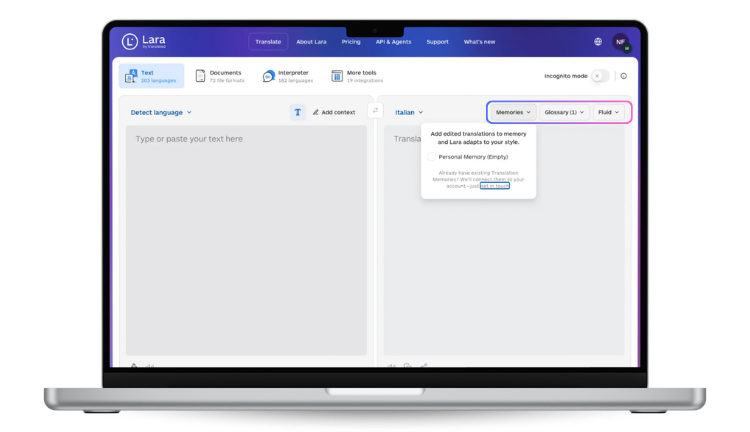
Lara Translate does not replace the platforms above. It handles the situations that they cannot.
Try Lara Translate on your next document
Upload a file and see how Lara Translate preserves your layout, applies your terminology, and delivers translation quality trained on 25 million human-translated documents.
FAQ
What is the best free language learning platform?
Duolingo is the strongest free option for most casual learners. It gives you access to every course and every lesson without a paywall, covers 40+ languages, and is available on every device. The gamified format — streaks, leaderboards, short daily lessons — makes it easy to build a consistent habit from zero. The main limitation to know about: in mid-2025, Duolingo moved to an “energy” system on mobile that caps how much you can practice per day even when you answer correctly. Desktop is less restrictive. Busuu and Mondly both offer limited free tiers as well, but content access is more restricted than Duolingo.
Which language learning platform is best for speaking practice?
italki and Preply are the best options if speaking is your primary goal. Both are tutor marketplaces that connect you with native speakers for one-on-one video sessions, and nothing replicates that experience with an app. italki gives you more flexibility and a wider price range, from around $2 to $80+ per hour depending on the tutor and language. Preply adds more platform structure, with tutors building lesson plans and tracking your progress. For app-based speaking practice, Promova’s AI role-play scenarios are among the more realistic available. Pimsleur builds spoken fluency through audio repetition, though it does not involve real conversation.
Is Babbel better than Duolingo?
It depends on what you mean by “better.” Babbel has a more structured, teacher-designed curriculum that explains grammar and builds progressively through coherent lessons. Duolingo is more accessible, free, and built for habit-forming through gamification. If you have tried Duolingo and found it too shallow or inconsistent, Babbel is likely a better fit. If you are starting from zero and want to build a daily routine before spending money, Duolingo is the right first step. The two platforms are not direct competitors — Babbel focuses on 14 European-leaning languages, while Duolingo covers 40+.
What is the difference between language learning and translation?
Language learning is the long-term process of building the ability to understand and produce a language independently. Translation is the immediate conversion of content from one language into another, without requiring that skill. The platforms on this list address the first problem: they help you build vocabulary, grammar, and speaking confidence over weeks and months. Translation tools like Lara Translate address the second: when you need to read a German contract today, send a document to a Japanese partner this week, or understand audio in a language you do not speak, a learning app cannot help. Both have their place, but they solve different problems on different timescales.
How long does it take to learn a language with an app?
That depends heavily on the language, your native tongue, how much time you put in, and what “learn” means to you. The US Foreign Service Institute categorizes languages by difficulty for English speakers: Category I languages like Spanish and French take around 600 to 750 classroom hours to reach professional working proficiency. Category IV languages like Mandarin, Arabic, and Japanese take 2,200 hours or more. App-based learning at 10 to 15 minutes a day will get you to basic conversational competence faster than nothing, but significantly slower than immersive study. Most honest assessments suggest that casual app use alone will not carry you past A2 or low B1 without additional speaking practice and exposure.
Can I use Lara Translate alongside a language learning platform?
Yes, and they serve different purposes. Language learning platforms help you build the underlying skill over time. Lara Translate handles immediate translation needs: documents, text, audio, and images across 200 languages, with translation quality trained on 25 million human-translated documents. If you are studying Spanish with Babbel but need to send a translated document to a client in Madrid today, Lara Translate covers that without interrupting your learning plan. The two tools do not overlap — one is a long-term investment in a skill, the other is an immediate solution to a communication problem.