

A company schedules a quarterly SAP update, and two days before go-live the finance team discovers that an invoice approval flow no longer works. Nobody had time to retest it by hand, and the test scripts written last year point to screens that have since changed.
Enterprise application test automation helps teams check business processes in packaged systems such as SAP, Salesforce, Oracle, and Workday after updates. This guide compares application coverage, authoring approaches, maintenance features, and pricing considerations for enterprise test automation tools.
|
TL;DR
|
What makes an enterprise test automation tool worth using in 2026?
Application coverage decides what you can test. Confirm support for your exact application versions, custom components, desktop clients, browsers, and APIs. A vendor’s support for a product family does not establish coverage for every interface or cross-system workflow.
Codeless authoring lets business users write tests. Worksoft lists codeless automation for business users and analysts, Leapwork lists no-code visual test building, and Virtuoso QA lists tests written in natural language with no locators or code.
Self-healing and AI can reduce maintenance. Ask which changes the tool can handle, how it records repairs, and when a person must approve them. A repaired locator still needs assertions that check the intended business outcome.
Change impact analysis helps prioritize retesting. Compare how the tool identifies affected processes and dependencies, and whether that analysis covers your customizations and connected systems. Validate its recommendations against known changes during the pilot.
Test languages are rarely the whole picture. Separate the languages supported for executable test steps from those used for documentation. Global rollouts may need translated test plans, acceptance scripts, bug reports, and release summaries, while code, selectors, identifiers, and original run evidence should remain traceable.
Enterprise test automation platforms compared
Compare the price of the complete testing setup, including authoring, parallel execution, environments, integrations, and services. Free developer or deployment products may not include the testing capabilities required for an enterprise rollout.
| Provider | Best for | Model | Pricing |
|---|---|---|---|
| Virtuoso QA | Teams that want natural language tests with release evidence | Enterprise test automation platform | Not published; demo offered |
| Tricentis Tosca | Large programs that need model-based testing across many systems | Model-based test automation platform | Not published; free trial offered |
| Worksoft | SAP and Oracle teams that want business process testing | Business process test automation platform | Not published; demo offered |
| Opkey | Teams that test Oracle, Workday, and SAP updates | Cloud application lifecycle platform | Not published; demo offered |
| ACCELQ | Teams that want codeless testing across web, API, and ERP | Enterprise QA platform | Not published; free trial offered |
| Leapwork | Teams that want no-code visual testing | Continuous validation platform | Custom quote |
| Panaya | SAP and Oracle teams that need change impact analysis | Testing and change impact platform | Not published; demo offered |
| Provar | Salesforce teams that want metadata-aware tests | Salesforce test automation platform | Not published; demo offered |
| Copado | Salesforce teams that combine DevOps with testing | Salesforce DevOps and testing platform | Free Essentials deployment tier; testing priced separately |
| Testsigma | Teams that want plain English tests across web, mobile, and Salesforce | Agentic test automation platform | Not published; demo offered |
Virtuoso QA
Best for: Teams that want natural language tests with release evidence.
Virtuoso QA is an enterprise test automation platform for browser-based applications. Its features include natural language test authoring with no locators or code, self-healing, AI test generation from requirements, failure triage that separates real bugs from flaky tests, release evidence for each run, and Touchstone, a layer of about 30 agents with human approval. It lists coverage for Dynamics 365, Salesforce, SAP, Oracle, Workday, and ServiceNow. The page does not list supported languages.
Pricing: Not published on the page reviewed; a demo and an interactive demo are offered.
Verdict: Consider Virtuoso QA when natural language authoring and release evidence matter.
Tricentis Tosca
Best for: Large programs that need model-based testing across many systems.
Tricentis Tosca provides model-based, codeless test automation for enterprise applications. Its product offering includes AI-assisted test creation and execution across supported technologies, with application-specific capabilities for systems such as SAP, Oracle, Salesforce, and Workday. Confirm deployment options, execution capacity, and whether supporting capabilities such as service virtualization require separate licensing.
Pricing: Request a quote covering licenses, execution capacity, deployment, and any additional products or services. A trial and demo are available.
Verdict: Consider Tricentis Tosca when model-based testing across many enterprise systems matters.
Worksoft
Best for: SAP and Oracle teams that want business process testing.
Worksoft focuses on business process automation across enterprise applications, including SAP, Oracle, Salesforce, Dynamics, and ServiceNow. Its platform includes Business Capture, Certify, execution management, impact analysis, and reporting, with data-related capabilities available through additional modules. Confirm the modules required for your end-to-end process.
Pricing: Request a quote for the platform, required modules, execution resources, and implementation support. A demo is available.
Verdict: Consider Worksoft when business process testing for SAP and Oracle matters.
Opkey
Best for: Teams that test Oracle, Workday, and SAP updates.
Opkey combines application lifecycle capabilities with test automation for enterprise systems. Its offering includes prebuilt tests, self-healing, configuration automation, impact analysis, and automatically generated training documentation. Evaluate how the prebuilt content maps to your actual configuration and customizations rather than assuming it can be used unchanged.
Pricing: Request a quote for the applications, capabilities, execution needs, and services in scope. A demo is available.
Verdict: Consider Opkey when prebuilt tests for Oracle, Workday, and SAP updates matter.
ACCELQ
Best for: Teams that want codeless testing across web, API, and ERP.
ACCELQ provides codeless automation across web, mobile, API, desktop, and mainframe technologies. Its enterprise offerings cover applications such as Salesforce, SAP, Oracle, Workday, ServiceNow, and Dynamics. Confirm which products and execution environments are required for your cross-system scenario.
Pricing: Request pricing for the selected products and execution capacity. Trial and demo options are available; confirm their scope before evaluating.
Verdict: Consider ACCELQ when codeless testing across many technologies matters.
Share test documentation across regional teams
Use Lara Translate to prepare test plans and acceptance instructions for regional reviewers, while keeping technical identifiers and source evidence intact.
Leapwork
Best for: Teams that want no-code visual testing.
Leapwork offers a continuous validation platform with visual automation and products for business process, performance, load, and API testing. Its application coverage includes major enterprise systems and desktop workflows. Distinguish the authoring and execution options of its products when assessing a no-code or developer-led implementation.
Pricing: Custom quote. Confirm the included products, execution capacity, support, and deployment options rather than using a separate developer offer as the price of an enterprise rollout.
Verdict: Consider Leapwork when no-code visual testing across applications matters.
Panaya
Best for: SAP and Oracle teams that need change impact analysis.
Panaya combines test management, test automation, and change impact analysis for enterprise environments. It offers application-focused capabilities for SAP, Oracle, and Salesforce, alongside broader enterprise application testing and SAP custom code correction. Check the scope of each product and how it links proposed changes to affected business processes.
Pricing: Request a quote for the applications and capabilities required. A demo is available.
Verdict: Consider Panaya when knowing what to retest after a change matters.
Provar
Best for: Salesforce teams that want metadata-aware tests.
Provar focuses on Salesforce test automation, using application metadata to help tests work with Salesforce components. It supports broader end-to-end workflows and integration with delivery pipelines. During a pilot, confirm coverage for your Salesforce configuration, custom components, APIs, and any connected non-Salesforce application.
Pricing: Request a quote covering authoring, execution, integrations, and support. Confirm the licensing requirements for parallel runs and additional environments.
Verdict: Consider Provar when Salesforce-native, metadata-aware testing matters.
Copado
Best for: Salesforce teams that combine DevOps with testing.
Copado combines Salesforce delivery workflows with testing capabilities. Copado Robotic Testing supports low-code functional automation, while the wider platform provides deployment pipelines and AI-assisted delivery tools. Treat deployment licensing and test automation as separate items when defining the package.
Pricing: Copado Essentials has a free deployment tier. Copado Robotic Testing is an additional offering; contact sales for testing and enterprise pricing. The free tier should not be treated as free enterprise test automation.
Verdict: Consider Copado when Salesforce deployments and testing in one pipeline matter.

Testsigma
Best for: Teams that want plain English tests across web, mobile, and Salesforce.
Testsigma offers plain-language test automation and AI-assisted authoring across web, mobile, API, and Salesforce scenarios. Its plans include features such as parallel execution, integrations, and auto-healing, with deployment and governance options varying by tier. Confirm which AI features are generally available in the proposed plan.
Pricing: Pro and Enterprise use custom pricing. Request a quote for the product, parallel execution capacity, deployment, integrations, and support you need.
Verdict: Consider Testsigma when plain English tests with release gating matter.
How to choose an enterprise test automation tool
- List your applications. Write down the packaged systems and customizations in scope, because coverage differs most between tools.
- Decide who writes tests. Compare visual, model-based, plain-language, and code-based workflows against the skills of the people who will maintain them. Business users may still need engineering support for data, environments, and complex integrations.
- Check update handling. Ask how the tool repairs tests and shows what to retest after SAP, Oracle, Workday, or Salesforce releases.
- Pilot one process. Run the same business process through two or three tools, because most vendors publish no prices and quote after a demo.
- Plan for regional teams. Decide how test cases, acceptance scripts, and evidence will be translated for teams that work in other languages.
Connect your QA documentation workflow with Lara Translate
Use Lara Translate alongside your QA tools to translate test plans, user acceptance scripts, bug descriptions, and release summaries. Export the documentation in a supported format or copy its prose, add context about the application and terminology, and return reviewed translations to your documentation or test management system.
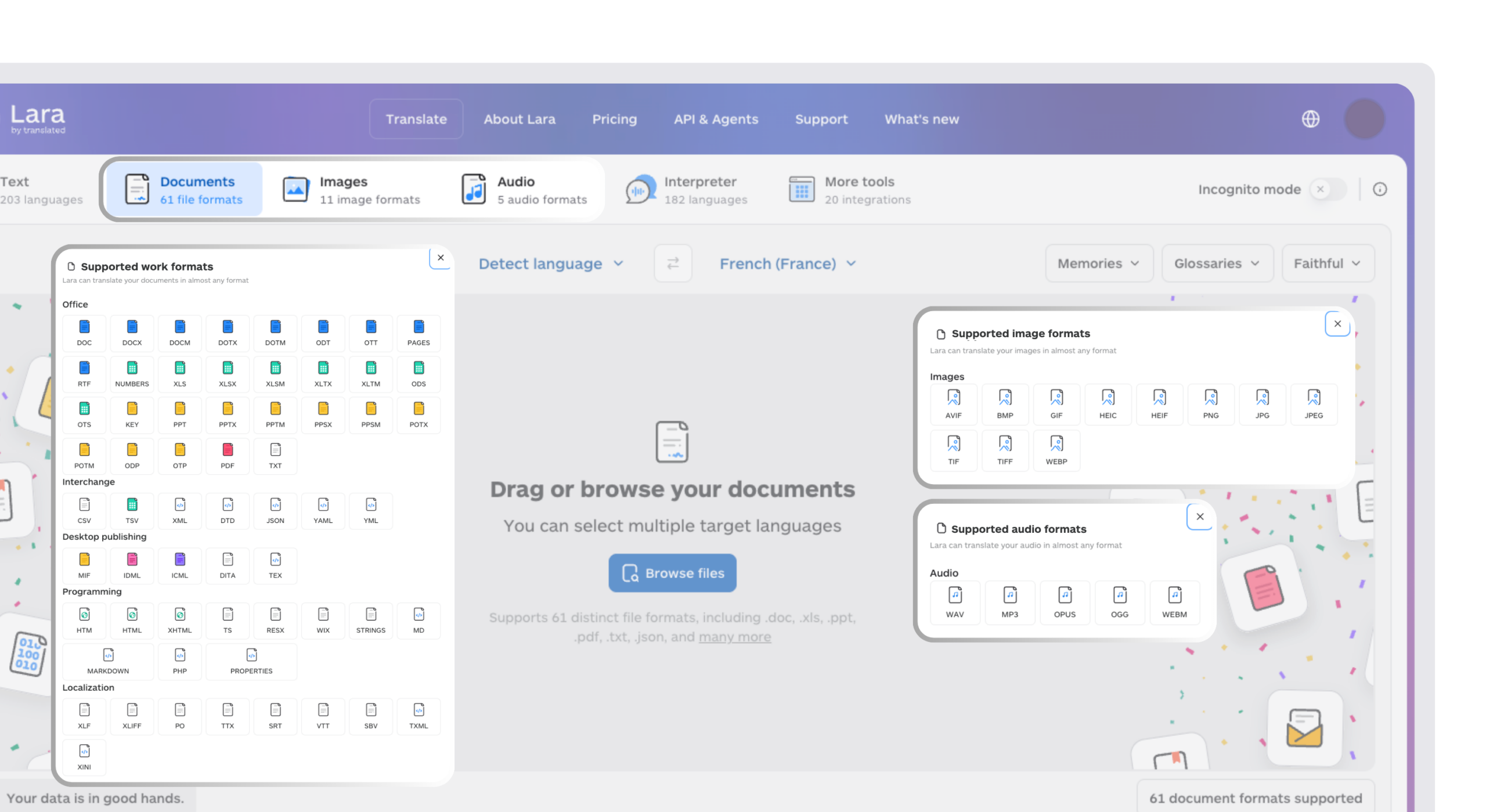
Preserve test IDs, code, selectors, API fields, and expected-value literals. Keep original execution logs and evidence unchanged, and label translations with the source version. This document workflow does not require a native integration or imply that translated prose can run as executable test steps.
Keep regional release reviews aligned
Translate approved documentation updates with Lara Translate, then have a qualified reviewer check technical meaning before sharing the new version.
Conclusion
The right tool depends on your applications, who writes the tests, and how often vendors release updates. Shortlist two or three, and pilot the same business process on each before you decide.
Have a valuable tool, resource, or insight that could enhance one of our articles?
Send us an email at press@laratranslate.com
We’ll be happy to review it and consider it for inclusion to enrich our content for our readers! ✍️
Frequently asked questions
What is enterprise application test automation?
Enterprise application test automation runs repeatable checks on business processes in systems such as SAP, Oracle, Workday, and Salesforce. It helps detect regressions after configuration changes, integrations, and vendor updates. Coverage and assertions determine what a passing run actually demonstrates.
Why is testing packaged applications different from testing custom software?
Packaged applications receive frequent vendor updates, carry heavy customization, and span many connected systems. Tests must follow business processes across screens and systems, and they must survive interface changes.
What does codeless test automation mean?
Codeless tools let testers build automated tests through recording, visual steps, or plain language instead of writing scripts. This lets business analysts contribute, though complex cases may still need technical input.
How does self-healing work in test automation?
Self-healing typically identifies an alternative way to locate a changed interface element and updates or proposes a repair. It can reduce locator maintenance, but it does not prove that the business process is correct. Review repairs and retain assertions that check the expected outcome.
How much does enterprise test automation cost?
Most vendors quote prices after a demo, based on users, applications, and usage. Compare total cost at your expected scale, including execution capacity and services.
How can global test teams work in several languages?
Translate test plans, user acceptance instructions, bug descriptions, and release summaries for regional reviewers. Preserve test IDs, code, selectors, API fields, and original run evidence. Have a qualified reviewer check technical meaning and maintain a link between each translation and its approved source version.
This article is about
- Enterprise test automation checks business processes in SAP, Salesforce, Oracle, and Workday
- How application coverage and authoring approaches affect enterprise test automation selection
- Why self-healing changes and AI-generated tests still need review and meaningful assertions
- How execution capacity, licensing, environments, and services affect total testing cost
- How translated test documentation supports regional teams while preserving technical traceability
Useful links
- Best AI SEO Content Automation Platforms in 2026
- The biggest problems in B2B sales, and the tools that solve them
- Lara Translate: text and document translation
This article was produced by the Lara Translate content team. Lara Translate is an AI translation platform built by Translated, with more than 25 years of professional translation experience. QA and release teams use Lara Translate to prepare test plans, acceptance instructions, and release summaries for review, across 200+ languages and 60+ file formats.