

Sales teams lose useful context when calls, emails, and meetings never reach the CRM. The best AI-native CRM platforms reduce that gap by capturing activity, enriching records, and helping teams act on customer information with less manual upkeep.
This guide compares best AI-native CRM platforms and adjacent relationship tools in 2026. The list includes products built around AI, established CRMs with AI features, personal relationship managers, and data platforms that solve part of the same problem.
|
TL;DR
|
What makes an AI-enabled CRM worth using in 2026?
Automatic capture should turn real activity into current, useful records. Strong products connect email and calendars, capture meetings, and turn interactions into summaries, follow-ups, or field updates. Coverage varies, so buyers should check which channels are supported and whether updates happen automatically or require approval.
Relationship intelligence and pipeline management also serve different needs. Some platforms calculate relationship strength and warm introduction paths. Others prioritize configurable objects, stage-based pipelines, or personal reminders. Pricing may depend on seats, credits, actions, data purchases, or a combination of them.
Best AI-native CRM platforms in 2026
| Platform | Best for | Product type | Published starting price |
|---|---|---|---|
| Attio | Configurable CRM and AI workflows | AI-enabled CRM | Free, Plus $35 per user monthly with annual billing |
| folk | Browser-assisted LinkedIn prospecting | Lightweight CRM | Standard $24 per member monthly with annual billing |
| Lightfield | Context-rich CRM automation | Agent-native CRM | 5,000 free credits, then usage-based |
| Affinity | Private capital relationship intelligence | Relationship intelligence CRM | $2,000 per user yearly |
| Clay | Enrichment and GTM workflows | Data and orchestration platform | Free, Launch from $185 monthly |
| Clarify | Automated deal and meeting intelligence | AI-native CRM | Free, Starter $40 monthly with annual billing |
| Day AI | Shared customer memory for agents | Customer-memory platform | Free, Turbo $25 monthly with annual billing |
| Breakcold | Multichannel social selling | AI sales CRM | $59 monthly for one seat |
| Pipedrive | Visual pipeline management | Established CRM with AI features | $14 per seat monthly with annual billing |
| Dex | Individual relationship management | Personal CRM | $12 monthly with annual billing |
1. Attio
Best for: Teams that want a flexible CRM data model with AI and workflow tools.
Attio combines configurable objects and attributes with real-time contact syncing, enrichment, workflows, call intelligence, and Ask Attio. Its plans include both shared workspace credits and individual seat credits for AI features and automations.
Pricing: Free supports up to three seats. Plus costs $35 per user per month with annual billing or $44 monthly. Pro costs $79 with annual billing or $99 monthly. Enterprise pricing is custom.
Verdict: Attio fits teams that value a configurable CRM structure and integrated AI tools. Compare credit allowances alongside seat prices.
2. folk
Best for: Teams that capture contacts from LinkedIn and manage relationship-led outreach.
folk uses its folkX browser extension to import people and companies from LinkedIn and Sales Navigator. The CRM also offers pipeline management, email campaigns, enrichment, AI assistants, and email, calendar, and WhatsApp sync. LinkedIn capture comes through the extension, so teams should evaluate that workflow rather than assume an automatic native sync.
Pricing: Standard costs $24 per member per month with annual billing or $30 monthly. Premium costs $48 with annual billing. Enterprise starts at $80 per member per month with annual billing.
Verdict: folk is useful for lightweight CRM work and browser-assisted prospecting, especially when contacts originate on LinkedIn.

3. Lightfield
Best for: Teams that want CRM records and agent workflows grounded in customer interactions.
Lightfield describes itself as an agent-native CRM. It combines CRM records, a call recorder, enrichment, sequences, workflows, and an agent platform. Its current pricing page says every plan has unlimited seats and access to core features, including automated record updates and agent-driven automations.
Pricing: Starter includes 5,000 free credits and then costs $0.040 per credit. Pro is $1,000 per month, Growth is $2,000 per month, and Enterprise pricing is custom.
Verdict: Consider Lightfield when interaction context and agent-run work belong in one system. Estimate credit use with representative sales activity before committing.
4. Affinity
Best for: Private capital firms that need relationship intelligence and warm introduction paths.
Affinity automatically captures email and calendar activity. Every published tier includes relationship intelligence, a relationship-strength score, warm introduction paths, pipeline management, and data enrichment. Higher tiers add capabilities such as meeting capture, AI chat, agents, and advanced enrichment.
Pricing: Essential costs $2,000 per user per year, Scale costs $2,300, Advanced costs $2,700, and Enterprise pricing is custom.
Verdict: Affinity is a specialized option for investors and deal teams where relationship paths are central to sourcing and deal flow.
5. Clay
Best for: Teams building enrichment, research, and go-to-market workflows around a CRM.
Clay connects to 150+ data providers, supports multi-provider waterfalls, and offers AI research through Claygent. Its core role is data enrichment and go-to-market execution. Growth adds CRM auto-sync, HTTP API integrations, webhooks, and intent signals, making Clay better suited to complementing a system of record than replacing a conventional sales pipeline.
Pricing: Free includes 500 actions and 100 data credits per month. Launch starts at $185 per month, or $167 per month at the annualized price shown on Clay’s pricing page. Growth starts at $495 monthly, or $446 at the annualized price. Usage is measured through actions and data credits.
Verdict: Clay is a capable enrichment and workflow layer for teams prepared to design their own processes. Model both types of usage when comparing costs.
Bring multilingual customer context into focus
Translate sales documents, images, audio, and text before adding them to a CRM workflow.
6. Clarify
Best for: Teams that want automated meeting and deal intelligence with usage-based AI pricing.
Clarify connects to email and calendars, records meetings, and uses credits for work such as meeting summaries, deal creation, field updates, tasks, and workflows. Clarify offers unlimited seats on every plan, separating team size from AI consumption.
Pricing: Free includes 1,000 credits per month. Starter costs $40 per month with annual billing and is presented for teams of up to three people. Growth starts at $1,000 per month with 100,000 monthly credits.
Verdict: Clarify is worth testing when automated CRM maintenance matters and per-seat billing would be restrictive.
7. Day AI
Best for: Teams that want shared customer memory for AI agents.
Day AI positions its product as customer memory for agents. It connects customer interactions and makes that memory available to AI assistants and agent workflows. Buyers can use it alongside an existing CRM, so the evaluation should focus on memory, retrieval, and agent access rather than assuming full pipeline replacement.
Pricing: Free supports one user. Turbo costs $25 per month with annual billing, Professional costs $60 and includes ten users, and Executive costs $200 and includes 100 users.
Verdict: Day AI is relevant when shared conversation memory matters more than replacing every part of an existing CRM.
8. Breakcold
Best for: Teams that sell through email and messaging channels.
Breakcold brings email, LinkedIn, Telegram, WhatsApp, calls, and meetings into a multichannel CRM inbox. Its published plan also includes enrichment, a meeting recorder, custom objects and fields, and integrations with AI tools through MCP.
Pricing: The base plan costs $59 per month and includes one seat, two connected accounts, and 3,000 AI CRM actions. Extra seats and connected accounts cost $10 per month each.
Verdict: Breakcold is a focused option for social-selling teams that need messaging context inside the CRM. Confirm channel policies and account requirements during a trial.
9. Pipedrive
Best for: Small and midsize teams that want a familiar visual sales pipeline.
Pipedrive is an established pipeline CRM with AI features across its current plan range. Lite includes AI-assisted report creation and other AI tools. Premium adds AI email creation and other advanced sales features, while optional add-ons can increase the total cost.
Pricing: With annual billing, Lite costs $14 per seat per month, Growth costs $39, Premium costs $59, and Ultimate costs $79.
Verdict: Pipedrive suits teams that prioritize visual pipeline management and a broad integration marketplace over an agent-native architecture.

10. Dex
Best for: Individuals managing professional and personal relationships.
Dex is a personal CRM that connects sources including LinkedIn, Gmail, Outlook, calendars, and WhatsApp. It combines contact records with notes, reminders, birthday notifications, and research briefs. Its design centers on individual relationship management rather than a shared team sales pipeline.
Pricing: With annual billing, Premium costs $12 per month and Professional costs $20. Enterprise pricing is available on request.
Verdict: Dex fits individual network management when reminders and relationship history matter more than forecasting or team deal stages.
How to choose the right AI CRM platform
Start with the work the system must perform. For warm introduction paths, examine Affinity. For a configurable CRM, compare Attio and Clarify. For automatic conversation context and agents, test Lightfield and Day AI. For prospect research and enrichment, evaluate Clay. Breakcold and folk serve multichannel and LinkedIn-led selling, Pipedrive offers a conventional visual pipeline, and Dex supports personal relationship management.
Run a proof of concept with representative email, calendar, meeting, and messaging data. Check whether the platform creates accurate records, respects access controls, and makes corrections easy. Then calculate the combined cost of seats, credits, actions, data, and add-ons at expected monthly volume.
A note on multilingual sales records
Global teams should test each CRM with the languages used in their calls, emails, notes, and documents. Capture support alone does not establish equal transcription, extraction, or summarization quality across languages, and the vendors in this comparison do not publish sufficiently comparable evidence for a reliable multilingual ranking.
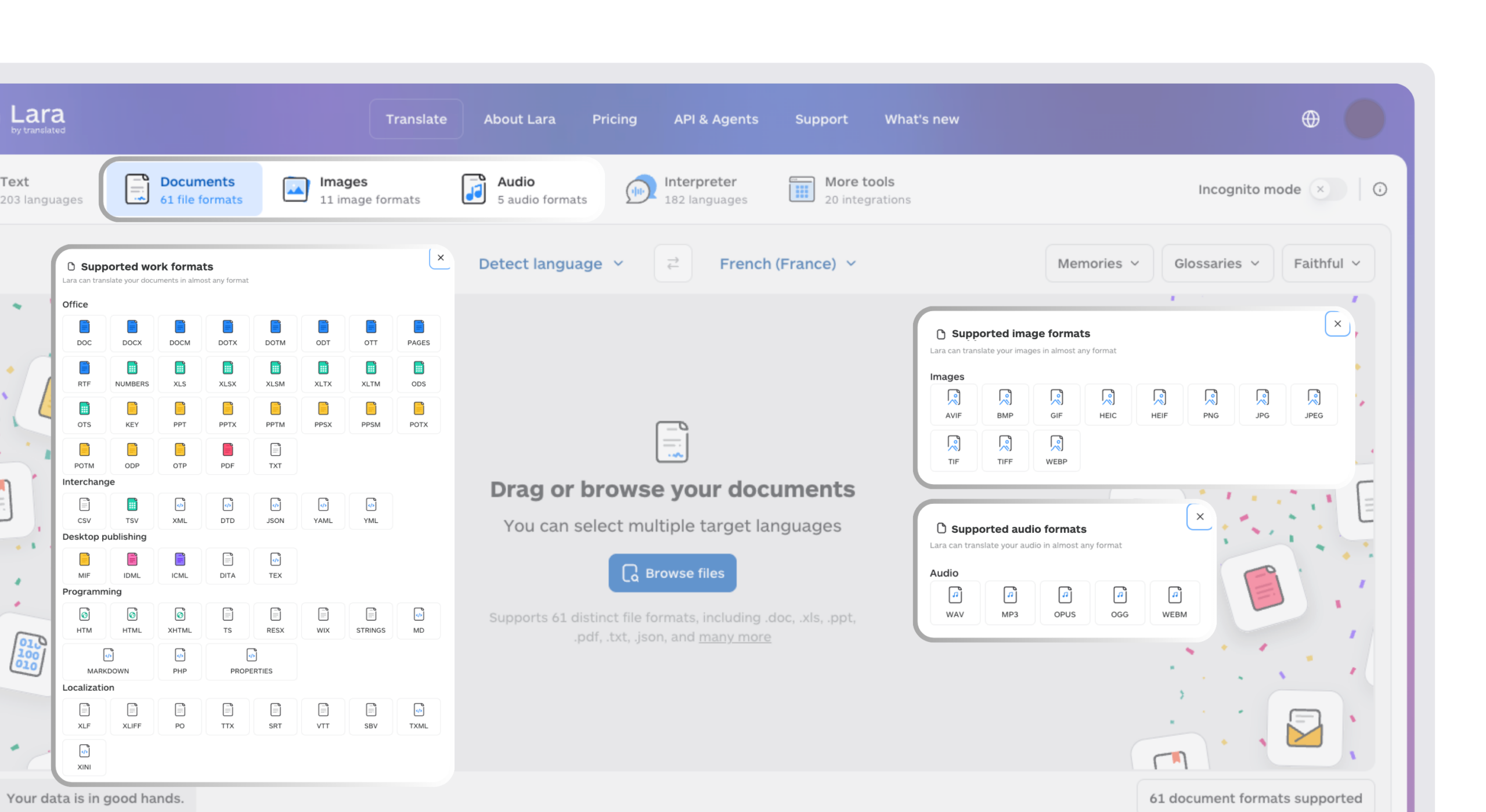
Lara Translate translates text, documents, images, and audio across 200+ languages. Its document workflow supports 60+ file formats, and its developer tools support glossaries, translation memories, and context. Teams can use Lara Translate to prepare multilingual source material for a CRM workflow while applying their own privacy, security, and governance requirements. This workflow does not imply a native integration with any CRM listed here.
Prepare sales content for every market
Use context, glossaries, and translation memories to keep multilingual customer material clear and consistent.
Conclusion
The strongest choice is the platform that captures your real sales activity, fits your relationship model, and stays economical at expected usage. Shortlist by workflow, then test record quality and total cost with your own data.
Have a valuable tool, resource, or insight that could enhance one of our articles?
Send us an email at press@laratranslate.com
We’ll be happy to review it and consider it for inclusion to enrich our content for our readers! ✍️
FAQ
What is the best AI-native CRM in 2026?
The best choice depends on the workflow. Lightfield emphasizes agent-driven CRM work, Clarify focuses on automated meeting and deal intelligence, Attio provides a configurable CRM, and Affinity serves relationship-driven private capital teams. Test the leading candidates with your own data.
What is the difference between an AI-native CRM and a traditional CRM with AI?
AI-native vendors generally make automated capture, record maintenance, and agent workflows central to the product. Established CRMs add AI capabilities to a conventional record and pipeline system. Because the label has no standard definition, compare specific capabilities.
Is Clay a CRM?
Clay is primarily a data-enrichment and go-to-market workflow platform. It can connect to CRMs and support outbound work, but teams that need conventional pipeline management will often pair it with a separate system of record.
How much does an AI CRM cost for a small team?
Costs range from free entry plans to thousands of dollars per user each year. The subscription or seat price is only one component because AI use may consume credits, actions, data purchases, or add-ons.
Do AI CRM platforms work for multilingual sales teams?
Results vary by platform, language, channel, and input type. Run a proof of concept with representative calls, messages, and documents, and use a dedicated translation workflow when material must be translated before CRM analysis.
This article is about
- The best AI-native CRM platforms and adjacent relationship tools in 2026
- Differences between agent-native, configurable, and traditional CRMs
- Relationship intelligence, automatic capture, and pipeline management
- Seat, credit, action, data, and add-on pricing models
- Multilingual sales records and translation workflows
Sources
- Attio pricing
- Attio credit documentation
- folk pricing
- folk LinkedIn CRM and folkX extension
- Lightfield pricing
- Affinity pricing and plan features
- Clay pricing and usage model
- Clarify pricing
- Day AI plans
- Breakcold plan and features
- Pipedrive pricing and AI features
- Dex pricing and integrations
- Lara Translate API capabilities
- Lara Translate supported file formats
- Lara Translate supported languages
- Translated company background
This article was produced by the Lara Translate content team. Lara Translate is an AI translation platform built by Translated, with more than 25 years of professional translation experience. Sales teams use Lara Translate to prepare multilingual customer content for consistent CRM workflows, across 200+ languages and 60+ file formats.