

Anyone working in localization right now can feel the ground shifting. Tools that were cutting-edge eighteen months ago are already being reassessed. Teams that ran efficient translation workflows in 2024 are finding the benchmarks have moved, not because the models changed dramatically, but because the systems around them did. The question is no longer whether to adopt AI for translation. It’s which capabilities matter most, and where the future of machine translation is actually heading.
This article breaks down the AI translation trends 2026 that are reshaping how localization teams work: where the technology has genuinely advanced, where real tensions remain, and how emerging developments are influencing procurement and workflow decisions. The goal here isn’t a forecast built on speculation. It’s a grounded read on what’s changing and why.
According to Research and Markets, the AI in language translation market is projected to reach $3.68 billion in 2026, growing to $8.93 billion by 2030 at a 24.8% CAGR (Research and Markets, 2026). That growth reflects real demand. It also means a crowded market where not every tool is solving the same problem. Understanding the landscape means looking past the headline number.
|
TL;DR
|
What are the AI translation trends in 2026?
Short answer
In 2026, AI translation is defined by seven shifts: LLMs becoming a structural part of the pipeline, adaptive MT as a default architectural feature, context handled at the architecture level, deeper workflow automation, governance moving from consideration to requirement, the expansion into multimodal and real-time content, and quality estimation reshaping human review. The teams that gain the most don’t just adopt a better model. They build a coherent system around it.
The AI translation trends 2026 center on seven shifts: LLMs moving from a supplementary tool to a structural part of the pipeline, adaptive machine translation becoming a default architectural feature, context handled at the architecture level, deeper workflow automation, governance and compliance moving from consideration to requirement, the expansion into multimodal and real-time content, and quality estimation changing the shape of human review. Each one addresses a limitation of the sentence-level neural machine translation that dominated the last decade. Here’s what’s changing, and what it means for how you plan.

Shift 1: LLMs move from supplementary to structural
For most of the past decade, neural machine translation ran on a sentence-by-sentence model. A source string came in, a target string went out. That architecture was fast and cost-effective, but it put a ceiling on quality for anything needing cross-sentence coherence, tonal consistency, or domain-specific nuance. Large language models are pushing past that ceiling.

The integration of large language models (LLMs) into professional translation workflows is one of the more structurally significant shifts of 2026, and one of the most consequential of the emerging AI translation technologies. LLMs handle discourse-level challenges that earlier NMT systems could not resolve reliably. They fix ambiguous pronouns across paragraphs. They hold register steady across a document. They adapt to domain conventions without an exhaustive glossary. For many content types, that means a real drop in post-editing volume.
There’s a catch. LLM-based translation without structural controls brings its own problems. Hallucinations, plausible but incorrect outputs, remain a genuine risk in generative architectures, especially for regulated or technically precise content. Fluency and accuracy are not the same thing. Teams that learn this in production tend to learn it at cost.
Hybrid architectures and what they mean for localization planning
A direction gaining ground in enterprise localization is the use of hybrid architectures that combine LLM reasoning with specialized translation models. Rather than pick one, these systems route content to the right component: LLM capabilities for context-heavy, creative, or document-level tasks, and deterministic translation models for terminology-sensitive or high-volume segments where consistency beats nuance. This layered approach is becoming a more realistic picture of what the future of machine translation looks like in practice.
Shift 2: Adaptive MT finds its place in AI-integrated pipelines
Adaptive machine translation is not new. A translation engine that adjusts to human corrections has existed for years, and several platforms have shipped some version of it for over a decade. What’s different now is the context. As AI-integrated translation pipelines become common, adaptive MT is turning into a central architectural requirement rather than a premium add-on.
In practice, that means translation memory is evolving beyond its old role as a passive lookup database. Modern adaptive systems treat approved segments as active examples that shape how the engine handles similar content next time. Teams that maintain well-curated memories see quality climb incrementally over time. Teams that treat each project as an island repeat the same correction work, again and again.
Here’s the implication for workflow design: how you manage your approved translations matters as much as which engine you run. Terminology consistency, segment approval discipline, and TM hygiene are becoming infrastructure concerns, not just editorial ones.
Lara Translate is built around this adaptive model. The platform combines the fluency and reasoning of fine-tuned LLMs with the precision of MT, and it supports translation memories that the engine uses in near real-time to adapt output style and terminology. The Think model runs multi-step linguistic analysis across every available project asset, including glossaries, style guides, and contextual metadata, catching major linguistic issues before output is delivered. Lara Translate supports more than 200 languages. For the full and current list, check the official language support documentation. The platform is available as an SDK across Python, Node.js, Java, PHP, and Go, and as an MCP server for integration into LLM-native workflows.
Try Lara Translate in your own workflow
Test Lara Translate on a real client text and see how it handles your terminology, context, and formatting.
Shift 3: Context handling moves to the architecture level
One of the clearer changes in 2026 is that context is increasingly treated as a first-class input rather than an optional parameter. For MT systems built around isolated sentences, context was inferred at best and ignored at worst. That’s changing at the architecture level across a growing number of professional translation APIs.
 The ability to pass document-level context, conversation history, source metadata, and domain signals directly into a translation request is becoming an expectation in enterprise MT procurement. Systems that accept rich context inputs produce more coherent output on the content that used to demand heavy human intervention: marketing copy, customer support transcripts, technical documentation with cross-references. The gap between context-aware and context-blind systems now shows up in production, not just in benchmarks.
For teams building translation workflows, this points to treating context management as a design concern alongside terminology and TM strategy. How context is structured, passed, and preserved across segments has become consequential for output quality in ways that weren’t obvious when most MT was sentence-level.
Shift 4: Workflow automation delivers the most immediate gains
Across enterprise localization operations in 2026, one pattern keeps repeating: the biggest efficiency gains come not from better models, but from cutting friction between steps. Content creation, translation handoff, review routing, and publication are still run manually in many organizations, through emails, shared spreadsheets, and ad hoc handoffs. Teams that automate these transitions operate at a noticeably different pace.
API-driven translation workflows, webhook triggers that kick off translation on content update, and CLI tooling that embeds localization into version control pipelines are changing how translation fits into content operations. For anyone managing high-volume or time-sensitive content, this kind of integration is shifting from a differentiator to a practical requirement. The translation engine is now just one component in a larger automated system.
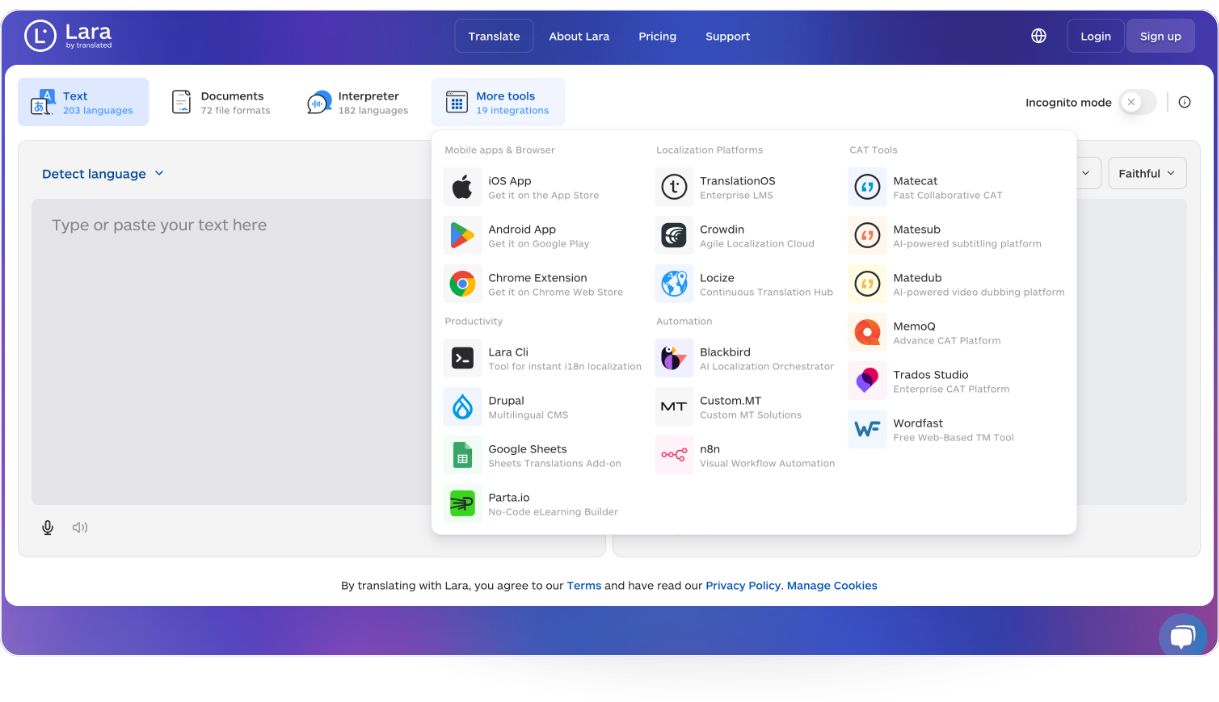
Procurement conversations reflect the change. Integration depth, meaning API coverage, MCP compatibility, CLI support, and GitHub Actions integration, gets weighed alongside linguistic quality and language pair breadth. Of all the shifts visible in 2026 buying decisions, this one may be the most consequential for how localization fits into engineering-driven organizations.
What the localization predictions for next year say about developer tooling
A growing share of localization predictions for next year focuses on developer tooling. As translation integrates more tightly into software development cycles, with localization strings managed in version control, translated on pull request, and validated in CI/CD pipelines, tools that support CLI-based translation, GitHub Actions integration, and programmatic memory management are gaining ground. That’s where the future of machine translation infrastructure is heading at scale.
Shift 5: Governance, compliance, and data privacy become requirements
For organizations in regulated industries, healthcare, legal, financial services, public sector, how AI translation handles sensitive data is no longer a side question. It’s a condition of adoption. Regulatory frameworks including the EU AI Act (European Commission, Regulatory framework on AI) are tightening expectations around transparency, human oversight, and auditability for AI systems used in consequential contexts. When translation touches regulated content, it falls within scope.
In practical terms, translation governance, knowing which system produced a given output, under which terminology rules, reviewed by whom, is becoming an operational requirement for some teams rather than a nice-to-have. Hallucinations in regulated content are not just quality problems. They’re compliance liabilities. And the question of where source data goes during translation, which servers process it and under which retention policies, is now a standard part of vendor evaluation in many sectors.

If you’re outside a regulated industry, these pressures are still worth tracking. Governance infrastructure, meaning audit trails, role-based access, and zero-retention processing, is likely to become more broadly expected as AI translation scales into sensitive content. It’s one of the areas where 2026 is accelerating demands that were previously limited to a narrow set of sectors.
Shift 6: Multimodal and real-time translation expand what “translation” covers
Translation has historically meant text. Of the shifts that are hardest to ignore in 2026, the expansion into audio, video, and image content stands out for the breadth of what it touches. A growing number of platforms now handle more than written strings, and the category of content localization teams need to consider is widening with it.
 Real-time speech translation, audio-to-audio processing, and the ability to translate text embedded in images or video frames are moving from research demos toward production tooling. Maturity varies a lot across providers and language pairs, and for many use cases human review stays essential. But the direction is clear. Multimodal translation is becoming a planning consideration for teams managing training materials, support recordings, product imagery with embedded text, and live communication channels.
The governance challenge here mirrors the one facing text-based AI translation, only compounded. Making sure the terminology standards, brand voice, and quality controls you apply to written content also apply to audio and visual formats takes deliberate infrastructure. Teams thinking about this now are better positioned than the ones who’ll be asked to retrofit controls later.
Shift 7: Quality estimation and the changing shape of human review
One of the more practically significant developments in production environments is the growing use of quality estimation (QE), tools that assess how reliable a machine translation output is without needing a human reference. As volumes grow and model quality improves for high-frequency content, applying uniform human review to everything is neither practical nor cost-effective.
 QE-based routing sends high-confidence output to publication and flags lower-confidence segments for a linguist. It focuses human expertise where it adds the most value. This doesn’t reduce the importance of human judgment. It redirects it. The segments that genuinely need linguistic expertise tend to be exactly the ones a QE model flags as uncertain.
The professional profile valued in localization teams is shifting alongside this. Skills in systemic quality evaluation, QE calibration, terminology management, and workflow design are becoming as relevant as line-by-line translation. It’s a gradual evolution, not a sudden replacement. Teams building for it now are developing capabilities that will matter more each year.
What these trends mean for localization strategy in 2026 and beyond
The seven shifts share a common thread. Look at the AI translation trends 2026 as a whole and the teams getting the most from AI translation are not the ones with the single best model. They’re the ones with the most coherent system around it. Well-maintained translation memories, enforced terminology, structured review workflows, governance controls, and deep pipeline integration compound over time in ways raw model quality does not.
What all of this points toward is less a single breakthrough and more a direction: how these capabilities get combined, governed, and improved over successive projects. If you’re evaluating your localization stack, the most useful question isn’t which tool wins a benchmark. It’s which platform supports the kind of structured, adaptive workflow that gets better with use.
Why it matters
The tools are no longer the bottleneck. What separates teams now is the system around the model: the memories, terminology rules, governance controls, and pipeline integration that compound over time. Get that structure right and quality keeps improving with every project. Ignore it, and even the best model plateaus.
Put these trends to work
Run Lara Translate against your own terminology, context, and file formats, and see how an adaptive workflow holds up on real content.
FAQs
What are the most important AI translation trends in 2026?
The most significant AI translation trends in 2026 include: deeper integration of LLMs into production workflows, adaptive MT becoming a standard architectural feature, the expansion of translation into multimodal content, growing governance and compliance requirements for regulated industries, and the use of quality estimation to route human review more efficiently.
What does the future of machine translation look like for enterprise teams?
For enterprise teams, the future of machine translation is increasingly a layered system: AI handles first-draft generation, translation memory and glossaries enforce consistency, quality estimation routes outputs intelligently, and human review focuses where linguistic judgment adds the most value. Governance controls and pipeline integration are becoming baseline expectations alongside linguistic quality.
Which emerging AI translation technologies are reshaping localization workflows?
Among the most operationally relevant emerging AI translation technologies are LLM-based document-level translation, adaptive MT integrated into AI pipelines, context-aware translation APIs, and multimodal translation tools covering audio and image content. Each addresses a limitation of earlier sentence-level NMT approaches in a different way.
How is governance affecting AI translation adoption in regulated industries?
Regulatory frameworks including the EU AI Act (European Commission, Regulatory framework on AI) are raising expectations around auditability, human oversight, and data handling for AI systems used in consequential contexts. For teams in healthcare, legal, and financial services, translation governance, knowing which system produced what output and under which controls, is becoming an operational requirement rather than an optional layer.
What do localization predictions for next year suggest about the human translator role?
Localization predictions for next year consistently point to a role evolution rather than elimination. Human expertise is increasingly valued for quality supervision, QE calibration, terminology management, and workflow governance, rather than sentence-by-sentence post-editing. Teams investing in these capabilities now are better positioned for where the industry is heading.
This article is about
- The key AI translation trends 2026 is bringing to localization strategy and technology selection
- How emerging AI translation technologies, including LLMs, adaptive MT, and multimodal tools, are changing translation workflows
- What the future of machine translation looks like for enterprise teams managing multilingual content at scale
- How governance, compliance, and data privacy are reshaping AI translation adoption in regulated industries
- Forward-looking MT predictions on quality estimation, human review, and the evolution of the localization profession
Have a valuable tool, resource, or insight that could enhance one of our articles?
Submit your suggestion
We’ll be happy to review it and consider it for inclusion to enrich our content for our readers! ✍️
Useful articles
- Going Full AI: What’s Driving the Market Chaos and Why Blind Automation Fails
- Why Domain-Specific AI for Business Outperforms General LLMs?