

Speech-to-speech translation converts spoken input in one language into spoken output in another, and for real-time conversation, the direct/streaming architecture beats cascade pipelines on latency, while cascade still wins on language coverage and engineering speed.
Prototype with a cascade (ASR plus machine translation plus text-to-speech) to validate your use case fast. Move to production with a streaming direct model, or a managed API, once you need sub-second turnaround. Watch the risk: voice preservation and prosody remain the hardest unsolved problems, and quality benchmarks like BLEU only capture part of what makes speech translation feel natural. Lara Translate’s audio-to-audio translation maps speech straight from one language to another as a managed API, showing what a production-grade direct path looks like today.
TL;DR
|
- Direct/streaming models cut latency and preserve voice character better than cascades, per a review of direct S2ST methods.
- Cascade pipelines remain the faster path to broad language coverage with off-the-shelf components.
- Evaluation still leans on BLEU and human mean opinion score (MOS) testing, neither of which fully captures conversational naturalness.
Key Takeaways
Real-time speech-to-speech translation works best as a direct or streaming architecture once you have enough time-aligned audio data, with cascade pipelines remaining the practical fallback for broad coverage and fast prototyping.
| Point | Details |
|---|---|
| Match architecture to data | Choose direct/streaming models only when you have enough time-aligned parallel audio; otherwise default to cascade. |
| Separate latency components | Track internal prediction delay, inference time, and transport latency separately during testing. |
| Evaluate beyond BLEU | Combine BLEU or word error rate with human MOS panels to catch naturalness problems text metrics miss. |
| Keep a cascade fallback | Route low-confidence or out-of-distribution language pairs to a cascade backup instead of failing outright. |
| Consider a managed path | Lara Translate’s audio-to-audio API translates a recording end-to-end (audio in, audio out) via API and SDKs; a live interpreter handles real-time conversation, no custom acoustic model to build. |
Cascade vs Direct Speech-to-Speech Translation Architecture
Every real-time speech translation app is built on one of two architectural bets. A cascade system chains automatic speech recognition, machine translation, and text-to-speech into three separate stages. A direct, or end-to-end, model collapses that chain into a single network that maps source audio straight to target audio. The choice determines your latency floor, your data requirements, and how well the output preserves the speaker’s actual voice.
Cascades are modular and easy to debug. You can swap the ASR engine, upgrade the MT model, or change the TTS voice independently, and each stage produces an inspectable text output you can log and correct. The cost is compounding: an ASR misrecognition propagates into the translation stage, then into synthesis, and each stage adds its own inference delay. Direct models avoid that error chain and, according to the same architecture review, better preserve prosody and speaker identity because they never collapse the signal down to plain text. The trade-off is data. Direct models need large volumes of time-aligned source-target audio, which is far scarcer than parallel text.
Streaming systems, whether cascade or direct, share a common set of building blocks:
- Streaming encoder: processes audio in small chunks rather than waiting for a full utterance, often built on Conformer-style layers that mix convolution and self-attention.
- Audio tokenization: many direct models represent speech as discrete units, sometimes called RVQ (residual vector quantization) tokens, turning continuous audio into a sequence a decoder can predict autoregressively, an approach detailed in research on audio tokenization for streaming decoders.
- Streaming decoder: generates target audio (or discrete units later vocoded into audio) incrementally as source chunks arrive.
- Lookahead policy: governs how much future source audio the model waits for before committing to an output segment.
A streaming direct model’s data flow looks like: microphone chunk → streaming encoder → discrete unit predictor → lookahead policy gate → streaming decoder → vocoder → speaker output. A cascade’s flow looks like: microphone chunk → ASR partial hypothesis → MT re-translation on each update → TTS synthesis → speaker output, with each arrow representing a queue where latency accumulates.
Two-pass unit-based approaches split the difference: predict discrete linguistic units first, then refine them into acoustic detail. Research on unit-based, two-pass direct S2ST shows this improves robustness in low-resource language pairs compared to single-pass direct generation, since the unit prediction stage acts as an intermediate error-correction layer.
Building the Data Pipeline for Real-Time Voice Translation
Training a direct or two-pass model demands time-synced parallel audio, and assembling that dataset is where most S2ST projects stall. The pipeline runs in a fixed order:
- Collect raw audio in matched source and target language pairs, ideally from the same speaker or comparable conversational context.
- Generate ASR transcripts for the source audio to create text anchors.
- Machine-translate the transcript, or use existing human translations if you have them.
- Synthesize target audio with TTS when you lack real target-language recordings.
- Run forced alignment to timestamp source and target segments against each other.
- Filter the result against quality thresholds before it enters training.
Before any batch enters training, run it through a validation checklist:
- Isolate single-speaker segments; discard overlapping speech unless you’re specifically training for speaker separation.
- Set a minimum signal-to-noise ratio (SNR) floor and reject clips below it.
- Track your forced-alignment success rate; a pipeline consistently below roughly 90% alignment confidence usually signals a transcript or timestamp problem upstream.
- Require timestamp annotations at the segment level, not just utterance level, for streaming training.
Augment thin datasets with time stretching, reverberation injection, and SNR-degraded copies of clean audio, plus TTS-synthesized target audio when human recordings are scarce. If your parallel speech data is thin, default to a cascade. Direct models only pay off once you have enough aligned audio to avoid overfitting to a narrow accent or speaker set.
How Much Delay Is Acceptable in Live Speech Translation?
Latency in a real-time speech translation app breaks into three distinct components: internal prediction delay (how much source audio the model needs before committing to output), inference time (raw compute latency), and transport latency (network round trip). Confusing these three is the most common mistake teams make when they report a single “latency” number that hides where the delay actually lives.
Your lookahead policy decides how the system trades context for speed:
- Turn-based: wait for a full utterance before translating; highest accuracy, worst conversational flow.
- Fixed-lookahead: commit to output after a fixed audio window, simple to implement and tune.
- Dynamic/adaptive policy: adjusts lookahead based on confidence or sentence structure, the approach StreamSpeech uses to jointly learn translation and policy in one multi-task model.
Research on simultaneous translation systems argues the shift from turn-by-turn to simultaneous streaming is the biggest usability leap available, but it only pays off with careful policy tuning. Multi-chunk training, exposing the model to variable-length audio segments during training rather than fixed utterances, lets one model serve multiple latency/quality operating points. During testing, log per-chunk timestamps, end-to-end delay percentiles (not just averages), and policy decision points so you can separate model latency from network latency later.
Prototyping and Deploying a Speech Translation API
Building a working demo is faster than most developers expect, but production deployment surfaces problems a demo never shows you.
For your prototype, lock down these basics first:
- Capture audio at 16kHz mono PCM as your baseline; most speech models expect this and resampling on the fly adds unnecessary overhead.
- Chunk audio into 200 to 400 millisecond frames for streaming transmission over WebRTC or WebSocket.
- Handle silence explicitly. Voice activity detection prevents you from wasting inference cycles on dead air.
- Define a clean session lifecycle: open, stream, flush on pause, and close, so you never leave a hanging connection consuming compute.
Choosing between a managed endpoint, an open-source model, and a custom-trained system comes down to three questions: Do you need languages the managed services don’t cover? Does your use case demand voice preservation beyond what a generic API delivers? Can your team maintain a training pipeline long-term? If you answer no to all three, a managed real-time endpoint gets you to market faster than training anything from scratch.
Once you’re past the demo stage, optimize for cost and reliability:
- Quantize models to int8 or int4 for inference where accuracy loss is acceptable; this often cuts inference latency substantially on the same hardware.
- Shard large models across GPUs only when a single device can’t hold the model in memory, since sharding adds coordination overhead.
- Precompute and cache anything static, like speaker embeddings or glossary terms, so each request only computes what actually changes.
- For multi-speaker rooms, run speaker diarization before translation, and keep separate streaming sessions per active speaker rather than mixing audio.
Edge deployment (on-device) cuts network latency to near zero but limits you to smaller, quantized models. Server deployment supports larger models with better quality but adds transport delay on every round trip. Most production systems land on a hybrid: lightweight voice activity detection on-device, heavier translation on a nearby edge server.
Skip the cascade, ship this quarter
Wire Lara Translate’s audio-to-audio API into your voice pipeline: a recording goes in, translated audio comes back, no ASR or TTS stages to build.
How Do You Measure Speech Translation Quality?
BLEU scores, borrowed from text machine translation, remain the default quality proxy for S2ST because they’re cheap to compute against a reference transcript. They also miss almost everything that makes speech sound natural: pacing, intonation, and whether the translated voice still sounds like the original speaker. Pair BLEU or ASR-derived word error rate with human MOS panels rating naturalness, and track latency percentiles (p50, p90, p99) rather than a single average, since tail latency is what users actually notice in conversation.

CVSS-style benchmarks, the dataset StreamSpeech evaluates against, give you timestamped test audio and standardized dev/test splits so results are reproducible across teams. Build your own held-out test set the same way: fixed splits, timestamped audio, and a documented alignment process.
Production throws harder problems at your system than any benchmark does:
- Noisy input: apply denoising and speaker separation before the translation stage, not after.
- Domain shift: a model trained on clean interviews degrades on accented, casual speech; budget for continuous fine-tuning.
- Low-resource languages: fall back to a cascade pipeline when direct-model training data is too thin for reliable unit prediction.
- Cost scaling: batch requests where latency budgets allow, and reserve premium low-latency inference for interactive sessions only.
Pro Tip: Keep a cascade running as a silent fallback behind your direct model in production. When confidence drops or a language pair falls outside your direct model’s training distribution, route to the cascade automatically instead of returning a broken translation.
On privacy, treat transcripts as personally identifiable information by default: encrypt audio in transit and at rest, minimize retention windows, and process on-device where consent or regulation demands it. A privacy-first approach to voice note transcription offers a useful model for handling consent and PII in adjacent audio-to-text workflows.
What Research Says About Building Natural-Sounding S2ST
If you have limited engineering time, spend it on lookahead policy tuning and voice disentanglement before anything else. Research on acoustic and semantic entanglement found that models conflating what is said with how it’s said produce robotic output even when the translated text is accurate. Isochrony, keeping translated speech roughly the same length and pacing as the source, is often harder to solve than raw translation accuracy.
- Prototype with a cascade when you need broad language coverage fast.
- Invest in direct/streaming architectures once voice preservation and sub-second latency become the actual product requirement.
Pro Tip: Test your system with real conversational interruptions and overlapping speech before launch. Clean, scripted test audio hides exactly the failure modes your users will hit first.
A Builder’s Take on Speech Translation Trade-offs
Most teams overbuild before they’ve measured anything. Prototype the cascade, clock your actual latency and MOS scores, and let those numbers, not architecture preference, decide whether a direct model is worth the data investment.
Where Lara Translate Fits Into a Production Voice Pipeline
The whole point of a direct model is to skip the cascade: audio in, translated audio out, with no separate ASR and TTS stages to build and maintain. Lara Translate’s audio-to-audio translation gives you exactly that as a managed API. A source recording goes in, a translated audio file comes back, end-to-end, with no manual speech-to-text or text-to-speech step in between.
It runs through the web interface, the API, and SDKs, accepts WAV, MP3, Opus, OGG, and WebM input (up to 200 MB or two hours per file), and bills per minute of processed audio (currently €0.08 / $0.08 per minute). The developer documentation for audio translation lists the current language support, request parameters, and SDK examples. For live, back-and-forth conversation rather than recorded files, Lara’s live voice interpreter covers 182 languages in real time.
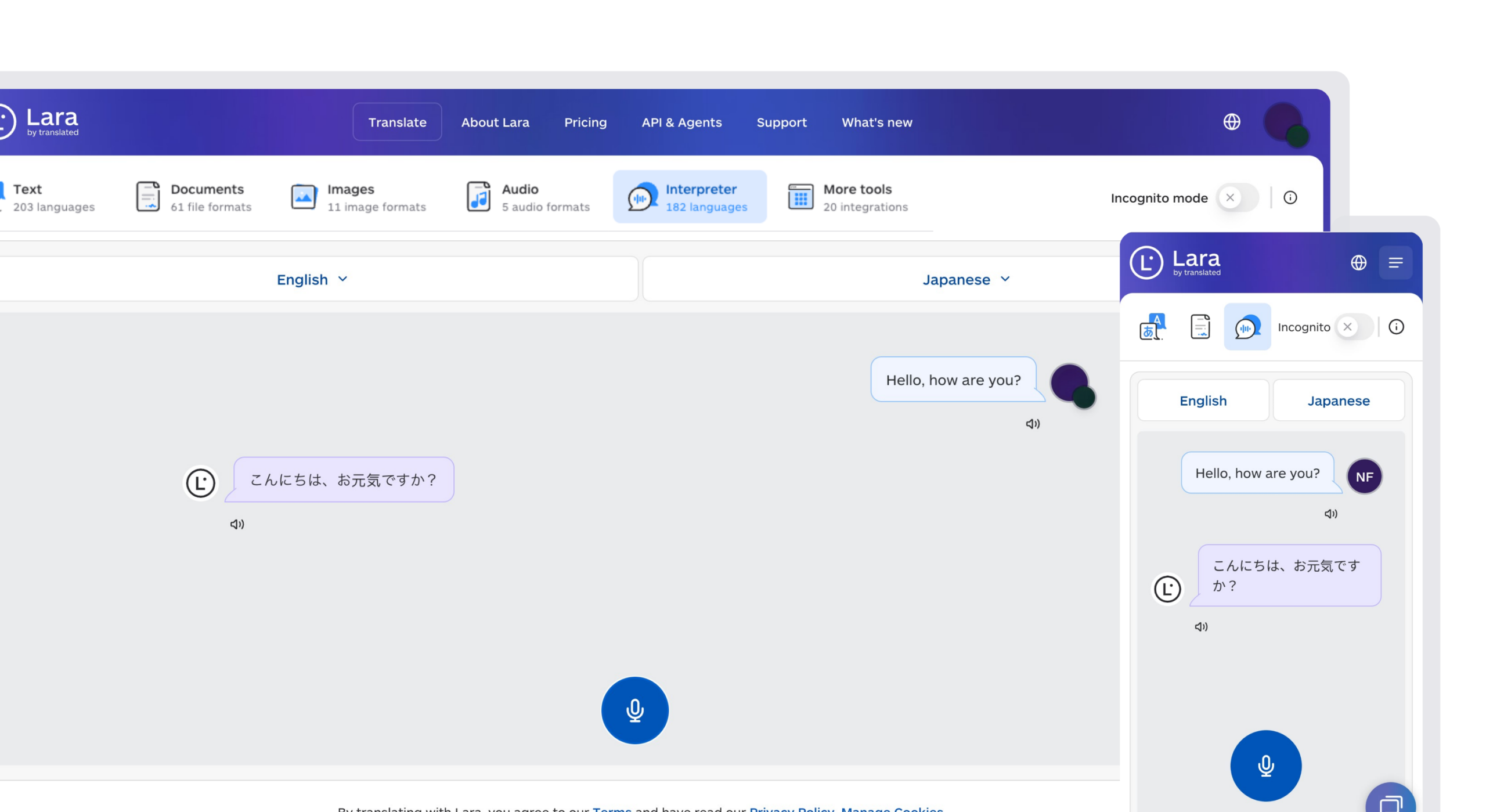
That handles the voice applications, audio localization, and speech-driven workflows most teams actually ship, without spending months collecting time-aligned parallel audio and training a custom acoustic model. Building your own direct model still makes sense when you need a specific voice-preservation guarantee, sub-second streaming latency, or on-device constraints an API can’t meet. For everyone else, the managed audio-to-audio path gets a working product live this quarter instead of next year.
Try it on your own audio
Send a real recording through Lara Translate’s audio-to-audio translation and hear the end-to-end result before you build anything custom.
Have a valuable tool, resource, or insight that could enhance one of our articles?
Send us an email at press@laratranslate.com
We’ll be happy to review it and consider it for inclusion to enrich our content for our readers! ✍️
FAQ
Is there a real-time voice-to-voice translator available today?
Yes. Managed services and open research systems like StreamSpeech both support real-time speech-to-speech translation. Lara Translate offers an audio-to-audio API that translates a recording end-to-end, audio in and audio out, plus a live interpreter across 182 languages for real-time conversation.
Can I translate live speech to text as an intermediate step?
Yes, this is exactly what a cascade pipeline does: it runs automatic speech recognition to produce live text, then machine-translates that text before optionally synthesizing translated speech.
Can I convert text to speech and translate it in one workflow?
You can, and many production systems do this deliberately: translate the text first with machine translation, then synthesize the translated text into speech using a TTS engine, which is the cascade approach described earlier in this guide.
Can Google Translate do speech to text?
Google Translate supports speech input that it transcribes and translates, functioning as a cascade-style tool rather than a direct end-to-end streaming model built specifically for continuous real-time conversation.
This article is about
How real-time speech to speech translation (S2ST) works and how to build it: the cascade versus direct/streaming architecture trade-off, the data pipeline for training direct models, how to measure and budget latency, how to prototype and deploy a speech translation API, how to evaluate quality beyond BLEU, and when a managed path like Lara Translate’s live voice interpretation beats building a custom acoustic model.
Sources
- Direct Speech to Speech Translation: A Review, cascade versus direct trade-offs in depth.
- StreamSpeech: Simultaneous Speech-to-Speech Translation with Multi-task Learning, the multi-task architecture and CVSS benchmark results.
- How Real is Your Real-Time Simultaneous Speech-to-Speech Translation (MIT TACL), simultaneous policy design.
- NeurIPS 2024 proceedings, acoustic and semantic disentanglement affecting voice naturalness.
- Machine translation (Wikipedia).
Recommended
- Lara Translate AI: Reliable, Fast, Free
- Audio Translation | Lara Translate
- AI + Human Translation | Lara
- Translate to and from English with Lara Translate