

International traffic is arriving on your site. It’s not converting. Most of the time, the reason isn’t your product. It’s the language.
Browser translation seems like a shortcut. It isn’t. Automated tools break at checkout, mistranslate product names, and leave your brand looking like an afterthought. More importantly, they do nothing for discovery. When someone in Germany searches for your product category, your English-only site is invisible. You don’t exist in that market, even if your product is exactly what they need.
Website translation isn’t about converting text from one language to another. It’s about making your business discoverable, credible, and functional in markets where your customers don’t search in English. Most business leaders understand this in principle but struggle with the timing and execution. So, why translate your website? When should you translate? Which languages come first? How do you maintain quality at scale without it becoming a bottleneck?
These questions become urgent when you notice international traffic bouncing at high rates, when competitors launch localized sites in your target markets, or when promising leads from non-English markets stall because prospects can’t evaluate your product properly.
|
TL;DR
|
The business case: benefits of website localization
Localization goes beyond making text readable. It adapts your website to work in a specific market: currency, payment methods, cultural expectations, and language. The returns show up in conversion data almost immediately.
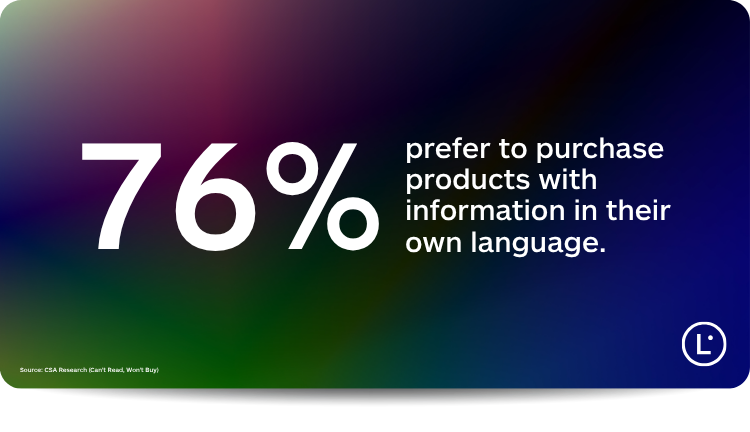
When product pages, pricing, and checkout appear in a customer’s language, purchase rates go up. E-commerce platforms tracking multilingual behavior consistently see higher cart completion rates on localized sites versus English-only sites serving international traffic. According to CSA Research (Can’t Read, Won’t Buy), 76% of consumers prefer to purchase products with information in their own language. The gap widens at every step of the funnel.
International visitors might browse English product pages with some effort. Abandonment spikes at checkout when they encounter English-only forms, unclear shipping costs, or unfamiliar payment methods. Each friction point compounds the previous one until conversion becomes unlikely.
Search visibility amplifies the effect. A translated, indexed page can rank for queries your English site was completely invisible to. If you sell project management software and your site only exists in English, you don’t appear when someone searches “Software für Projektmanagement” in Germany. Your translated site becomes discoverable in that market without additional ad spend.
Each properly translated and optimized page becomes an entry point for organic traffic. That traffic costs nothing to acquire, converts at higher rates than paid traffic, and grows over time as your site builds authority in each language market. That’s the compound effect most teams underestimate.
Competitive positioning shifts too. When international customers research vendors and find one site in their language alongside several English-only options, the localized site gets serious consideration first. This advantage matters most in B2B, where procurement teams evaluate whether vendors understand their market before issuing RFPs.
That evaluation often happens before you even know you’re being considered. Procurement teams research solutions, compare options, and shortlist vendors based on public information alone. English-only sites get eliminated early. By the time the RFP arrives, competitors with localized sites have already established credibility.
Building user trust through native language content
User trust drives transactions. Language sits at the center of that trust equation. It’s the core reason to invest in proper website translation rather than leaving it to browser tools.
When international customers land on a site in their language, comprehension becomes immediate rather than effortful. The cognitive load drops. They can focus on evaluating your product rather than parsing English descriptions.
More importantly, language signals investment. A translated website tells customers you’ve committed resources to serve their market properly. English-only sites communicate the opposite: you’re testing the market, or selling opportunistically, without real support infrastructure behind it.

This trust gap widens for transactions involving sensitive information. Users are significantly less likely to complete checkout on a site that isn’t in their language. That hesitation isn’t irrational. It signals to them that the vendor hasn’t committed to their market. For SaaS platforms targeting European enterprises, this trust factor often determines whether a prospect converts or moves to a competitor with proper localization.
The credibility extends to product perception. When specifications, documentation, and support resources exist in a customer’s language, they can evaluate everything properly. English descriptions force guessing at details they can’t fully understand. That uncertainty kills conversions before your sales team ever gets involved.
Reaching global audiences: the ROI of website translation
The website translation ROI question comes down to measurable revenue growth versus translation costs. You need concrete numbers showing how that investment generates returns, not just a general argument that it’s worth doing.
Direct revenue impact is immediate. When you translate your website and make it discoverable in new markets, you open access to customers who couldn’t find or understand your offering before. Each translated version functions as a new storefront with minimal incremental cost compared to physical market entry.
The compounding effect builds over time. Paid advertising requires continuous spending to maintain traffic. Translated content becomes a permanent asset. Once published, those pages generate organic traffic, leads, and conversions without recurring costs. As search engines index your content and build authority in each language market, traffic grows without additional investment.
Operational efficiency contributes too. When support documentation, FAQs, and self-service resources exist in customers’ languages, support ticket volume drops. Customers solve problems independently instead of struggling through English docs or requiring translated support conversations. That’s real cost reduction, not just revenue upside.
Market entry speed compounds the returns further. Traditional international expansion requires establishing physical presence, hiring local teams, and building infrastructure. Website translation enables market entry immediately. For digital products and services, translated sites can generate international revenue within days of launch.
The ability to reach a global audience also provides strategic risk management. Businesses dependent on single markets face concentration risk. Revenue distributed across multiple language markets hedges against local economic downturns or competitive disruption in any single region.
How Lara Translate supports website localization
Website translation at scale requires technology that delivers quality without sacrificing speed. Lara Translate addresses this through specialized AI translation trained specifically on professional business translation data.
Unlike general-purpose language models, Lara Translate functions as a specialized Translation Language Model. It’s trained on professionally reviewed business documents, delivering contextual accuracy that general tools miss. When product descriptions use industry-specific terminology or marketing copy needs to maintain brand voice, this training difference shows up in output quality.
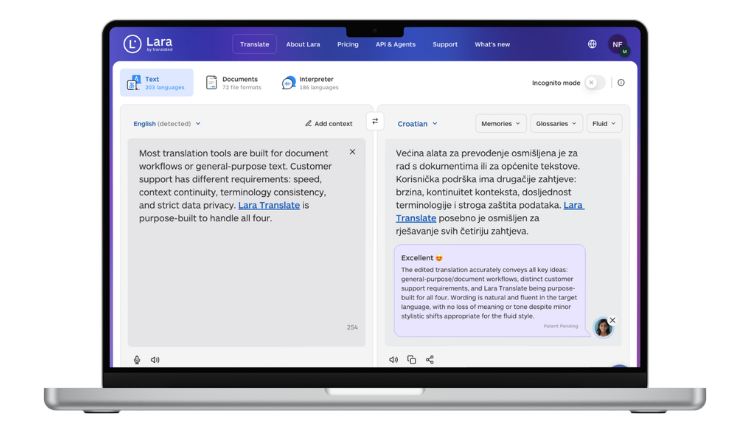
Speed determines whether translation blocks your workflow or enables it. Lara Translate completes 99% of translations in 1.2 seconds. This performance supports both initial translation projects and ongoing content updates as you add products, documentation, or resources. No bottlenecks waiting for translation to finish.
The platform supports 200+ languages through 42,000+ language pairs, covering virtually any market scenario. This breadth solves the common problem where you find translation support for major European languages but not for the regional variants or less common languages your actual markets use.
For teams managing translation as part of content workflows, Lara Translate integrates through APIs and standard protocols. Translation becomes automated deployment rather than manual file management. Updates push through your existing CI/CD pipeline without separate translation processes slowing releases.
Security controls handle sensitive content. Incognito Mode processes confidential translations without data retention, addressing concerns about proprietary content, customer data, or unreleased products going through translation systems.
Customization through glossaries and translation memories maintains consistency. When you have established terminology, technical vocabulary, or specific brand voice requirements, these assets ensure translated content matches your standards across all languages without manually reviewing every translation.
Ready to translate your website?
Test Lara Translate on your web pages and see how it preserves formatting, maintains brand voice, and delivers translations in 1.2 seconds.
Practical implementation: moving from why to how
Understanding why to translate your website only helps if you can actually execute without derailing operations. Translation projects fail most often from poor planning, not from translation quality. Here is what most teams get wrong.
 Start with data, not assumptions. Analytics reveal which countries generate traffic but don’t convert, where users spend time but bounce at checkout, and which markets show growth potential. These insights direct translation resources toward languages offering real returns rather than guessing at priority markets.
Look for specific patterns. High traffic from Brazil with low conversion suggests language barriers. Support tickets in German asking basic product questions signal that documentation needs translation. Sales calls from France that don’t progress past initial interest often indicate prospects can’t evaluate properly in English alone.
Content prioritization prevents overwhelming initial scope. Translating everything simultaneously creates complexity without corresponding value. Begin with high-value pages: homepage, key product descriptions, pricing, and primary conversion paths. Expand systematically based on user behavior rather than trying to translate your entire site at launch.
The mistake most businesses make: trying to achieve complete parity across all languages immediately. This delays launch, inflates budgets, and forces you to maintain massive translation volumes before seeing any return. Better to launch with core pages translated well than with everything translated poorly.
Quality control catches problems before customers see them. While AI translation delivers strong baseline quality, review processes identify terminology drift, cultural disconnects, or technical errors. This becomes critical for customer-facing content, legal text, and technical specifications where errors damage credibility or create liability.
 Set clear review priorities. Legal pages and checkout flows need human review. Blog posts and general documentation can launch with AI translation plus light editing. Product names and branded terms need glossary enforcement to prevent mistranslation.
Maintenance workflows prevent the common problem of partially translated sites. Websites evolve constantly. New products launch, pricing changes, content updates. Workflows that automatically flag new or changed content for translation keep all language versions current rather than letting translations drift out of sync with your English site.
The worst user experience is finding most content translated but key pages still in English. It breaks trust and suggests abandoned market commitment. Automated workflows that trigger translation when English content changes prevent this problem before it happens.
For businesses implementing multilingual SEO strategies, translated content provides the foundation. But SEO extends beyond translation to localized keywords, market-specific backlinks, and regional search optimization. Translation makes content accessible. SEO makes it discoverable.
Measuring success and building competitive advantages
Tracking the right metrics reveals whether translation investments deliver business value, or where gaps need closing.
Traffic metrics by language and region show which translated versions attract visitors and how users discover those pages. Search console data reveals whether translated content ranks for target keywords and generates organic traffic growth over time.
Engagement metrics indicate whether translated content resonates. Time on page, bounce rates, and pages per session show if international visitors find value or immediately leave. Significantly lower engagement in translated versions signals problems requiring attention beyond translation quality alone.
Conversion metrics ultimately determine success. Comparing conversion rates between original and translated content reveals whether translation removes barriers, or whether other factors are preventing conversions. Lower rates in translated versions often point to payment options, shipping, pricing, or trust signals rather than translation quality itself.
Revenue attribution by market segment demonstrates direct impact. When translation enables new market entry, tracking revenue growth in those markets provides clear ROI measurement. For existing international traffic, pre- and post-translation revenue comparison shows conversion improvement from proper localization.
Competitive dynamics favor early movers in most markets. Search rankings in international markets favor established, quality content in local languages. When you establish presence through translated content before markets become saturated, you build authority that later competitors must overcome. That SEO advantage compounds as translated content accumulates backlinks, social proof, and search engine trust.
Customer acquisition costs typically run lower for early entrants who establish organic presence before markets fill with paid competition. Later entrants face higher acquisition costs and steeper challenges earning organic traffic. That timing advantage is real, and it’s finite.
Strategic considerations beyond translation
Website translation is a foundation, not a complete strategy. It enables communication. But successful expansion also demands payment localization, legal compliance, and support in the customer’s language and time zone. These are the gaps that translation alone won’t close.
Payment localization determines whether international orders complete. Supporting local payment methods, currencies, and regional preferences often drives conversion as much as language translation does.
Legal compliance with local regulations affects data privacy, consumer protection, and content requirements. Translated websites operating in Europe must comply with GDPR. Other regions impose different requirements. Translation doesn’t eliminate compliance obligations.
Customer support in local languages and time zones affects satisfaction beyond the website itself. When customers encounter problems, support availability in their language at convenient times directly impacts retention.
These broader considerations don’t diminish translation’s importance. Translation provides the essential foundation that enables everything else. Without translated websites, international customers never engage enough to encounter payment options, compliance requirements, or support needs in the first place.
Thank you for reading 💜
As a thank you, here’s a special coupon just for you: IREADLARA26.
Redeem it and get 10% off Lara PRO for 6 months.
If you already have a Lara account, log in here to apply your coupon.
If you are new to Lara Translate, sign up here and activate your discount.
FAQs
Why translate my website instead of using browser translation?
Browser tools offer basic understanding but damage user experience, SEO, and brand credibility. Professional translation ensures quality, search visibility, and stronger market positioning.
What is the typical ROI timeline?
Initial results usually appear within 30 to 90 days. Full ROI typically develops within 6 to 12 months, depending on market conditions and promotion strategy.
How many languages should I start with?
Begin with 2 to 3 priority languages based on business data, market potential, and competition. Expand gradually to optimize resources and results.
Can AI match human translation quality?
Modern AI can deliver publish-ready quality for most business content. Legal, highly creative, or culturally sensitive materials may still require human review.
How do I maintain translated content over time?
Set up workflows that flag new or updated content for translation. Integrate with your CMS and assign clear responsibilities to ensure consistency.
This article is about
- Why businesses need to translate their websites to access international markets and compete globally rather than limiting themselves to single-language audiences
- The specific benefits of website localization including improved conversion rates, enhanced search visibility, competitive advantages, and user trust building through native language content
- How website translation delivers measurable ROI through new revenue streams, reduced customer acquisition costs, operational efficiencies, and faster market penetration compared to traditional international expansion
- How Lara Translate’s specialized AI translation technology supports business website localization with fast, accurate translations across 200+ languages while maintaining security and enabling customization
- Practical implementation strategies for website translation including market prioritization, content selection, technical considerations, quality control processes, and ongoing maintenance approaches
Have a valuable tool, resource, or insight that could enhance one of our articles?
Submit your suggestion
We’ll be happy to review it and consider it for inclusion to enrich our content for our readers! ✍️
Useful articles
- Managing translation budgets and deadlines with effective time tracking solutions
- Changing translation style: a new way to reach wider audiences