

What is AI human translation? It is a hybrid workflow where Lara Translate produces an instant AI translation, then a professional linguist reviews it to validate accuracy, terminology, and intent for business-critical use.
If you have ever shipped a translation that was “mostly right” but still risky, you already know why this exists. AI gets you speed and scale. Human review adds a final layer of assurance when mistakes are expensive, embarrassing, or legally sensitive.
Short answer
AI human translation means you translate with Lara Translate first, then a professional linguist reviews the output. You keep the speed of AI, and you add human validation for content where wording must be correct, consistent, and defensible.
Why it matters: Most translation risk is not “the whole thing is wrong.” It is one clause, one number, one disclaimer, or one ambiguous term. AI + human translation is designed for those situations where you want the efficiency of AI but still need professional accountability.
TL;DR
|
Need extra assurance on a sensitive translation?
Translate instantly with Lara Translate, then add a professional linguist review for business-critical content where wording must be validated.
What is AI human translation?
AI human translation is a two-layer workflow (often called AI + human translation or AI translation with human review): Lara Translate creates the first draft instantly, then a professional linguist validates it for accuracy, terminology, and intent.
- Layer 1 (AI): Lara Translate generates the translation instantly, using the context and instructions you provide.
- Layer 2 (Human): a professional linguist reviews the output to ensure it is accurate, consistent, and appropriate for the intended use.

How the hybrid translation workflow works
- You provide the input: the text or document, plus source language, target language, and content type.
- Lara Translate translates first: you get speed and scale, with context, style, and terminology controls as the baseline.
- A linguist reviews the translation: focusing on accuracy, terminology consistency, tone, and high-risk phrasing.
- You receive validated output: ready for publishing, filing, sharing, or internal approval.
Tip: If you can, share approved terms, product names, and “must-not-change” phrases. Even a short glossary reduces rework.
What the human review checks
Human review is most valuable where small choices have big consequences. A professional linguist typically checks:
- Terminology and consistency: are key terms translated the same way across the whole text?
- Meaning and nuance: is the intent preserved, not just the literal wording?
- Ambiguity: are there phrases that could be interpreted differently in the target language?
- Style and register: does it sound appropriate for legal, financial, formal, or customer-facing contexts?
- Risk hotspots: disclaimers, obligations, deadlines, numbers, and clauses that must be precise.
AI-only vs AI human translation
AI-only is ideal when you want speed and the stakes are low to medium. AI human translation is for cases where you want speed, but also want the output validated by a professional.
| Scenario | AI-only | AI + human |
| Internal comprehension | Best fit | Usually not needed |
| Customer-facing, brand-sensitive | Often OK, depending on risk | Strong choice |
| Legal, financial, official documents | Risky | Best fit |
When should you choose AI human translation?
Choose AI human translation (AI + human translation) when being “mostly right” is not enough.
- Regulated or contractual content: policies, terms, compliance docs, procurement, HR, legal notices.
- Money and liability: invoices, pricing terms, payment clauses, warranties, penalties.
- High-visibility brand content: homepages, campaign pages, investor updates, executive communications.
- Customer support risk: escalations, refunds, safety instructions, formal complaints.
- Anything that will be filed or audited: official submissions where wording must be defensible.
| Risk level | Examples | Recommendation |
| Low | Internal notes, research, quick comprehension | AI-only |
| Medium | Support macros, help content, product documentation | AI-only or AI + human (depends on impact) |
| High | Contracts, financial terms, official submissions | AI + human |
AI + human translation vs post-editing: what’s the difference?
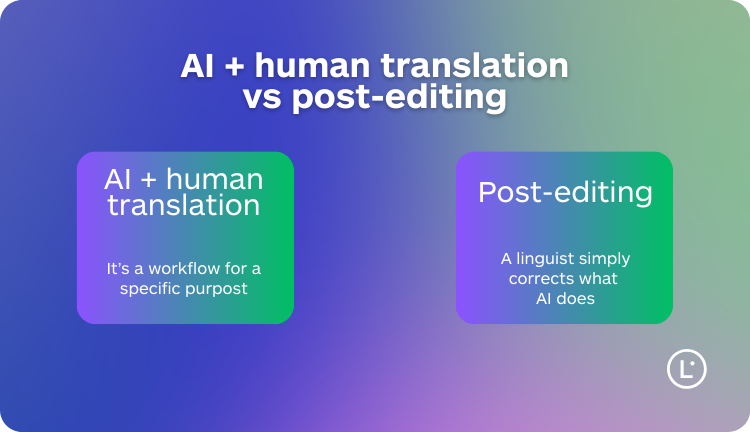
People often use these terms interchangeably. In practice, both mean a professional reviews an AI translation.
- AI + human translation: emphasizes the hybrid workflow as a productized service. AI first, then human validation for a specific purpose (publish, file, share).
- Post-editing: emphasizes the editing step. The linguist edits the AI output to meet a defined quality level.
The important part is the outcome: validated wording, consistent terminology, and reduced risk for the intended use.
How to request AI + Human translation
To start, you typically share:
- Approximate word count or document length
- Source language and target language
- Content type (legal, financial, medical, marketing, technical, other)
If you are using Lara Translate already, you can also share context and preferred terminology to reduce review time and increase consistency:
- Request a human review on top of AI translations
- What context to provide to Lara Translate
- Translation styles (Faithful, Fluid, Creative)
- How glossaries work in Lara Translate
Then you receive a tailored proposal.
Get AI speed, with human validation
If your content is sensitive, official, or business-critical, add a professional linguist review on top of Lara Translate. Share your word count and get a tailored proposal.
FAQ
What is AI human translation?
AI human translation combines Lara Translate’s instant AI translation with a final review by a professional linguist, so the output is validated for its intended use.
Who reviews the translation?
A professional translator with relevant field experience reviews the output, focusing on accuracy, terminology, and risk hotspots.
How do I request AI + human translation?
Share your word count, languages, and content type to receive a tailored proposal. If useful, add context and approved terminology to speed up review.
How is pricing calculated?
Pricing depends on word count, language pair, and complexity. The quickest way to estimate is to share approximate length, languages, and content type.
This article is about:
- Answering what is AI human translation in plain terms.
- Explaining the hybrid workflow: AI first, then professional validation.
- Showing what human review checks: terminology, ambiguity, and risk hotspots.
- Helping you decide when hybrid translation adds real value.