

Reach for a synonym of “phrase” and you hit a wall fast. The thesaurus hands you 49 options, but half of them break the sentence you are trying to fix. The trick is not finding more words. It is knowing which of the eight that actually matter fits the register, the grammar, and the tone in front of you.
The best single-word alternatives, ranked by how often they actually fit: expression, wording, saying, idiom, locution, statement, utterance, and turn of phrase. Thesaurus.com lists 49 related words for this entry alone, but most writers need fewer than eight to cover every real situation.
TL;DR
|
Quick picks by use:
- Expression (neutral noun): the safest all-purpose swap in most sentences
- Wording (neutral noun): use when the focus is on exact word choice or drafting
- Saying (informal noun): fits proverbs, folk wisdom, and quoted speech
- Idiom (neutral/academic noun): correct when the expression is figurative or culture-specific
- Locution (formal/academic noun): preferred in linguistics and grammar writing
- Statement (neutral noun): works when the phrase asserts a fact or position
- Utterance (formal/academic noun): signals spoken language or linguistic analysis
- Turn of phrase (neutral, multi-word): use when praising or describing a clever construction
Pro Tip: Before swapping, identify whether “phrase” is working as a noun (“a memorable phrase”) or a verb (“she phrased it carefully”). Only expression, wording, and utterance can substitute for the verb form; the rest are nouns only.
Grouped alternatives by meaning and register
Not every synonym works in every sentence. Merriam-Webster’s thesaurus separates synonym entries by sense, which is the right instinct. The groups below follow the same logic.
General wording and word choice. These alternatives focus on how something is written or said, not what it means idiomatically. Reach for expression or wording here.
Fixed expressions and idiomatic language. Use idiom or turn of phrase when the phrase carries a meaning beyond its literal words.
Short assertions and statements. When the phrase makes a claim or declares something, statement fits better than “idiom.”
Technical and linguistic terms. Writers working in grammar, translation, or linguistics need more precise vocabulary.
- Locution: formal/academic; Dictionary.com defines it as a particular form of expression or a phrase, especially as used by a particular person or group
- Utterance: signals spoken language and is standard in discourse analysis
WordHippo’s alternative-word list for “phrase” extends these groups further with colloquial options like catchphrase, slogan, and motto for branded or repeated expressions.
How to choose the right alternative in four steps
Swapping one word for another takes seconds. Choosing the right swap takes a structured habit. PracticeMock’s phrase-replacement guides build this habit around a grammar-first sequence, and it transfers directly to everyday editing.
- Identify the grammatical role. Decide whether “phrase” is a noun or a verb in the sentence. This single check eliminates most wrong candidates before you compare meanings, because verb uses rule out noun-only synonyms like locution and saying.
- Check the timeline and tense. A sentence with a past-time marker (“last year,” “in her speech”) rules out future-tense or present-continuous substitutes immediately. PracticeMock’s SBI PO strategy guide calls this the single fastest elimination step in phrase-replacement exercises.
- Match the register to your audience. A linguistics paper wants locution or utterance; a blog post wants saying or expression; a contract wants wording. The right meaning in the wrong register still reads off.
- Test the substitute in the full sentence. Read the whole sentence aloud with the swap in place. Collocation errors and agreement breaks that a word list hides become obvious the moment you hear them.
Pro Tip: Watch for sentences where “phrase” is modified by an adjective like “idiomatic” or “colloquial.” Those modifiers already signal which substitute to use: “idiomatic phrase” becomes simply “idiom,” and “colloquial phrase” becomes “expression” or “saying” depending on whether it is fixed or flexible.
Stuck between two wordings?
Run your sentence through Lara Translate and compare context-aware phrasing alternatives side by side, in English or across 200+ languages.
Which tools help you find more alternatives quickly?
A good thesaurus gives you options. A good workflow tells you which option to use. The tools below serve different parts of that process.
| Tool | Best for | How to use it |
|---|---|---|
| Thesaurus.com | Quick synonym shortlist | Search the word, filter by relevance score |
| Merriam-Webster Thesaurus | Sense-separated synonyms with examples | Read the example sentences, not just the word list |
| Dictionary.com | Definitions and grammatical senses | Check the part-of-speech entries before substituting |
| WordHippo | Broad colloquial and formal options | Use the “in a sentence” feature to test fit |
| Rephrase AI Word Rephraser | Generating a shortlist of 5 to 8 alternatives fast | Paste the full sentence for context-aware results |
| ToolNova One Word Substitution | Replacing multi-word descriptions with one precise word | Enter the description, review the top suggestion in context |
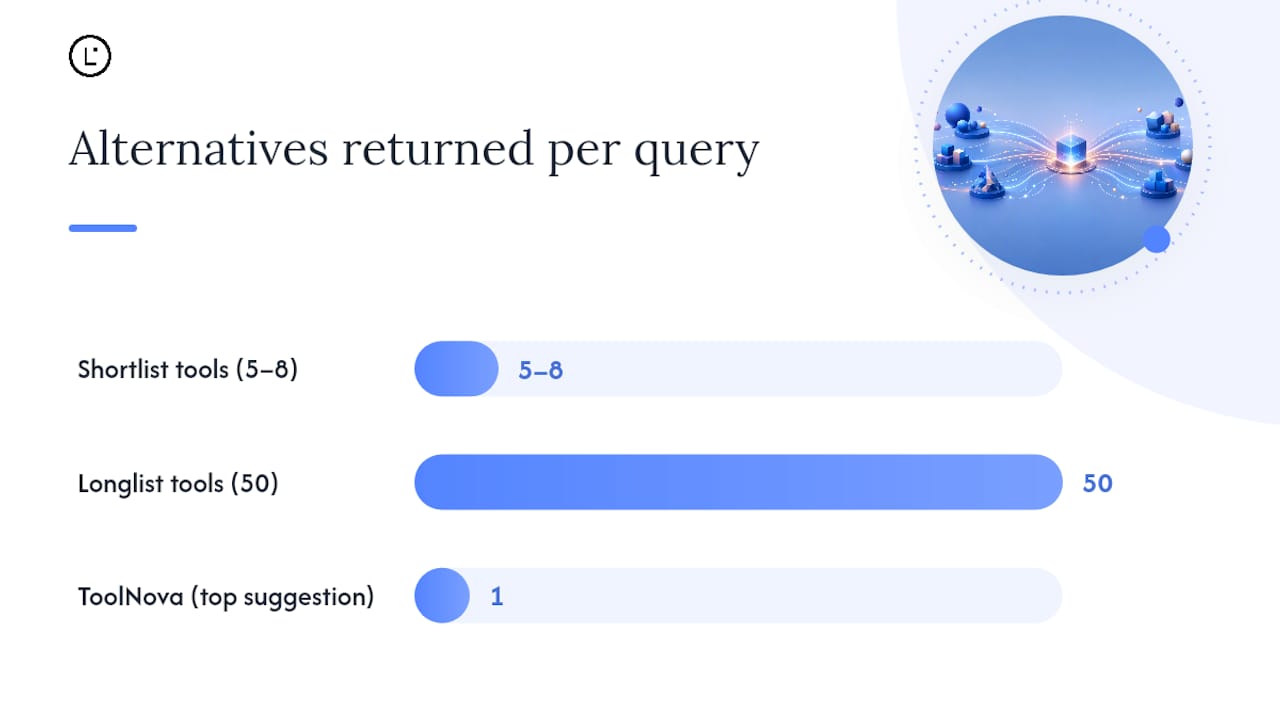
The shortlist method: tools that return 5 to 8 alternatives outperform those that return 50. A long list forces you to evaluate every option; a short, ranked list lets you test and decide in under a minute.
Key Takeaways
The most reliable way to replace “phrase” is to identify its grammatical role first, then match the register to your audience before testing the substitute in the full sentence.
| Point | Details |
|---|---|
| Check noun vs. verb first | Most alternatives are nouns only; verb uses require worded, expressed, or framed. |
| Match register to context | Locution fits linguistics papers; saying fits casual writing; wording fits legal or professional drafts. |
| Use the shortlist method | Tools returning 5 to 8 context-aware options are faster and more accurate than long synonym lists. |
| Test in the full sentence | Read the substituted sentence aloud to catch collocation errors and agreement breaks. |
| Lara Translate for phrasing | Lara Translate’s alternative phrasing suggestions help non-native and native writers find context-aware substitutes with AI and human validation. |
Why synonym sense is a skill worth building deliberately
Most writers treat synonym selection as a lookup task. Find a word, swap it in, move on. That habit produces technically correct sentences that still read wrong, because the word fits the dictionary definition but not the sentence’s register, collocation, or tone.
The writers who develop a genuine synonym sense do something different: they notice why a word feels off before they know what to replace it with. That noticing is a skill, and it builds through deliberate practice rather than passive reading.
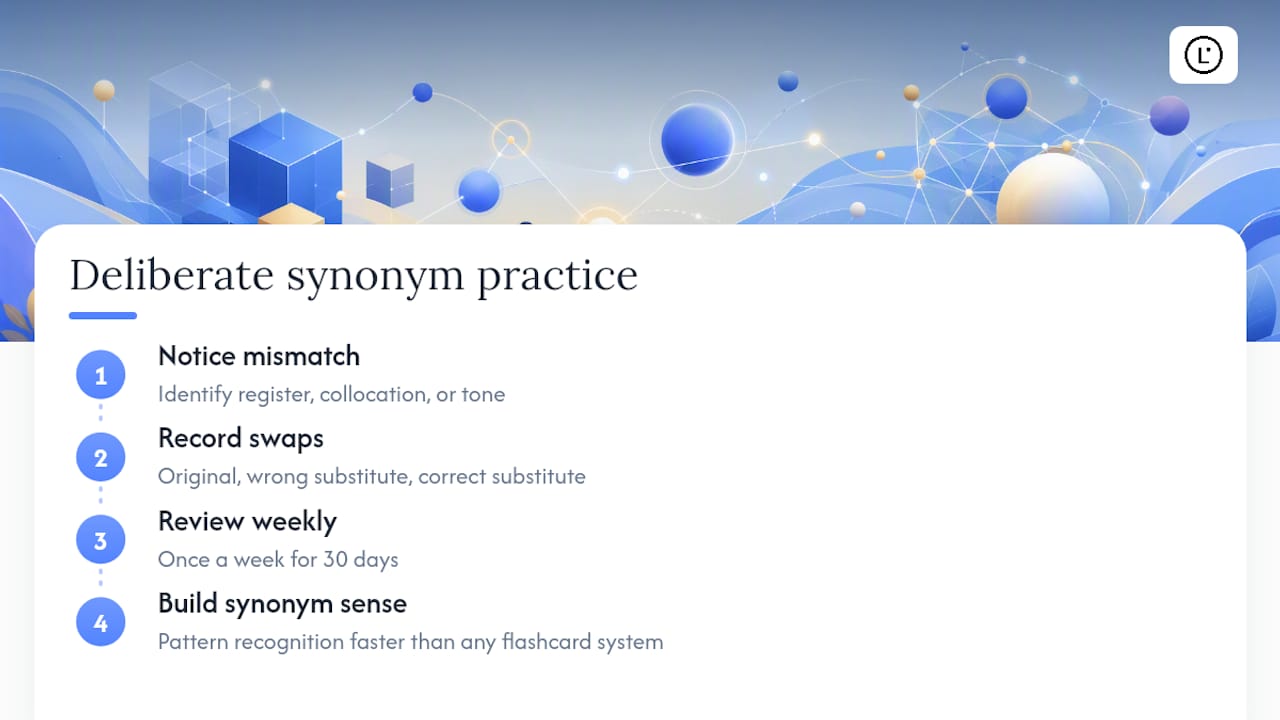
One reproducible habit is worth adopting. Keep a small notebook, digital or paper, dedicated to phrase swaps that gave you trouble. Not a vocabulary list, but a record of the original sentence, the wrong substitute you tried first, and the correct one you landed on. Review that log once a week for 30 days and you build pattern recognition faster than any flashcard system, because the entries come from your own writing and carry real context.
The broader point is that no thesaurus replaces judgment. Merriam-Webster can tell you that locution and expression are both synonyms for phrase. Only you can tell which one belongs in the sentence you are editing.
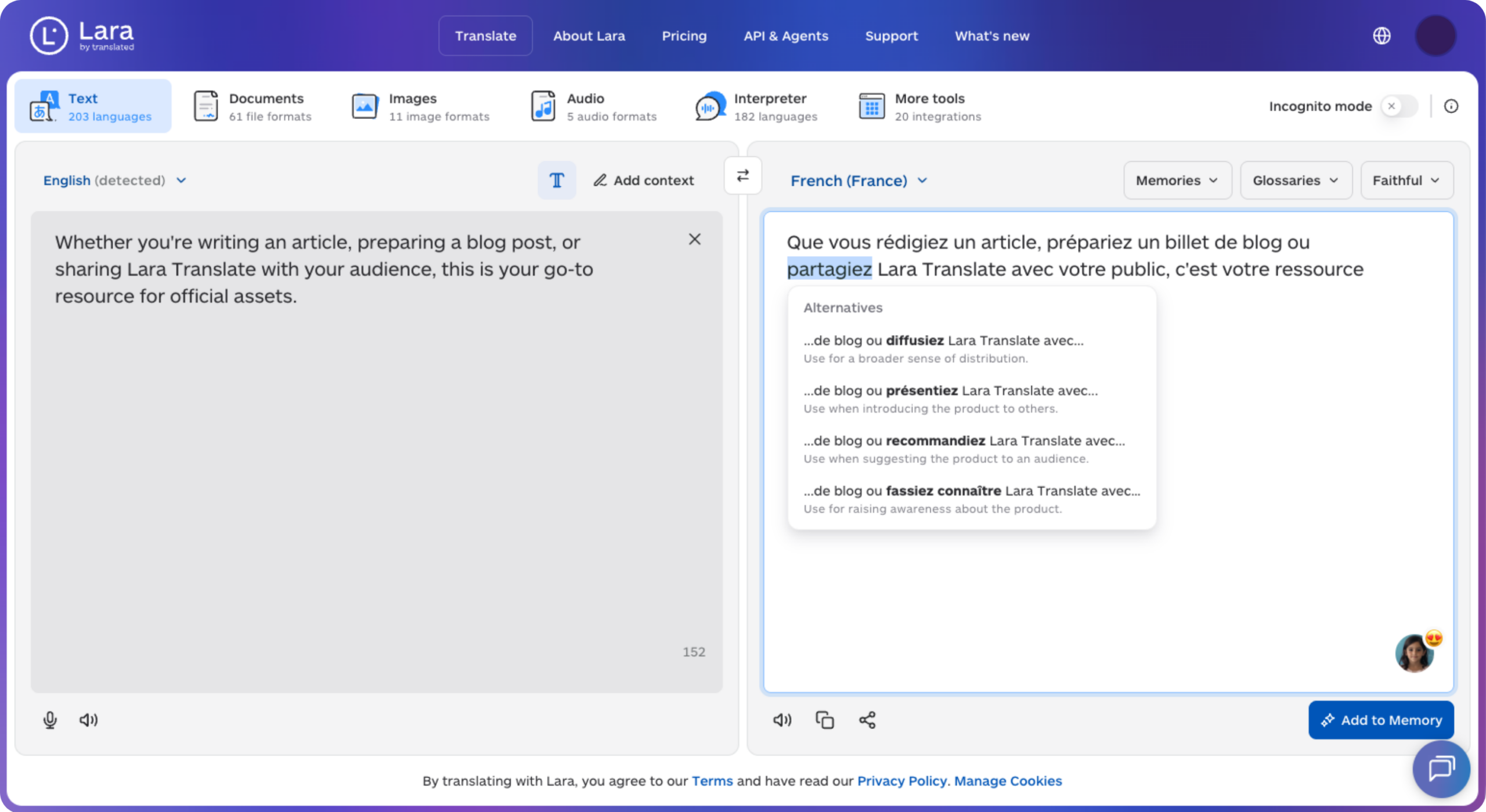
Lara Translate surfaces context-aware phrasing alternatives instantly
Writers working across languages face a sharper version of the synonym problem: the right word in English may have three plausible translations, each with a different register. Lara Translate’s AI and human validation platform addresses this directly by returning alternative phrasing suggestions alongside each translation, so you can compare options and pick the one that preserves your intended tone.
For non-native writers editing in English, or professionals translating documents where wording precision matters, Lara Translate combines machine speed with human review across 200+ languages. The result is a context-aware shortlist rather than a single forced output.
Find the wording that fits
See how Lara Translate surfaces alternative phrasing suggestions on your own text, free and with no sales call.
FAQ
What is a better word for “phrase”?
Expression is the most versatile single-word substitute for “phrase” across registers. For formal or linguistic contexts, locution or utterance are more precise; for casual writing, saying or wording fit naturally.
What are alternative phrases?
Alternative phrases, also called synonymous phrases or phrase substitutes, are words or expressions that can replace “phrase” while preserving the sentence’s meaning. Common options include expression, idiom, saying, wording, statement, and locution, each suited to a different register or grammatical context.
What are similar phrases called in linguistics?
In linguistics, similar phrases sharing meaning or structure are called synonymous expressions or paraphrases. When they are fixed and figurative, they are classified as idioms; when they are grammatically equivalent constructions, they are called parallel constructions or synonymous locutions.
What is a better word for “phrase” when used as a verb?
When “phrase” functions as a verb (as in “she phrased it carefully”), the closest substitutes are worded, expressed, framed, or put. Most noun-form alternatives like locution or saying do not work as verb replacements.
How do I find the right phrase alternative for my context?
Identify the grammatical role (noun or verb), check the sentence’s tense and register, then test the substitute in the full sentence aloud. Tools like Thesaurus.com and Merriam-Webster provide sense-separated options with example sentences to guide the choice.
Useful sources
- PHRASE Synonyms & Antonyms – 49 words | Thesaurus.com
- PHRASES Synonyms: 57 Similar Words | Merriam-Webster Thesaurus
- PHRASE Definition & Meaning – Dictionary.com
- What is another word for phrase? | WordHippo
- Phrase Replacement English Practice Questions with Detailed Solutions – PracticeMock
- Master SBI PO Phrase Replacement Strategy & Tips – PracticeMock
- Free Word Rephraser | Find Better Word Alternatives Online | Rephrase AI
- One Word Substitution, Replace Phrases with Single Words | ToolNova
- Translate to and from English with Lara Translate
- Lara Translate AI: Reliable, Fast, Free
This article is about
Choosing another word for “phrase,” with eight ranked single-word alternatives, grouped by meaning and register, a four-step method for picking the right one, the tools that speed it up, and how Lara Translate surfaces context-aware phrasing suggestions for writers working across languages.
Recommended
- Lara Translate AI: Reliable, Fast, Free
- AI Lara Terjemahan: Andal, Cepat, Gratis
- AI Lara Terjemahan: Boleh Dipercayai, Pantas, Percuma