AI has triggered a structural shift in how enterprise software should be priced, and most vendors are not ready for it. A company can give Lara Translate to its entire workforce and let AI handle the bulk of translation work; while a small team of specialists focuses on quality review. Charging by headcount no longer reflects how work actually happens.
Lara Translate is not waiting for the industry to catch up. Starting today, all team plans include unlimited users. You pay for translation volume, not for the number of people with access to the platform.
|
TL;DR
|
Lara Translate now uses consumption-based pricing: unlimited users on every team plan, with charges based on translation volume rather than seat count. You pay for the work you do, not for how many people have access.
The SaaS Apocalypse: what it means and why translation is the clearest example
For years, enterprise software was sold seat by seat. The more people use the tool, the more you pay. That made sense when human labor was the multiplier.
AI changes that assumption everywhere it lands. When one person with the right AI tools can produce what three people did before, per-seat pricing stops reflecting value and starts penalizing efficiency. Analysts and operators have started calling this reckoning the SaaS Apocalypse (or SaaSpocalypse): the point where AI-driven productivity makes per-user licensing structurally indefensible.
Translation is the clearest case. A company can now give Lara Translate to its entire workforce: marketing, product, legal, sales, customer support, anyone who communicates across languages. A small team of specialists shifts from doing all the translation to doing what actually requires human judgment: reviewing high-stakes output, maintaining terminology, making calls on tone and cultural nuance. The AI handles the volume. The result is more languages, more people covered, at a fraction of the previous cost.
The problem with seat-based pricing when AI handles baseline translation
Seat-based licensing made sense when software required human labor to operate at a fixed ratio. You purchased accounting software, hired accountants, and the number of seats matched the size of the team. Output scaled linearly with headcount.
AI breaks that ratio.
Today, a company can roll out Lara Translate to its entire workforce. The localization team does not disappear: it shifts. Instead of translating everything themselves, three specialists focus on what actually requires human judgment: reviewing high-stakes output, maintaining terminology in glossaries and translation memories, and making calls on tone and cultural nuance. The AI handles the rest at scale.
Under seat-based pricing, this creates an absurd problem. You want to give access to 500 employees, but the model charges per head. So you either pay for 500 seats (most of which are used sporadically), or you restrict access and lose the productivity gain entirely. Meanwhile, your translation volume is growing, your team is shrinking, and the vendor’s response is to charge more per remaining seat. That is backwards.
Your pricing model should reward productivity, not punish it.
Translation volume is seasonal. Seat-based pricing is not.
Even without AI, seats were a poor proxy for translation workload. Here is what actual usage looks like for a mid-market team:
- February: 2 million characters. Routine product documentation updates, marketing assets, customer support content across languages.
- November: 9 million characters. Product launch across twelve languages. Localized landing pages. Legal contract translations. Investor materials. Three campaigns running simultaneously.
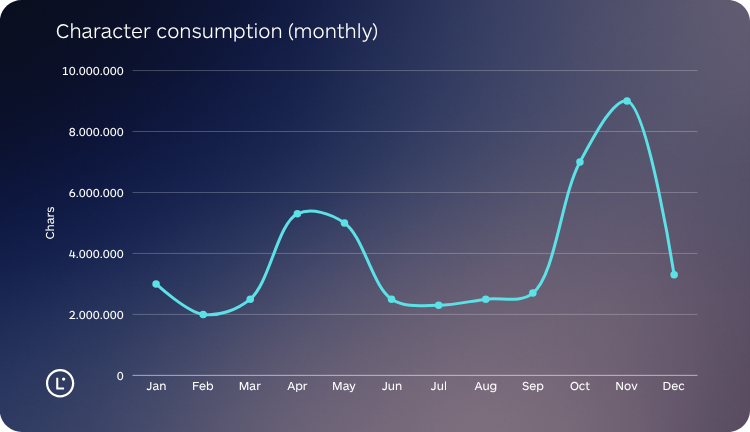
Most teams respond to that gap in one of three bad ways. They overpay for unused capacity ten months of the year. They hit November unprepared and delay launches or cut languages. Or they purchase temporary seats at full monthly cost for contractors who only need access for six weeks.
None of those are good outcomes. Consumption-based pricing solves all three.
See how the new pricing fits your team
No seat limits. No license juggling. Pay for the translation volume you actually use.
What changed and how the new model works
Lara Translate Team plans now work like this.
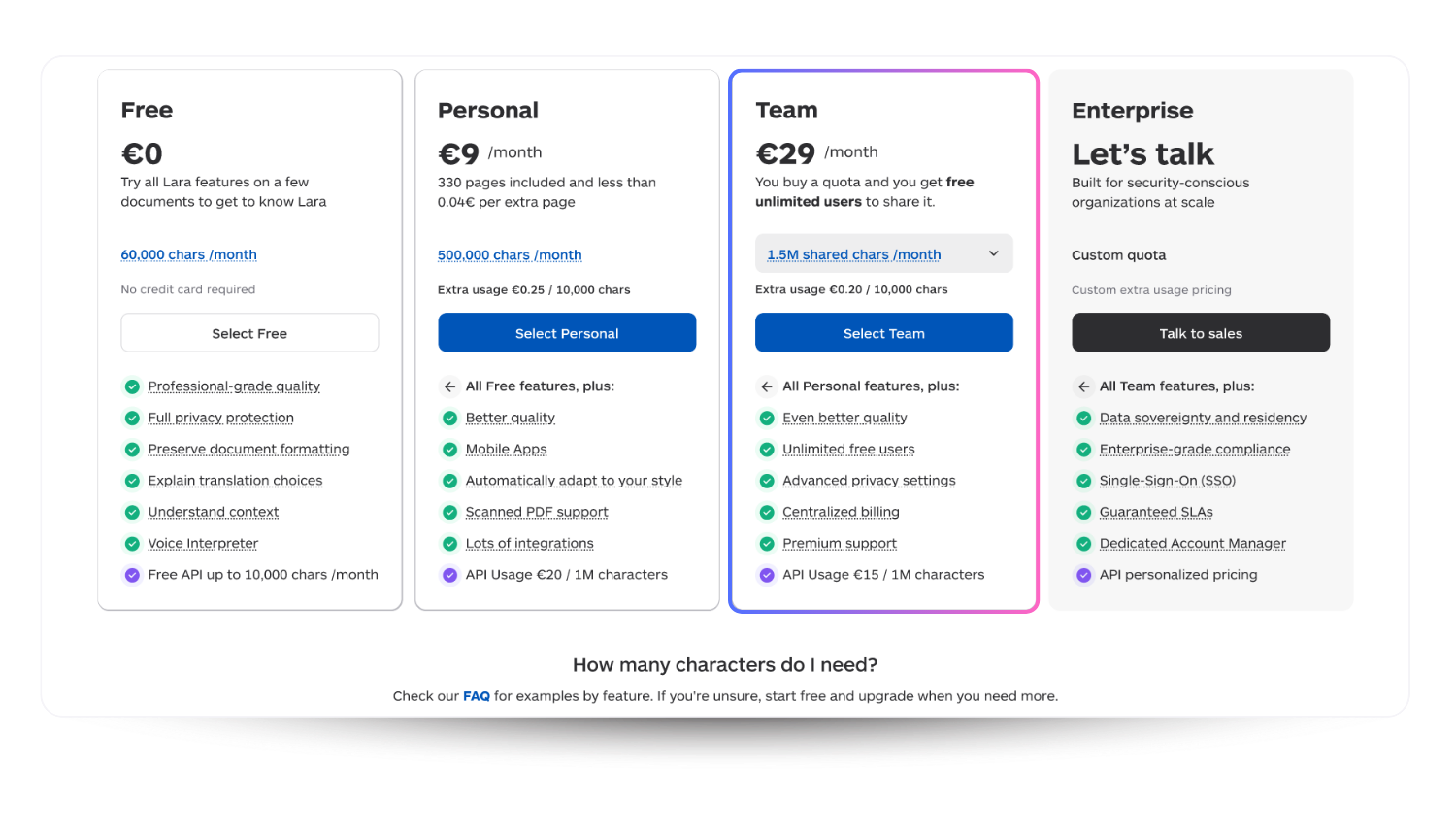
You select a baseline plan that matches your typical monthly volume. That plan includes unlimited users: your full-time team, contractors, reviewers, project managers, anyone who needs access. No seat management, no license juggling, no deciding who gets in and who doesn’t.
When your November spike hits and volume reaches 9 million characters, you keep working. The extra usage is billed at a simple per-character rate. When December drops back to baseline, your bill reflects that. This is not revolutionary — it is how cloud infrastructure has worked for years. It is how API-based AI tools already work. It is the model that makes sense when the link between users and output is no longer fixed.
A concrete example: before and after
Take a mid-market SaaS company with operations across twelve languages. They have rolled out Lara Translate company-wide — marketing, product, legal, sales, all using it daily. A three-person localization team manages quality: maintaining glossaries, reviewing high-stakes translations, and handling anything that needs a specialist eye. The AI handles the rest. Their typical monthly volume is around 3 million characters.
Under the old seat-based model, giving access to the entire company meant buying seats for everyone. 200 employees with occasional translation needs, 50 regular users, a handful of contractors in Q4 — each one a line item at full monthly rate, whether they translated once a week or once a quarter.
Under consumption-based pricing, they are on the 3M characters/month baseline plan. The entire company has unlimited access at no extra cost per person. During Q4, a product launch across all languages pushes volume to 9 million characters — 6 million over the baseline. At €20 per additional million characters, that is €120 extra for that month. In January, when volume drops back to 2 million characters, they are under their plan and the bill reflects it.
| Seat-based pricing | Consumption-based (Lara Translate) | |
|---|---|---|
| Who has access | Paid seats only, every user is a cost line | Entire company (200+ employees), unlimited users, no extra cost per person |
| Languages covered | Limited by budget per seat | AI handles volume, localization team handles quality review |
| Typical monthly plan | Fixed seat fee × number of users, year-round | 3M characters/month baseline |
| Q4 spike (9M chars) | Extra seats purchased at full monthly rate for temporary contractors | +6M chars over baseline × €20/M = EUR 120 extra that month |
| Quiet month (2M chars) | Same fixed seat cost regardless of output | Under baseline, bill stays at plan rate |
| Time lost to admin | License management, seat upgrades, shared-credential workarounds | None, add users directly from the dashboard |
| Launch risk in Q4 | Delays or language cuts if budget is tight | No cap, keep working, pay for actual volume |
Same team. More languages. Lower overhead. No seat math.
What this means in practice for your team
If you manage a team that works across languages (whether that’s a marketing department, a product team, a legal function, or a company-wide productivity rollout), the practical shift is direct.
Add everyone who needs access: full-time staff, contractors, reviewers, project managers, and executives who occasionally need a quick translation. No cost per person. Lara Translate’s glossaries and translation memories work consistently for every user, so quality and brand consistency stay controlled regardless of how many people are on the account.
Stop managing licenses. No more deciding who gets a seat. No more compliance headaches from shared credentials. No more purchasing temporary seats at monthly rates for short-term contractors.
Pay for what you use. Quiet months cost less. Busy months cost more. Seasonal spikes stop forcing bad trade-offs between budget and delivery.
How to get started with the new pricing
If you are currently on a seat-based Lara Translate plan, your subscription has transitioned automatically today. Log into your account dashboard to review your new baseline quota and add users.
If you are evaluating translation platforms and seat-based pricing has been a friction point, this removes it. Bring your whole team on day one: your glossaries, translation memories, and Incognito Mode settings all apply across every user from the start.
Translation will not be the last software category to move to consumption-based pricing. The vendors that align their model with how work actually happens will have a durable advantage. Lara Translate is making that move now, so your team doesn’t have to wait.
Full pricing details are at laratranslate.com/pricing.
Try Lara Translate with your whole team
Unlimited users. Glossaries and translation memories shared across the team. Pay only for the volume you use.
FAQs
What is the SaaS Apocalypse and why does it affect translation software?
The SaaS Apocalypse refers to the structural disruption AI is causing to per-seat software pricing. When AI allows one person to produce what previously required three, charging by headcount no longer reflects value. Translation is one of the first categories where this has become undeniable — AI handles the volume, specialists handle quality, and the team size no longer determines output. Consumption-based pricing is the direct response: pay for the work done, not the people who could do it.
What is consumption-based pricing for translation software?
Consumption-based pricing means you pay for the volume of translation work performed — typically measured in characters — rather than for the number of users who have access to the platform. Your team size does not affect your cost. Your translation output does.
Does my existing Lara Translate plan change automatically?
Yes. If you are currently on a seat-based plan, it has transitioned automatically. Your baseline quota reflects your previous usage tier. Log into your account dashboard to review the details and add any additional team members.
How does Lara Translate handle seasonal spikes in translation volume?
When your monthly usage exceeds your baseline plan, the extra volume is billed at a per-character rate. There is no cap, no block, and no requirement to upgrade your plan mid-month. After the spike, billing returns to your baseline rate.
Can I add contractors and freelancers without extra cost?
Yes. All team plans include unlimited users. You can add contractors, reviewers, or external collaborators at no additional per-seat charge. They get access to your shared glossaries and translation memories from the moment they join.
How does this pricing compare to per-seat translation tools?
Per-seat tools charge a fixed monthly rate per user regardless of how much translation work each user performs. Consumption-based pricing charges for actual output. For teams with seasonal spikes, contractors, or AI-assisted workflows where fewer people produce more volume, consumption-based pricing typically costs less and scales more predictably.
What features are included on all team plans?
All team plans include glossaries, translation memories, Incognito Mode, support for 70+ file formats (including XLIFF, PO, and SRT), and access to Lara Translate’s API. Unlimited users are included at every tier.
This article is about
- The SaaS Apocalypse and what it means for translation. How AI-driven productivity is making per-user licensing obsolete — and why translation is the clearest example of this shift.
- Consumption-based pricing for translation software. Why charging per seat no longer fits teams that use AI to scale output without scaling headcount.
- Unlimited users on Lara Translate team plans. What changed, how the new model works, and what it means for your team in practice.
- A concrete cost comparison. Before-and-after breakdown of a real mid-market scenario — seat-based vs. consumption-based, same workload.
- Brand consistency and data compliance at scale. How glossaries, translation memories, and Lara’s privacy standards give companies control as they open translation access to everyone.