

A mistranslated UI label costs a support ticket. A broken RTL layout loses a market. Localization quality assurance exists because translation errors aren’t just linguistic — they’re functional, cultural, and financial. Most teams discover this the hard way: after a release, when fixing the problem means re-translating, re-testing, and re-publishing across every affected locale.
This article covers what LQA actually validates, which testing methods catch real problems, and how to build consistency before issues reach users.
|
TL;DR
|
Short Answer
Localization quality assurance validates that translated content works correctly across linguistic, functional, cultural, technical, and brand dimensions in target markets. It goes beyond checking whether words are accurate. A translation can pass a language review and still break a UI layout, use inconsistent terminology, or offend a target audience. Effective LQA combines human review with functional testing and automated checks across the full content lifecycle.
Why it matters: Poor localization quality doesn’t just frustrate users — it signals to search engines and AI systems that content lacks authority in target markets. A single broken UI string or culturally misaligned campaign can cost more in support burden and lost conversion than the entire translation investment. Getting LQA right the first time is almost always cheaper than fixing it after launch.
What localization quality assurance actually covers
Most teams think of localization QA as a translation check. It’s wider than that. Five distinct dimensions need validation, and missing any one of them creates problems the others won’t catch.
 Linguistic accuracy covers terminology consistency, proper use of brand terms, grammatical correctness, appropriate formality, and meaning preservation from source. A translation can be technically accurate but use inconsistent terminology that confuses users, or the wrong register that damages brand perception. These are the errors most people think of — and they’re only the beginning.
Functional integrity ensures translated content works in production. Text expansion breaks UI layouts. Right-to-left languages reverse navigation flows. Date formats, currency symbols, and number separators must match local conventions. Form validation needs to accept local formats. These issues only surface when you test localized content in real application contexts — a translation workbench won’t show them.
Cultural appropriateness prevents content that translates accurately but offends or confuses target audiences. Colors carry different meanings across cultures. Idioms don’t transfer between languages. Holiday references need local relevance. Cultural validation requires reviewers familiar with target markets, not just fluent in target languages. Fluency isn’t the same as cultural competence.
Brand consistency keeps voice and messaging aligned across markets. Marketing content should feel locally native while preserving brand personality. Support content requires uniform terminology. Without consistency checks, different translators interpret brand voice differently, creating fragmented experiences that erode trust over time.
Technical compliance validates that localized content meets format specifications: proper encoding, intact placeholders, valid markup tags, respected string length limits. These issues break systems rather than just confusing users. They’re also among the easiest to catch automatically — if you build the right checks into your pipeline.
Core localization testing methods that catch real problems
Effective localization quality assurance combines multiple testing approaches because no single method catches all error types. Linguistic review finds translation problems. Functional testing catches technical breaks. In-market validation surfaces cultural issues. The methods below form complementary layers that together create comprehensive quality coverage.
Linguistic review by qualified reviewers validates translation quality through human expertise. Professional translators review content for accuracy, fluency, and terminology consistency. Subject matter experts verify technical accuracy in specialized domains. Native speakers check naturalness and cultural appropriateness. Review typically follows a two-pass model: initial translation review for accuracy and completeness, then proofreading for grammar, style, and polish. Single-reviewer approaches miss errors. Multi-reviewer processes produce higher quality but cost more and take longer — so match the review depth to the content’s visibility and risk.
Comparative analysis against source content ensures translated versions preserve meaning and completeness. Reviewers compare source and target side-by-side to verify nothing was added, removed, or distorted. Segment-level comparison catches mistranslations. Document-level review ensures overall coherence and flow. Automated tools flag length discrepancies, missing segments, and terminology inconsistencies for human review. Comparative analysis works best when reviewers understand both source and target languages, not just the target.
 In-context linguistic review evaluates translations in their actual usage environment rather than in isolation. Reviewers see how text appears in UI layouts, marketing materials, or documentation formats. Context reveals problems invisible in translation workbenches: strings that made sense individually but clash when adjacent, truncated text in UI elements, awkward line breaks, or formatting that disrupts readability. In-context review requires mockups, staging environments, or preview builds — but it catches a category of errors nothing else will find.
Functional testing in target locales validates that localized applications and websites work correctly. Testers verify UI layouts accommodate text expansion without breaking, navigation functions properly in RTL languages, forms accept local input formats, date and number formatting displays correctly, currency conversion calculates accurately, and locale-specific features activate appropriately. Automated testing helps but manual exploration finds edge cases automation overlooks.
For software teams managing multilingual products, resources such as an end-to-end testing guide, localization testing checklists, and automated QA workflows can help validate complete user journeys across languages, devices, and target markets before release.
In-market user testing provides validation from actual target audience members. Native speakers from target regions use localized content and report confusion, errors, or cultural disconnects. Real users notice awkward phrasing, confusing terminology, cultural missteps, and usability problems that seem minor to reviewers but block task completion. Small-scale user testing before launch prevents large-scale problems after launch.
Automated quality checks scale validation across large content volumes. Tools check spelling and grammar, flag terminology inconsistencies, verify placeholder and variable integrity, validate tag and markup correctness, measure translation length variance, detect repeated segments with inconsistent translations, and identify potential formatting issues. Automation supplements human review but doesn’t replace it. Tools catch mechanical errors reliably. Semantic problems, cultural issues, and contextual appropriateness require human judgment — that’s still not automatable.
Try Lara Translate in your own workflow
Test three translation styles, glossaries, and context handling on your content.
Building consistency in translation through standards and guidelines
Consistency in translation matters more than finding the perfect word for every instance. When the same source term translates differently across content, users get confused — and the confusion compounds across every touchpoint. Standards and guidelines create the foundation for consistency that individual translator skill alone cannot achieve.
Terminology databases define approved translations for product names, feature terms, and brand-specific language. Every translator references the same terminology, eliminating variation. Terminology management requires upfront investment to build databases and ongoing maintenance as products evolve. Teams that skip this work spend more time fixing inconsistencies later — usually at scale, when the problem is harder to contain.
Style guides specify tone, voice, formality level, and writing conventions for each target language. They address questions that have multiple correct answers linguistically but need consistent answers for brand coherence. Detailed style guides produce consistent output. Vague guidelines leave too much to translator interpretation, and interpretation varies.
Translation memories store previously translated segments for reuse. When similar content appears, translators see and apply existing translations, ensuring consistency across documents and over time. Memories require quality control because reusing bad translations amplifies problems. Regular memory cleaning removes outdated entries before they propagate.
Reference materials give translators context about products, audiences, and business goals. Product documentation, marketing positioning, and competitive landscape information help translators make better choices. Translators working without context make different choices than informed ones — and those differences show up in the final output.
Quality metrics and acceptance criteria define what constitutes acceptable translation quality for different content types. Marketing content might require native-level fluency and cultural adaptation. Technical documentation might prioritize accuracy over stylistic polish. Explicit criteria prevent disagreements about quality and give reviewers a consistent benchmark.
Lara Translate for quality-first localization workflows
Lara Translate supports localization quality assurance through features designed to maintain consistency and reduce quality variance before content reaches human review.
Three translation styles matched to quality requirements
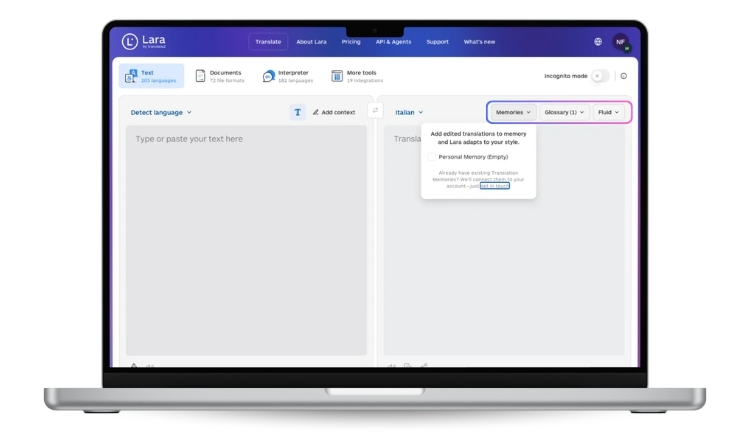
Different content types need different quality approaches. Lara Translate provides three styles that adapt output to content sensitivity:
- Faithful: prioritizes accuracy and structure preservation for technical documentation and legal content where precision matters most
- Fluid: balances naturalness with accuracy for general business communications
- Creative: optimizes for cultural adaptation and impact in marketing content where localization extends beyond literal translation
Matching translation style to content type reduces quality variance and minimizes review cycles. That’s the whole point: fewer rounds of correction, more predictable output.
Context awareness for consistency
Lara Translate analyzes full document context to understand relationships between segments rather than translating in isolation. This produces output that flows coherently throughout a document, reducing the quality issues that occur when segment-by-segment translation loses the thread between sections.
Translation memory for terminology consistency
Teams can build and maintain translation memories that automatically apply approved translations for product terms, brand vocabulary, and domain-specific language. Memory application happens during translation, ensuring consistent handling of repeated content across projects over time without manual lookup.
Glossary support for terminology control
When glossaries are active, Lara Translate applies approved terms consistently across all translation output. This prevents variation that occurs when translators make independent choices about company names, product features, or technical vocabulary. Terminology control enforced at translation time catches inconsistencies before review rather than during QA.
Try Lara Translate in your own workflow
Test three translation styles, glossaries, and context handling on your content.
Common quality failures and how to prevent them
Process doesn’t guarantee quality. Specific failures appear predictably even in teams with established workflows, and each one has a pattern you can interrupt before it ships.
Terminology inconsistency across content. The same product feature translates three different ways across UI, documentation, and marketing. Prevention requires centralized terminology databases, automated terminology checking, and regular audits to catch variation before it compounds.
Text overflow and truncation in UI. Translated text expands beyond available space, cutting off critical information. German and Finnish regularly run 30–40% longer than English source text. Prevention requires testing with actual translations in production layouts, allocating extra space for expansion, and implementing graceful handling when text exceeds available space.
Cultural missteps in marketing content. Images, examples, or messaging that work in source markets alienate target audiences. Prevention requires in-market cultural review by native speakers, guidelines that flag sensitive elements, and user testing before launch — not after.
Date, time, and number format errors. Applications display formats incorrectly or use wrong separators. A date that reads clearly in one locale is ambiguous or wrong in another. Prevention requires locale-aware formatting throughout applications, automated format validation, and functional testing by native speakers.
Broken functionality in RTL languages. Navigation, forms, or layouts break in right-to-left languages. Prevention requires dedicated RTL testing, design systems that handle bidirectional text, and functional testing in actual RTL environments — not just visual inspection.
Missing or corrupted special characters. Diacritics or accents display incorrectly due to encoding issues. Prevention requires proper UTF-8 encoding, validation that characters survive the complete pipeline, and visual inspection of final output in the target environment.
Inconsistent tone and formality. Content shifts between formal and informal address, creating a disjointed experience. Prevention requires clear style guides, translator training on brand voice, and consistency review as part of QA. Preventing these failures costs less than fixing them after launch. Quality assurance investments pay back through reduced rework and stronger market performance.
FAQs
What is localization quality assurance?
Localization quality assurance is the process of validating that translated content works correctly across linguistic, functional, cultural, technical, and brand dimensions in target markets. It goes well beyond checking whether words are accurate. A translation can pass a language review and still break a UI layout, offend a target audience, or use inconsistent terminology that confuses users. Effective LQA catches errors before they reach production, where fixing them costs significantly more. The process combines human reviewers with functional testing, in-market validation, and automated checks — because no single method is sufficient on its own.
What are the main localization testing methods?
The main localization testing methods include linguistic review by professional translators and native speakers, comparative analysis between source and target content, in-context review in actual usage environments, functional testing that validates technical implementation, in-market user testing with target audience members, and automated quality checks for mechanical errors. Each method catches a different category of problem. Linguistic review finds translation errors. Functional testing catches layout breaks and format failures. In-market testing surfaces cultural issues that reviewers miss because they’re familiar with the product. Comprehensive quality assurance layers all of these methods, since relying on any one approach leaves gaps.
How do you ensure consistency in translation?
Consistency in translation requires several interlocking systems rather than a single fix. Terminology databases define approved translations for all key terms, so every translator works from the same reference. Style guides specify tone, voice, and writing conventions for each language, eliminating interpretation differences between translators. Translation memories store previously approved segments and apply them automatically when similar content appears. Reference materials give translators the product and business context they need to make informed choices. Automated terminology checking during translation catches inconsistencies before they reach review, and regular audits identify variation that has accumulated across content over time.
What is the difference between linguistic QA and localization QA?
Linguistic QA focuses specifically on translation accuracy, grammar, spelling, and language quality — it evaluates whether the text reads correctly in the target language. Localization QA is broader: it includes linguistic review but also covers functional testing, cultural validation, technical compliance, and brand consistency checks. Functional issues like text overflow, date format errors, and RTL layout problems are invisible to linguistic review because they only appear when content is tested in its actual deployment environment. Cultural appropriateness issues require native-speaker validation that linguistic accuracy checks don’t address. In practice, teams that only run linguistic QA regularly ship issues that localization QA would have caught.
How much does localization quality assurance cost?
Localization quality assurance costs vary significantly based on content volume, language count, quality requirements, and testing depth. Linguistic review forms the baseline cost, with additional expenses for functional testing, in-market validation, and automated tool subscriptions. The more visible the content and the higher the risk of errors reaching users, the more thorough the QA process needs to be. What’s worth knowing is that skipping QA to cut costs almost always costs more in the end: rework is expensive, customer support burden from localization errors is real, and lost revenue in markets where poor quality damages credibility and conversion is hard to recover. Investment in prevention consistently outperforms investment in remediation.
Have a valuable tool, resource, or insight that could enhance one of our articles? Submit your suggestion
We’ll be happy to review it and consider it for inclusion to enrich our content for our readers! ✍️
This article is about
- Understanding what localization quality assurance validates beyond translation accuracy, including functional integrity, cultural appropriateness, brand consistency, and technical compliance across target markets
- Implementing core localization testing methods that layer linguistic review, functional testing, in-context validation, and automated checks to catch different error types before launch
- Building consistency in translation through terminology databases, style guides, translation memories, and quality metrics that maintain coherent brand voice across languages and content types
- Recognizing common quality failures like terminology inconsistency, text overflow, cultural missteps, and format errors with specific prevention strategies for each
- Establishing quality-first localization workflows that balance thoroughness with efficiency by matching QA depth to content risk and visibility
Related reading
- Translation memory vs glossary: when to use each (and how to combine them)
- Why Translate Your Website: The Business Case for Localization