

Lara Translate vs ChatGPT for translation is not a debate about who can write nicer sentences. It is a question of reliability under real business constraints: terminology that cannot drift, tone that must stay consistent, formatting that must survive, and edge cases that cannot turn into confident nonsense.
That is where a Domain-Specific Language Model (DSLM) approach beats using a general-purpose LLM directly, otherwise known as GenAI. Lara Translate is built translation-first and workflow-first, so teams can standardize quality instead of relying on “prompt luck”.
|
TL;DR
|
Why it matters
In enterprise translation workflow reality, “mostly correct” becomes expensive fast: rework, terminology drift, inconsistent brand voice, and broken documents that someone has to fix manually. A DSLM approach reduces those failure modes by design because it prioritizes predictable output and repeatable controls, not prompt artistry.
What is a DSLM in translation, and is Lara Translate a DSLM?
Definition: In translation, a Domain-Specific Language Model (DSLM) is a language model optimized for translation workflows, not general text generation. It prioritizes meaning fidelity, terminology compliance, consistent style, and predictable output, with low-hallucination behavior and production latency.
Is Lara Translate a DSLM? Lara Translate behaves like a DSLM in practice because it is built for translation-first reliability and workflow controls, and its docs describe adaptive translation that uses context or previously translated content while combining LLM-level fluency with low hallucination rate and MT latency.
Lara Translate vs ChatGPT for translation: what changes in production
Most teams do not fail at multilingual because they chose the “wrong words.” They fail because their workflow cannot guarantee consistency across people, documents, and time.
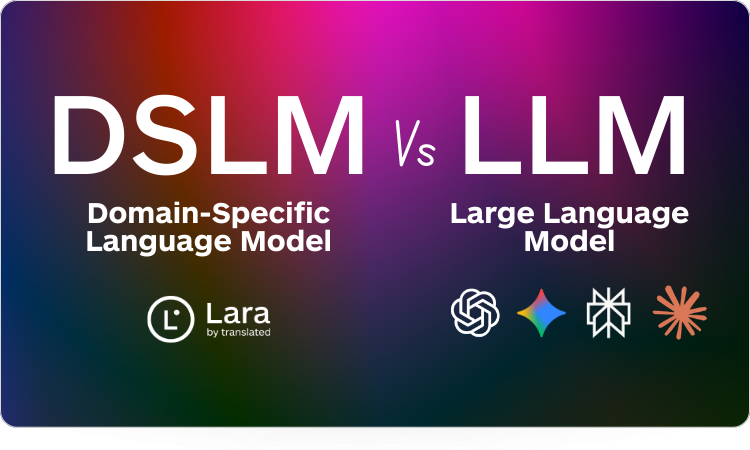
Here is the practical difference between using a general-purpose LLM directly and using a DSLM-style translation system.
| What matters | General LLM used directly (eg. ChatGPT, Gemini, Claude, DeepSeek…) | DSLM approach with Lara Translate |
|---|---|---|
| Terminology control | Possible, but prompt-dependent and fragile | Workflow controls like glossaries and translation memories support consistent wording |
| Context-aware AI translation | Depends on what a user pastes and how they prompt | Docs describe adaptive translation using context or previously translated content |
| Hallucination risk | Can be unpredictable, especially under ambiguity | Docs describe combining LLM capabilities with a low hallucination rate and MT latency |
| Style consistency | Varies across users and prompts | Style modes help standardize output for different content types |
| Enterprise translation workflow | Hard to govern across teams | Designed for repeatable workflows across documents, teams, and integrations |
Proof: what Lara Translate’s first-party docs say (and why it maps to a DSLM)
If you want a safe, credible “proof section,” anchor it to what Lara Translate documents explicitly state. These are the translation-first capabilities that align with a DSLM approach:
- Adaptive translation: Lara Translate is described as an adaptive translation AI that can adjust on the fly to a domain.
- Leverages context and previously translated content: The docs describe using context or previously translated content to adapt to domain conventions, which supports terminology consistency and reuse.
- Low hallucination rate plus MT latency: The docs position Lara as combining LLM-level fluency and reasoning with low hallucination rate and the latency profile of machine translation, which is critical for scale.
- Project assets for control: In production, teams need controls that outlive a single prompt. Lara Translate supports translation workflow assets like glossaries, translation memories, and style guidance so output can be standardized across users and teams.
Source: Developer docs
Key takeaway: this is the DSLM mindset applied to translation: optimize the system for reliability, reuse, and governance, not for open-ended generation.
Why Lara Translate is a DSLM in practice?
1) It is purpose-built for translation, not general text generation
 General LLMs are trained to be helpful across everything: poems, recipes, code, history, advice.
Lara Translate is engineered around translation quality and translation workflows:
-
It analyzes the full text/document for consistency and flow.
-
It supports professional controls like styles, glossaries, and translation memories.
-
It is designed for both text and document translation, including preserving layout and handling many file types.
That scope is narrower than a general LLM, and that is a strength for production translation.
2) It adapts to domain without you “retraining a chatbot”
 In real companies, domain needs change by team and by document type: legal today, support tickets tomorrow, product UI next week.
Lara Translate is adaptive, meaning it can adjust to a domain using context or previously translated content, without requiring training or retraining.
This aligns with how translation teams actually work: you do not want a model that “sounds smart”, you want one that locks onto your conventions quickly.
3) It is designed to reduce hallucinations where hallucinations are unacceptable
 For translation, a hallucination is not a funny mistake. It can be:
-
a compliance issue
-
a product misrepresentation
-
a contractual change
-
a support escalation
Lara Translate’s docs explicitly emphasize combining LLM capabilities with the low hallucination rate of MT.
And the product positioning highlights transparency features, including explaining choices and flagging ambiguity.
4) It builds control into the UI, not only into prompts
 Prompting is fragile. Two users write two different prompts and you get two different “brands”.
Lara Translate bakes control into the workflow:
-
Three translation styles (Fluid, Faithful, Creative) to match content intent.
-
Glossaries to enforce approved terminology.
-
Translation memories as a first-class feature, not an afterthought.
This is the difference between “a model that can translate” and “a translation system you can standardize across a company”.
1-minute decision table: when to use a general LLM vs a DSLM workflow
| Your content | What you optimize for | Best default |
|---|---|---|
| Internal drafts, low-risk notes | Speed and convenience | General LLM can be fine |
| Marketing pages, brand voice copy | Consistent tone and message | DSLM workflow with style controls |
| Product UI strings, help center, support macros | Terminology, consistency, reuse | Context-aware AI translation + glossaries/TMs |
| Legal, compliance, contracts, regulated docs | Lowest risk of meaning drift | DSLM workflow plus human review when required |
In conclusion, why does Lara Translate beat a generic LLM for production translation?
If you are choosing between Lara Translate and a generic LLM (such as ChatGPT, Gemini, Claude, Perplexity, Grok, or DeepSeek), choose the system that stays reliable when your workflow gets messy: long documents, strict terminology, multiple stakeholders, and zero tolerance for “confident guesses.”
Lara Translate is built translation-first, with controls that standardize quality across a team, not per prompt: style modes for intent, glossary, and translation memory support for consistency, and transparency features that explain choices and flag ambiguity so you can fix risk before it ships. The result is not just nicer wording. It is a predictable translation you can govern, reuse, and trust across real documents and real business constraints.
Try Lara Translate on a real document
Upload a file, set a style, add context, and test terminology with glossaries and translation memories. See ambiguity flags and explanations before you publish.
FAQ
Is ChatGPT or GenAI good for translation?
ChatGPT can be useful for quick, low-risk translation and paraphrasing. The problem in production is governance: different prompts and different users can produce inconsistent terminology and tone across the same brand and content set.
What does “domain-specific language model” mean for translation teams?
It means the model and workflow are optimized for translation outcomes: meaning fidelity, terminology compliance, consistent style, and predictable behavior across documents, teams, and release cycles.
How does a DSLM reduce hallucinations in translation?
By optimizing the system around translation constraints and predictable output, not open-ended generation. Lara Translate’s first-party docs describe combining LLM capabilities with low hallucination rate and MT latency, plus adaptive behavior using context or previously translated content. (Developer docs)
What helps most with terminology control?
A glossary and a translation memory, used consistently across teams. That is how you prevent “approved terms” from slowly drifting across documents and time.
When should you add human review?
When the cost of a meaning shift is high: legal, compliance, regulated content, or high-visibility customer-facing pages. A good workflow is “AI first for speed, human review when risk or ambiguity demands it.”
This article is about:
- Why “Lara Translate vs ChatGPT for translation” is primarily about reliability, consistency, and governance.
- What a DSLM means in translation, and why a domain-specific model approach fits production workflows better than prompt-driven translation.
- How context-aware AI translation, glossaries, translation memories, and style controls reduce terminology drift and hallucination risk at scale.
Useful articles: