

Italian idioms are small cultural shortcuts. They compress superstition, humor, daily routines, and social rules into a few words. That is why they are fun for language learners and painful for literal translation.
If you run Italian idioms through a basic translator, you often get a grammatically correct sentence that is still wrong in intent. The result can be funny, confusing, or awkward in real life.
TL;DR
|
Why it matters
Idioms are where “correct translation” often fails, because people are translating intent, not words. Learning the meaning behind these Italian idioms you can’t translate literally helps you avoid awkward literal phrases and speak more naturally in English.
What Italian idioms cannot be translated literally?
Short answer: They are common Italian expressions where the literal translation is misleading. To translate them well, you usually need the real meaning and a natural English equivalent that matches the situation and tone.
This guide lists Italian idioms you can’t translate literally with a word-for-word version, what people actually mean, and examples you can copy into real conversations.
Summary table (quick reference)
| Idiom | Literal translation | What it means | Closest English equivalent |
|---|---|---|---|
| In bocca al lupo | Into the wolf’s mouth | Good luck | Good luck / Break a leg |
| Acqua in bocca | Water in your mouth | Keep it secret | Keep it to yourself / Mum’s the word |
| Essere al verde | To be at the green | No money left | I’m broke / I’m short on cash |
| Non tutte le ciambelle riescono col buco | Not all donuts come out with a hole | Not everything works out | Not everything goes as planned / You can’t win them all |
| Piove sul bagnato | It rains on the wet | Problems keep piling up | When it rains, it pours |
| Fare orecchie da mercante | To make merchant ears | Pretend not to hear | Turn a deaf ear |
| Avere le mani bucate | To have pierced hands | Spend money too fast | Money burns a hole in his pocket |
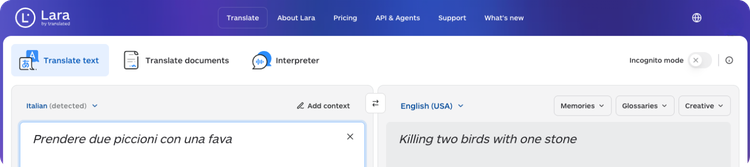
| Prendere due piccioni con una fava | Catch two pigeons with one bean | Achieve two goals at once | Kill two birds with one stone |
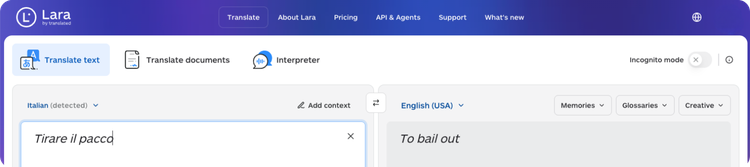
| Tirare il pacco | To pull the package | Bail at the last minute | Stand someone up / Bail |
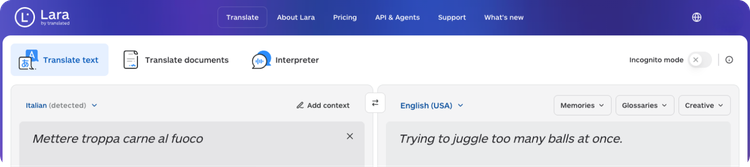
| Mettere troppa carne al fuoco | To put too much meat on the fire | Do too many things at once | Too many irons in the fire |
How to translate In bocca al lupo?
Literal translation: “Into the wolf’s mouth.”
 What it means: A classic way to say “good luck,” especially when someone is about to face something stressful or high-stakes. Think exams, interviews, first days, sports matches, or any performance moment. Traditionally, people reply with “Crepi!” or “Crepi il lupo!” as part of the ritual.
How it’s used: You say it right before the moment of truth, often in a supportive, almost protective way.
- “Domani ho l’esame di guida.” “In bocca al lupo!”
- “Stasera canto dal vivo per la prima volta.” “In bocca al lupo!”
- “Ho il colloquio con il CEO tra un’ora.” “In bocca al lupo!”
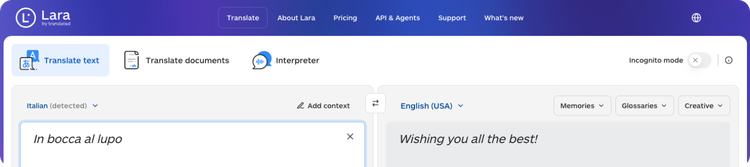
How Lara Translate translates it: “Wishing you all the best!” If the context is a show, performance, or audition, it can become “Break a leg,” because that is the natural English equivalent in that situation.
How to translate Acqua in bocca?
Literal translation: “Water in your mouth.”
 What it means: “Keep it secret” or “do not say anything.” It can be playful (gossip among friends) or serious (work confidentiality). It signals that the information is private, sensitive, or not confirmed yet.
How it’s used: You say it right after revealing something, as a quick “please do not spread this.”
- “Te lo dico, ma acqua in bocca: Marco sta per cambiare lavoro.”
- “Acqua in bocca finché non firmiamo il contratto.”
- “Non lo dire a nessuno, acqua in bocca.”
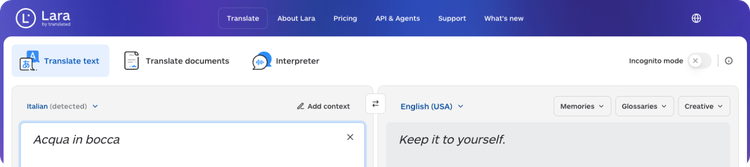
How Lara Translate translates it: “Keep it to yourself.” or “Don’t tell anyone.” If the tone is informal: “Mum’s the word.”
How to translate Essere al verde?
Literal translation: “To be at the green.”
 What it means: You have run out of money, or you are very low on funds. It’s common in everyday situations like end of the month budgeting, unexpected expenses, travel planning, and student life. Often said with humor, even when it’s true.
How it’s used: You use it to explain why you cannot afford something right now, or why you need to be careful with spending.
- “Aperitivo? Volentieri, ma sono al verde.”
- “Dopo l’affitto sono al verde fino a fine mese.”
- “Vorrei venire in vacanza, ma quest’anno sono al verde.”
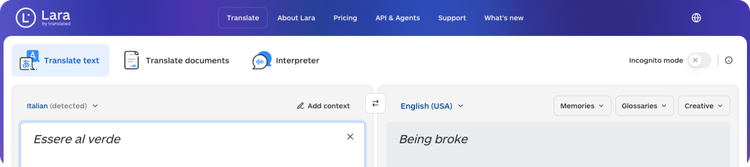
How Lara Translate translates it: “Being broke.” or “Being short on cash.” If the tone is softer: “Running low on money.”
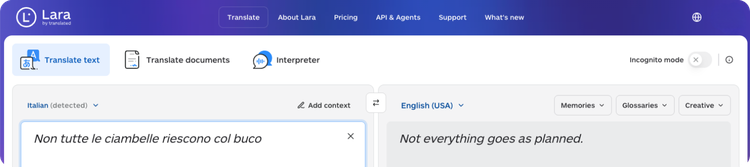
How to translate Non tutte le ciambelle riescono col buco?
Literal translation: “Not all donuts come out with a hole.”
 What it means: Not everything succeeds, and not every attempt turns out perfectly. It’s a gentle way to accept a mistake or an imperfect result without blaming someone too harshly. You hear it in work, cooking, DIY, planning, and anywhere effort does not match the outcome.
How it’s used: You use it after something did not work out, to reduce tension and put things into perspective.
- “Il progetto non è venuto come speravamo. Pazienza, non tutte le ciambelle riescono col buco.”
- “Ho provato la ricetta nuova, ma è venuta male. Non tutte le ciambelle riescono col buco.”
- “Abbiamo fatto un errore, ma capita. Non tutte le ciambelle riescono col buco.”
How Lara Translate translates it: “Not everything goes as planned.” Depending on tone: “You can’t win them all.”
How to translate Piove sul bagnato?
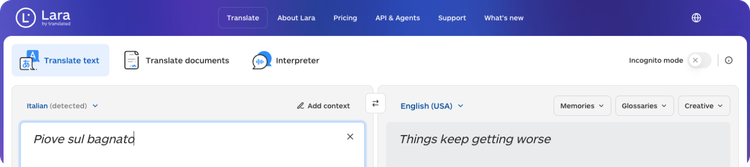
Literal translation: “It rains on the wet.”
 What it means: Bad luck or problems keep piling up, especially when things were already going badly. It’s the feeling of a second setback arriving right after the first one, like a frustrating chain reaction.
How it’s used: You use it when you want to describe the feeling of “seriously, now this too?”
- “Già ero in ritardo, poi si è pure rotto l’ascensore. Piove sul bagnato.”
- “Mi hanno cancellato il volo e mi hanno anche perso la valigia. Piove sul bagnato.”
- “Tra bollette e spese impreviste, piove sul bagnato.”
How Lara Translate translates it: “When it rains, it pours.” Or more neutral: “Things keep getting worse.”
How to translate Fare orecchie da mercante?
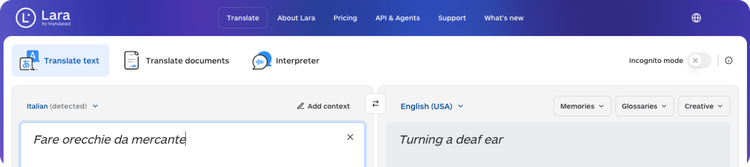
Literal translation: “To make merchant ears.”
 What it means: Pretending you did not hear, usually on purpose, because responding would be inconvenient. It can describe someone ignoring requests, avoiding responsibility, or only “hearing” what benefits them.
How it’s used: You use it when someone is clearly aware, but chooses to ignore you.
- “Gli ho chiesto di pagarmi, ma fa orecchie da mercante.”
- “Ogni volta che parliamo del problema, fa orecchie da mercante.”
- “Ha letto i messaggi e non risponde: fa orecchie da mercante.”
How Lara Translate translates it: “Turning a deaf ear.” Or more explicitly: “He’s ignoring it on purpose.”
How to translate Avere le mani bucate?
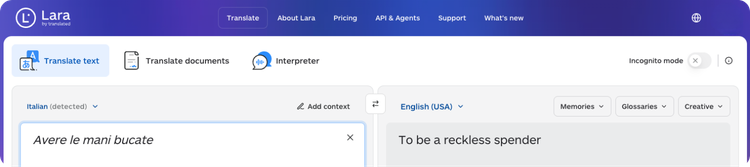
Literal translation: “To have pierced hands.”
 What it means: Someone can’t hold on to money because they spend it too quickly. It can be teasing (about shopping habits) or critical (about financial responsibility). The idea is that money “falls through” as soon as it arrives.
How it’s used: You use it to describe a spending habit, sometimes jokingly, sometimes seriously.
- “Appena prende lo stipendio, lo finisce. Ha le mani bucate.”
- “Non riesce a risparmiare, ha le mani bucate.”
- “Con le mani bucate, è impossibile mettere da parte qualcosa.”
How Lara Translate translates it: “To be a reckless spender” Or idiomatic: “Money burns a hole in his pocket.”
How to translate Prendere due piccioni con una fava?
Literal translation: “To catch two pigeons with one bean.”
 What it means: Achieving two goals with one action. It’s common in planning, errands, work tasks, and social plans, especially when you want to highlight efficiency.
How it’s used: You say it when you combine things smartly to save time or effort.
- “Andiamo in centro: facciamo la spesa e passiamo in banca. Due piccioni con una fava.”
- “Se facciamo la call oggi, risolviamo due problemi insieme: due piccioni con una fava.”
- “Visito i miei e porto anche il regalo: due piccioni con una fava.”
How Lara Translate translates it: “Killing two birds with one stone.” Or more modern: “Two birds, one stone.”
How to translate Tirare il pacco?
Literal translation: “To pull the package.”
 What it means: Standing someone up or bailing on plans, often at the last minute. It’s informal and common among friends, dating, and casual appointments. Sometimes it implies the person disappeared without warning.
How it’s used: You use it when someone does not show up, cancels late, or vanishes.
- “Dovevamo vederci alle 9 e non è venuto. Mi ha tirato il pacco.”
- “Ha confermato e poi nulla. Pacco totale.”
- “Ogni volta che organizziamo qualcosa, qualcuno tira il pacco.”
How Lara Translate translates it: “He stood me up.” Or more general: “To bail out.” or “He didn’t show up.”
How to translate Mettere troppa carne al fuoco?
Literal translation: “To put too much meat on the fire.”
 What it means: Trying to do too many things at the same time, risking confusion, delays, and lower quality. You’ll hear it in work projects, team decisions, and personal life when someone overcommits.
How it’s used: You use it as a warning to simplify, prioritize, or slow down.
- “Stiamo lanciando tre iniziative insieme. Stiamo mettendo troppa carne al fuoco.”
- “Prima finiamo questo, poi passiamo al resto. Troppa carne al fuoco non va bene.”
- “Tra palestra, corso, lavoro e side project, hai troppa carne al fuoco.”
How Lara Translate translates it: “Trying to juggle too many things at once” Or plain: “You’re taking on too much.”
Lara Translate and Italian idioms you can’t translate literally
Idioms are tricky because the “right” translation depends on context, tone, and social intent. A basic translator may produce a correct sentence that still feels wrong, because it sticks too closely to the words.
Lara Translate helps with Italian idioms you can’t translate literally by aiming for the meaning first. In Creative style, it can choose a natural English equivalent (like “Break a leg” for a performance) instead of forcing a word-for-word output. When the intent is unclear, it can encourage you to add context so the final translation matches the situation.
Try Lara Translate in your own workflow
Test Lara Translate on a real client text and see how it handles your terminology, context, and formatting.
FAQ: Italian idioms you can’t translate literally
What does “In bocca al lupo” mean in English?
It means “good luck.” In performance contexts, the closest natural equivalent is often “Break a leg.”
What do you reply to “In bocca al lupo”?
Traditionally, Italians reply with “Crepi!” or “Crepi il lupo!” In English, people usually just say “Thanks!”
What does “Acqua in bocca” mean?
It means “keep it secret,” “don’t tell anyone,” or “keep it to yourself,” depending on tone.
How do you say “Essere al verde” in English?
Common equivalents are “I’m broke,” “I’m short on cash,” or “I’m running low on money.”
What is the English equivalent of “Piove sul bagnato”?
A close idiomatic match is “When it rains, it pours.” If you want something neutral: “Things keep getting worse.”
What does “Tirare il pacco” mean?
It means someone bailed on plans, didn’t show up, or stood you up, often at the last minute.
Why are Italian idioms hard to translate?
Because they carry cultural assumptions, tone, and social intent. Literal translations often miss what the speaker is really doing (encouraging, warning, teasing, or criticizing).
Have a valuable tool, resource, or insight that could enhance one of our articles?
Submit your suggestion
We’ll be happy to review it and consider it for inclusion to enrich our content for our readers! ✍️
This article is about:
- Explaining Italian idioms you can’t translate literally with literal translations vs real meanings.
- Giving natural English equivalents and examples you can reuse in real conversations.
- Showing why context and tone matter when translating idioms and cultural expressions.
- How Lara Translate aims to preserve intent, not just words.