

You’ve seen Guten Tag in emails, hotels, and everyday conversations. But what is the best English equivalent, and when does it sound too formal, too stiff, or just weird?
This guide explains what Guten Tag means in English in professional, natural, and casual contexts, plus common mistakes to avoid. And how to use Guten Tag in English.
What does “Guten Tag” mean in English?
Direct translation: Good day. In practice, the most natural equivalent in many real situations is Hello or Good afternoon, depending on the time and context.
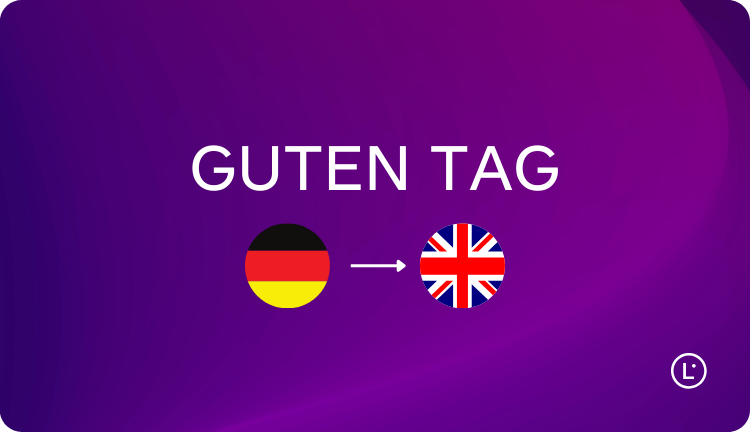
The direct translation of “Guten Tag”
The simplest translation is:
- Guten Tag = Good day
In practice, Good day can sound old-fashioned in everyday English. In many contexts, English speakers would naturally say Hello or Good afternoon. The right choice depends on who you are speaking to, and whether it is morning, afternoon, or a formal setting.
| German | English | Tone | Best for |
|---|---|---|---|
| Guten Tag | Hello | Neutral | Most situations, especially in writing |
| Guten Tag | Good afternoon | Polite | Service, meetings, afternoon greetings |
| Guten Tag (formal greeting) | Good day | Very formal / old-fashioned | Rare, specific tone or very formal style |
The “Professional” context (Faithful): when “Hello” or “Good afternoon” is the right move
In professional settings, Guten Tag is a safe default in German. In English, the most natural equivalent depends on the channel:
- In emails and written messages: Hello is usually the safest.
- In person, especially in the afternoon: Good afternoon is the closest polite match.
Use it in these situations
- Greeting customers or clients in a polite, neutral way
- Starting a meeting (especially after lunch)
- Reception, hotel check-in, service desks
- Business emails when you want a professional tone
Examples (German → English)
- Guten Tag, Frau Schmidt. → Hello, Ms. Schmidt.
- Guten Tag zusammen. → Hello, everyone.
- Guten Tag, danke für Ihre Nachricht. → Hello, thank you for your message.
- Guten Tag, ich hätte eine Frage. → Good afternoon, I have a question.
Translate “Guten Tag” with the right tone
See the best English options for Guten Tag, then adjust the context (business email, reception, casual hello) to get a natural, confident greeting.
The “Natural” context (Fluid): how people actually greet in English
In everyday English, people rarely say “Good day” as a standard greeting. These options usually sound more natural:
Natural English equivalents
- Hello (neutral, universal)
- Hi (casual)
- Good afternoon (polite, time-specific)
- Hey (very casual)
Quick examples
- German: Guten Tag! → English: Hello!
- German: Guten Tag, haben Sie kurz Zeit? → English: Hello, do you have a minute?
- German: Guten Tag, wie kann ich helfen? → English: Good afternoon, how can I help?
Tip: If the German sentence uses Guten Tag mainly to be polite, Hello is often the closest English match. If it is clearly time-based (after lunch), Good afternoon works better.
The “Creative” context: casual and vibe-based alternatives
If the vibe is informal, you may translate the intent instead of the words.
Casual alternatives (use with friends or close coworkers)
- Hi
- Hey
- Hey there
- Hi there
Very informal, slangy options (use carefully)
- Yo (very casual, some contexts only)
- What’s up? (more like “Na, was geht?” than “Guten Tag”)
Rule of thumb: If Guten Tag is used to be polite or professional, do not translate it into slang. Stay with Hello or Good afternoon.
Common mistakes (and how to avoid them)
1) Translating “Guten Tag” as “Good day” in normal conversation
Mistake: Guten Tag → Good day (in everyday chat)
Better: Guten Tag → Hello / Good afternoon
2) Using “Good afternoon” in the morning
Mistake: Guten Tag (10am) → Good afternoon
Better: Guten Tag → Hello (or Good morning if the German context is morning)
3) Translating “Guten Tag” as “Good morning” automatically
Mistake: Guten Tag → Good morning (always)
Better: Use Hello as default, or Good afternoon if the context is clearly afternoon.
4) Missing that “Tag” is not just “day” in greetings
Important: In greetings, Guten Tag functions like a polite “hello,” not like a literal “have a good day.” Context matters more than word-for-word translation.
Quick cheat sheet: pick the right translation fast
- Work email (safe default): Hello
- Reception, service, afternoon: Good afternoon
- Everyday neutral: Hello
- Friends: Hi / Hey
- Not sure: Hello
Try it with Lara Translate
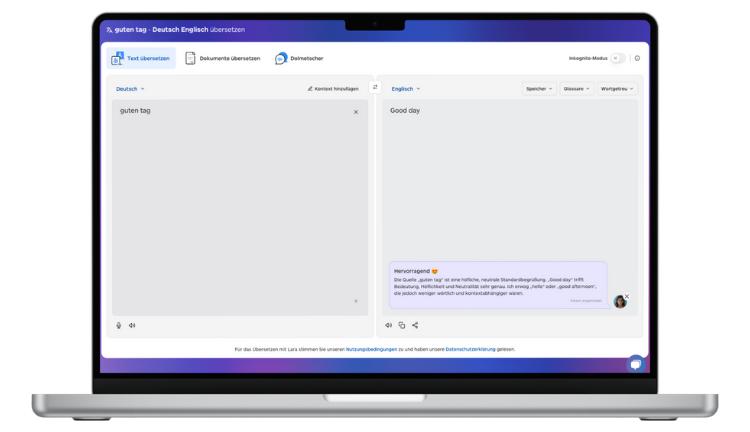
If you want the most natural option for your exact sentence, translate it with context. Start from: Guten Tag (DE → EN) in Lara Translate, then add a short note like “business email,” “hotel reception,” or “casual hello” to steer tone.
FAQ
Does “Guten Tag” always mean “Good day”?
Not exactly. Word-for-word it is “Good day,” but in most real English contexts the natural equivalent is “Hello” or “Good afternoon,” depending on time and tone.
Is “Hello” a correct translation of “Guten Tag”?
Yes. In many emails and neutral greetings, “Hello” is the closest everyday English match.
When should I use “Good afternoon” for “Guten Tag”?
When the context is clearly afternoon, especially in service, meetings, or polite in-person greetings.
What is the safest option if I’m unsure?
Use “Hello.” It sounds natural and works in most contexts.
This article is about:
- Explaining what “Guten Tag” means in English and why the literal translation can sound unusual.
- Showing the best English greeting by context: professional, everyday, and very casual.
- Helping you avoid common mistakes, like overusing “Good day,” choosing “Good afternoon” at the wrong time, or translating word-for-word instead of by intent.