

Making localization a dedicated role is a signal that translation has grown too important to leave scattered across product, marketing, support, and legal. Whoever takes that seat inherits a wide brief: build the strategy, the vendor model, the technology stack, the quality framework, and the internal credibility to fund all of it, usually at the same time. The instinct is to move fast and pick a tool. The decision that matters more comes first, and it is quieter: how the company will divide content between automation and human expertise.
Get that routing model right early and the function scales as volumes and languages grow. Standardize on one method for everything and you spend the next two years unwinding it. This is a strategy piece for the person building localization from the ground up, and for the company that just hired them.
|
TL;DR
|
Short answer
A company’s first localization hire is being asked to build a system, not to translate content by hand. The decision that shapes that system is how to split content between automation and human expertise. Standardizing on one method for everything is the common trap, because your content does not share a single risk profile, visibility level, or quality bar. The model that scales routes each content type by volume, risk, visibility, and business value, then chooses tooling that can serve every lane from one place. Do that early and the function grows without being rebuilt.
Why it matters: The operating model a first localization leader sets decides whether the function scales or stalls. A rigid technology-only or agency-only setup gets expensive to unwind once volume grows. Build it as a flexible mix of AI and human translation, on one partner with shared linguistic assets, and you can show quick wins early and add automation as the function matures.
What is a first localization hire actually being asked to build?
A system, not a stack of translated files. When a company creates its first dedicated localization role, translation is usually already happening, informally, across product, marketing, support, and legal, handled by whoever was closest to the deadline. The mandate is to turn that into something deliberate: a strategy, a process, a vendor model, a technology stack, a quality framework, and the internal credibility to get budget for all of it.

That is a real opportunity, because you get to build the model correctly from the start instead of inheriting someone else’s shortcuts. The risk is moving too fast on the wrong axis. Pick a tool in week one and you can look busy while locking in a workflow you later have to tear out. Decide how content should be routed first, and the tooling choice gets much simpler. The model comes before the vendor.
The first strategic decision: AI, human, or a mix?
A mix, decided per content type. Framing the choice as AI versus human translation is the trap, because it treats translation as one uniform task when your content is anything but. Product strings and help-center articles arrive in high volume and change constantly. A contract or a regulated policy carries legal weight where a wrong word is a real risk. A launch campaign needs cultural adaptation, not literal accuracy. These do not share a quality bar, so they should not share a workflow.
The model that scales routes content by volume, risk, visibility, and business value. A practical starting point is three tiers.
| Tier | Content examples | Profile | Workflow |
|---|---|---|---|
| Tier 1 | UI strings, help center, changelogs | High volume, low risk, changes often | AI translation, glossaries and TMs for consistency |
| Tier 2 | Internal training, knowledge base | Matters, not a legal or brand risk | AI translation with human review or post-editing |
| Tier 3 | Legal, regulated, campaigns, high-visibility | Low volume, high risk or visibility | Professional human translation, transcreation where needed |
These are not competing philosophies. They are settings on the same dial, and you decide where it sits for each lane. Content that was too expensive to localize at all becomes feasible under automation, while your specialist budget concentrates where it changes outcomes. You are designing a system, not betting the function on one tool.
See how the automated tier holds up
Run a real piece of your content through Lara Translate and check the output against your terminology and tone.
Build the linguistic foundation before the volume arrives
Start the glossary and the translation memory in your first quarter, not after the backlog forms. A glossary locks approved terminology, so product names, regulated language, and brand terms stay consistent across every team and language. A translation memory stores approved translations, so recurring content is reused instead of re-paid.
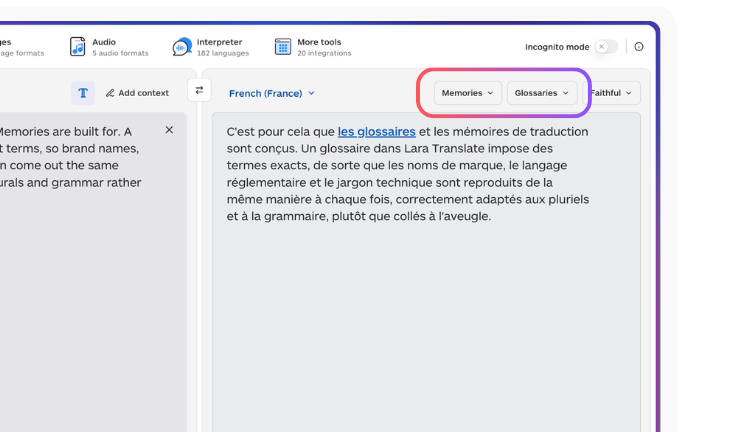
Here is the part most new teams underestimate: these assets feed both workflows. The same glossary and translation memory steer the AI output and guide the human linguists, so consistency holds whether a string was automated or handled by a specialist. That shared foundation is also what a translation management setup is meant to centralize. Build these early and every later launch runs cheaper and faster. This is the compounding part of the job.
One partner instead of a stack of vendors
The awkward part of the traditional setup is that AI tools and professional translation usually come from different providers. That means separate onboarding, separate terminology, and a handoff every time content moves between them, and every handoff leaks context and consistency. For a first localization hire trying to keep the operating model simple, that fragmentation is a tax you pay forever.
Lara Translate is the AI translation platform built by Translated, so the automated tiers and the professional human tiers sit under one relationship. Content can move from fully automated, to AI-drafted and human-reviewed, to fully human, without leaving the partner or duplicating your glossary and translation memory. Lara also handles text, documents, images, and audio, and connects through a web interface, API, and MCP, so it fits the systems your content already lives in.
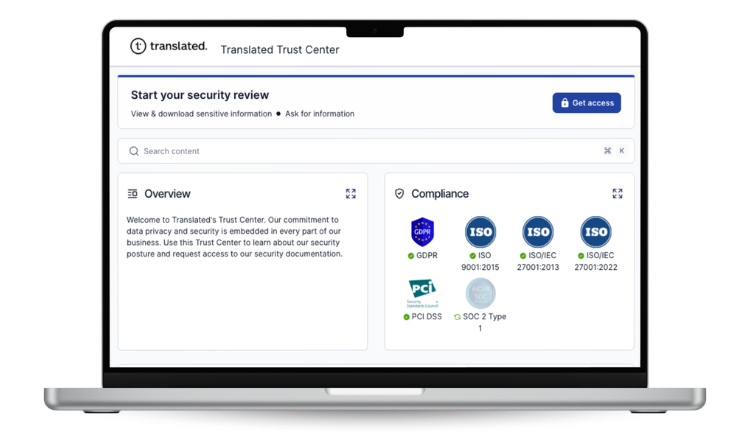
This is also how a team of one scales without hiring for every language. Through Translated you reach professional linguists across markets and domains on demand, and through Lara you get AI translation across 206 languages, so you buy capacity instead of headcount. When procurement and legal need sign-off, Translated maintains recognized certifications for information security, quality management, and translation services, including ISO 27001, ISO 9001, and ISO 17100 (Translated Trust Center).
How to show progress in your first quarter
Pick two proofs. Take a bounded, high-volume, lower-risk content set and localize it fast with Lara to show throughput and coverage in weeks. Then take one visible, high-stakes launch and ship it with human review on top to show quality where it counts. Two wins, two different kinds of proof, early in your tenure.
Consolidation is a reportable win on its own. Pulling scattered freelancers, agencies, and generic AI into one AI-plus-human partner means fewer handoffs, one set of linguistic assets, and one point of accountability. Build the model right at the start and the company gains a localization capability that scales with it, not a pile of one-off translation jobs. That is the difference between a function that matures and one that stays a bottleneck.
Design a model that uses AI and human translation together
See how Lara Translate and Translated’s linguists cover every tier, from fully automated to fully human, under one partner.
Have a valuable tool, resource, or insight that could enhance one of our articles? Submit your suggestion
We’ll be happy to review it and consider it for inclusion to enrich our content for our readers! ✍️
FAQ
What should a company’s first localization hire prioritize?
Start with the operating model, not the first translation project. The highest-value early move is deciding how content will be routed between automation and human expertise, because that choice shapes vendors, budget, and quality for years. Alongside it, stand up the linguistic foundation: a glossary and a translation memory that every workflow will draw on. These two moves, a routing model and shared assets, let you show progress quickly without locking the function into a single tool or agency. Everything else, from language coverage to integrations, gets easier once they exist.
Should a new localization team use AI or human translation?
Both, applied to different content. Treating it as one choice for everything is the common mistake, since content types carry different risk, volume, and visibility. High-volume, lower-risk material like support articles and UI strings suits AI translation. Sensitive, regulated, creative, or highly visible content needs human review on top of an AI draft, or fully professional translation. The right model sets that split per content type rather than committing the whole program to one method.
How do you decide which content to automate?
Score each content type on volume, risk, visibility, and business value. High volume with low risk points to automation, because speed and coverage matter more than hand-crafting and the cost of a small slip is low. High risk or high visibility, like legal, regulated, or brand-defining material, points to human involvement, either as review on top of an AI draft or as fully human translation. Map your content once against these factors and you get a routing rule you can reuse. As your glossaries and translation memories mature, more content can shift safely toward the automated tiers.
How do you scale localization without building a big team?
You buy capacity instead of hiring for it. A single localization manager cannot employ a linguist for every language, domain, and content type, and does not need to. Through Translated you reach professional linguists across markets on demand, and through Lara you get AI translation across 206 languages, plus support for text, documents, images, and audio in one place. Integrations through API, SDK, and MCP let that capacity plug into the systems you already run. The result is a program that scales with content volume rather than with your headcount.
Can one partner provide both AI and professional human translation?
Yes. Lara Translate is the AI translation platform built by Translated, and Translated provides professional human translation, linguistic review, transcreation, and project management. Because they share one relationship, you can move a single piece of content from fully automated, to AI-drafted and human-reviewed, to fully human, without switching vendors or duplicating assets. Glossaries and translation memories are shared across both, so terminology stays consistent end to end. For a new localization function, that removes the overhead of coordinating a separate AI tool and a separate agency.
This article covers: what a company’s first localization hire is really being asked to build, why AI versus human translation is the wrong framing, how to route content into tiers by volume, risk, visibility, and business value, how to build glossaries and translation memories that feed both workflows, and how Lara Translate and Translated combine AI and professional human translation under one partner so a new function can scale.