

|
TL;DR
|
Short Answer
Maintaining brand voice in translation requires four things working together: a glossary that locks in approved terminology per language, a style guide with executable rules for register and cultural adaptation, tone controls at the engine level matched to each content type, and post-editing by linguists who treat voice as a deliverable — not a bonus.
Why it matters: Brand voice is one of the few things that differentiates you from competitors selling the same category. When translation flattens it — even technically correct translation — customers in new markets never build the same relationship with the brand that your home-market customers have. Consistent voice across languages is not a nice-to-have; it is the whole point of localization done well.
What does brand voice mean in a translation workflow?
Before you can maintain brand voice in translation, you need to define it in operational terms. A brand voice statement that lives in a PDF on a shared drive will not survive contact with a translation queue. The brand voice that survives is the one broken down into assets that a translator — human or machine — can actually apply. Four layers matter. The first is your lexicon: the specific words you use for your product, features, customer segments, and value propositions — and the words you avoid. “Subscribers,” not “users.” “Plan,” not “tier.” The second is register: where your writing sits between formal and casual. A B2B enterprise brand might sit at “professional, low contractions, no jargon.” A direct-to-consumer brand might sit at “warm, first-name, conversational.”
The third layer is voice principles — the texture of the writing. Sentence length, rhythm, use of questions, use of humour, use of data. This is what makes two brands with the same register sound different from each other. The fourth is cultural adaptation rules: how voice flexes in each locale. In Japanese, a warm tone may need to respect honorifics. In German, short English sentences may need more structural signposting to read naturally.
This groundwork feeds every method below. Skip it, and glossaries drift, style guides stay abstract, and AI engines have nothing concrete to learn from.
Four layers matter. The first is your lexicon: the specific words you use for your product, features, customer segments, and value propositions — and the words you avoid. “Subscribers,” not “users.” “Plan,” not “tier.” The second is register: where your writing sits between formal and casual. A B2B enterprise brand might sit at “professional, low contractions, no jargon.” A direct-to-consumer brand might sit at “warm, first-name, conversational.”
The third layer is voice principles — the texture of the writing. Sentence length, rhythm, use of questions, use of humour, use of data. This is what makes two brands with the same register sound different from each other. The fourth is cultural adaptation rules: how voice flexes in each locale. In Japanese, a warm tone may need to respect honorifics. In German, short English sentences may need more structural signposting to read naturally.
This groundwork feeds every method below. Skip it, and glossaries drift, style guides stay abstract, and AI engines have nothing concrete to learn from.
Build the governance layer: glossary and style guide for translators
The first investment that pays for itself on every new market is a proper glossary and style guide — for your translators and for the AI systems that now sit alongside them in every pipeline. A working glossary is not a spreadsheet of terms. It is a termbase that includes the approved translation in each target language, the context of use (UI, legal, marketing, support), a short definition, and the forbidden variants. “Dashboard” in French is “tableau de bord,” not “panneau de contrôle.” Document it once, reuse it everywhere. A working style guide is not a brand manifesto. It is a set of executable rules. How do you treat branded terms — often, do not translate them? How do you handle numbers, dates, currencies, and units? What is your policy on loanwords, anglicisms, gendered language, and formality (tu/vous, du/Sie)? How do you localize examples, names, idioms, and cultural references? The discipline matters because both humans and machines need the same reference to produce consistent output. A glossary and style guide that ships with every job — embedded in the CAT tool, attached to the prompt, or loaded into a translation memory — is what lets you maintain brand voice in translation at production speed, rather than relying on memory and goodwill. For a deeper walkthrough of how brand governance travels from source to target in high-stakes marketing content, see the guide on AI marketing localization: how to keep brand voice across languages.Train the model on your voice: the case for a custom AI translation engine
Governance tells the system what to do. A custom AI translation engine teaches it what you sound like. Out-of-the-box models translate toward a statistical average of their training data. A customized or adaptive engine moves the output toward your voice instead. The training material is content you already own: translation memories from previous projects, approved bilingual assets, your style guide, your glossary, and past post-edits from your in-market reviewers.
The case for a custom engine strengthens when two conditions stack: you translate enough volume that governance alone struggles to enforce consistency, and your brand voice is a differentiator — the thing customers actually buy. If only one condition is true, governance plus post-editing usually suffices. Both together? A customized or adaptive engine is what lets you maintain brand voice in translation at scale, because every job teaches the system more about how you write.
One caveat worth stating plainly: a custom engine is only as good as what you feed it. Train it on inconsistent content, and you get inconsistent translations faster. The governance layer is the input. The engine is the amplifier.
Out-of-the-box models translate toward a statistical average of their training data. A customized or adaptive engine moves the output toward your voice instead. The training material is content you already own: translation memories from previous projects, approved bilingual assets, your style guide, your glossary, and past post-edits from your in-market reviewers.
The case for a custom engine strengthens when two conditions stack: you translate enough volume that governance alone struggles to enforce consistency, and your brand voice is a differentiator — the thing customers actually buy. If only one condition is true, governance plus post-editing usually suffices. Both together? A customized or adaptive engine is what lets you maintain brand voice in translation at scale, because every job teaches the system more about how you write.
One caveat worth stating plainly: a custom engine is only as good as what you feed it. Train it on inconsistent content, and you get inconsistent translations faster. The governance layer is the input. The engine is the amplifier.
Dial in tone consistency at the engine level
Beyond training, modern AI translation engines expose tone controls you can set per job. This is where tone consistency stops being a copywriting problem and becomes a parameter. The usable controls tend to fall into three buckets. Style presets define how close to the source you want the output — Faithful versus Fluid versus Creative — and how much latitude the model has in the target language. Faithful keeps the output as close to the source as possible; legal copy and product specs need this. Fluid produces natural, conversational text suited for blog posts, social, and editorial content; the source informs but does not constrain. Creative gives the model enough latitude to rewrite for impact, not just translate for accuracy — that is the preset for taglines and campaigns.
Register hints express a tone instruction the model reads before translating: “translate in a warm, first-person tone suitable for consumer marketing.” Context blocks go further — a short brief, a glossary reference, or a sample of brand-approved text the model uses as stylistic guidance before it begins.
The discipline is matching the preset to the content type. If the same preset runs on every job, you get consistency within that preset but not across content types — which defeats the purpose. Codify which content type uses which preset, put it in the style guide, and hold the pipeline to it. For a tone-led application of this approach to campaign content, the article AI marketing localization: how to keep brand voice across languages walks through the patterns that travel well across locales.
The usable controls tend to fall into three buckets. Style presets define how close to the source you want the output — Faithful versus Fluid versus Creative — and how much latitude the model has in the target language. Faithful keeps the output as close to the source as possible; legal copy and product specs need this. Fluid produces natural, conversational text suited for blog posts, social, and editorial content; the source informs but does not constrain. Creative gives the model enough latitude to rewrite for impact, not just translate for accuracy — that is the preset for taglines and campaigns.
Register hints express a tone instruction the model reads before translating: “translate in a warm, first-person tone suitable for consumer marketing.” Context blocks go further — a short brief, a glossary reference, or a sample of brand-approved text the model uses as stylistic guidance before it begins.
The discipline is matching the preset to the content type. If the same preset runs on every job, you get consistency within that preset but not across content types — which defeats the purpose. Codify which content type uses which preset, put it in the style guide, and hold the pipeline to it. For a tone-led application of this approach to campaign content, the article AI marketing localization: how to keep brand voice across languages walks through the patterns that travel well across locales.
Post-editing: the human layer that makes AI sound like you
AI translation gets a draft to most of the quality you need in seconds. The last stretch is usually where brand voice lives — and that is where post-editing earns its place. Post-editing is not proofreading. A post-editor is a linguist who reviews AI output against the source, the glossary, and the style guide, then rewrites whatever does not sound like you. Their job is to protect brand personality, not just catch errors. Three rules make post-editing scale without becoming a bottleneck. Give editors the same assets the AI had — glossary, style guide, translation memory, reference content. If the editor is flying blind, they will diverge from the AI output and consistency erodes. Close the loop: every edit is a data point, so feed approved post-edits back into the translation memory so the AI needs less correction on the same patterns over time. Segment by risk: high-visibility marketing, legal, and product copy get full post-editing; internal or low-traffic content can run with light post-editing or spot checks. Match the effort to the stakes. For a concrete example of how governance, engine choice, and post-editing combine in a high-conversion marketing asset, see this guide on marketing deck translation: how to keep brand voice (and conversion) across languages.Measure and iterate
Build a minimal QA loop any content team can run. A termbase compliance check confirms approved terms were used. A style compliance check checks whether register and voice principles held. An in-market sample review by a native speaker every few weeks catches drift that tools miss. A feedback channel from local teams — sales, support, community — surfaces voice issues before marketing does. The goal is not perfection on any single asset. It is a system that catches drift early and corrects it at the source — in the glossary, the style guide, or the engine’s training data — so the next batch improves automatically.How Lara Translate helps maintain brand voice in translation
Lara Translate combines AI translation with the features that brand-sensitive workflows actually need.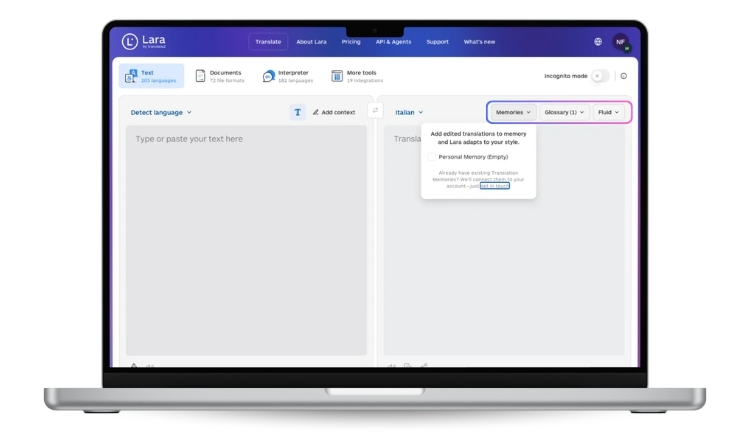
- Three translation styles for tone calibration. Lara Translate offers Faithful, Fluid, and Creative styles, letting content teams match engine behaviour to content type: Faithful for legal and technical copy, Fluid for editorial content, Creative for marketing and campaigns.
- Add Context for per-job guidance. Before each translation, you can give Lara a short brief — the audience, the industry, the intended tone. Lara adjusts the output accordingly, without changing the engine or the style preset. Useful when a single style covers multiple content types that still need different register.
- Glossaries for exact terminology enforcement. Lara Translate supports both monodirectional and multidirectional glossaries with case-sensitive exact matching. Approved terms travel with every job, across every language pair. How glossaries work in Lara Translate.
- Translation Memory support. Paid plan users can have Translation Memories linked to their account via the Lara Translate support team — and via the API for developer workflows. Once linked, Lara references approved phrasing from past jobs, keeping your lexicon consistent at scale. Edits update the memory in real time. How Translation Memories work in Lara Translate.
- The Think model for linguistic analysis. The Think model performs multi-step linguistic analysis across grammar, style, and context. It detects and corrects approximately 80% of major linguistic issues — useful for catching register drift and terminology inconsistencies before they reach a reviewer.
- Coverage across the content stack. With support for 207 languages and 42,000+ language pairs, and exactly 70 file formats, the same engine handles web content, product copy, support articles, and marketing decks. That consistency matters when the goal is to maintain brand voice across every touchpoint, not just the ones the content team directly manages.
Keep your brand voice intact with Lara Translate
Apply translation styles, Add Context, Glossaries, and Translation Memory to preserve tone across every language your brand speaks.
FAQs
What does it mean to maintain brand voice in translation?
It means preserving tone, terminology, register, and cultural adaptation across every language — not just the literal meaning. A brand with a warm, direct, first-person voice in English should read the same way in German or Japanese, adjusted for what “warm and direct” means in those cultural contexts. The output should sound unmistakably like your brand in every market, not like a fluent but anonymous translation of it.Can AI translation keep a brand’s voice, or does it flatten it by default?
Out-of-the-box engines flatten voice toward a statistical average of their training data. They do not know your house style, your approved terminology, or your register preferences. With a glossary, a style guide, tone controls matched to each content type, and post-editing by linguists who treat voice as a deliverable, AI translation can preserve voice at scale. The system needs the inputs before it can produce the right outputs.What is the difference between a glossary and a style guide for translators?
A glossary defines which terms to use and which to avoid in each language — specific words, product names, feature names, and the forbidden alternatives. A style guide defines how to write: register, tone, sentence length, formatting conventions, and cultural adaptation rules. A glossary controls vocabulary. A style guide controls the rest. You need both, and they serve different functions in the pipeline.Do I still need post-editing if I use a high-quality AI translation engine?
For brand-critical, high-visibility content — homepage copy, campaign assets, product marketing — yes. AI engines handle terminology and fluency well, but the nuance of brand voice is the last thing to stabilize in any output. A post-editor catches the moments where the translation is technically correct and tonally wrong. For low-stakes internal content, light post-editing or periodic spot checks are usually enough. Match the effort to the risk.How do you measure brand voice consistency across languages?
Run termbase compliance checks to confirm approved terms were used, and style compliance reviews to assess whether register and voice principles held. Back those up with periodic in-market samples reviewed by a native speaker who understands your brand. Set up a feedback channel from local teams — sales, support, community — who will hear about voice issues before marketing does. Feed corrections back into the glossary, style guide, or engine so the next batch starts from a better baseline, not from scratch.Keep your brand voice intact with Lara Translate
Apply translation styles, Add Context, Glossaries, and Translation Memory to preserve tone across every language your brand speaks.
This article is about
- Why generic machine translation flattens brand voice and how to fix it at the system level.
- Defining brand voice in four operational layers: lexicon, register, voice principles, cultural adaptation.
- Building a glossary and style guide for translators that both humans and AI can apply.
- When a custom AI translation engine, tone controls, and post-editing are worth the investment.
- How to use Lara Translate’s styles, Add Context, Glossaries, and Translation Memory to maintain brand voice at scale.
- A minimal QA loop for catching voice drift across languages before it reaches customers.
Have a valuable tool, resource, or insight that could enhance one of our articles? Submit your suggestion
We’ll review it and consider it for inclusion to enrich our content for our readers.
Useful articles
- Lara Translate MCP: Context-Aware AI Translation for Any Workflow
- AI Translation Trends 2026: What Actually Works
- AI Marketing Localization: How to Keep Brand Voice Across Languages