

Picking the wrong language service provider used to mean slow turnarounds and inconsistent quality. In 2026, it means misaligned AI strategy, broken compliance trails, and localization pipelines that can’t scale. The stakes changed. The market did too.
Traditional translation now represents less than 50% of what the biggest LSPs actually sell. AI reasoning models have arrived. At least one major provider just repositioned entirely. The short answer on who leads: TransPerfect at $1.32B in revenue, Smartling for security-conscious enterprises, Phrase and Crowdin for developer-first teams, and Lara Translate for teams that need professional-grade AI translation with real terminology control. Here’s the full picture.
What makes a top-tier language service provider in 2026
The best language service providers in 2026 share a defining characteristic: they’ve stopped positioning themselves as translation vendors. The top players now frame their value around AI orchestration, content operations, and measurable business outcomes. That shift is real, not just marketing.
Technology integration remains the clearest differentiator. LSPs that built proprietary platforms years ago (translation management systems, quality analytics, API ecosystems) are now layering AI reasoning models on top of that infrastructure. The ones that didn’t are catching up fast, or struggling to compete.
Data security has become non-negotiable. Regulated industries are pushing for on-premise processing, EU data residency, and contractual privacy guarantees. Any LSP that can’t meet these requirements is effectively locked out of enterprise healthcare, legal, and financial services work. Multimodal localization (covering video, audio, and interactive content alongside text) has moved from niche capability to baseline expectation for companies managing global content at scale.

Enterprise-focused language service providers
Scale creates its own requirements. If you’re managing multi-language projects across dozens of markets, content types, and regulatory environments, the following providers are the ones that have actually built for that. Each made significant moves in the past twelve months.
Lionbridge entered 2026 under new leadership, with Sebastian Bretschneider appointed as CEO. The company has leaned hard into AI-human hybrid workflows: their LLM-assisted post-editing solution (combining generative AI with expert reviewer oversight) claims up to 40% cost reduction on translation projects. For gaming clients specifically, Lionbridge Samurai™ is a dedicated AI-powered localization solution launched in 2025 that targets the fast-turnaround demands of game content pipelines.
Milengo made a notable repositioning announcement in February 2026: the company now describes itself as an AI-Led Language Solutions Integrator (LSI) rather than a traditional LSP. The shift reflects a deliberate pivot toward helping B2B SaaS and manufacturing clients treat multilingual content as a scalable, measurable operation. Their client base includes Snowflake, Bosch, and Genesys. Worth considering if your priority is AI orchestration over traditional translation vendor relationships.
TransPerfect reported $1.32 billion in billed revenues for 2025, a 7% increase and their 33rd consecutive year of growth. The more interesting number: traditional language services fell below 50% of total revenue for the first time. TransPerfect acquired Unbabel (including its TowerLLM and COMET technology) alongside a string of media production companies, pushing firmly into content operations beyond translation. Their GlobalLink NOW secure AI translation portal surpassed 150,000 active client users. If you’re evaluating an enterprise provider with large-scale, multi-language project needs, TransPerfect’s footprint is hard to ignore.
MarsHub is an AI-powered language solutions provider combining advanced AI technology with native human expertise to deliver fast, high-quality localization at scale. Ranked among the Top 75 Nimdzi Global LSPs and Top 35 CSA Global providers, MarsHub offers AI-driven translation, localization, subtitling, and multilingual workflow solutions for industries including gaming, software, legal, healthcare, and media. Its ecosystem includes tools like MarsMT, MarsCloud, and AI-powered quality assurance designed to streamline global content delivery with speed, accuracy, and consistency.
RWS Group has been through significant internal change. The company restructured in late 2025 into three divisions (Generate, Transform, and Protect) and executed its first major brand repositioning in two decades. In May 2026, RWS acquired Obviously Group for up to £40 million, signaling continued appetite for growth despite a challenging FY25. RWS remains a serious option for regulated industries where compliance and precision drive vendor selection, but prospective clients should track their transformation closely.
Smartling achieved ISO 27001 certification in 2025, strengthening its enterprise security posture, and posted 218% growth in AI translation volume. They ranked number two on G2’s 2026 Best Software Awards for CMS Products. For modern, agile businesses that prioritize security certifications alongside translation speed, Smartling continues to be a credible choice.
Try Lara Translate in your own workflow
Test Lara Translate on a real client text and see how it handles your terminology, context, and formatting.
Specialized providers for specific industries
Developer teams have a different problem than enterprise content teams: localization needs to live inside the build pipeline, not beside it. These providers were built for that.

Phrase has opened its ecosystem to a “Bring Your Own Engine” model, letting teams plug in their preferred machine translation or AI layer. Their Phrase Orchestrator launch claims 50x faster automation for localization workflows. That’s a significant shift for a platform historically built around tight integration with its own toolchain. For teams that want workflow flexibility without rebuilding their entire stack, Phrase is worth evaluating.
Crowdin (which integrates with Lara Translate) launched a Dubbing Studio in 2025, integrating with ElevenLabs to handle audiovisual localization directly within the platform. For tech companies running agile development cycles, Crowdin’s developer-first approach and growing multimedia capabilities make it a strong fit.
Keywords Studios is now operating under new ownership following its acquisition by CPP Investments, EQT, and Temasek in November 2024. Their specialization in gaming localization remains unchanged: voice-over, subtitling, cultural adaptation, and audio production for game studios are their core offering. If your content is game-related, Keywords Studios is effectively in a category of its own for depth of specialized services.
Regional specialists making global impact
A global platform doesn’t automatically mean global expertise. Regional language service providers consistently outperform generalists on cultural accuracy and local compliance, and that gap matters more as trade frameworks create new markets with specific documentation requirements.
The African Continental Free Trade Area has created sustained demand for providers with genuine expertise in African language pairs, not just nominal coverage. Providers operating without native linguistic knowledge tend to underperform on both quality and compliance. In the Asia-Pacific region, the Regional Comprehensive Economic Partnership continues to drive demand for teams who actually understand the linguistic and cultural landscape of Southeast Asia rather than treating it as a single market.
Eastern European and Central Asian markets have produced strong regional specialists, particularly for companies navigating Eurasian Economic Union documentation requirements. If your expansion targets these regions specifically, a regional specialist will typically outperform a global generalist on both quality and turnaround.
The technology advantage: Lara Translate’s approach
General-purpose AI guesses at translation context. Lara Translate was trained specifically on professional translation data: 25 million human-translated documents, aligned across multiple languages, with a model architecture built for linguistic precision rather than general text generation. That distinction matters when the output has to be right.
In November 2025, Translated expanded Lara to 206 languages and launched Lara Think, a new reasoning model designed for enterprise translation. Lara Think reduces translation errors by 50 to 60%, delivers an average human evaluation grade 40% higher than the baseline model, and produces results in under 10 seconds at a cost comparable to professional translation. For low-resource and underrepresented languages, internal tests showed up to 76% improvement in translation quality.
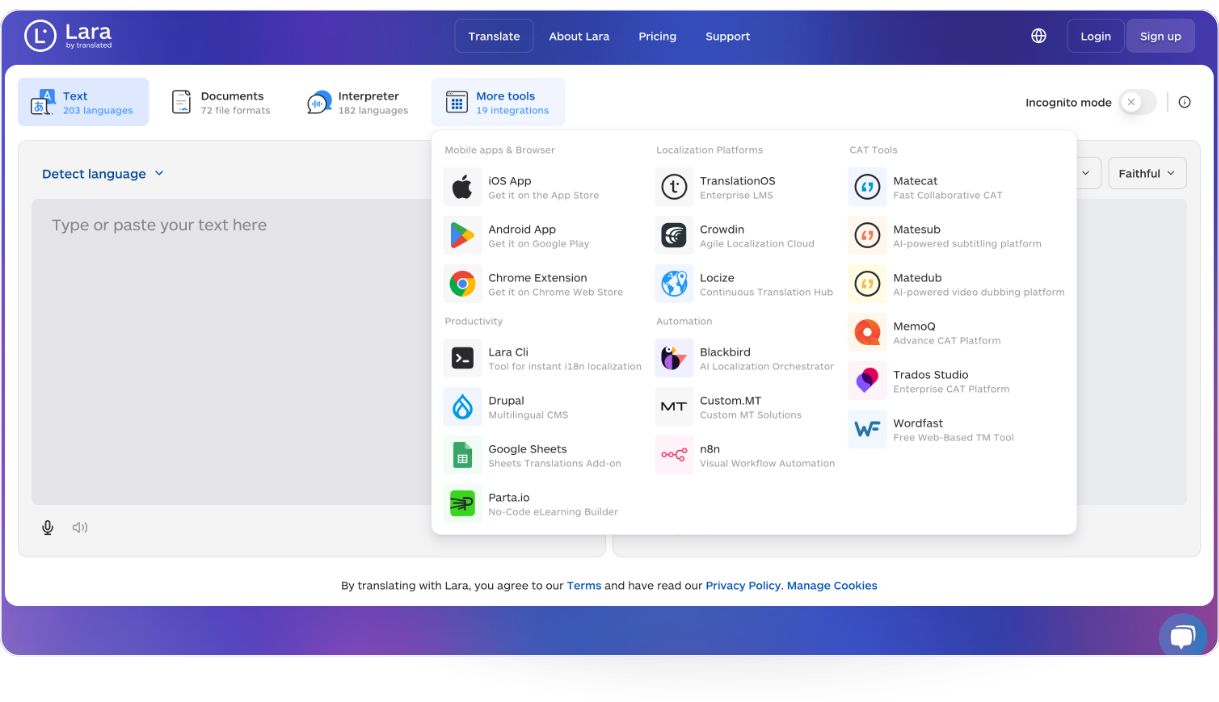
Unlike generic AI translation tools, Lara Translate gives you three distinct translation styles: Faithful (for precision-critical content), Fluid (for readability), and Creative (for marketing and adaptive content). Glossaries and translation memories work across all three, keeping terminology consistent at scale without manual enforcement. Incognito Mode keeps sensitive content out of model training entirely. It’s a practical requirement for regulated industries, not a nice-to-have.
Recent platform additions include a Chrome Extension for in-browser translation, a CLI for automated localization in developer workflows, audio-to-audio translation via SDK, and full mobile apps for Android and iOS. Crowdin integration lets teams plug Lara directly into their existing localization pipeline. You can also explore SaaS localization strategies that work well with Lara’s API-first approach.
Quality assurance in modern language services
Translation quality assurance has moved well beyond linguistic review. Modern QA frameworks combine automated checks, human expert validation, functional testing for software outputs, and cultural appropriateness review, often in parallel rather than in sequence. The best language service providers build these layers into their standard workflow rather than treating them as optional add-ons.
For regulated content, compliance verification runs alongside linguistic QA: medical, legal, and financial translations face documentation requirements that go beyond accuracy. Teams using AI translation are increasingly required to demonstrate what models were used, what review steps were taken, and how errors were caught. That audit trail is now part of the quality story, not separate from it.
Making the right choice for your business
Most teams pick a provider based on price, then spend months working around what the provider doesn’t do well. The smarter question is: what does your localization workflow actually look like, and where does it break?
Large enterprises with complex, multi-language projects across diverse content types will find the most value from full-service providers like TransPerfect or Smartling, where platform depth and global scale are genuine advantages. Companies focused on SaaS localization should prioritize providers with strong developer integrations, continuous localization support, and agile-compatible workflows. Phrase, Crowdin, and Lara Translate’s API all fit here. For businesses entering emerging markets, regional specialists provide the cultural accuracy and compliance insight that global platforms tend to miss.
Budget matters, but it’s not the right variable to optimize. The real calculation is time-to-market, consistency at scale, and how much manual work your team absorbs on top of what the provider delivers. That’s where the ROI lives.
FAQs
What should I look for in a language service provider in 2026?
Look for a combination of proven AI integration and human oversight, with clear experience in your industry and target markets. Essential capabilities include proven translation quality assurance processes, verifiable data security measures (ISO certifications, EU data residency if relevant), and clean integration with your existing tech stack. In 2026, also ask how they handle AI transparency and audit trails for regulated content.
How do language service providers ensure quality?
Modern LSPs use layered QA that combines automated checks with human expert review. This typically includes linguistic validation, cultural appropriateness assessment, functional testing for software localizations, and compliance verification for regulated industries. The best providers run these in parallel rather than sequentially, which is what actually compresses turnaround times without cutting corners.
What’s the difference between translation and localization services?
Translation converts content from one language to another. Localization adapts that content for a specific regional market, accounting for cultural norms, local regulations, date and number formats, and market-specific references. The best language service providers treat these as a single integrated service, not separate deliverables.
How important is technology in modern language services?
Very. But the useful question isn’t whether an LSP uses AI, it’s how. Technology drives turnaround speed, consistency, and cost efficiency. Human expertise remains essential for cultural nuance, complex content, and quality sign-off. The providers outperforming in 2026 are the ones who’ve built genuine workflows around both, rather than marketing AI on top of unchanged processes.
What is Lara Think and how does it differ from standard AI translation?
Lara Think is the reasoning model launched by Translated in late 2025 as part of the Lara Translate platform. Unlike standard machine translation, it applies a dedicated reasoning step before producing output, reducing errors by 50 to 60% and achieving human evaluation grades 40% higher than the baseline model. It supports 206 languages and is trained specifically on professional translation data rather than general web content.
TL;DR
|
This article is about
- Comprehensive overview of top language service providers for 2026 global expansion strategies
- Key characteristics that distinguish leading LSPs in today’s competitive marketplace
- Enterprise-focused providers and specialized solutions for SaaS localization requirements
- Regional specialists serving emerging markets in Africa, Asia-Pacific, and Eastern Europe
- Technology integration including Lara Translate’s Lara Think reasoning model and 206-language support
Have a valuable tool, resource, or insight that could enhance one of our articles? Submit your suggestion
We’ll be happy to review it and consider it for inclusion to enrich our content for our readers! ✍️
Useful links: