

Updated to February 2026.
If you’ve ever searched for the best free AI tool to translate, compared translation alternatives, or wondered whether machine translation can really understand context and nuance, you’re in the right place.
Updated for February 2026. Right now you’re probably wondering what the best free option is. So let’s see who wins: Lara Translate vs DeepL.
Quick Comparison Table (Free Version)
First of all, let’s see how the free version of DeepL stacks up against Lara Translate. We’re comparing, in both cases, the standard translation model to understand what’s available out of the box, without subscriptions, so you can judge the real value, feature for feature.
| Category | DeepL (Free) | Lara Translate (Free) |
|---|---|---|
| Languages supported | ❌ 100+ languages | ✅ 200+ languages |
| Contextual explanations | ❌ No built-in explanation | ✅ Lara Feedback explains choices and flags ambiguity |
| Idiomatic expression handling | ⚠️ Often fluent, but can go literal on idioms | ✅ Designed to resolve meaning using context |
| Tone and style adaptation | ✅ Generally fluent | ✅ Translation styles (Faithful, Fluid, Creative) |
| Data privacy (GDPR) | ✅ GDPR compliant | ✅ GDPR compliant + Incognito mode available |
| File translation (free) | ✅ DOC/DOCX, PPTX, PDF (with a DeepL account) | ✅ 70+ file types, supports documents up to 200MB |
| Free usage limits | ⚠️ Text limits depend on where you use it (often 1,500 to 5,000 chars) | ✅ 5,000 characters/day + 4 document pages/day |
Try Lara Translate in your own workflow
Test Lara Translate on a real client text and see how it handles your terminology, context, and formatting.
The Best Free AI Tool to Translate?
Today’s challenger? DeepL, widely praised for fluency and speed. In late 2025 it also expanded language coverage dramatically, so it’s now a very different product than it was a couple of years ago.
But the real question remains: does DeepL consistently grasp the deeper meaning behind words, or does it sometimes settle for surface-level translations that miss cultural subtleties and conversational nuance?
Unlike standard AI translators, Lara Translate is built around context control and transparent translation behavior. It aims to understand not just the words, but the intent, tone, and cultural context behind them. Whether you’re a multinational company adapting marketing copy, a content creator localizing a message, or a team translating real documents, context is what prevents “fluent but wrong” output.
In this article, we’ll put Lara Translate to the test against DeepL on some of the toughest translation scenarios:
- Idiomatic expressions that don’t translate literally
- Cultural nuances that shape meaning
- Ambiguous phrases requiring interpretation
- Conversational tone and natural flow
If you’ve ever felt that a translation sounded too mechanical or missed the point, you’re not alone.
When it comes to AI translation, context is king
Now, let’s explore 3 real-world translation challenges where DeepL’s approach can still miss the mark, and where Lara Translate’s context-aware workflow aims to deliver accurate, natural translations.
Round 1 – French Idiom Misinterpreted
Original Sentence: “Poser un lapin.”
DeepL
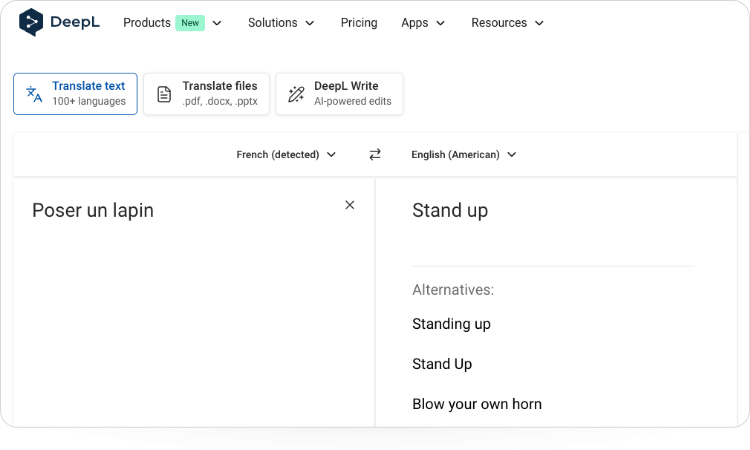
⛔️ Literal translation: The phrase is taken literally, so readers may not understand that it means “to stand someone up” or “not show up.”
Lara Translate
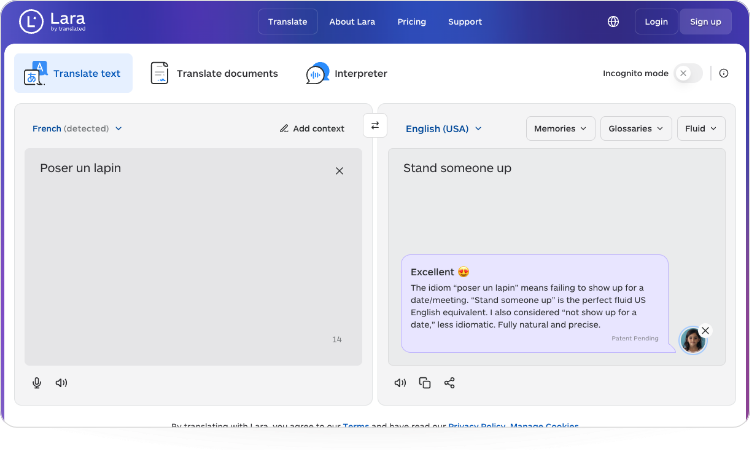
✅ Lara Translate captures the idiomatic meaning, translating it as “stand someone up,” which sounds natural and clear in English.
Round 2 – Literal German Phrase
Original Sentence: “Ich verstehe nur Bahnhof.”
DeepL
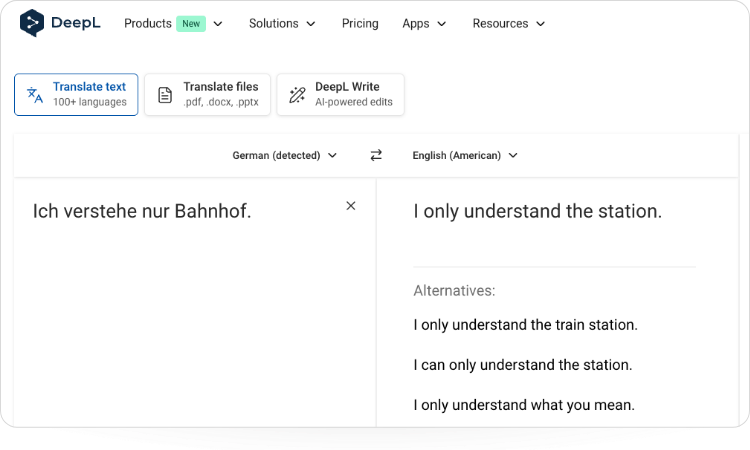
⛔️ Literal translation: The literal translation confuses readers because it doesn’t convey that this expression means “I don’t understand anything”.
Lara Translate
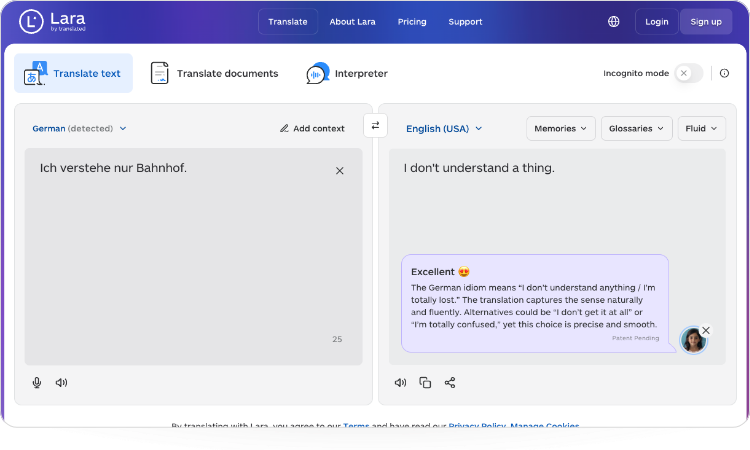
✅ Lara Translate understands the figurative meaning and translates it as “I don’t understand a thing”, making the sentence clear and idiomatic in English.
Round 3 – Lost Cultural Context
Original Sentence: “Da steppt der Bär.”
DeepL
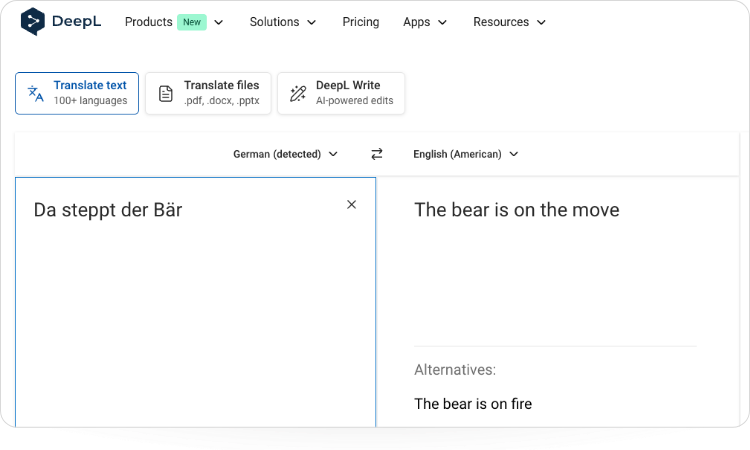
⛔️ Literal translation: The literal version misses that this phrase means “It’s going to be a great party” or “There’s a lively atmosphere,” leading to confusion.
Lara Translate
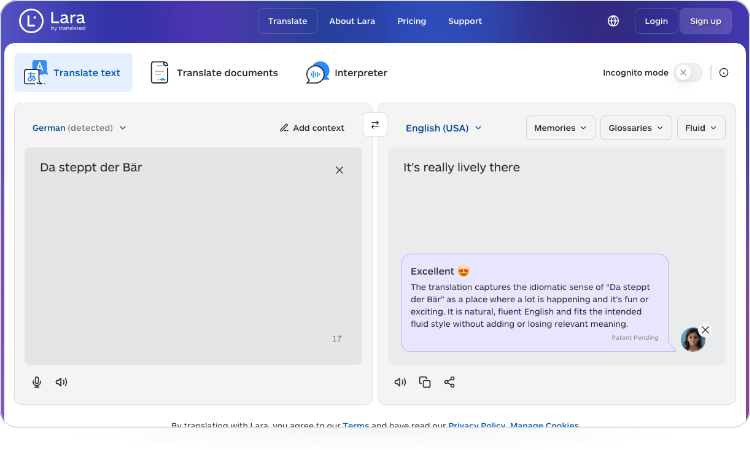
✅ Lara Translate captures the cultural nuance, translating it as “It’s really lively there”, preserving the original meaning naturally.
DeepL document translation supported file formats: PDF, DOCX, PPTX, XLSX
DeepL vs Lara Translate for document translation: formats, layout, and control
DeepL’s document translation is a strong “upload and get a translated file back” workflow, especially for common business formats. Depending on your plan, DeepL supports file translation for formats like Word (DOCX), PowerPoint (PPTX), PDF, and more, with limits that can vary by plan and file type.
Where Lara Translate typically pulls ahead is when document translation is not just about translating text, but about staying consistent and in control across real workflows. Lara Translate is built around context-aware translation, multiple translation styles (Fluid, Faithful, Creative), and professional controls like glossaries and translation memories. It can also explain key choices and flag ambiguity, which helps when wording changes meaning or tone.
Another practical difference is breadth of document workflows. Lara Translate supports broad format coverage beyond standard office files, plus bulk workflows and multilingual document translation (generating multiple target languages in one go). DeepL also supports bulk and multi-language document translation in its Pro offering for certain document workflows, so if your needs stay within common office formats, it can still be a solid fit.
| What matters in document translation | DeepL | Lara Translate |
|---|---|---|
| Supported document formats | Strong support for common business formats. Exact coverage and limits can vary by plan and file type. | Broad format coverage (including non-office and localization formats), designed for real document workflows. |
| Layout preservation | Designed to keep formatting for supported document types, so output stays usable. | Focuses on layout-preserving document translation so teams spend less time redesigning. |
| Context and tone control | Good general quality, but fewer explicit controls for context and tone within document workflows. | Context-aware translation plus style options (Fluid, Faithful, Creative) to guide tone and intent. |
| Terminology consistency | Works well for one-off docs, but consistency controls depend on workflow and setup. | Glossaries and translation memories help lock terminology across documents and teams. |
| Explainability while editing | Not typically positioned around explanations for translation choices. | Can explain choices and flag ambiguous wording to support review and QA. |
| Multilingual output in one pass | Available in some document workflows, depending on plan and feature set. | Multilingual document translation is supported for generating multiple target languages efficiently. |
The Best Free AI Tool to Translate
Most translation tools give you just a glimpse of what their AI can do until you hit a paywall. Want deeper context? Better control? Clearer intent? Then you usually need to subscribe.
With Lara Translate, you can test context-aware translation behavior in the free plan, including Lara Feedback and translation styles, plus document translation and broad format support.
👇 Try Lara Translate now and see the difference 👇
Try Lara Translate in your own workflow
Test Lara Translate on a real client text and see how it handles your terminology, context, and formatting.
This article is about:
- Comparing Lara Translate with DeepL to evaluate the best free AI tool for nuanced, context-aware translation.
- Showing how idiomatic expressions, cultural subtleties, and ambiguity can still break “fluent” AI translations.
- Highlighting Lara Translate features like contextual feedback and translation styles, designed to keep meaning and tone under control.
- Providing a transparent, feature-by-feature comparison of what you actually get for free.
FAQ
How does Lara Translate differ from DeepL?
DeepL is known for fluency and speed and now supports 100+ languages. Lara Translate emphasizes context control and transparency through features like Lara Feedback, which explains choices and flags ambiguous terms.
Is Lara Translate really free to use?
Lara Translate has a free plan with daily limits: up to 5,000 characters per day for text and up to 4 document pages per day for document translation.
Why does idiomatic translation matter?
Literal translations often lead to awkward or misleading results. Expressions like “Ich verstehe nur Bahnhof” need contextual understanding, not word-for-word conversion.
Which tool supports more file types?
DeepL’s free file translation supports DOC/DOCX, PPTX, and PDF with a DeepL account. Lara Translate supports 70+ file types, which is useful if your work includes mixed document and localization formats.
Is DeepL limited to 1,500 characters?
In many free contexts, DeepL is capped at around 1,500 characters at a time. Some DeepL free experiences with an account support up to 5,000 characters, depending on where you use DeepL.
Is Lara Translate GDPR-compliant?
Yes. Lara Translate is GDPR-compliant and also offers Incognito mode, which deletes text immediately after translation.
Who should use Lara Translate over DeepL?
If you care most about meaning, tone, and clarity in edge cases like idioms, ambiguous phrases, or brand voice, Lara Translate is often the better fit. If your priority is quick, fluent everyday translation, DeepL can be a strong option.